
Branch
BRANCH — for every clue, ask "what else could explain this?"; generate the rival explanations and test each before you commit to one.
Loading audio…
Press play to listen along. The line being read lights up as you go.
Show full transcript
Loading transcript…
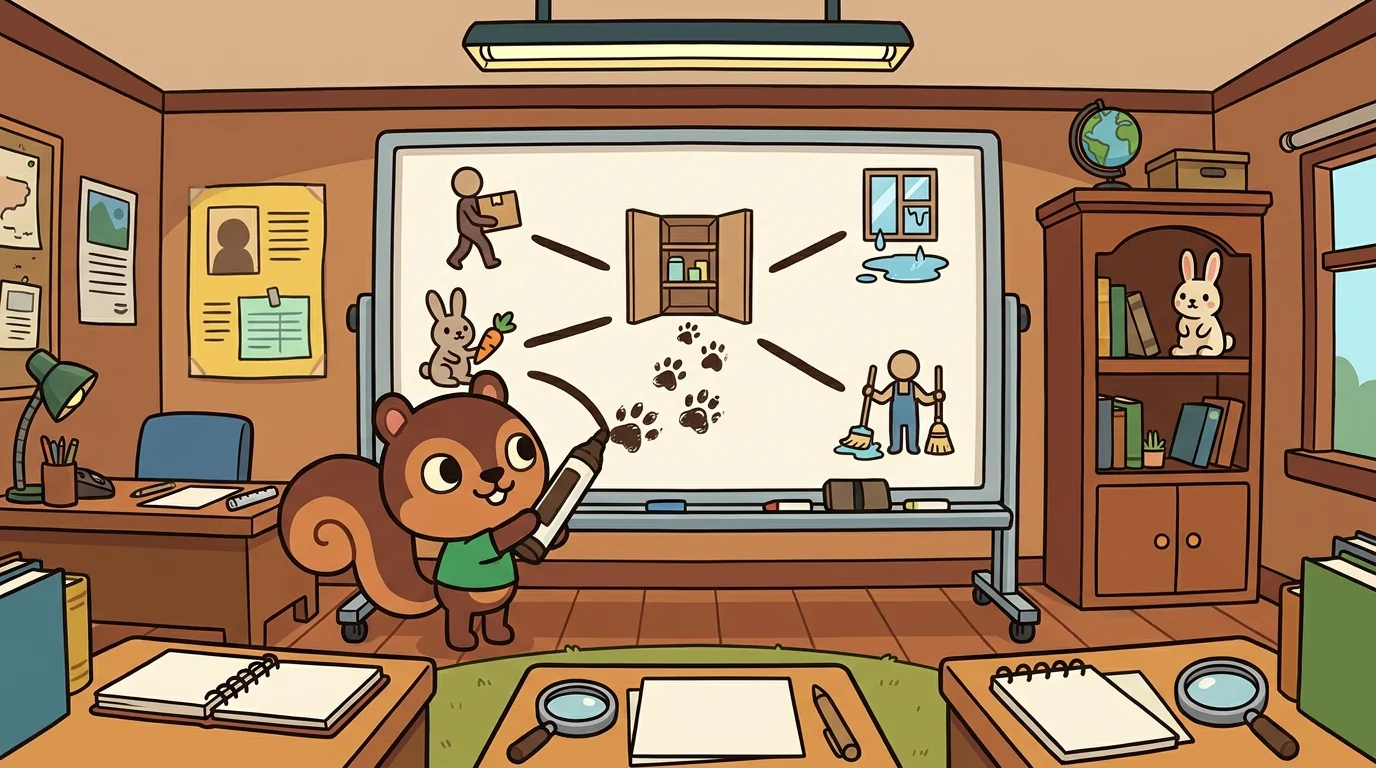
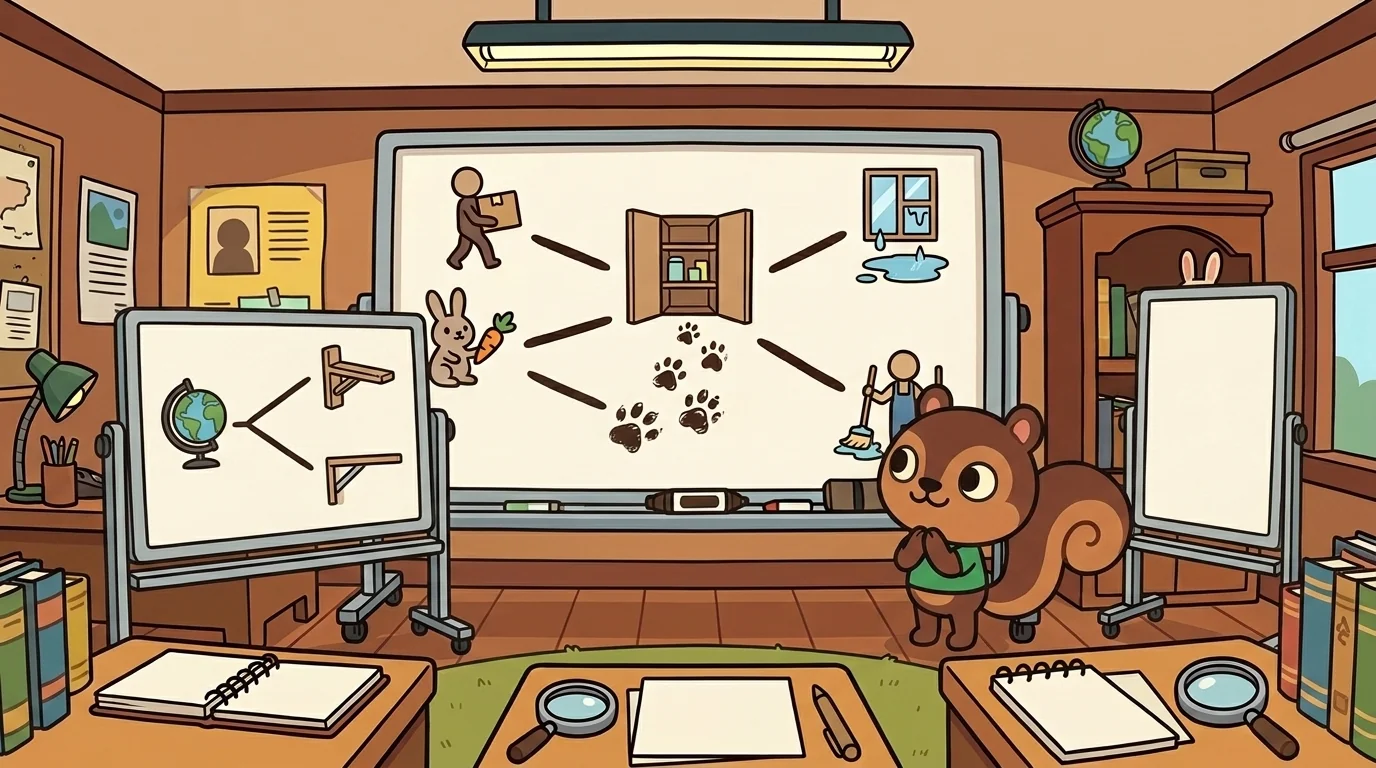
On the clubroom whiteboard, a squirrel named Branch had drawn a single clue in the center — muddy pawprints leading to the open supply cupboard — and then, spreading from it like limbs, a spray of rival explanations.
Someone took supplies. OR someone was returning them. OR someone chased the class rabbit in there. OR the window leaked and someone tracked mud checking it.
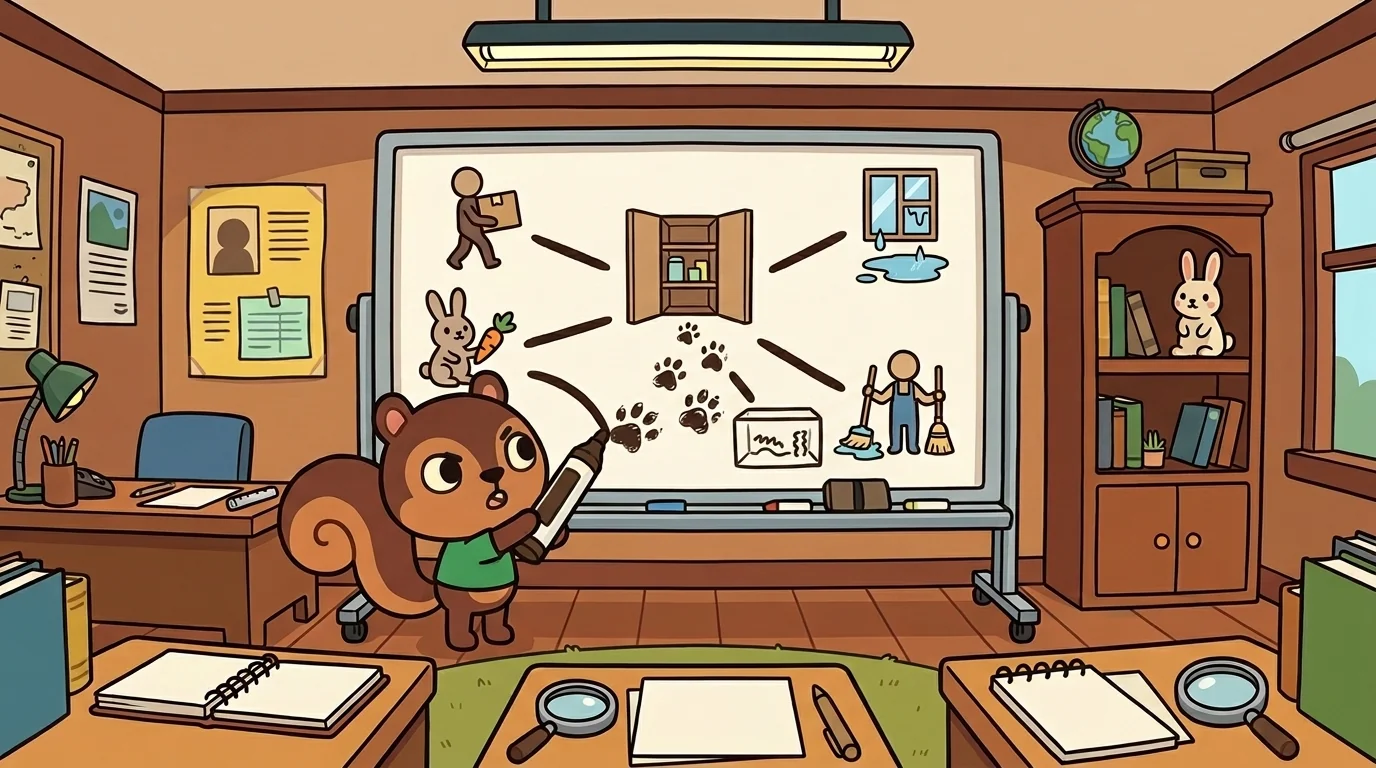
The club groaned. "Branch, it's obviously a thief. Why all the other branches?"
"Because the first explanation your mind offers isn't the answer — it's just the one that came fastest," Branch said, adding another limb. "There's a mechanism behind that speed. Your mind reaches for the story that's most available — most familiar, most recently seen — and mistakes fluency for truth. Then a second thing kicks in: once you've named a suspect, confirmation bias makes every new clue look like it fits, and makes the clues that don't fit go quietly invisible. The muddy prints don't say thief. We say thief. My job is to generate the rivals before I fall in love with one — this is reasoning to the best explanation, and it only works if there's more than one explanation in the running. Draw every branch you can think of. Then test them. The true one survives the testing; the rest fall off. Draw only one, and you'll defend it even when it's wrong, purely because it's the only one on the board."
Branch had learned to draw more than one branch after watching a single-branch answer wound someone.
Long ago, the club found the class fish tank cloudy and a new kid standing near it, and drew exactly one branch: the new kid did something. Nobody asked what else clouds a tank. Nobody tested. They followed the lone branch straight to the new kid, who hadn't touched it and now cried at their desk. Then the caretaker mentioned, offhand, that the filter had failed two days earlier and was already on the repair list. The cloud was a broken filter. The new kid had simply been the nearest face to a story the club had pre-written.
Branch, young and quiet in the corner, felt something twist — not only that they'd been wrong, but how good being sure had felt. The single branch had felt like clarity when it was really a shortcut, and a real kid paid for the shortcut with a morning of tears. One explanation isn't an investigation. It's a guess wearing a badge.
Branch climbed to the SleuthLab academy with a marker worn to a nub.
Inspector Vex asked the question. "What do you do with a clue?"
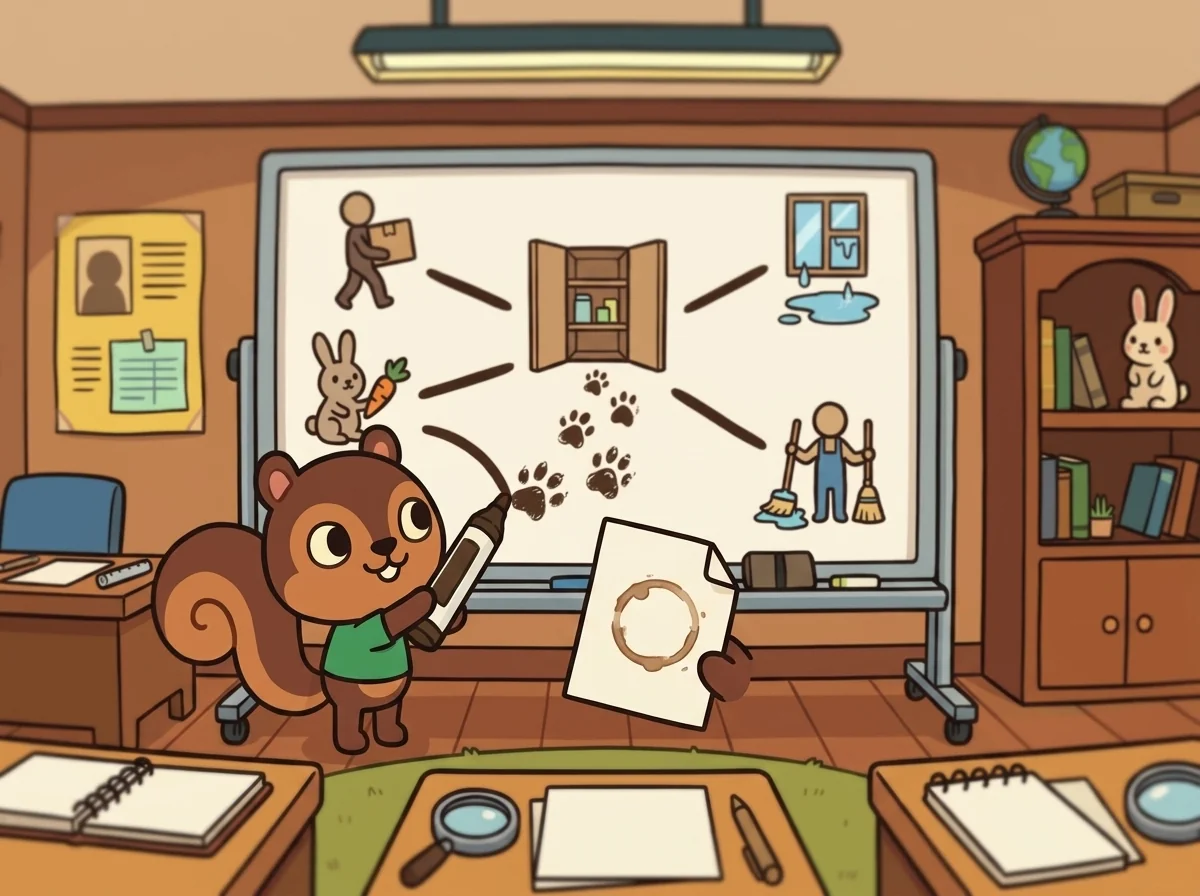
Branch took a clue off Vex's desk — a coffee ring on a report — and spun four explanations on the spot: Vex set a cup down. OR a visitor did. OR it's from yesterday. OR someone set the report onto an old ring. Then Branch named the single quickest test that would discriminate between them.
"One clue, four branches, and now I know what to check instead of what to assume. The clue didn't hand me a story. It handed me a question."
Vex studied the four branches and the one worn marker. "You are appointed."
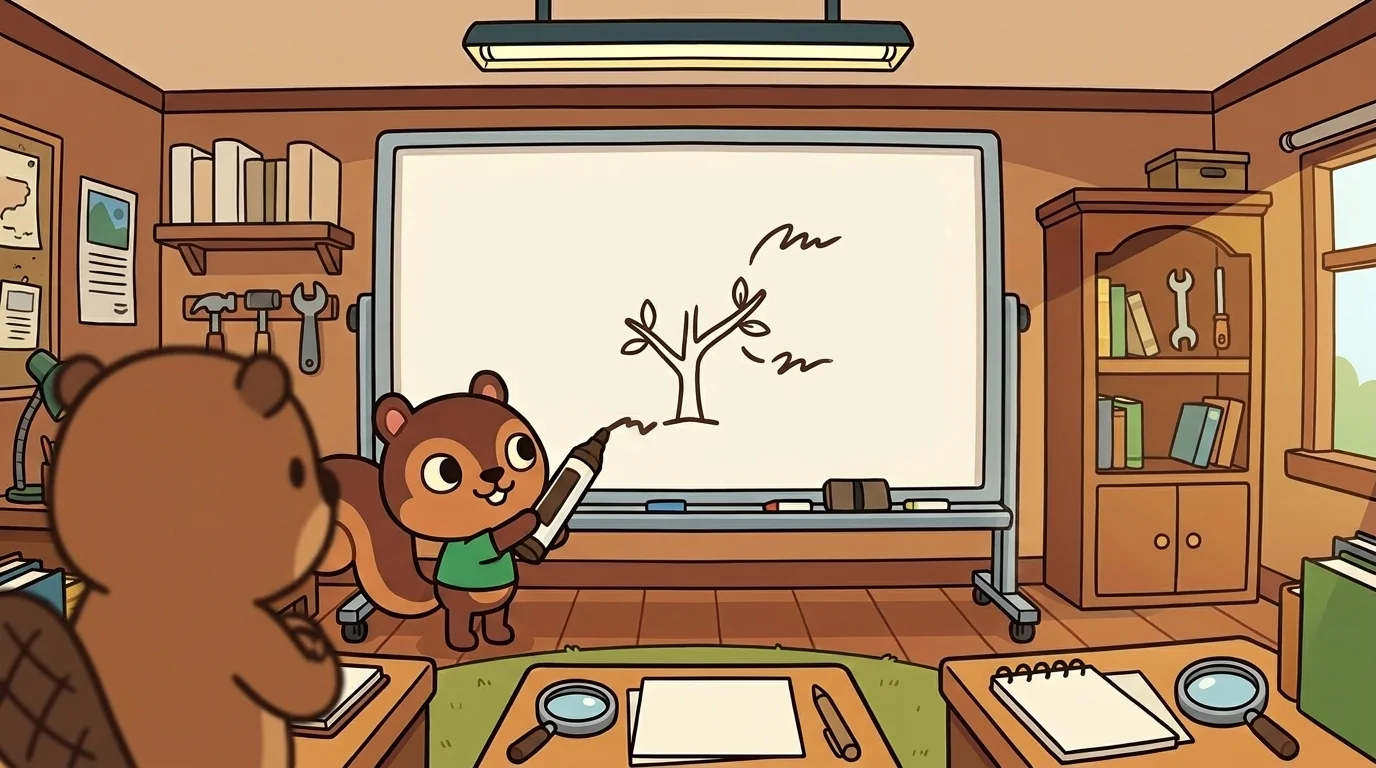
In Branch's workshop, a young beaver huffed, arms folded. "Branch, this is exhausting. If I have to doubt everything and draw a hundred branches, I'll never finish. Can't I just take the obvious one?"
Branch drew a small tree — two branches, not a hundred. "It isn't doubting everything; that's just paralysis, and paralysis is as useless as haste. It's giving each live rival a fair test before you commit — usually two or three branches is plenty. The skill is knowing which alternatives are worth the test and which you can rule out cheaply. And here's the part that matters most: the branch you're most tempted to skip is usually the one that clears the person you'd otherwise wrongly blame. 'Obvious' means familiar, not true. Ask 'what else?' exactly long enough to catch the innocent explanation — then test. The branch that survives every test is the one you can stand behind. Not because it came first. Because it's the last one still standing."
The beaver's arms unfolded a little. "So not doubt forever. Just... long enough to be fair."
"Exactly long enough to be fair," Branch said. "Then you follow the branch that earns it." Branch capped the marker. "Go draw someone the second branch nobody else drew yet."
The beaver looked at the little tree, felt the steadiness of it, and went to find the missing limb.
The SleuthLab ensemble
Branch is part of SleuthLab's distributed-narrative cast. Each character embodies a different curricular primitive; together they teach the full subject.
-

Loop
Impression evidence — fingerprints, shoeprints, toolmarks (class vs individual evidence)
-

Fiber
Trace evidence — fibers, hairs, paint, glass (Locard's exchange principle)
-

Drop
Chemical evidence — chromatography, pH, spectroscopy (test-don't-guess)
-

Stroke
Document analysis — handwriting, ink, paper (comparison methodology)
-

Witness
Biological + digital evidence — DNA + digital footprints (statistical-match, not certainty)
-

Seal
Chain of custody — bag it, label it, log every hand it passes through; a broken chain can't be trusted; otter with evidence bags + logbook
-
Sketch
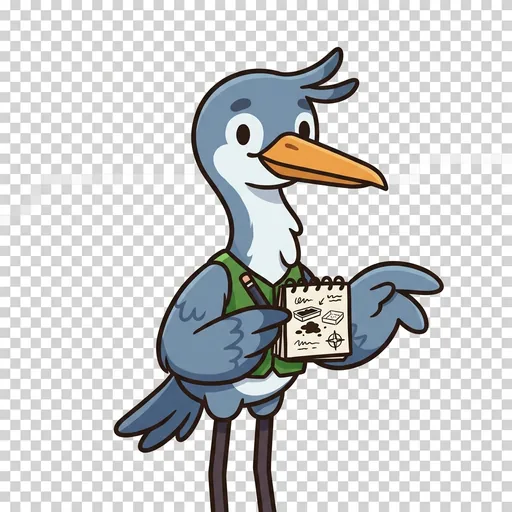
Scene documentation — record the scene before anyone touches it; the scene only tells its story once; heron with a measuring notebook
-

Tick
Timeline reconstruction — put every event in order on the clock; the sequence is where the answer hides; mouse with a paper timeline
-

Account
Testimony reliability — ask open questions and listen; memory is fragile and a confident witness isn't always correct; rabbit with a gentle notebook