
Freeze
TABLEAU — a frozen stage picture the whole cast holds so the audience reads the moment like a painting. Named directly: tableau, stage composition, focal point, levels, the readable image.
Loading audio…
Press play to listen along. The line being read lights up as you go.
Show full transcript
Loading transcript…
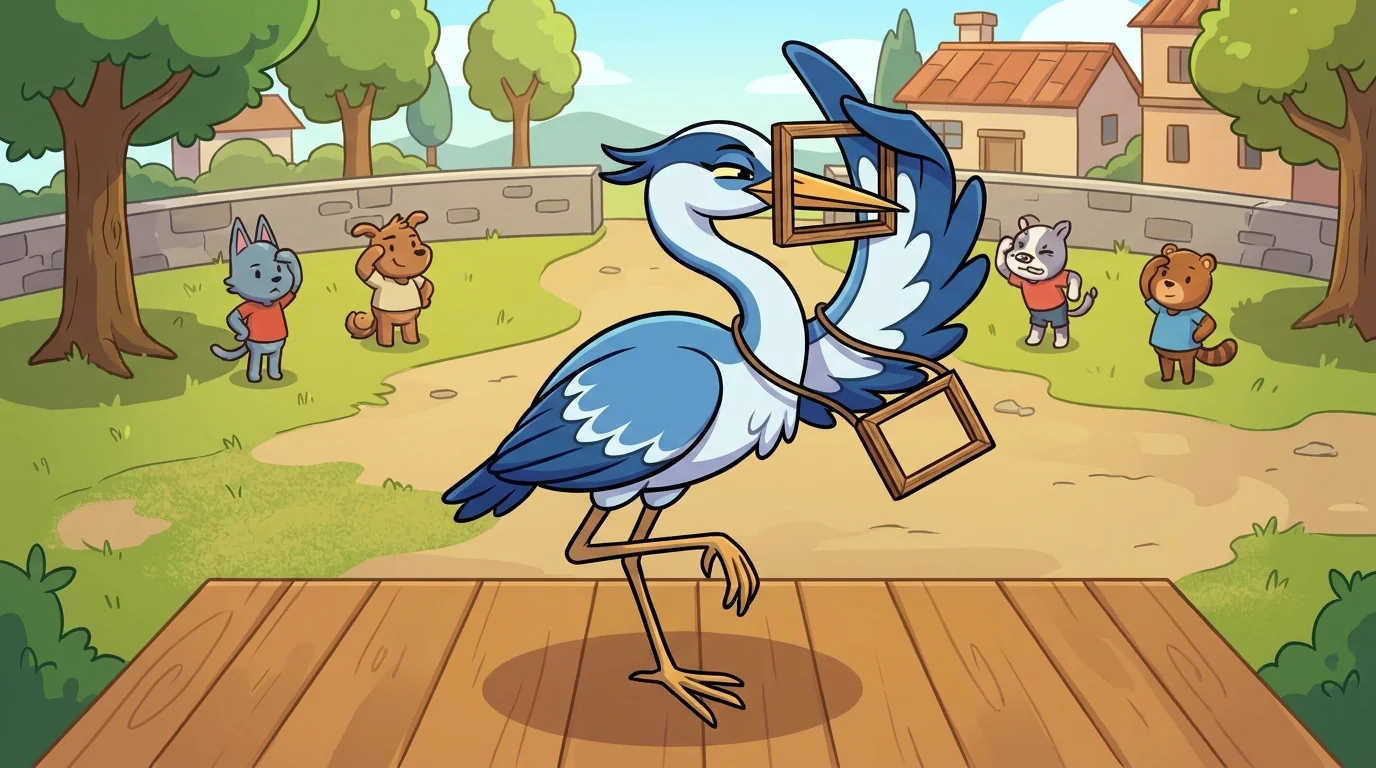
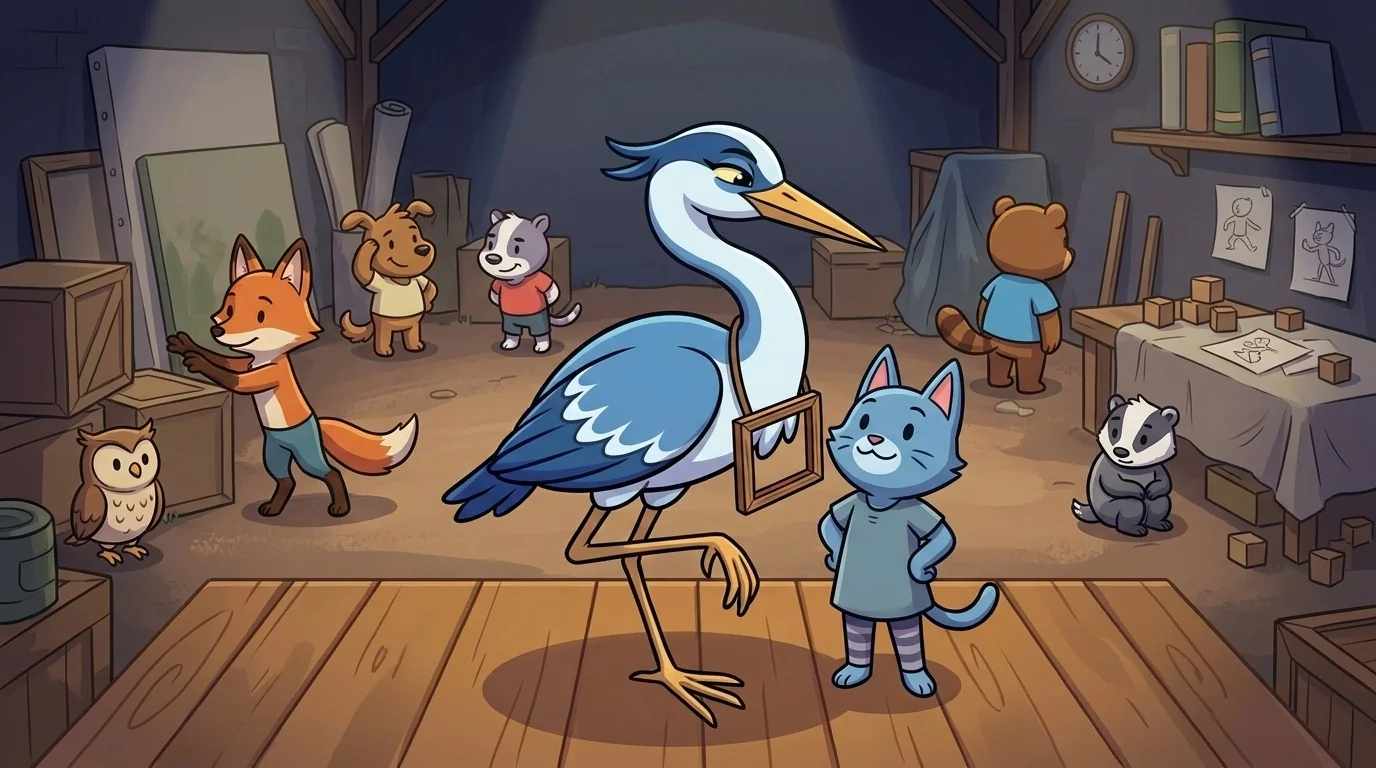
Freeze was a heron-tween, and stillness was her whole art — she could hold a pose so completely, one leg lifted, neck curved, wing half-raised, that visitors mistook her for a statue and jumped when she blinked.
Her frozen poses weren't stiff; they were full of life, caught mid-feeling, like a photograph of a story's most important second. Around one wing she wore a small empty picture-frame on a strap, and she'd hold it up to the cast, squint through it, and call "Freeze!" — and everyone snapped into a single still image she could read like a painting. "A tableau," she told the young actors, lowering the frame. "A frozen stage picture. Hold it, and the audience gets a whole second to read the moment — who wants what, who's afraid, who's winning." She studied the pose they'd struck. "But a picture only works if it's readable. Right now you're all facing me, evenly spaced, like a class photo. Nothing pulls my eye. Where do I look?"
A young actor, mid-freeze, mumbled: "...At all of us?"
"That's the trouble," Freeze said. "At all of you is at none of you."
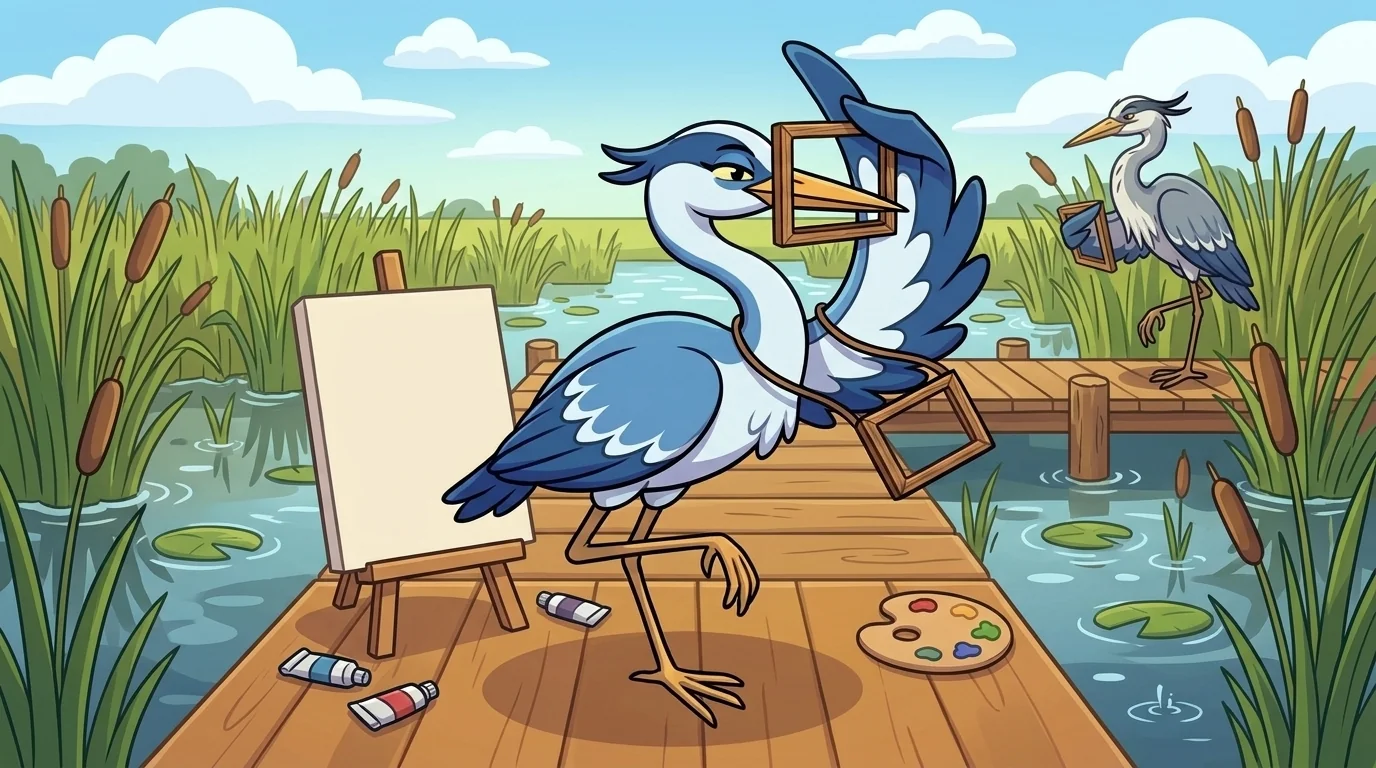
Freeze had learned about readable pictures the hard way, long before she knew the word tableau.
She'd grown up in a family of shadow-puppeteers, who told whole stories with flat cut-out figures held against a lit cloth. And she'd learned, painfully, that a shadow-picture with too much in it said nothing — six figures crowded on the cloth was just a smudge. Her grandmother's rule, said while trimming a puppet: the eye can only follow one thing at a time. Give it one thing to follow, and clear the rest to point at it.
Freeze hadn't understood the size of that at six. She'd wanted every puppet on stage at once, all doing something. The cloth had been chaos. It turned out her grandmother had been teaching her composition — the focal point, and the art of arranging everything else to lead the eye toward it — without either of them ever using the word.
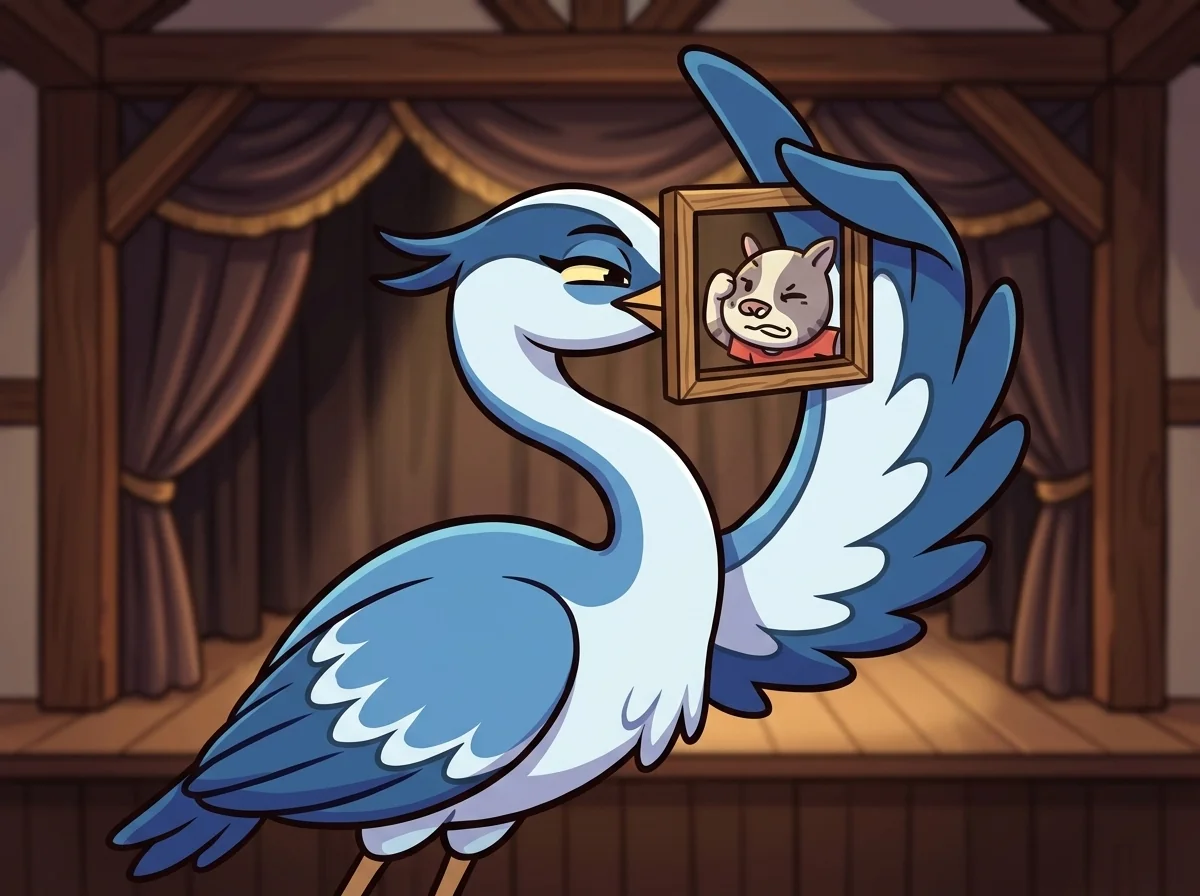
She walked to StageForge, because a place devoted to the live stage ought to know that a picture can be as loud as a shout.
Curtain, the old mentor who ran the workshops, didn't ask her to prove she was trained. He set a cast of six on the stage and said, "Make me a picture I can read."
Freeze didn't give a speech. She held up her empty frame, squinted, and began to move people — one actor forward and low, on one knee, the focal point; the others angled toward him, some standing, some crouched, so the stage had levels; a gap of empty space opening around the kneeling one so the eye fell on him first. Then she called "Freeze," and the six of them held it. She stepped back. "There. One clear thing to look at. Everyone else composed to point at him. That's a tableau that reads."
Curtain looked at the picture for a long moment — his eye going, without being told, straight to the kneeling actor. "You didn't just freeze them," he said. "You composed them. Most people freeze a mess and call it a picture."
"A frozen mess is still a mess," Freeze said. "It just holds still while the audience fails to read it."
He nodded, slow and certain. "Then you'll make the pictures here. The ones the audience can read in a single held breath."
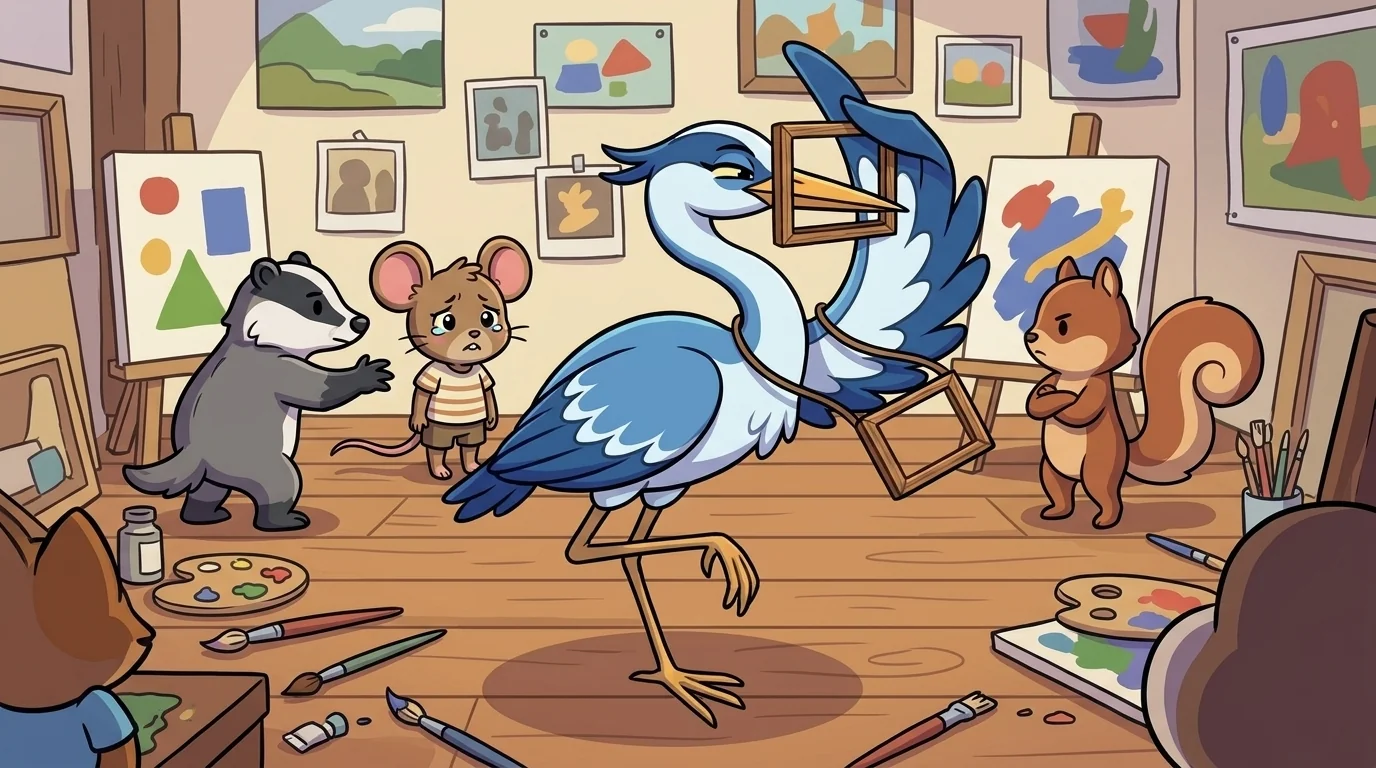
Freeze's corner filled with young actors who thought a tableau just meant stop moving.
A girl froze her scene one afternoon — and it was a jumble: everyone bunched center, all at the same height, all facing out. "I froze!" she said, proud. "That's a tableau, right?"
"You stopped," Freeze agreed warmly, "which is step one. But look through my frame." She handed it over. "Where does your eye go?"
The girl squinted through the empty frame at her own frozen cast. "...Nowhere. Everywhere. It kind of slides around."
"That's the whole lesson," Freeze said. "A tableau isn't stop moving. It's arrange a picture. Give it a focal point — the one who matters most this second. Put the others at different levels — some low, some high — so it's not a flat row. Angle bodies toward the focal point so the whole picture points like an arrow. And leave a little space around the important thing, so the eye lands on it." She reshaped the cast as she spoke — one forward, others angled in, levels breaking up the flat line. "Freeze that."
The girl looked through the frame again, and her eyebrows went up. "Oh — now I can't help looking right at her."
"That's the truest thing you've said today," Freeze said. "You didn't add anything. You just arranged it so the eye knew where to go. A picture that tells the audience where to look tells them what the moment is about."
Later, when the hall emptied and the work-lights hummed, the girl came back, turning the empty frame over in her hands.
"But if I have to arrange every freeze so carefully," she said, "won't it feel fake? Like a posed photo instead of a real moment?"
Freeze thought about the crowded shadow-cloth, and her grandmother's steady trimming.
"It's the opposite," she said. "A messy freeze is what feels fake — because the audience is working, squinting, trying to find the moment, and that pulls them out of the story. A composed tableau feels effortless to watch, so they stay inside the feeling. The arranging is invisible when it's done well." She lifted the frame to the empty stage, squinting through it out of habit. "You don't compose a picture to make it look posed. You compose it so the audience can feel it without having to hunt for it. Clear the clutter. Point the eye. Then the frozen second says the thing the whole scene was building toward."
The girl nodded slow, and Freeze watched something settle in her — the same click Freeze had felt the day a crowded cloth became a clear story. She felt her own long neck ease, and a quiet gladness rose behind her ribs: to teach a young one that a single held picture, arranged with care, can land as hard as any line — that was a still, sure joy she could hold as long as any pose.
The empty frame caught the work-light. The stage waited, uncomposed. Somewhere, another messy freeze waited to become a picture that holds.
The StageForge ensemble
Freeze is part of StageForge's distributed-narrative cast. Each character embodies a different curricular primitive; together they teach the full subject.
-

Face
Acting — character work through voice, body, and emotional life
-

Pen
Playwriting — turning ideas into scripts with character, conflict, structure
-

Block
Blocking — directing actors through stage geography
-

Rig
Stagecraft — the technical-theater craft that makes the visible-stage possible
-

Riff
Improvisation — the live-performance craft of Yes, and...
-
Rafter
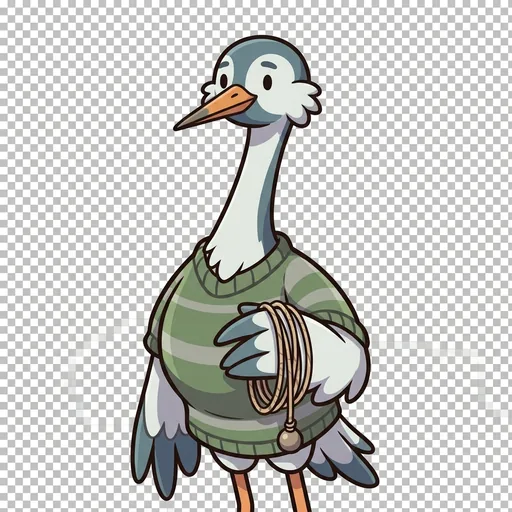
Projection — making your voice reach the back row without shouting, by supporting it with breath so even a quiet line lands in the last seat
-

Yearn
The objective — what a character wants in a scene, badly enough to drive every line and move; the engine under a performance
-

Undertow
Subtext — the real meaning running under the spoken line; what a character truly means beneath the words they actually say
-

Hitch
Pacing and timing — the rhythm of a scene and the deliberate pause that makes a line land, the held beat before the joke or the truth
-
Opening Night
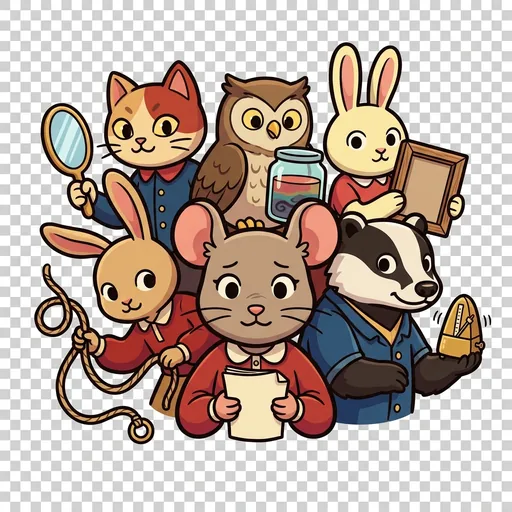
The whole company on stage together — how acting, objective, subtext, tableau, and timing combine so one live scene truly comes alive