
Rafter
PROJECTION — making your voice reach the back row without shouting, by supporting it with breath. Named directly: breath support, the diaphragm, resonance, carrying vs yelling, filling the house.
Loading audio…
Press play to listen along. The line being read lights up as you go.
Show full transcript
Loading transcript…
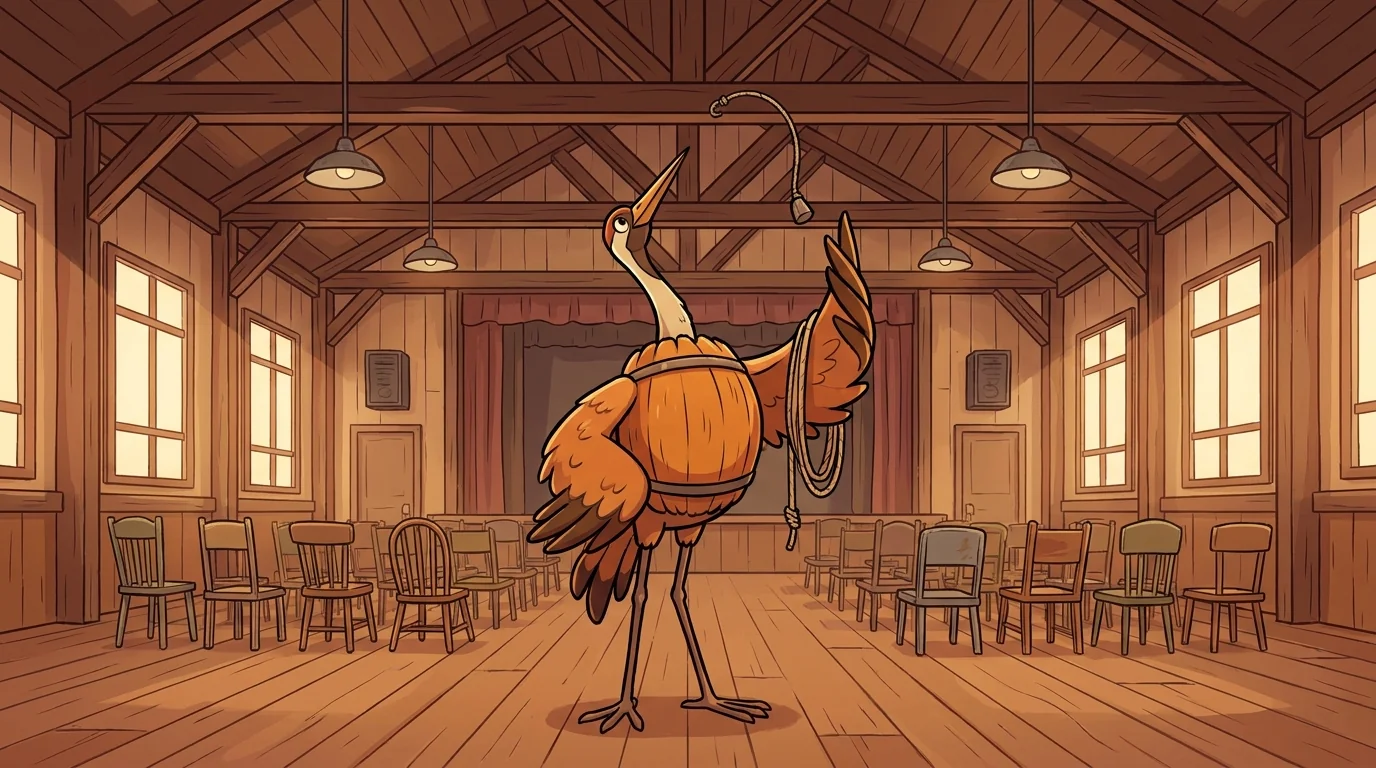
Rafter was a crane-tween, tall and long-necked, with a deep round barrel of a chest he was always filling and slowly emptying, like a bellows that had learned to breathe.
When he spoke, even softly, his voice seemed to travel — you could stand at the very back of the StageForge rehearsal hall and hear every word of a whisper, warm and clear, as if he were beside you. He wasn't loud; that was the strange, wonderful thing. In his wing he carried a coil of thin rope with a tiny weight, which he'd toss up toward the rafters to remind himself where his voice needed to go. "Projection isn't volume," he told a young actor who'd just screamed her line until it cracked. "You yelled. Yelling comes from the throat, it tires you out, and it still doesn't carry — it just gets sharp." He laid a wing on his own great chest. "This does. A voice that reaches the back row is supported — pushed by the breath, from down here, not squeezed out of the throat. Carrying, not yelling."
The actor rubbed her sore throat. "But the back of the hall is so far. How do I get there if I don't get louder?"
"You breathe lower," Rafter said, "and you aim farther."

Rafter had learned about carrying without shouting long before he knew the word projection.
He'd grown up near the sea, in a family of ferry-callers — the ones who called the boats in across the water, voices reaching a mile of open bay. And they never shouted; a shouted call frayed and died over the waves. They placed the voice, low and round and steady, riding out on a long supported breath. His mother could stand on the dock and be heard on a boat you could barely see, in a voice that sounded, up close, almost gentle. Don't push from the throat, she'd told him. Push from the belly, and aim past the thing you're calling to. The voice that strains dies at your feet. The voice that's carried arrives.
Rafter hadn't understood the size of that at six. He'd tried to be loud and gone hoarse in a minute. It turned out his mother had been teaching him breath support and resonance — power from the diaphragm, not the throat — without either of them ever using the words.

He walked to StageForge, because a place devoted to the live voice ought to know the difference between carrying and yelling.
Curtain, the old mentor who ran the workshops, didn't ask him to prove he'd trained. He walked to the very back of the empty hall and said, quietly, "Fill it. Don't shout."
Rafter tossed his little rope-weight up toward the rafters, drew one enormous slow breath all the way down into that barrel chest, and spoke — not loudly, but supported, the sound round and warm and riding out on the breath — and Curtain, at the back wall, heard every word land soft and clear beside his ear. "I didn't raise my voice," Rafter said, from the stage. "I lowered my breath. I aimed past you, at the back wall, and let the support carry it."
Curtain came back down the hall slowly. "You filled the whole house," he said, "and I never once heard you strain."
"Strain is the sound of a voice that ran out of breath and started pushing from the throat," Rafter said. "Support is the sound of one that didn't have to."
He nodded, slow and certain. "Then you'll teach the carrying here. The voices that reach the last seat without a single shout."
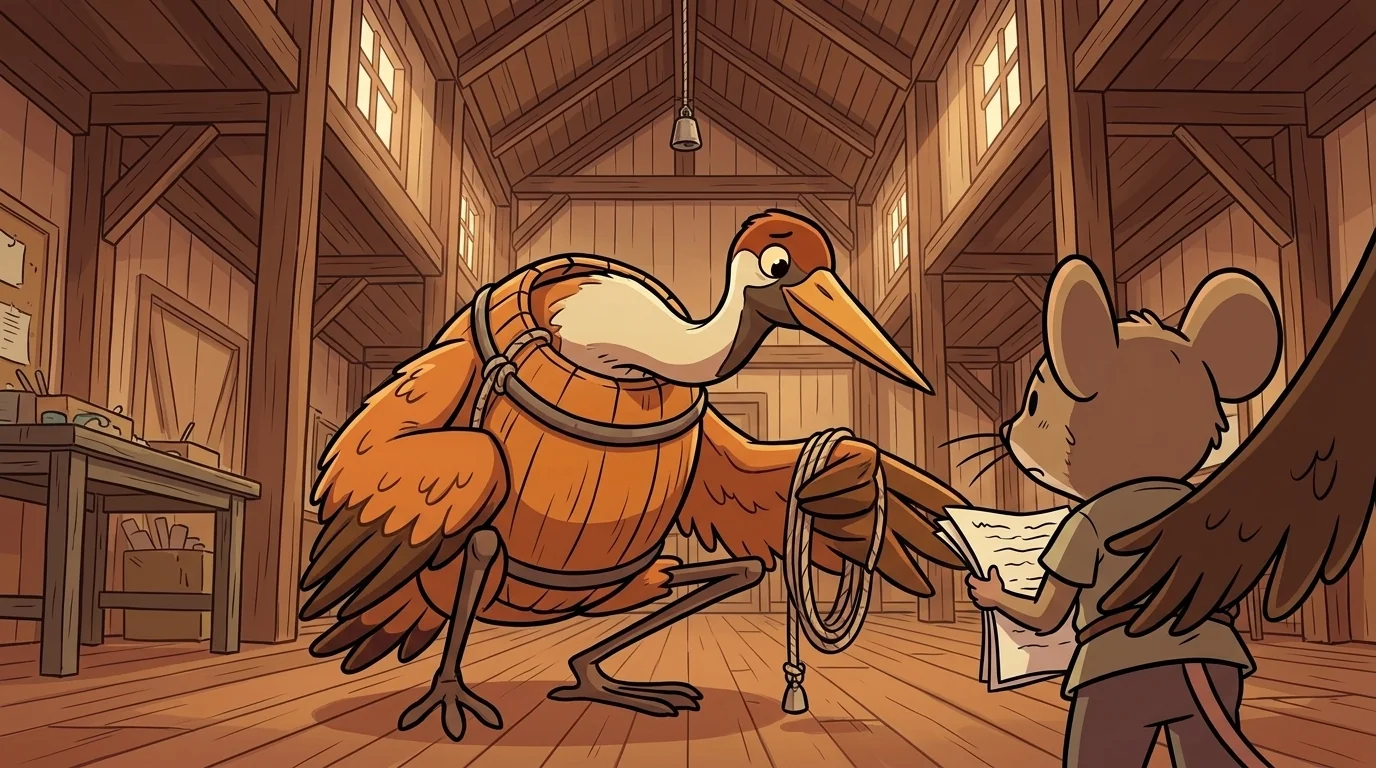
Rafter's corner filled with young actors who thought be heard in the back meant be as loud as possible.
A boy blasted his line one afternoon, straining till it went ragged. "Did the back row hear THAT?" he rasped.
"They heard a boy hurting his throat," Rafter said gently. "And I promise you, in the very back, it still sounded thin — because a yelled voice gets sharp, not far." He set a wing on the boy's stomach. "Breathe. Not up here in your shoulders — down here, so my wing moves. That's the breath that supports. Now — say the line again, but instead of getting louder, aim it at the back wall, like you're throwing my rope-weight all the way up to the rafters. Let the breath carry it there."
The boy breathed low, aimed high, and spoke — and it came out rounder, warmer, effortless, and it reached.
The boy touched his own throat, surprised. "...That didn't even hurt. And it felt bigger."
"That's the truest thing you've felt today," Rafter said. "Loud comes from the throat and dies at your feet, and it costs you your voice by the second act. Supported comes from the breath and reaches the last row, and you could do it all night." He picked up his rope-weight. "You don't push a voice to the back of the house. You support it and aim it there. Carry, don't yell — and the quietest true line still lands in the farthest seat."
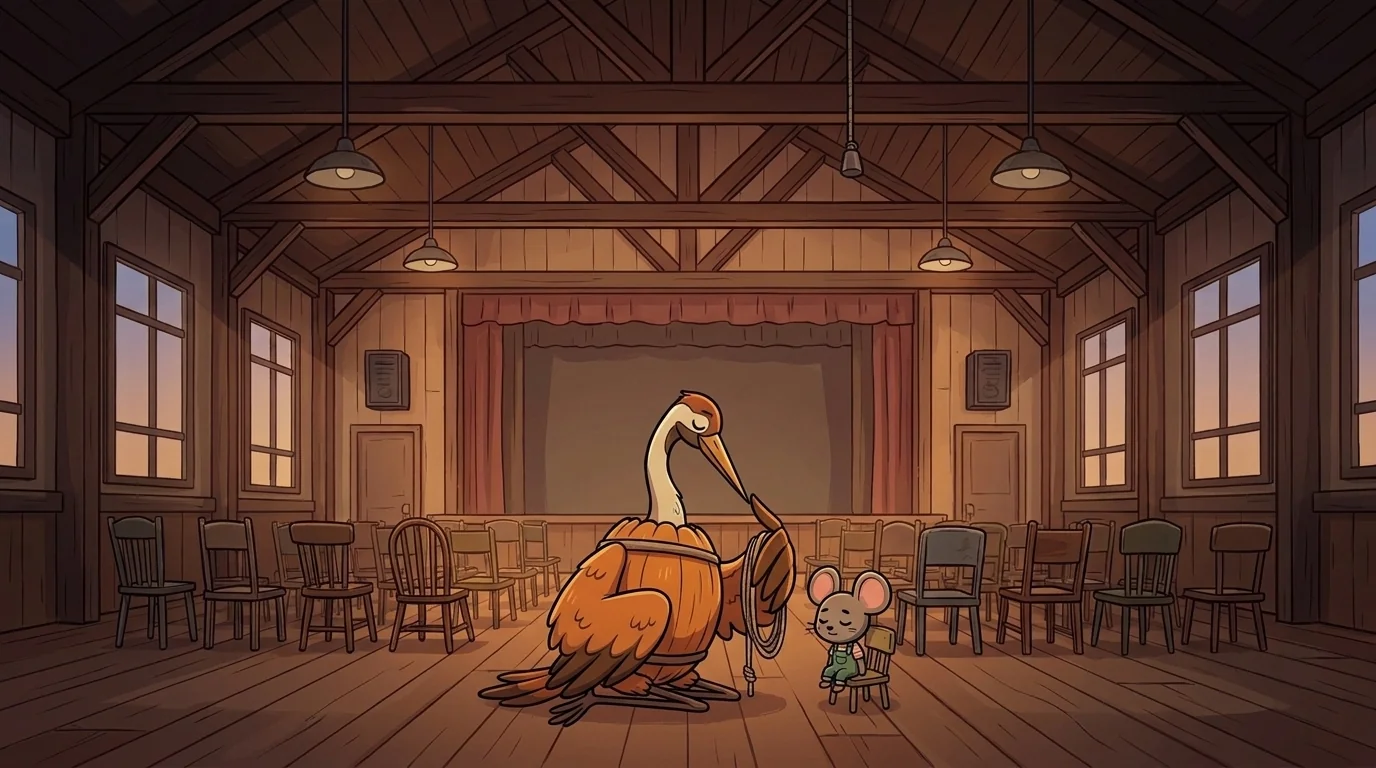
Later, when the hall was dim and empty, the boy came back, thoughtful, one hand on his stomach the way Rafter had shown him.
"So a whisper can reach the back row," he said, "and a scream might not. That's backwards from everything I thought."
Rafter thought about his mother on the dock, heard across a mile of bay in a voice that sounded gentle up close.
"It only feels backwards until you've done it once," he said. "Volume is about how hard you push at the source. Projection is about support and aim — a well-breathed voice, sent to a target, arrives with room to spare. That's why the actor who fills the theater isn't the one straining hardest. It's the one breathing lowest and reaching farthest." He drew a slow, enormous, easy breath, his barrel chest rising. "A supported voice is a kindness — to the back row, who get to hear you, and to yourself, because you'll still have a voice at the curtain call. Carry it. Don't spend it."
The boy nodded slow, one hand still on his stomach, and Rafter watched something settle in him — the same ease Rafter had found the day he stopped straining and started carrying. He let his great breath out long and even, and a quiet gladness rose behind his ribs: to teach a young one that the far seat is reached by support and not by force — that was a warm, roomy joy, and it never once left him hoarse.
The StageForge ensemble
Rafter is part of StageForge's distributed-narrative cast. Each character embodies a different curricular primitive; together they teach the full subject.
-

Face
Acting — character work through voice, body, and emotional life
-

Pen
Playwriting — turning ideas into scripts with character, conflict, structure
-

Block
Blocking — directing actors through stage geography
-
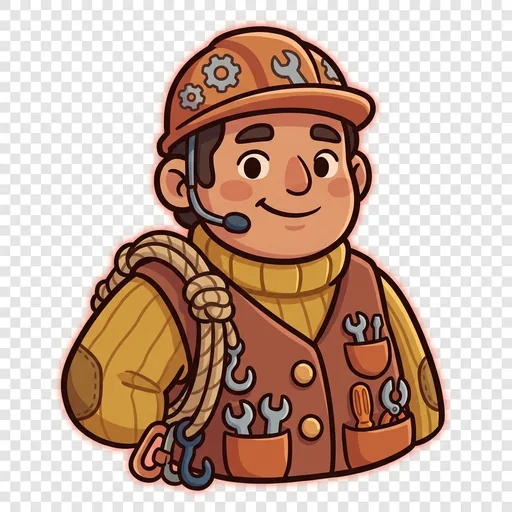
Rig
Stagecraft — the technical-theater craft that makes the visible-stage possible
-

Riff
Improvisation — the live-performance craft of Yes, and...
-

Yearn
The objective — what a character wants in a scene, badly enough to drive every line and move; the engine under a performance
-

Undertow
Subtext — the real meaning running under the spoken line; what a character truly means beneath the words they actually say
-

Freeze
Tableau — a frozen stage picture the whole cast holds so the audience can read the moment like a painting
-

Hitch
Pacing and timing — the rhythm of a scene and the deliberate pause that makes a line land, the held beat before the joke or the truth
-

Opening Night
The whole company on stage together — how acting, objective, subtext, tableau, and timing combine so one live scene truly comes alive