
Brawn
BRAWN — how heavy a star is at birth decides its whole life story: how hot it burns, how long it lives, and how it ends. Small stars fade quietly across trillions of years; heavy stars blaze bright, burn fast, and end in a great blast.
Loading audio…
Press play to listen along. The line being read lights up as you go.
Show full transcript
Loading transcript…
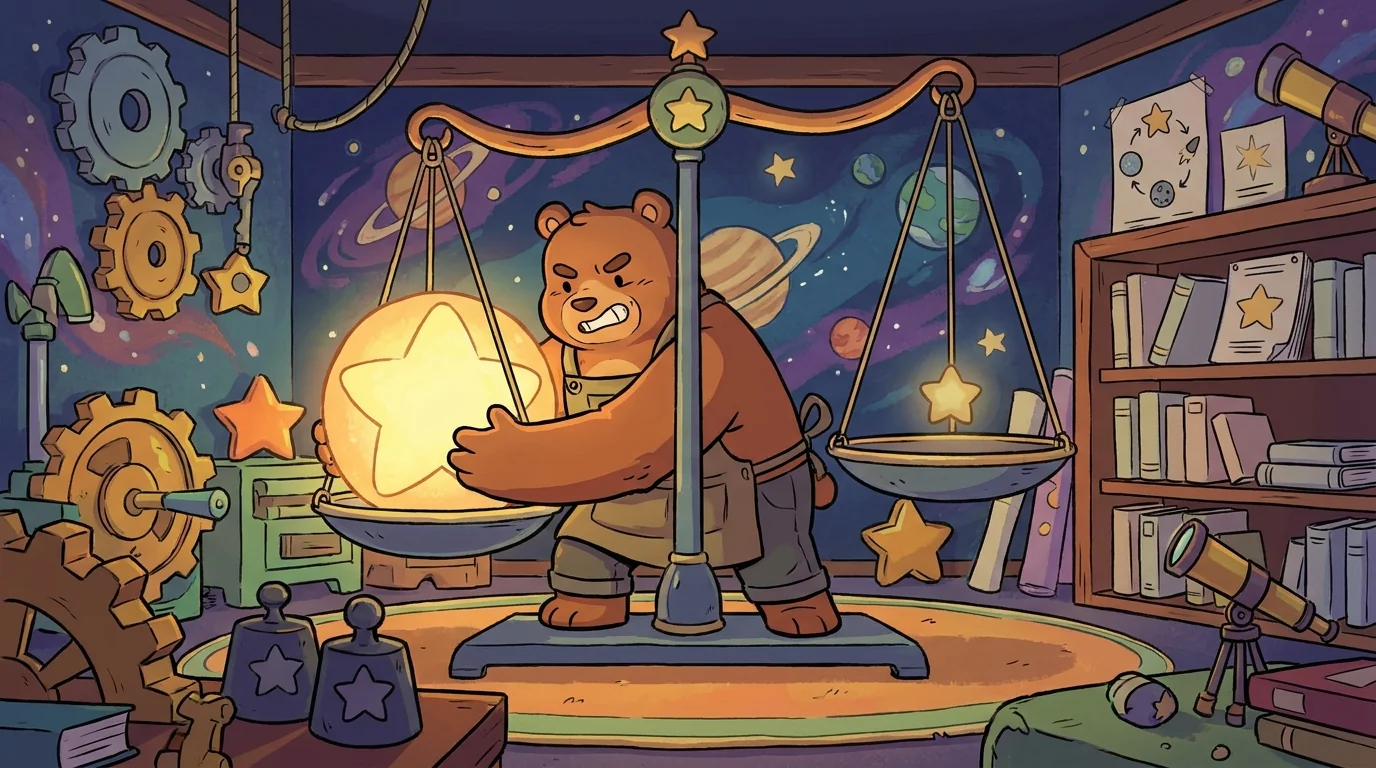
Out in the great dark, among newborn stars still glowing in their nursery of gas, a sturdy little keeper named Brawn floated in a bright orange suit, holding the one instrument that could tell a star's entire future — a star-weigher — while beside him a young stargazer was certain that what mattered most about a star was how bright it looked tonight.
Brawn was solid and calm, strong-armed, a kind round face behind the visor. The young stargazer — an eager comet-sprite — pointed at a brilliant blue-white star. "That's the important one. Look how bright it burns! It must be the greatest star in the whole nursery." Brawn shook his head gently and raised his star-weigher toward it. "Bright, yes. Great — that depends on what you mean. Watch what my weigher tells us." The instrument read the star's mass, and Brawn's face turned thoughtful. "This one is heavy — many times heavier than an ordinary sun. And because it's so heavy, I can tell you its whole life story already, though it was born only moments ago in star-time. It will burn ferociously hot and blue. It will spend its enormous fuel recklessly fast. And in just a few million years — a blink, for a star — it will die in a titanic explosion."
The comet-sprite blinked. "You can tell all that... just from how heavy it is?"
"From nothing else so much as that," Brawn said. "A star's mass at birth is the single fact that writes everything that follows: how hot, how bright, how long, and how it ends. Not its color tonight. Not how pretty it looks from here. Its weight. Set at the very beginning — and from it, the whole story unspools."
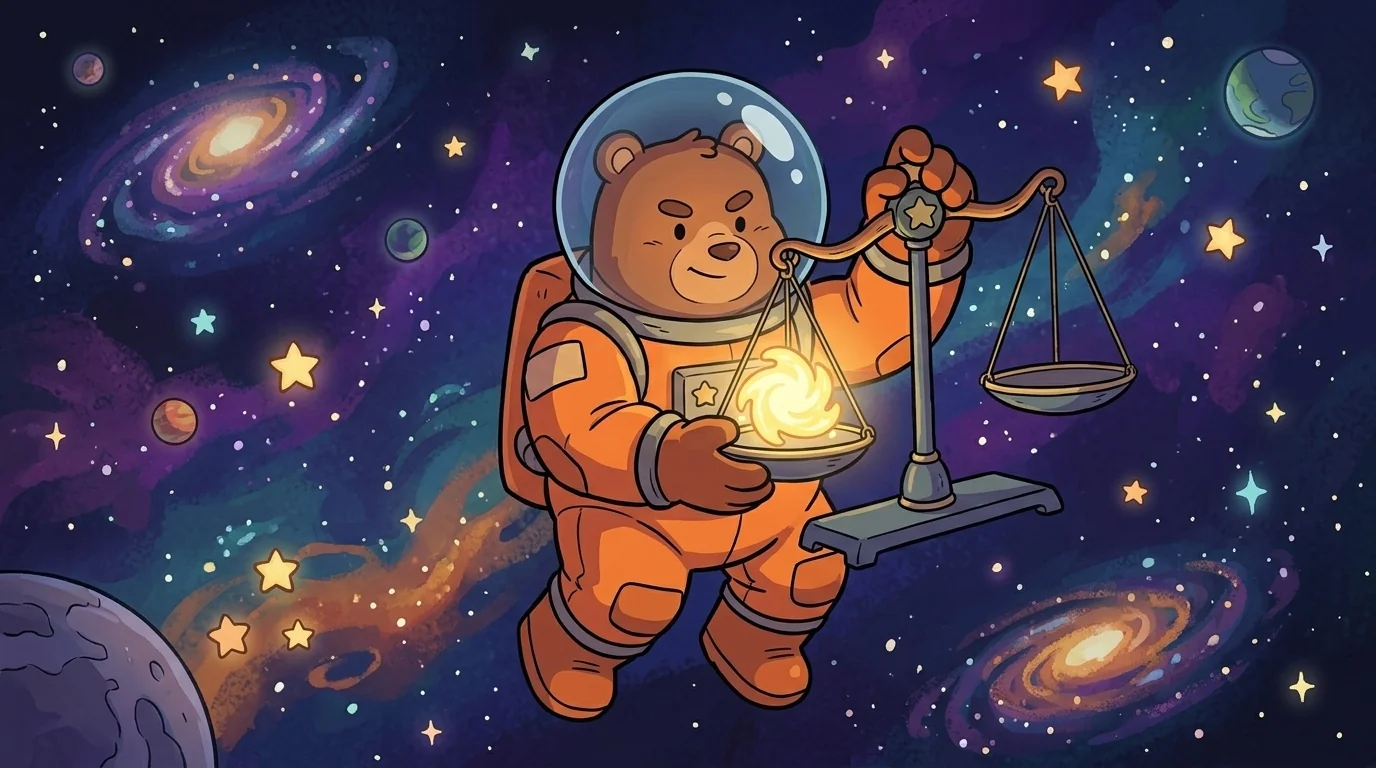
Brawn had not always known that the weight was the whole story. When he was young, he'd judged stars the way the comet-sprite did — by their dazzle, by the moment.
He'd fallen in love with the brightest star he could find, a blazing giant, and declared it the finest star that would ever be — sure it would outshine everything forever. He hadn't weighed it. He hadn't understood that its very brilliance was the sign of a life burning terribly fast. And then, in what felt to him like no time at all, the blazing giant reached the end of its short, furious life and blew itself apart in a supernova, gone. Brawn had been stunned, and a little heartbroken, and — mostly — confused. How could the greatest star die so young?
An old keeper named Ember, who had watched a thousand stars live and die, explained it to him. "You mistook brightness for greatness, and greatness for lasting," she said. "The bright ones burn fast because they're heavy — heaviness feeds a furious fire that eats its fuel in a hurry. The dim little stars you never noticed? They're light, and they'll still be glowing, gentle and steady, long after every dazzling giant is dust." Brawn never forgot it: that the weight told the truth the dazzle hid, and that burning brightest was not the same as burning longest, or best.
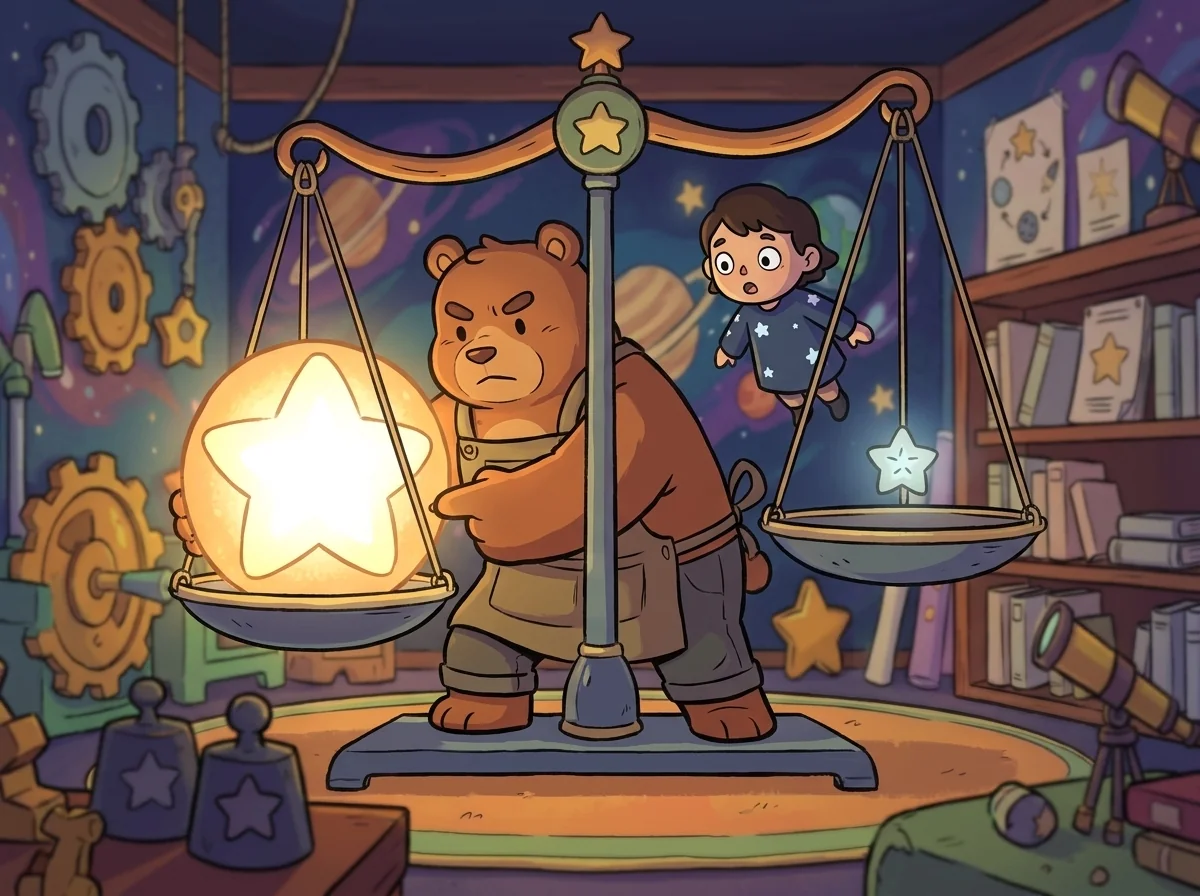
He came to the StarForge observatory as a young keeper, drawn to the one place that treated a star's mass — not its glamour — as the key to understanding it.
The observatory's chief keeper set two stars before him: one a modest, dim red point, one a gorgeous blue blaze. "Which will I still be watching," the chief asked, "when the other is long gone?"
The old dazzle-Brawn would have picked the blaze. This Brawn raised his star-weigher to each. "The blue one is heavy — it'll burn magnificent and die young, a few million years. The little red one is light — it sips its fuel so slowly it'll still be glowing steadily trillions of years from now, long after the sun itself is gone." He lowered the weigher. "So you'll still be watching the dim little one. Not because it's brighter. Because it's light, and light stars last."
The chief keeper regarded him. "Most young keepers pick the blaze every time," she said. "You weighed them, and read their fates from the scale. That instinct — to trust the mass over the dazzle — is the heart of understanding stars. You belong here."
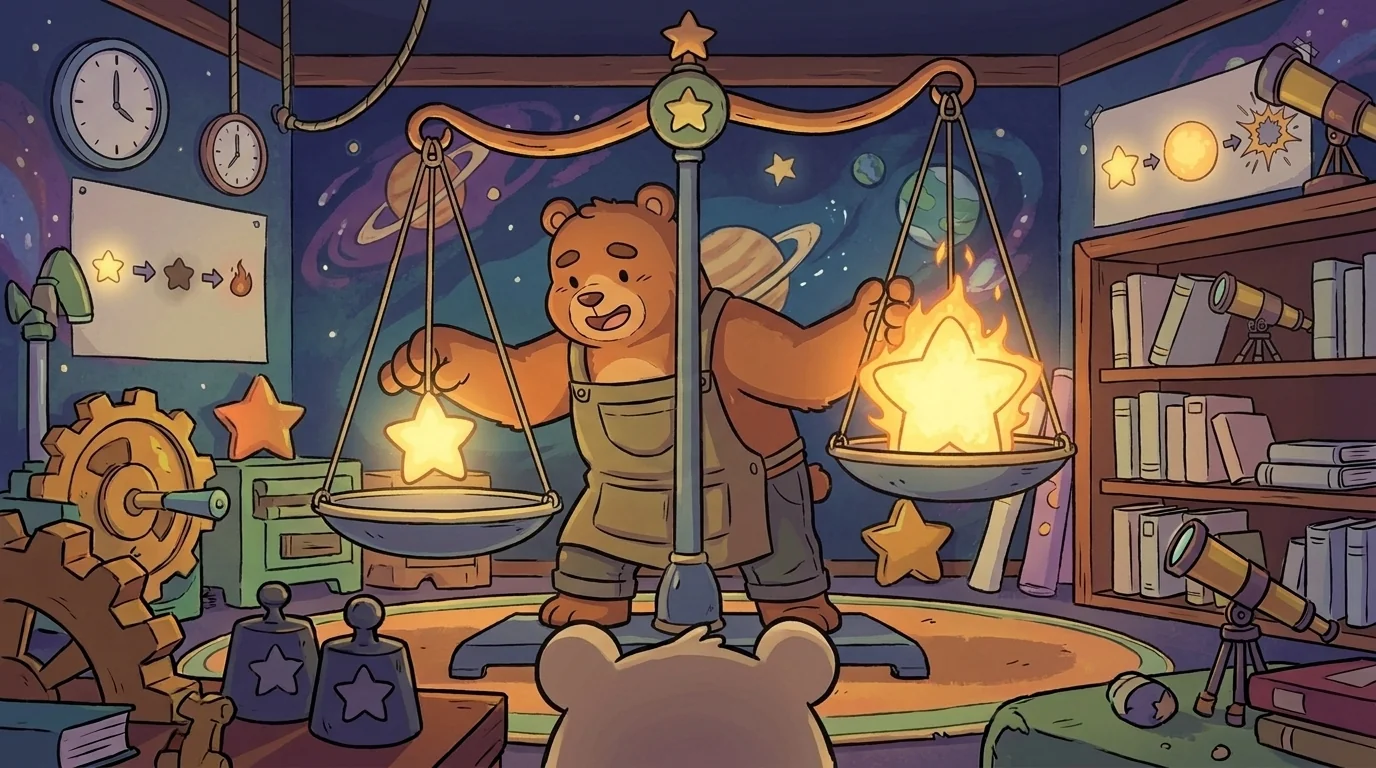
Over the years, Brawn's star-weigher drew every young keeper who confused a star's brightness with its worth.
One evening a discouraged little keeper drifted up, gazing at a faint red dwarf. "My star is so dim," she said. "Barely a glow next to the big blue ones. It feels like a failure of a star." Brawn raised his weigher to it, gently. "Let me tell you what your dim little star actually is. It's light — and because it's light, it burns its fuel so slowly, so carefully, that it will still be shining when every one of those show-off blue giants has exploded and scattered to dust. Your star isn't a failed bright star. It's a patient one. It has chosen — by its nature — the longest life a star can live." The little keeper looked at her faint star with new eyes. "So it's not dim because it's bad. It's dim because it's going to last... almost forever?" "Almost forever," Brawn said warmly. "Bright and brief, or dim and lasting — the weight decides, and neither one is better than the other. They're just different ways to be a star. The universe needs both." The little keeper's gaze softened on her patient red glow, and Brawn watched the shame lift off her like heat-shimmer.
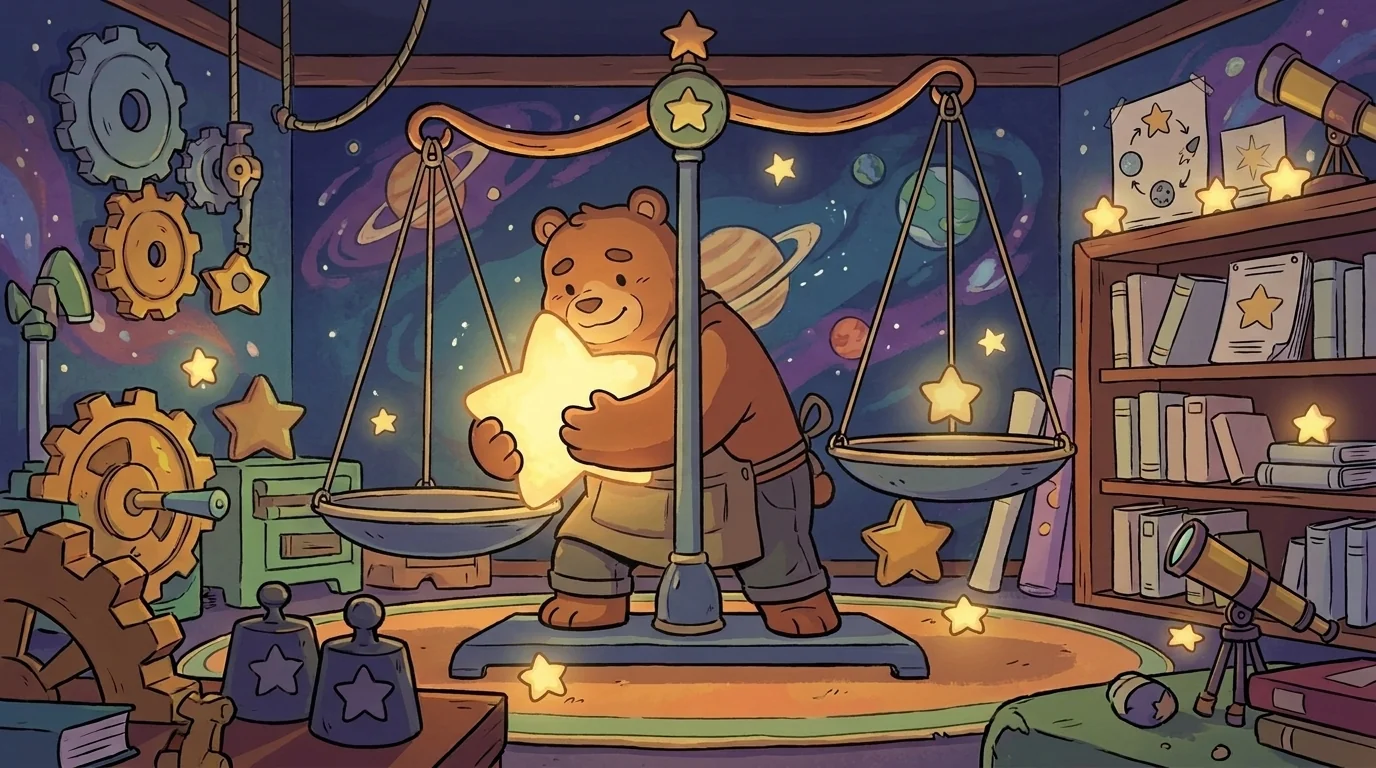
When the observatory had quieted and the great dark pressed close and full of stars, the little keeper drifted back with a smaller question.
"Doesn't it ever make you sad," she asked, "knowing a star's whole ending the moment it's born? That the weight decides it all, and nothing the star does can change it?"
Brawn thought about a blazing giant he'd loved and lost, and an old keeper who'd taught him what the weight really meant.
"It used to," he said. "I thought knowing the ending stole the wonder." He turned his star-weigher slowly in his gloved hands. "But it did the opposite. Knowing that the heavy ones burn bright and brief makes their brilliance more precious, not less — you treasure the blaze because you know it won't last. And knowing the light ones last almost forever fills the quiet dim stars with a wonder I used to miss entirely. The weight doesn't take the story away. It lets me read it — and love each star for the life it was born to live."
He felt it as he said it — a deep, settled awe spreading warm through his chest, his strong shoulders easy, his breath slow in the vast quiet. Not the shallow thrill of chasing the brightest thing. The grounded, tender wonder of understanding that every star, heavy or light, is living out exactly the life its weight wrote for it — and that this is not a sadness, but a marvel.
"That's the feeling I keep now," he told the little keeper, and his star-weigher gleamed against the dark. "Not chasing the dazzle. Reading the weight — and honoring the whole long story it tells."
The StarForge ensemble
Brawn is part of StarForge's distributed-narrative cast. Each character embodies a different curricular primitive; together they teach the full subject.
-

Wick
Protostar (collapsing gas, igniting)
-

Glow
Main-sequence star (hydrogen fusion / stable)
-

Swell
Red giant (helium fusion / expanded outer layers)
-

Pinch
Stellar collapse + neutron star / supernova compaction
-

Ember
White dwarf / stellar remnant (cooling final state)
-

Waltz
Binary stars — most stars are not alone; they circle a partner in a slow gravitational dance
-

Smolder
Brown dwarf — a clump of gas too light to ignite; warm and dim, almost-but-not a star
-

Quiver
Variable stars — stars that pulse brighter and dimmer in a steady, measurable beat
-

Flare
Stellar flares and starspots — a star's stormy magnetic surface weather