
Quiver
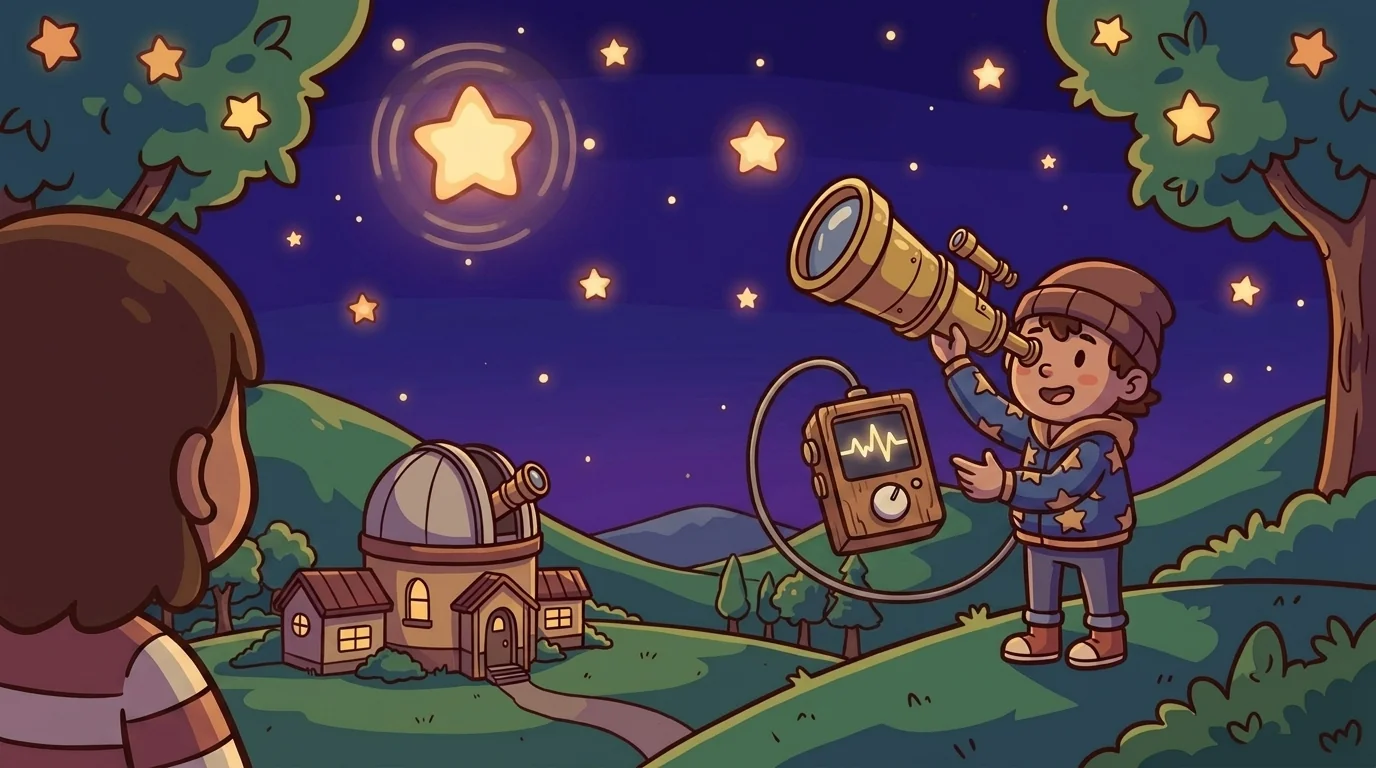
QUIVER — some stars beat like a heart, swelling and shrinking, brightening and dimming on a steady rhythm. The beat is so dependable that astronomers use it to measure distances across space — a pulsing star is a cosmic ruler.
Loading audio…
Press play to listen along. The line being read lights up as you go.
Show full transcript
Loading transcript…

Out among the far lights, a bright little keeper named Quiver floated in a shimmery gold suit, and her own glow did something no other keeper's did — it pulsed, bright then dim, bright then dim, like a tiny glowing heartbeat — while beside her a young keeper thought a star that couldn't hold a steady brightness must be sick.
Quiver was warm and rhythmic, her light swelling and fading on a gentle beat. The young keeper — a worried star-finch — watched her pulse with concern. "Your light keeps changing," he said. "Getting brighter, then dimmer, over and over. Is something wrong with you? A good star should shine steady." Quiver smiled through a bright phase of her pulse. "Nothing's wrong. I'm a variable star — I pulse on purpose. Watch a whole beat with me." Together they watched her swell and brighten, then shrink and dim, then swell again — slow, regular, dependable as breathing. "A pulsing star actually breathes," Quiver said. "It swells up, which cools and dims it, then shrinks back down, which heats and brightens it — over and over, on a rhythm it keeps for ages. It's not broken. It's beating." She pulsed once, bright. "And here's the wonder: because my beat is so steady, so reliable, astronomers can use it. A certain kind of pulsing star beats slower the brighter it truly is — so if you time the beat, you know the true brightness, and if you know the true brightness, you can tell exactly how far away it is. A pulsing star is a ruler for measuring the whole universe."
The star-finch's worry turned to wonder. "So your changing isn't a problem... it's the thing that makes you useful?"
"My rhythm is my gift," Quiver said. "The very changing you thought was a flaw is how I help map the cosmos."

Quiver had not always seen her pulse as a gift. When she was young, she'd been ashamed of it.
She'd looked at the steady stars — the ones that held one calm, constant brightness — and felt broken beside them, wishing she could just be even, unchanging, reliable in the way she thought reliability had to look. She tried to force her light to hold steady, to stop the pulse, and it felt like trying to stop her own heartbeat: impossible, and wrong. She was sure her changing made her a lesser star.
An old keeper named Cepheid, who had spent a lifetime studying pulsing stars, found her straining to hold still and gently stopped her. "You're trying to erase the very thing that makes you precious," Cepheid said. "The steady stars are lovely, yes. But your rhythm — the reliable beat of your changing — is something they can never do. Astronomers cross the entire universe using stars like you, because your beat can be trusted. You are not a broken steady star. You are a working rhythm, and the rhythm is the treasure." Quiver understood then that being reliable didn't mean being unchanging — it meant being dependable, and a steady rhythm of change is one of the most dependable things there is.

She came to the StarForge observatory as a young keeper, drawn to the one place that treated her pulse as an instrument rather than an illness.
The chief keeper pointed to a distant, faint pulsing star, impossibly far. "How far away is that one?" she asked. "We have no ruler that reaches it."
The old ashamed-Quiver would have said it couldn't be known. This Quiver watched the far star's beat and timed it. "Its beat is slow — so its true brightness is high. But it looks faint from here. A bright thing that looks faint must be very far... and from exactly how faint, against how bright I know it truly is, I can tell you the distance." She named it. "Its own rhythm measured the way to it."
The chief keeper was quiet a moment. "Most young keepers say the far ones are unknowable," she said. "You used a star's own heartbeat as a measuring rod across the void. That is one of the deepest tricks in all of astronomy. You belong here."
Over the years, Quiver's pulse drew every keeper who felt broken for not being steady.
One evening a downcast little keeper drifted up, flickering unevenly. "I can't hold a steady light like the others," she said. "I go up and down. I feel unreliable." Quiver pulsed beside her, warm. "Let me show you what 'up and down on a rhythm' can do." She timed her own beat, then used it to measure the distance to a star no steady light could reach. "The steady stars can't do this. Only a rhythm can. Being reliable was never about never changing. It's about your changing being something others can count on." The little keeper watched Quiver's dependable beat. "So I'm not unreliable... I just have a rhythm instead of a flat line?" "A rhythm you can trust is worth more than a flatness," Quiver said. "The universe is mapped by stars that beat. Your ups and downs, if they're steady, aren't a weakness — they might be exactly your gift." The little keeper's uneven flicker settled into a gentler, more even pulse, and Quiver watched the shame turn slowly into something like pride.

When the observatory had quieted, the little keeper drifted back with a smaller question.
"Doesn't it tire you," she asked, "beating all the time? Never getting to just rest at one brightness?"
Quiver thought about the ashamed years of trying to hold still, and an elder named Cepheid who taught her the rhythm was the treasure.
"I used to think the beat was a burden," she said, pulsing gently. "That rest meant holding one steady light forever." Her glow swelled and eased. "But the beat is my rest — it's my natural rhythm, the way breathing is rest, not work. Trying to hold still was the exhausting thing. Now I let the pulse rise and fall the way it's meant to, and there's a deep ease in it — bright, then dim, then bright, dependable as a heartbeat. My rhythm isn't a burden I carry. It's just how I shine, and it happens to be how I help others find their way."
She felt it as she said it — a warm, rhythmic calm rising and easing through her chest with each pulse, her light swelling and softening without strain, her whole self at rest in its own steady beat. Not the ache of forcing a flat, unchanging glow. The gentle, glad ease of a heart that beats because it's alive — and lights the way for others precisely because it can be trusted to.
"That's the feeling I keep now," she told the little keeper, pulsing warm. "Not a flat line. A rhythm I can trust — and that others can trust to find their way."
The StarForge ensemble
Quiver is part of StarForge's distributed-narrative cast. Each character embodies a different curricular primitive; together they teach the full subject.
-

Wick
Protostar (collapsing gas, igniting)
-

Glow
Main-sequence star (hydrogen fusion / stable)
-

Swell
Red giant (helium fusion / expanded outer layers)
-

Pinch
Stellar collapse + neutron star / supernova compaction
-

Ember
White dwarf / stellar remnant (cooling final state)
-

Brawn
Stellar mass — how heavy a star is at birth decides its whole life story
-

Waltz
Binary stars — most stars are not alone; they circle a partner in a slow gravitational dance
-

Smolder
Brown dwarf — a clump of gas too light to ignite; warm and dim, almost-but-not a star
-

Flare
Stellar flares and starspots — a star's stormy magnetic surface weather