
Waltz
WALTZ — most stars are not alone; they circle a partner. A binary system is two stars bound by gravity, orbiting a shared center in a slow, endless dance. Many of the points of light in the sky are really pairs.
Loading audio…
Press play to listen along. The line being read lights up as you go.
Show full transcript
Loading transcript…
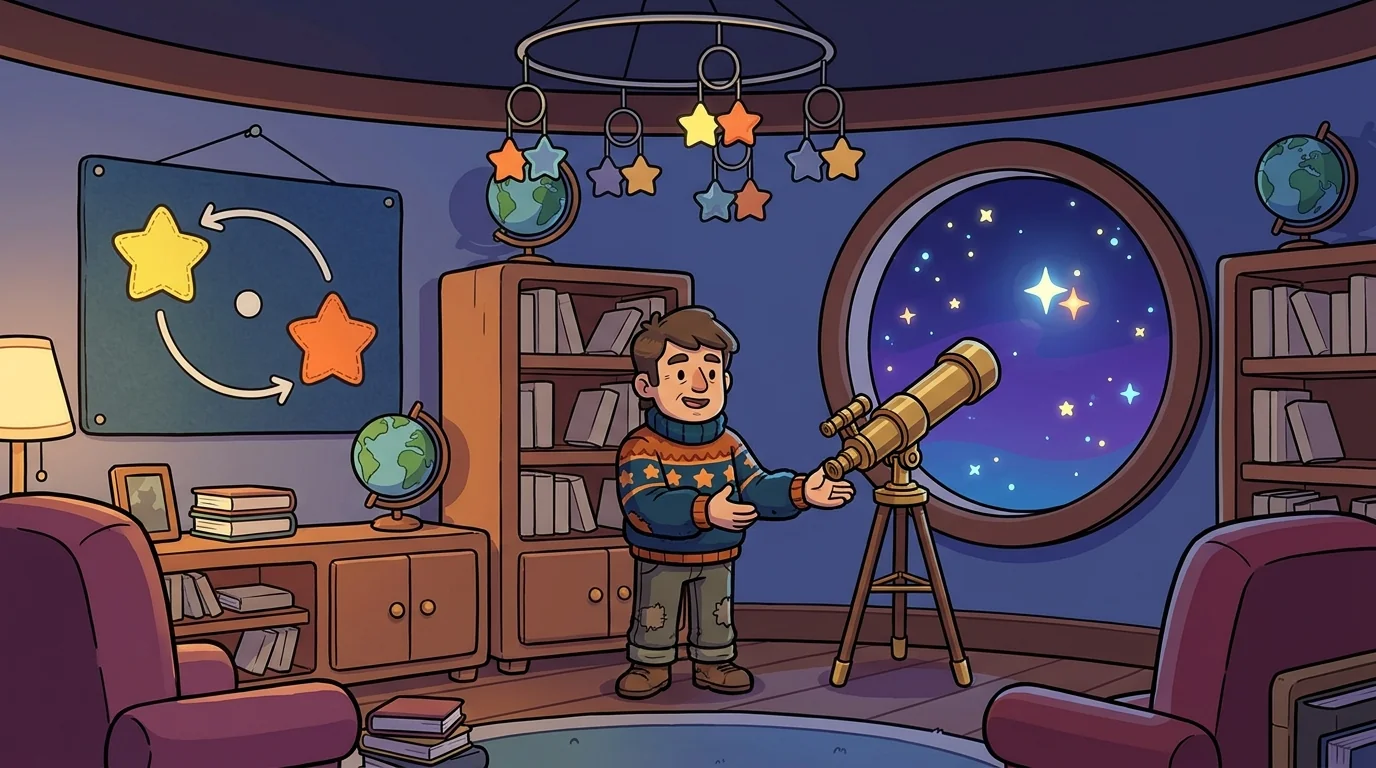
Out among the shimmering lights, a graceful little keeper named Waltz spun gently in a flowing purple suit, holding a small toy of two beads on a loop she called a pair-tracker — while beside her a young keeper was certain that every star in the sky shone alone.
Waltz was elegant and turning, her suit shimmering as she twirled. The young keeper — a solitary night-owl — gazed out. "Each star, all alone in the dark," he said, a little wistful. "So many lonely lights." Waltz laughed softly and held up her pair-tracker, the two beads circling each other on the loop. "Lonely? Look closer at that 'single' star you're watching." She aimed a special lens at it, and what had looked like one point of light resolved into two, circling each other in a slow, graceful loop. "That's not one star. It's two — a binary. Bound together by gravity, forever orbiting a shared center between them, in a dance that never ends." She spun the beads on her loop. "And here's the wonder most people never learn: more than half of all the stars you can see are really pairs, or even little families of three or four. The sky isn't full of lonely lights. It's full of partners, dancing so close that from far away they blur into one." She twirled. "Most stars were never alone at all."
The night-owl stared through the lens at the circling pair. "So the sky isn't lonely... it's full of dances I just couldn't see?"
"Full of them," Waltz said. "Two stars, one shared center, an endless slow waltz. You only saw single points because the partners were too close together to tell apart from here."
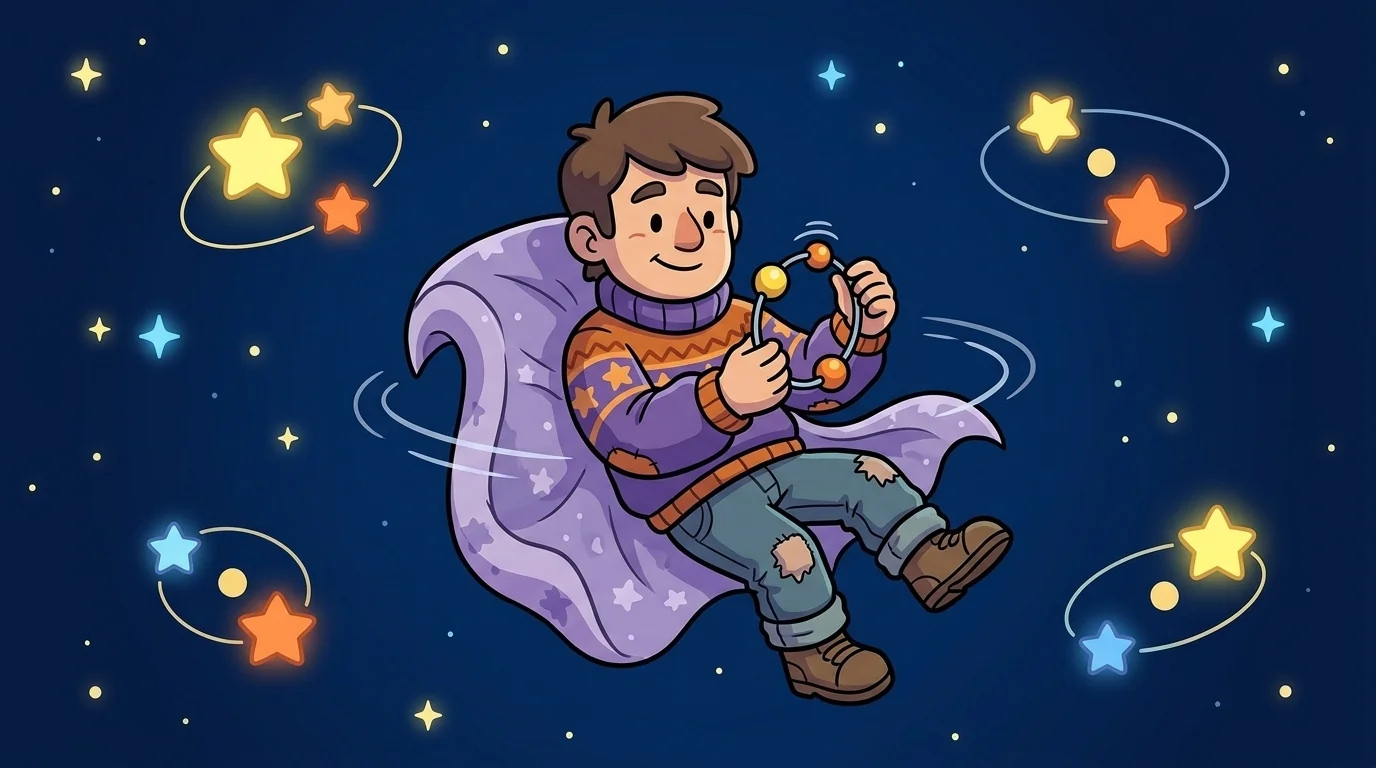
Waltz had not always seen the pairs. When she was young, she'd felt the loneliness the night-owl felt.
She'd believed she was meant to shine alone — that a star's job was to be a single, independent light, needing no one. She'd held herself apart, spinning solo in the dark, proud and a little sad, sure that dancing with a partner would mean she wasn't strong enough to shine by herself. And she'd looked at the sky and seen only isolated points, each one alone, and felt the whole cosmos was a scatter of separate lights that never touched.
An old keeper named Sirius-Watch, who studied the great bright pairs, found her spinning alone and gently offered a hand. "You think shining alone is strength," she said. "But look — through the right lens, most of those 'single' stars are dancing with a partner, bound by gravity, each holding the other in orbit. And they don't shine less for it. A binary is not two weak stars leaning together. It's two whole stars, each complete, choosing to move around a shared center. Partnership isn't the opposite of being whole. Most of the sky discovered that long ago." Waltz let herself be drawn into the dance, then, and found that circling a shared center didn't diminish her light at all — it only meant she was no longer spinning in the dark alone.
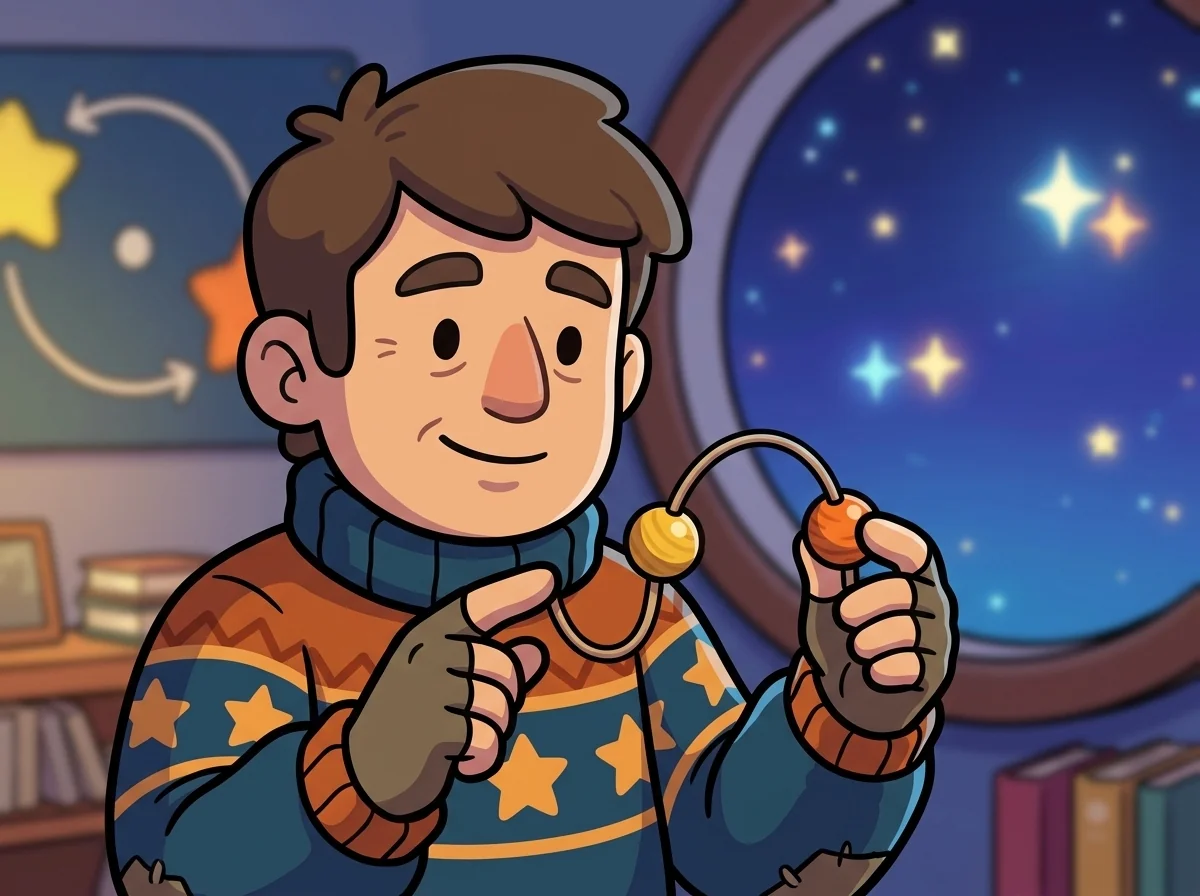
She came to the StarForge observatory as a young keeper, drawn to the one place that saw the sky as full of partnerships rather than isolated points.
The chief keeper pointed to a single bright star. "Is that one star or more?" she asked. "Look carefully before you answer."
The old solo-Waltz would have said "one — alone, like all of them." This Waltz raised her finest lens and watched the point patiently. "It wobbles — it's being tugged. And there... it splits into two. That's a binary: two stars circling a shared center, so close they looked like one. Not a lonely light. A dance." She lowered the lens. "Most of them are, once you look closely enough."
The chief keeper smiled. "Most young keepers see single points and call the sky lonely," she said. "You looked until the pairs revealed themselves. Seeing the partnerships hidden in the points — that is a truer picture of the cosmos. You belong here."
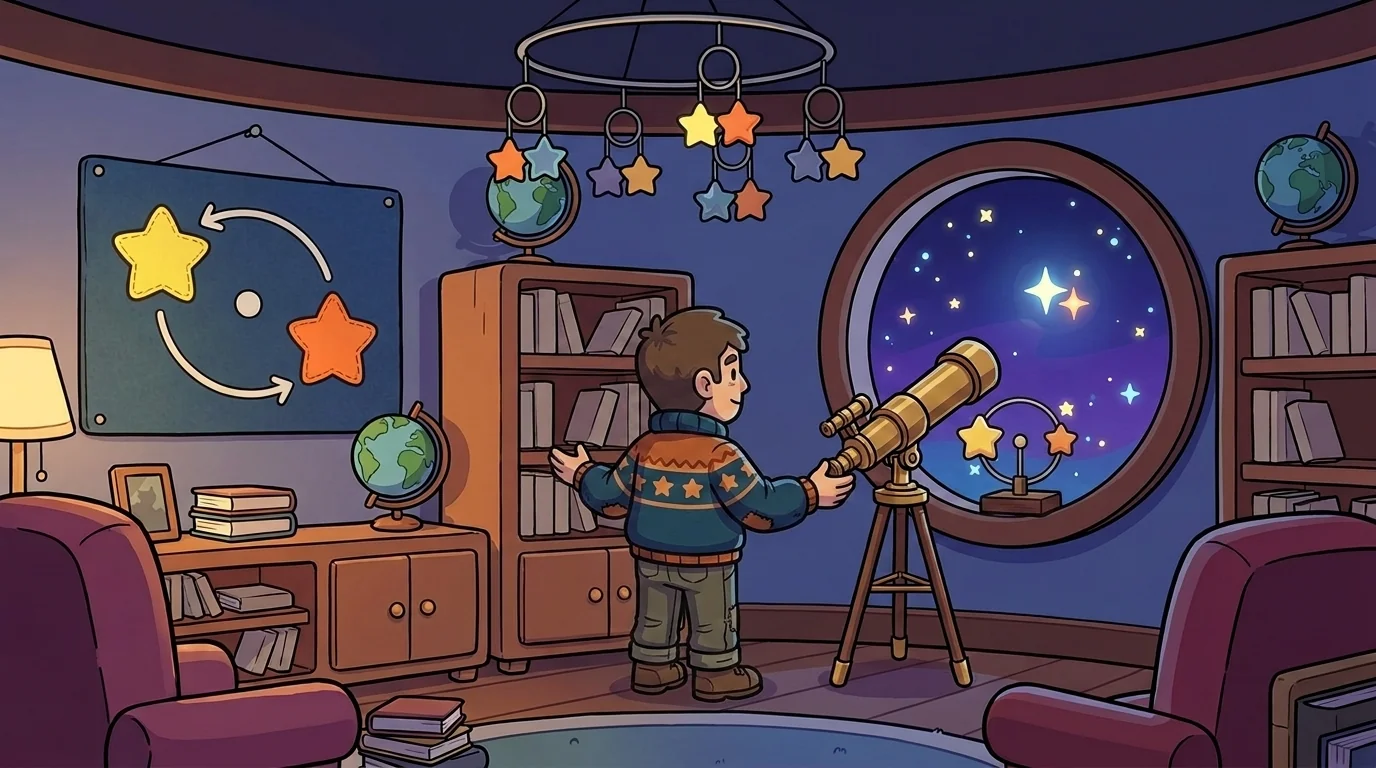
Over the years, Waltz's pair-tracker drew every keeper who felt they had to shine alone.
One evening a proud, isolated little keeper drifted up, holding herself apart. "I shine by myself," she said, a little stiffly, a little sadly. "I don't need to orbit anyone. That's strength, isn't it?" Waltz spun her pair-tracker gently. "Let me show you the real sky. More than half of all stars dance with a partner — and they're not the weak ones. Each is a whole, complete star, and they choose to circle a shared center, holding each other steady across the ages." She aimed her lens at a glorious bright binary. "Look how they shine together. Not one leaning on the other. Two whole lights, in a shared dance." The little keeper watched the pair circle. "So orbiting a partner doesn't make me less of a star?" "It never did," Waltz said warmly. "You can shine alone if that's your nature — some stars truly do. But partnership isn't weakness, and most of the sky is dancing. Being whole and being partnered were never opposites." The little keeper's stiff solo spin eased into something more open, and Waltz watched the lonely pride soften into something warmer.
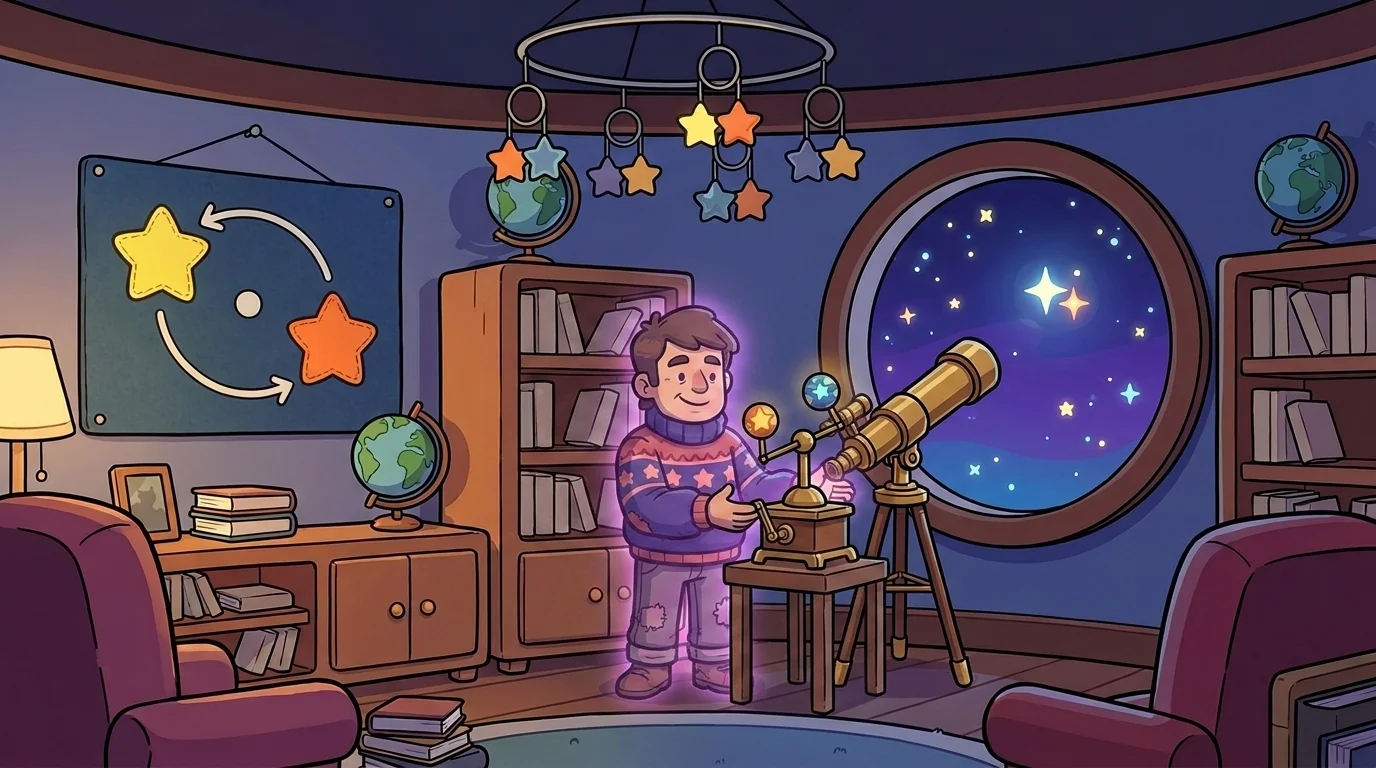
When the observatory had quieted, the little keeper drifted back with a smaller question.
"How do two stars orbit," she asked, "without one being the center? Doesn't one have to be in charge?"
Waltz thought about her lonely spinning years, and an elder who'd drawn her into the dance.
"That's the most beautiful part," she said, twirling her beads on their loop. "In a true binary, neither star is the center. They both orbit a shared point between them — a balance point, belonging to neither and to both. The heavier one moves in a smaller circle, the lighter in a bigger one, but they move around the same shared center, together, forever." She spun softly. "I used to think a dance meant one star leading and one following, one center and one orbiter. But the loveliest dances have no single center at all — just two whole lights, moving around something they share. Neither in charge. Both holding the balance."
She felt it as she said it — a warm, turning grace flowing through her, her spin easy and unhurried, her whole self content in a motion that circled something shared rather than something alone. Not the stiff, proud loneliness of shining solo in the dark. The gentle, glad wholeness of a light that dances around a shared center, complete and partnered at once.
"That's the feeling I keep now," she told the little keeper, her suit shimmering as she turned. "Not a lonely point. Not one star in charge. Two whole lights, one shared center, an endless slow waltz."
The StarForge ensemble
Waltz is part of StarForge's distributed-narrative cast. Each character embodies a different curricular primitive; together they teach the full subject.
-

Wick
Protostar (collapsing gas, igniting)
-

Glow
Main-sequence star (hydrogen fusion / stable)
-

Swell
Red giant (helium fusion / expanded outer layers)
-

Pinch
Stellar collapse + neutron star / supernova compaction
-

Ember
White dwarf / stellar remnant (cooling final state)
-

Brawn
Stellar mass — how heavy a star is at birth decides its whole life story
-

Smolder
Brown dwarf — a clump of gas too light to ignite; warm and dim, almost-but-not a star
-

Quiver
Variable stars — stars that pulse brighter and dimmer in a steady, measurable beat
-

Flare
Stellar flares and starspots — a star's stormy magnetic surface weather