Dreamer
COUNT EVERY LOT
Listen along — Dreamer
Loading audio…
Press play to listen along. The line being read lights up as you go.
Show full transcript
Loading transcript…
Dreamer the Fox
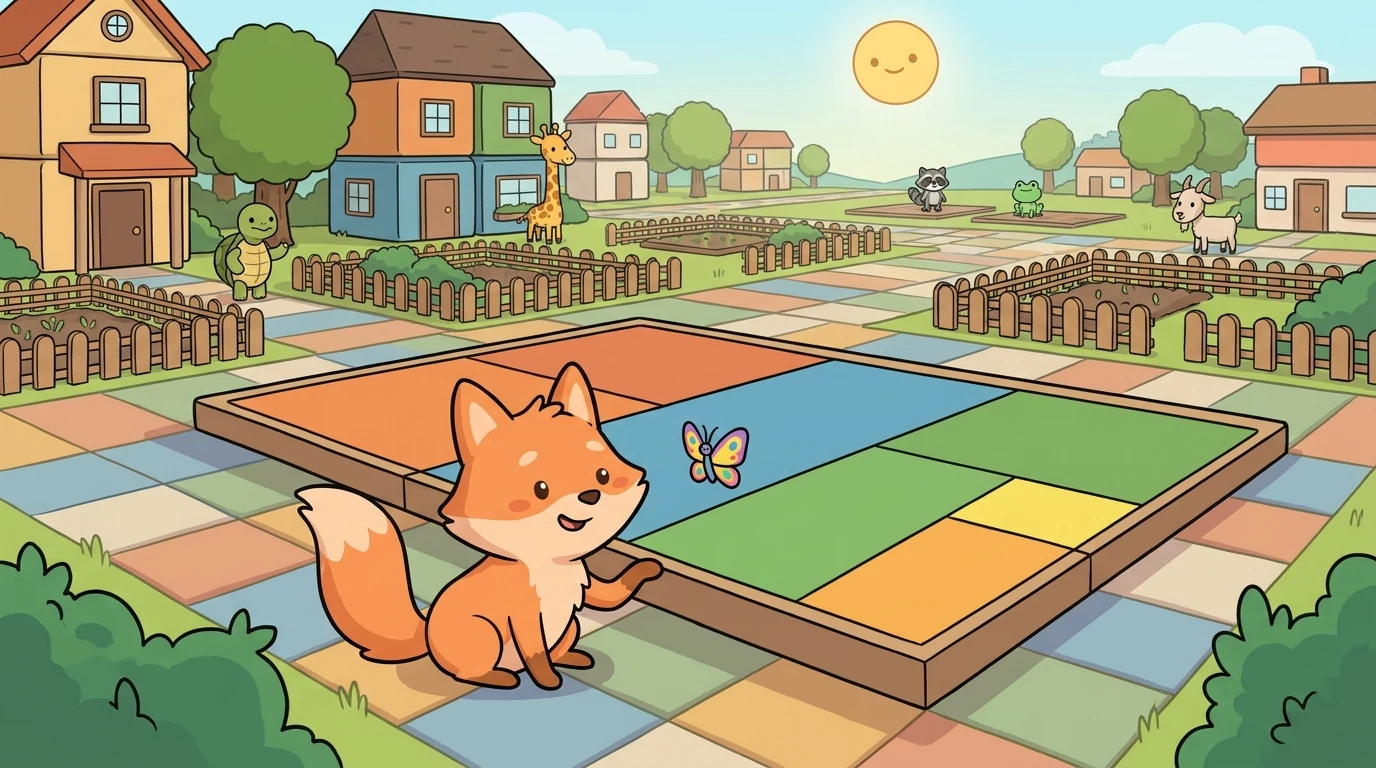
Dreamer is a soft orange fox with a fluffy tail and big, gentle, dreamy eyes. Dreamer is new at this - a friendly novice, still learning - and Dreamer’s mind likes to wander off to lovely daydreams right in the middle of counting. That is not a bad thing about Dreamer. It just means Dreamer needs a good friend nearby: you.
One day Dreamer is looking at a square block that has been split into four lots. There is a big lot up in one corner. Two matching middle lots - twins, the same size as each other. And one tiny corner lot. Four lots in all.
Dreamer starts to count, humming happily. “The big lot… a hundred,” Dreamer murmurs. Then Dreamer’s eyes drift to a butterfly. “…and the little corner lot… four.” Dreamer smiles, dreamy. “A hundred and four! All done!”
But wait. Dreamer daydreamed right past the two middle lots. The twins! They were sitting there the whole time, and Dreamer forgot them. So Dreamer’s whole came up short.
This is where you help, gently. You don’t laugh. You just point: “Dreamer - look. You counted the big lot and the little corner. But you skipped the two middle lots. Count them too.” And Dreamer blinks, follows your paw, and sees them - the two twins, twenty and twenty. “Oh!” says Dreamer, warm and glad. “You’re right - I daydreamed past them. A hundred, and twenty, and twenty, and four… a hundred and forty-four! You caught the ones I missed. Thank you.”
That is the whole lesson Dreamer helps you learn.
When a block splits into lots, count them ALL.
Every lot belongs to the whole. The big one, the little corner, AND the middle twins that are so easy to daydream past. Miss one, and the whole comes up short. Teaching Dreamer to catch every lot teaches you to catch every lot too.
A grown-up can play too! Split a square of tiles into four lots - a big one, a tiny corner, and two matching middles. Pretend to be Dreamer: count only the big lot and the corner, then “daydream.” Let the child be the helper who points and says, “you forgot the two middle lots!” Then count them all together: “big… middle… other middle… corner… now the whole is right.” Being the one who spots the missing lot feels good - and it makes the counting stick.
When you point out the lots Dreamer skipped, and Dreamer counts them all and lands on the true whole, Dreamer feels a bright, thankful happiness - not because anyone said Dreamer was clever, but because a good friend helped, and now the count is complete. Dreamer’s dreamy eyes go soft and grateful. “Count them all,” Dreamer says. “Even the ones I’d daydream past. You helped me see. Let’s always count every lot.”
Reading together with a grown-up? A card for the grown-up
For the grown-up: ask one question, then wait. When they answer, add one word to what they said. Tap the button when they have said something — that is one turn each, a circle. Nothing is recorded or kept.
Let them finish it
Say “Dreamer says: when a block splits into lots, count them ALL …” and stop. Let them finish it.
Now wait. Count slowly to five in your head. Their answer is worth the quiet.
Circles together: 0
The ArrayPals ensemble
Dreamer is one of the friends in ArrayPals. Each friend shows you one idea by how they act; meet them all and you have the whole subject.
-

Tila
The whole block - Mayor Tila the tortoise, whose town block is made of all its little square lots; count every lot and you have counted the whole block
-

Rift
The friendly split - a clever raccoon who breaks one big block along a straight line into smaller lots, counts each, and adds them back; the whole stays exactly the same, the counting gets easier
-

Tenner
Round to the friendly ten - a tall giraffe who reaches a lumpy number UP to its nearest tidy ten for a quick, close guess, then tiles it to be sure
-

Skipper
Equal rows, skip-counted - a springy frog who hops along equal rows counting by the row (three, six, nine, twelve); skip-counting the same equal group again and again IS multiplying
-
Fence
The fence or the field - a sturdy goat who shows that the fence AROUND the edge and the grass INSIDE are two different counts, not the same number