Arch
MATH↔ART BRIDGE
Loading audio…
Press play to listen along. The line being read lights up as you go.
Show full transcript
Loading transcript…

The seashell lay on the windowsill, pearly and quiet, and Arch was already after it. She was a small russet-and-cream fox-tween, quick-eyed, and the little brass caliper had come off her belt without her seeming to decide it should. Its two wooden-and-brass arms opened like measuring jaws and settled against the shell's longest curve. Click. She read the gap, scribbled a number in the leather sketchbook under her arm, then swung the arms to the width and read that too.
She divided the first number by the second in her head. "One point six-one," she murmured, and grinned like she'd caught someone hiding.
Her friend Cable, passing with a tuning-fork in her tail-feathers, paused. "That's your favorite number again."
"It isn't mine. It's the shell's." Arch turned the sketchbook so Cable could see the two measurements, the little division sum, the answer sitting there like a fingerprint. "One point six five. That's this shell's number. People say one famous number hides in every shell and every sunflower. I don't take their word for it, or mine. I measure, and the shell tells me."
Cable listened for the ratio in things; Arch looked for it. Same math, two senses. Arch pressed the caliper's arms shut and slid it home. Whatever came onto the windowsill next, she would measure that too — not because she guessed a shape would be beautiful, but because the caliper could prove whether a hidden number was living inside it.

She had learned to distrust her own eye early, and it had happened in her family's workshop.
Arch's family were the village facade-designers — the foxes who set the proportions of the public buildings, the church and the inn and the little schoolhouse. When Arch was six she stood in front of two paper sketches her father had pinned to the wall, both of a proposed meeting-hall front, and he asked which one she liked better. She pointed at the left one without hesitating. It felt right.
Her father nodded and handed her the caliper. "Now measure both."
She measured the height and the width of each facade, dividing one by the other the way he'd shown her. The one she'd pointed at came out close to one point six-one. The other came out at nothing special — a flat, forgettable number. Her eye had felt the ratio before her hand could name it.
"Your eye is good," her father said. "It notices when a thing sits at a nice proportion. But the eye can be fooled, and it can't tell anyone else what it saw. The caliper can." He tapped the paper. "The villagers will love the buildings whose proportions land on the good ratios, and they won't know why they love them. That's the math, hiding under the loving. Your job is to make it show."
By the time she was grown, Arch could feel a proportion coming and still refused to trust the feeling until the brass arms agreed. Feels-right was a place to start looking. It was never a place to stop.

She walked to the BridgeForge academy the summer she turned twenty-two, and Archie met her at the gate holding a plain wooden picture-frame. Not a beautiful one. A blank one.
"Tell me something true about this," the academy's founder said, and handed it over.
Arch turned it in her paws, took the caliper off her belt, and measured the frame's outer edges — long side, short side. She divided. "One point four-eight," she said. "This frame's own number. Not the famous one people expect." She measured the inner opening and divided again. "The opening's at one point six. Different again." She looked up. "So whoever built it cared more about how the picture would sit than how the frame would look empty. That's a real thing I can show you, with numbers, not a feeling I have about it."
Archie took the frame back and studied the two figures she'd read off it, and something in his face settled. He hadn't wanted a guess about beauty. He'd wanted to see her reach for the tool before she reached for an opinion — and she had. A place opened for her at the academy that afternoon.

Her workshop always started with one object on the bare table. Today, the seashell again.
"Watch my hands, not my mouth," Arch told the fox-kits in the front row. She fitted the caliper to the shell's spiral and read the length aloud, wrote it down, fitted it to the width, read that, wrote it down. Then she divided the two out loud, slowly, so they could follow. The answer came up near one point six-one, and a small "ohh" went round the bench.
"Now you don't get to just believe me," she said. She passed calipers down the row. "Measure it yourself. If your number's near one point six-one too, we've caught the same thing."
They fumbled, they pinched their own paws in the brass, they measured crooked and got wild answers, and she walked them back — square the arms to the real edge, read where the arms actually sit. One by one their numbers drifted toward hers.
Then she set out a second shell, a lumpy broken one, and had them measure that. It came out at nothing near one point six. A kit looked crestfallen. "Did I do it wrong?"
"You did it right," Arch said. "This shell just isn't at a famous ratio. That's not a failure — that's how you know the numbers are real. If every shell gave the same answer whatever you measured, the caliper would be telling you nothing." She held up a leaf, a pinecone, a slate roof-tile, a portrait. "Each one has its own number. You measure them all the same, and you let the numbers sort themselves." A kit near the wall — the quiet one who'd said barely a word — measured the leaf and whispered one point six to herself before Arch even asked, and grinned.
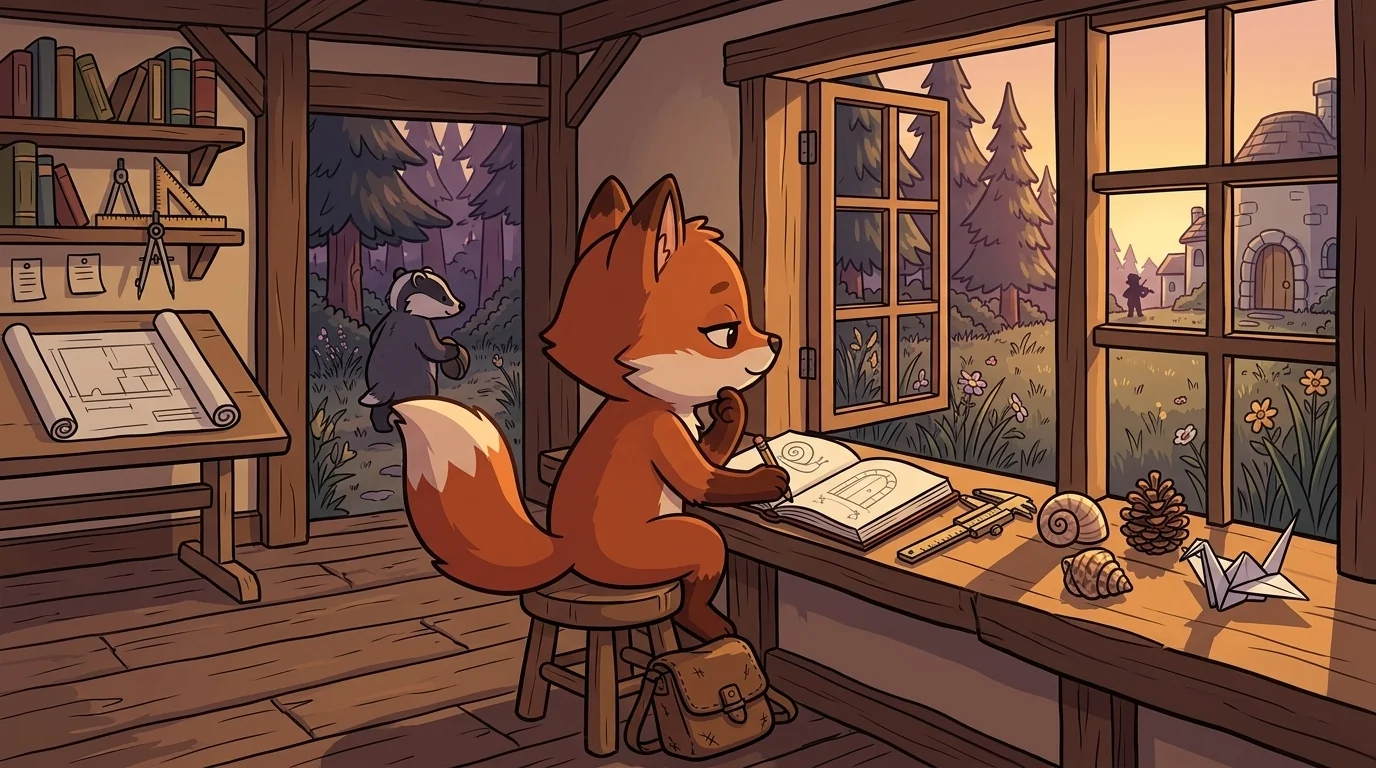
"Is this art class, then?" a fox-kit asked, still holding a caliper like it might bite.
Arch smiled. "It's a looking class. You don't have to be an artist to see the ratio. You don't have to be a math kid to measure it. You look carefully, you measure carefully, and the number tells you what your eye already suspected." She closed her own caliper with a soft click. "Nobody's shutting you out of this. There was never a door."
The kit's shoulders came down from around her ears. She turned the shell over in the light, looking at it differently now — not just as a pretty thing, but as a thing with a secret number folded inside it, waiting to be caught.
That was the moment Arch worked for. Not the answer itself, but the small amazed quiet that arrived when a kid realized a shape had been carrying a number all along, and that she'd been allowed to find it the whole time. It left Arch warm and steady, the way you feel when someone stops apologizing for looking.
The sketchbook lay open, waiting for the next object.
Hear it as an audio drama
A short play starring Arch, from BridgeForge. Different voices, same idea. Listen any time after you read.
Loading audio…
Read the drama script
- Narrator: From Spark and Anvil and BridgeForge — this is Arch, in chapter 1 of the BridgeForge cast.
- Narrator: This drama uses an AI-generated voice. Voiced via Gemini 2.5.
- Narrator: Arch is a small fox-tween. A brass caliper hangs from her belt beside a soft-leather sketchbook.
- Narrator: She moves with quiet grace, always paying close attention to proportion, the way things fit together beautifully.
- Arch: I am Arch. What I teach is math-art. It is the math you can actually see.
- Arch: I show you the golden ratio, about 1.618. You can find it in the spiral of a seashell or a sunflower.
- Arch: You don't need to be an artist to see it. You don't need to be a mathematician to measure it.
- Arch: You just need to look carefully. Then you measure carefully with the caliper. The ratio shows in the seeing.
- Narrator: Arch grew up in a small village. Her family were facade-designers, shaping the proportions of every public building.
- Arch: By age six I knew the lesson. The buildings people loved most were the ones whose math you could see.
- Narrator: She walked to the BridgeForge academy at twenty-two. The founder asked her one question about her craft.
- Arch: The math-art bridge is visible proportion. You measure it with the caliper, you check the ratio. The math is in the eye.
- Narrator: The founder listened to her answer and simply said, "You are appointed."
- Narrator: Look carefully. Measure carefully. The ratio shows in the seeing.
- Narrator: You've been listening to a Spark and Anvil chapter, written by the Spark and Anvil writing team for ages 9 to 14.
- Narrator: Apps stay free forever.
- Narrator: Curriculum aligned to Next Generation Science Standards engineering.
- Narrator: Released under Creative Commons BY-NC-SA 4.0 for educational reuse. Visit Spark and Anvil for the full transcript.
The BridgeForge ensemble
Arch is one of the friends in BridgeForge. Each friend shows you one idea by how they act; meet them all and you have the whole subject.
-

Truss
Math↔Science bridges — causal-evidential connection (measurement + replication; both sides need numbers)
-
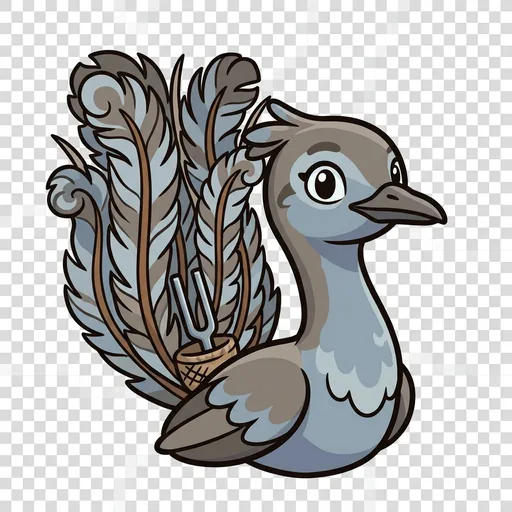
Cable
Math↔Music bridges — ratio-temporal connection (frequency ratios + rhythm; math you can HEAR)
-

Pier
Math↔Social-Studies bridges — data-narrative connection (statistics in history + civics; numbers + people)
-
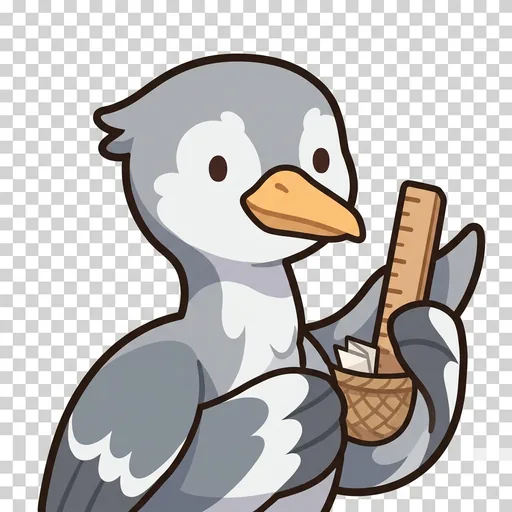
Splice
Math↔ELA bridges — structure-metaphor connection (sequence + symmetry in writing; math is the bones)
-
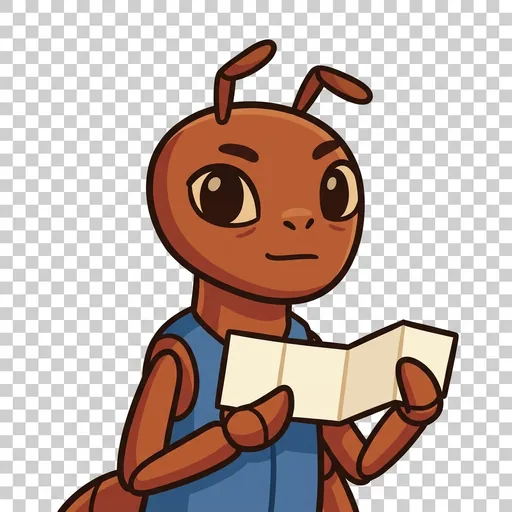
Girder
Math-computing bridge — order-of-operations is the same as sequence in code; math you can run
-
Rivet
Math-movement bridge — rate, angle, and trajectory; a jump is math in the air
-

Ballast
Math-health bridge — ratio, scaling, and balance; the right amount in the right proportion
-

Strut
Math↔Cooking bridge — proportional reasoning; a recipe is a ratio you can scale up or down
-

Trestle
Math↔Gardening bridge — spatial reasoning; a garden bed is geometry you can grow