Cable
MATH↔MUSIC BRIDGE — ratio-temporal connection (frequency ratios + rhythm; math you can HEAR). The cross-curricular primitive of *the bridge whose math shows up as audible ratio.*
Loading audio…
Press play to listen along. The line being read lights up as you go.
Show full transcript
Loading transcript…
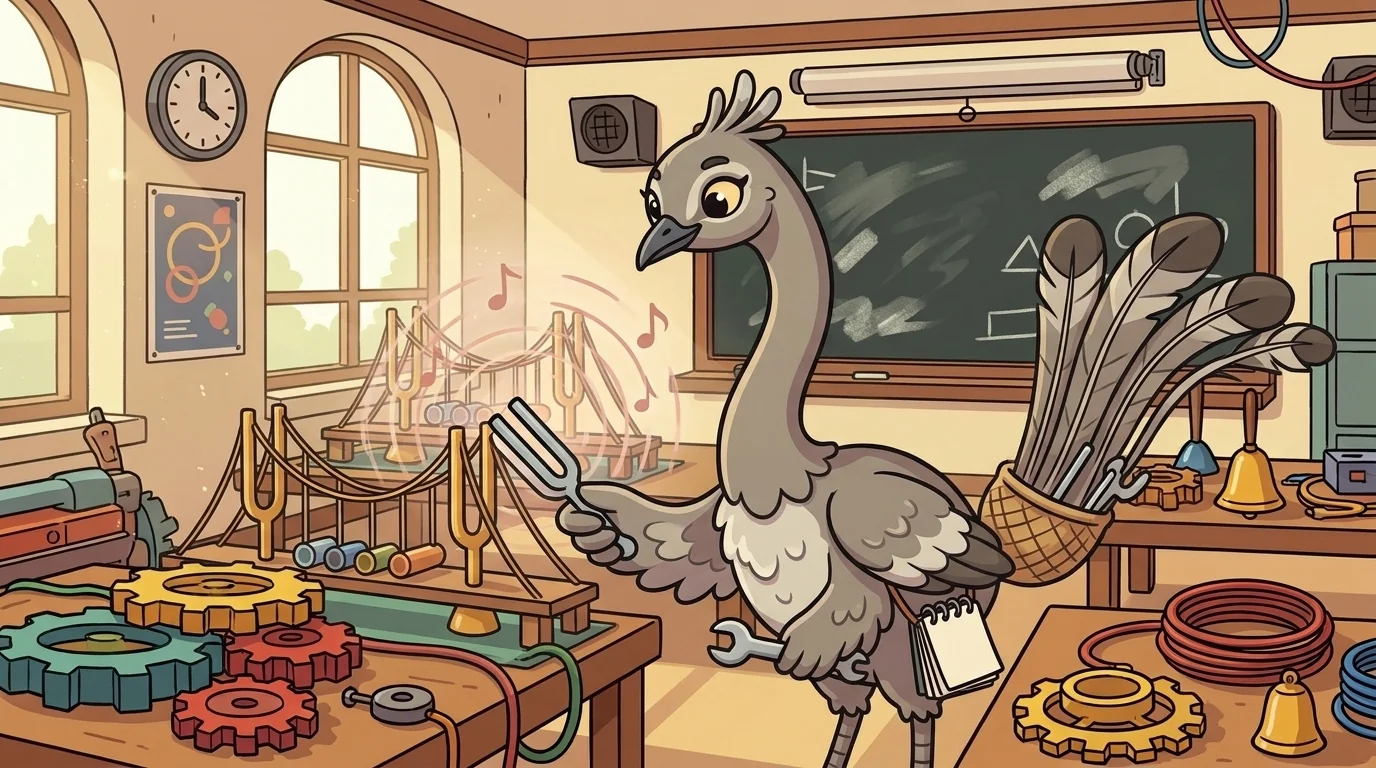
Cable the lyrebird wasn't very big, but her ears were. Her long neck swiveled to catch the tiniest sounds. Her feathers were the color of soft clouds and wet stone. Her bright eyes missed nothing. She always carried two things. A small notebook labeled "RATIOS" hung from her hip. And tucked into a woven pouch in her tail was a tiny steel tuning-fork.
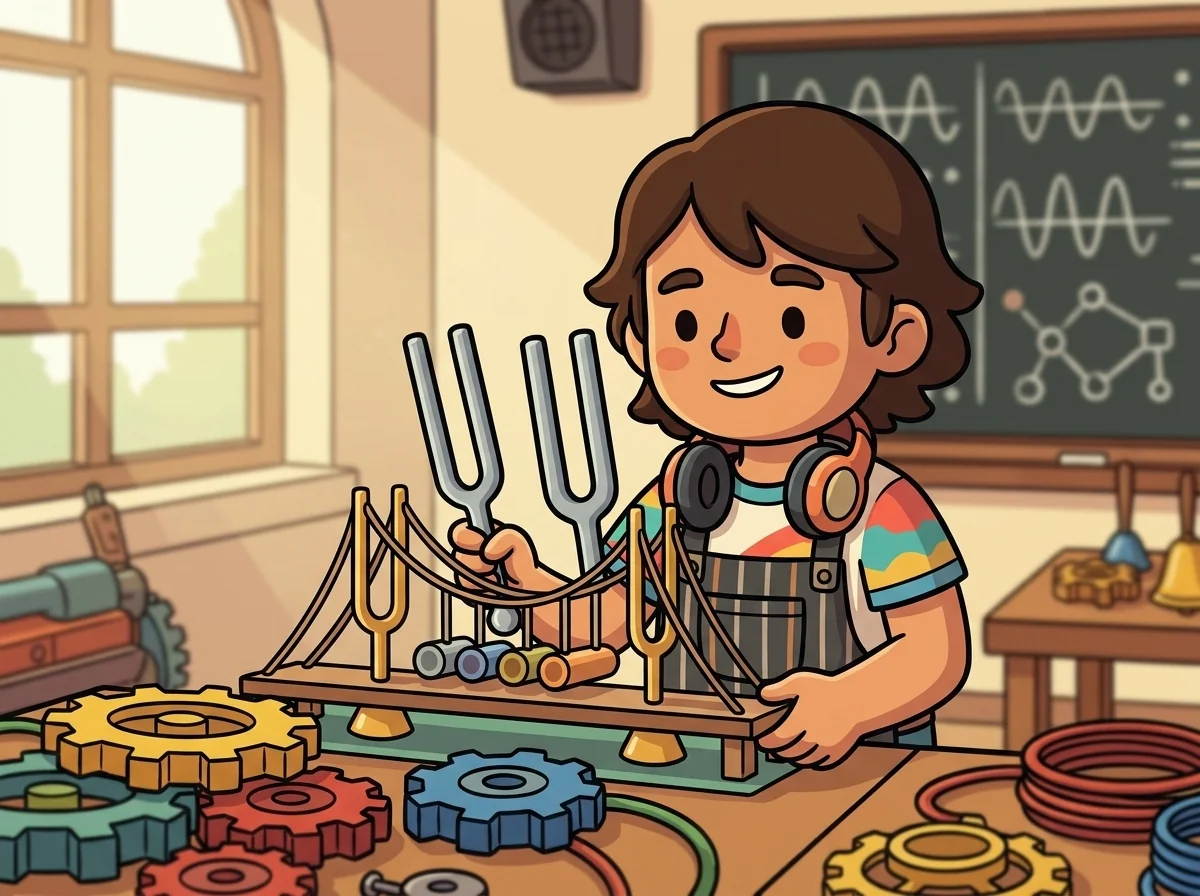
When she tapped the fork on something hard, a sound bloomed in the air. It was a deep, steady hum. The fork shivered in her grip, vibrating 440 times every single second. This was the note A, a sound you could find right above the middle of a piano. Cable used this fork to check if other sounds were in tune. She also used it to reveal a secret. She used it to show you math you could actually hear.
She flipped open her notebook. The letters inside were neat and blocky. They showed the simple recipes that make up most of the music we hear.
Octave = 2:1 (One sound shivers twice as fast as the other.) Perfect Fifth = 3:2 Perfect Fourth = 4:3 Major Third = 5:4 Minor Third* = 6:5
This was Cable’s special job at the academy. She showed everyone how math and music were connected by a real, solid bridge. It wasn't just a nice idea. When you sing an octave, one note vibrates exactly twice as fast as the first. That’s not a feeling. That’s a fact. It’s a 2-to-1 ratio your own throat can make. The math is right there in your ear.
Cable was very clear about one thing. This wasn't just for "musical kids." She sounded a bit like her friend JestForge Pause when she talked about it. "The ratio is in your ear," Cable would say. "You don't need to be a music genius to hear it. You don't need to be a math whiz to count it. You just have to listen close. And count carefully. The math is waiting for you."
Cable grew up in a small village where her family were the official bell-tuners. They made sure the big church bells and the meeting-hall bells all sounded right together. Every bell had to have a perfect relationship with its neighbor. That way, when they rang for a harvest festival, the air filled with beautiful harmony, not a clanging mess.
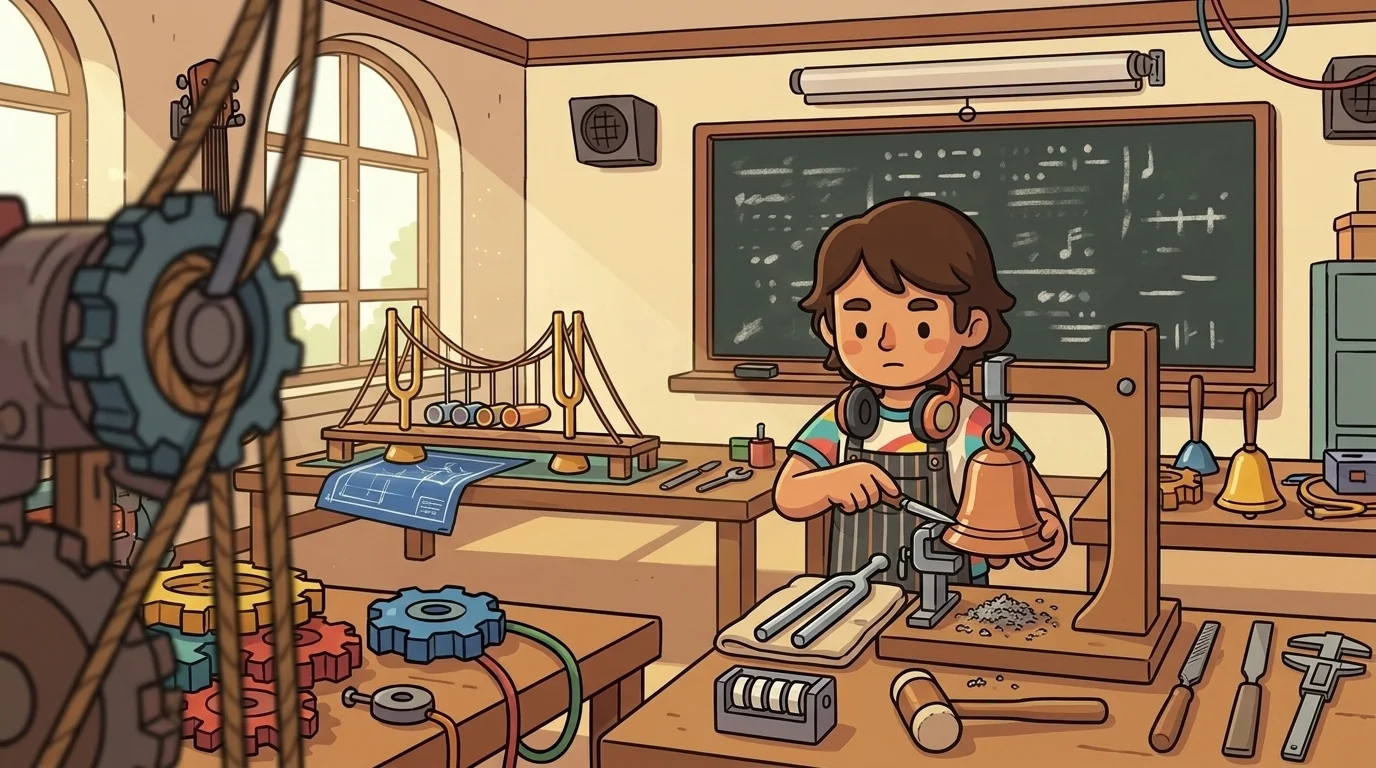
She learned the family trade by age six. Tuning bells was just math you could hear. A bell that was a little bit off sounded sour. Its ratio was wrong. Fixing the bell meant fixing the math. You’d carefully shave a little metal off the inside, tap it, and listen again. Clang. Clang. Thunk. Not yet. Shave a little more. Clang. Clang. Beeeelll. Perfect. The ratio was right.
When she was old enough, she walked to the BridgeForge academy. The headmaster, Archie, asked her a single question. "So, you want to teach the math-music bridge. What is it?"
Cable stared at the floor for a long moment. Then she looked up. "It's about time and sound," she said. "The ratio shows up when you listen. It's math you can hear. The bridge is the place where what you measure and what your ear tells you are the exact same thing. It’s something you can build, not just a fuzzy idea."
Archie smiled. "You're hired."
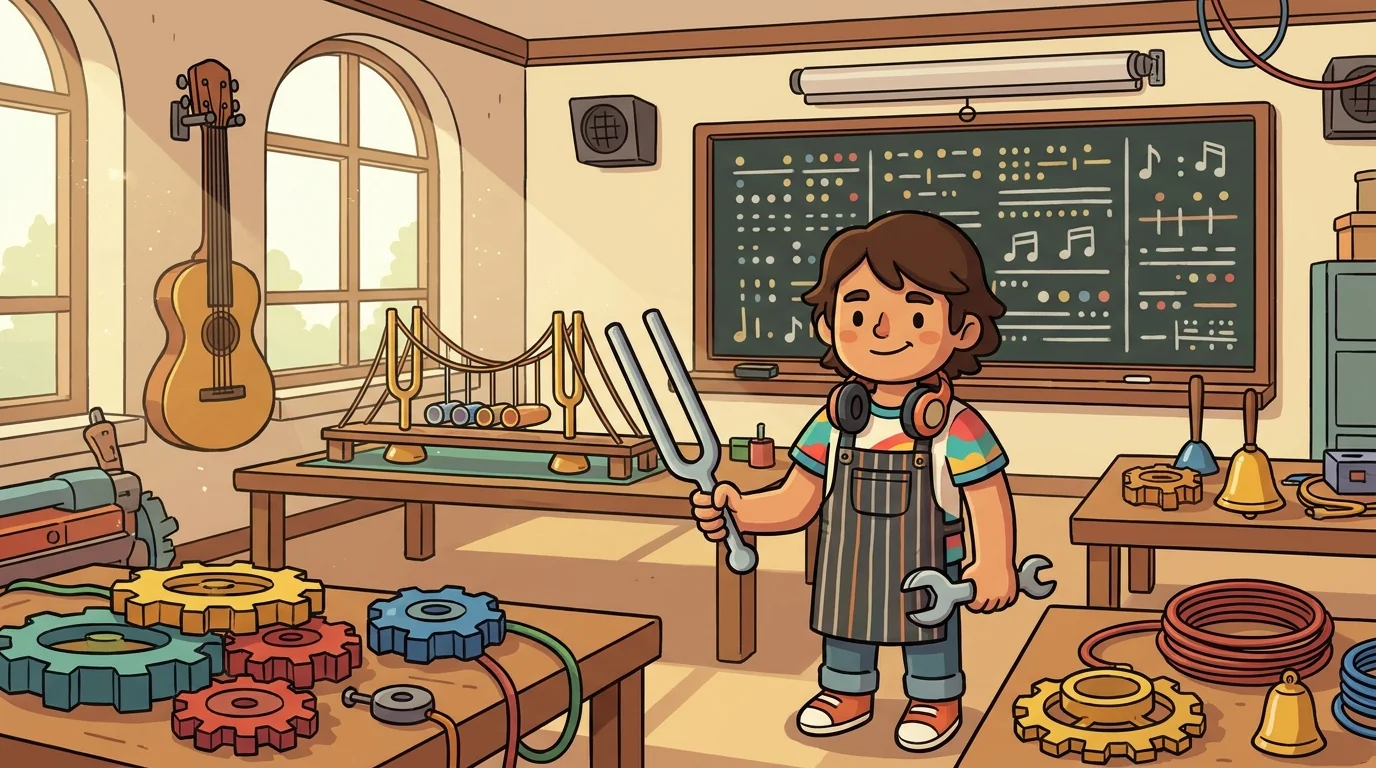
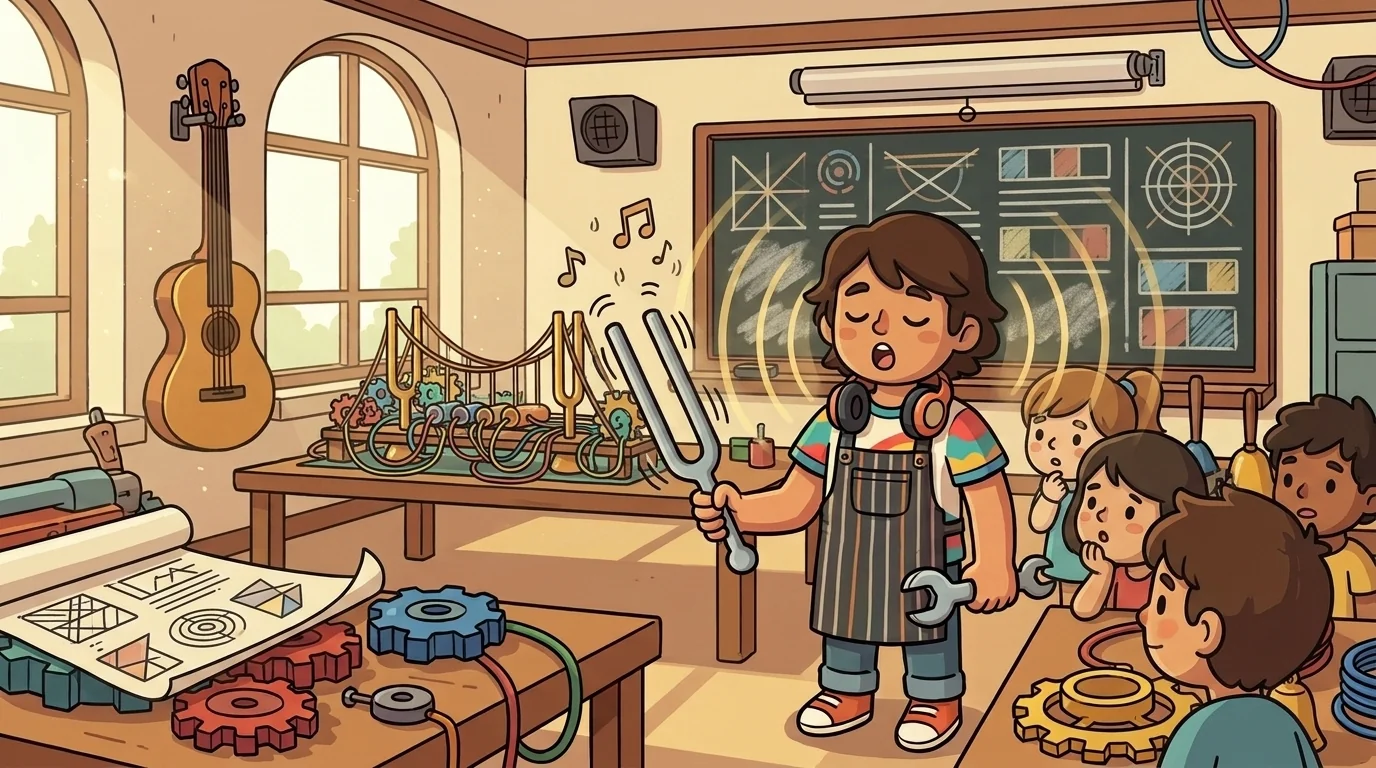
In her workshop, Cable starts every first lesson the same way. She taps her tuning-fork against the edge of her desk. A clear, perfect A rings out. It hangs in the air like a tiny silver thread. She holds the fork up for everyone to see.
"I am Cable," she says. "The bridge I teach is math↔music. It is a bridge of sound and time. This fork is shaking 440 times a second. That is math."
She takes a breath. Then she sings a note that is pure and clear, perfectly matching the fork. "A-440." Then, she sings another note, much higher, but that sounds like it fits perfectly over the first. "A-880. My voice is now shaking exactly twice as fast. The 2-to-1 ratio. That's the octave."
The students lean in. They can hear it. They are hearing math.
She shows them how to build the bridge themselves. "First, just listen," she says. "Listen for the space between two notes. That space is called an interval." "Next, match the interval to its ratio," she continues, tapping her notebook. "An octave is 2-to-1. A fifth is 3-to-2. A fourth is 4-to-3." "Rhythm is math, too. It’s just splitting up time. A 4/4 beat splits one moment into four equal parts. Tap your foot. One, two, three, four. You're doing math." "The tuning-fork is your guide," she finishes. "It gives you a solid number: 440. Your ear gives you the music. When they agree, the bridge is strong."
Sometimes a student would get a worried look. "Cable? I heard an interval, but it doesn't fit any of the simple ratios."
Cable would smile. "That's not a failure! That's fantastic! It just means you found a microtone. Those are the secret notes hiding in the tiny spaces between the simple ratios. The music we hear most often uses these simple ones. But music from India, or Arabia, or Indonesia uses different ratios all the time. Their math bridges look different than ours. And they are just as strong."
Students always asked her if the math-music bridge was hard to learn. Cable always said the same thing.
"It is not hard," she told them. "It is listen, plus count, plus check. The ratio is already in your ear. The math is in the listening."
She strikes the fork again. A-440 rings out. The next interval waits to be heard.
The BridgeForge ensemble
Cable is part of BridgeForge's distributed-narrative cast. Each character embodies a different curricular primitive; together they teach the full subject.
-

Truss
Math↔Science bridges — causal-evidential connection (measurement + replication; both sides need numbers)
-

Arch
Math↔Art bridges — proportion-aesthetic connection (golden ratio + symmetry; math you can SEE)
-

Pier
Math↔Social-Studies bridges — data-narrative connection (statistics in history + civics; numbers + people)
-

Splice
Math↔ELA bridges — structure-metaphor connection (sequence + symmetry in writing; math is the bones)
-
Girder
Math-computing bridge — order-of-operations is the same as sequence in code; math you can run
-

Rivet
Math-movement bridge — rate, angle, and trajectory; a jump is math in the air
-

Ballast
Math-health bridge — ratio, scaling, and balance; the right amount in the right proportion
-

Strut
Math↔Cooking bridge — proportional reasoning; a recipe is a ratio you can scale up or down
-

Trestle
Math↔Gardening bridge — spatial reasoning; a garden bed is geometry you can grow