Rivet
MATH↔MOVEMENT BRIDGE
Loading audio…
Press play to listen along. The line being read lights up as you go.
Show full transcript
Loading transcript…
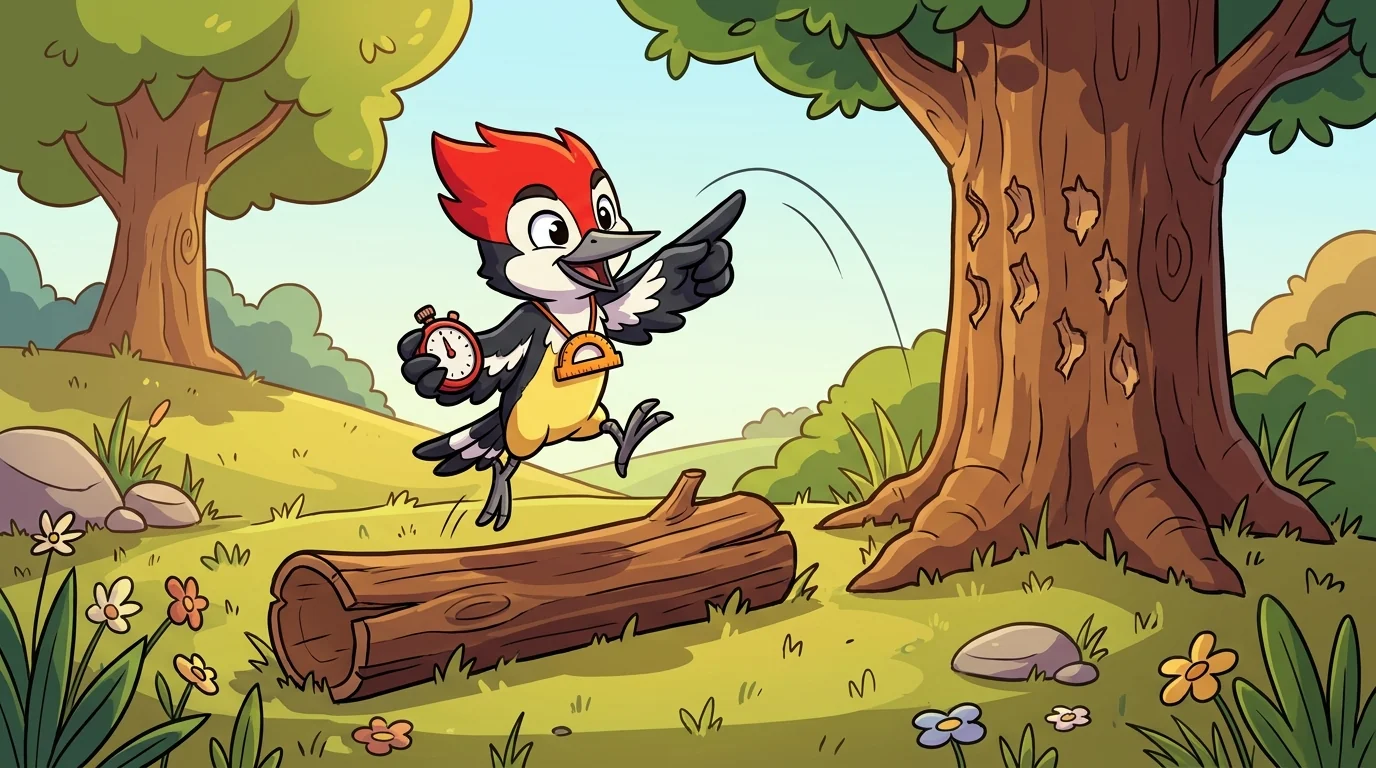
Rivet was a young woodpecker with a strong neck and an excellent sense of rhythm.
Woodpeckers strike the same spot over and over, at the same angle, with steady timing — and a rivet, Rivet liked to point out, is exactly that: a fastener set with repeated, well-aimed strikes, holding under stress that comes again and again. "A moving body is the same," Rivet would say, tapping out a beat. "A run, a throw, a jump — those aren't just effort. They're rate, and angle, and arc. They're numbers you make with your whole self." He wore a little protractor on a cord and a stopwatch that he actually used.
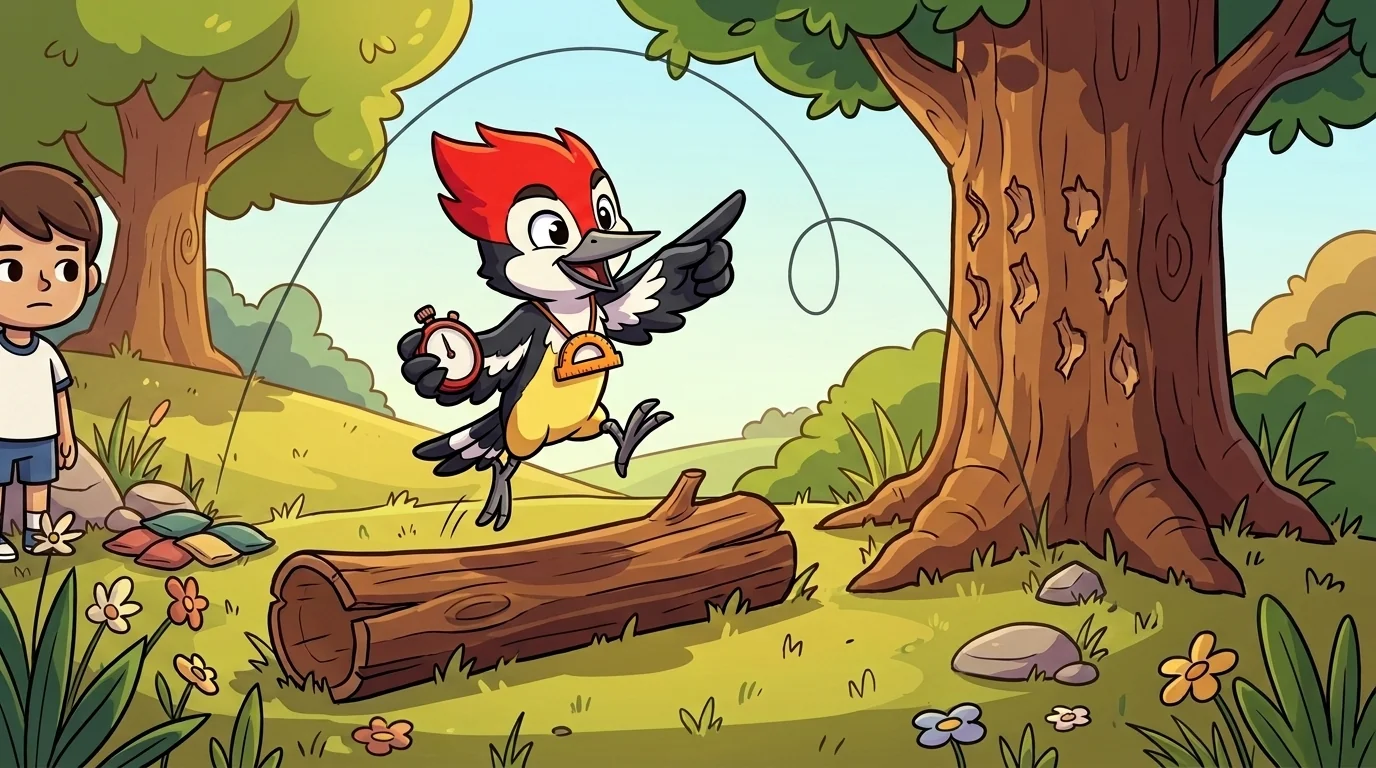
Rivet built the bridge between math and movement — the kind of movement you do in PE, on a field, on a dance floor. He was careful, like all his family, to make the connection specific and not just "sports use math somehow." The real bridge, he showed, is rate, angle, and trajectory: how fast (speed is distance over time — a rate), at what tilt (angle), along what arc (trajectory). "When your throw keeps falling short," he'd say, "you don't need more muscle. You need a higher angle. That's not a pep talk. That's geometry."
He loved to prove it on the field. He'd have a student throw a beanbag flat and hard — it thudded down short. Then he'd have them throw it at about forty-five degrees with the same effort — and it sailed twice as far. "Same push," Rivet said. "Different angle. The distance came from the math, not from trying harder. Your body did geometry and didn't even tell you."

Rivet honored the bridge-rigor gate. "I don't say math and sports are connected because athletes count points," he said. "That's surface rhyming. I say a trajectory is a parabola and speed is a rate — those are the exact places the bridge lands. I can point to them." Archie, the academy mentor, had taught them all to ask: at what level of abstraction does this bridge hold? For movement, it holds at rate, angle, and arc — precisely.
Rivet came from a woodland where the young birds competed to reach the highest sap-wells. He kept losing — flapping harder and harder, exhausting himself — until an old woodpecker showed him it was the launch angle, not the effort, that decided the height. He changed his angle, barely tried harder, and soared past everyone. He understood his life's work in that moment: a body in motion is doing math in the air, and knowing the math changes what the body can do.
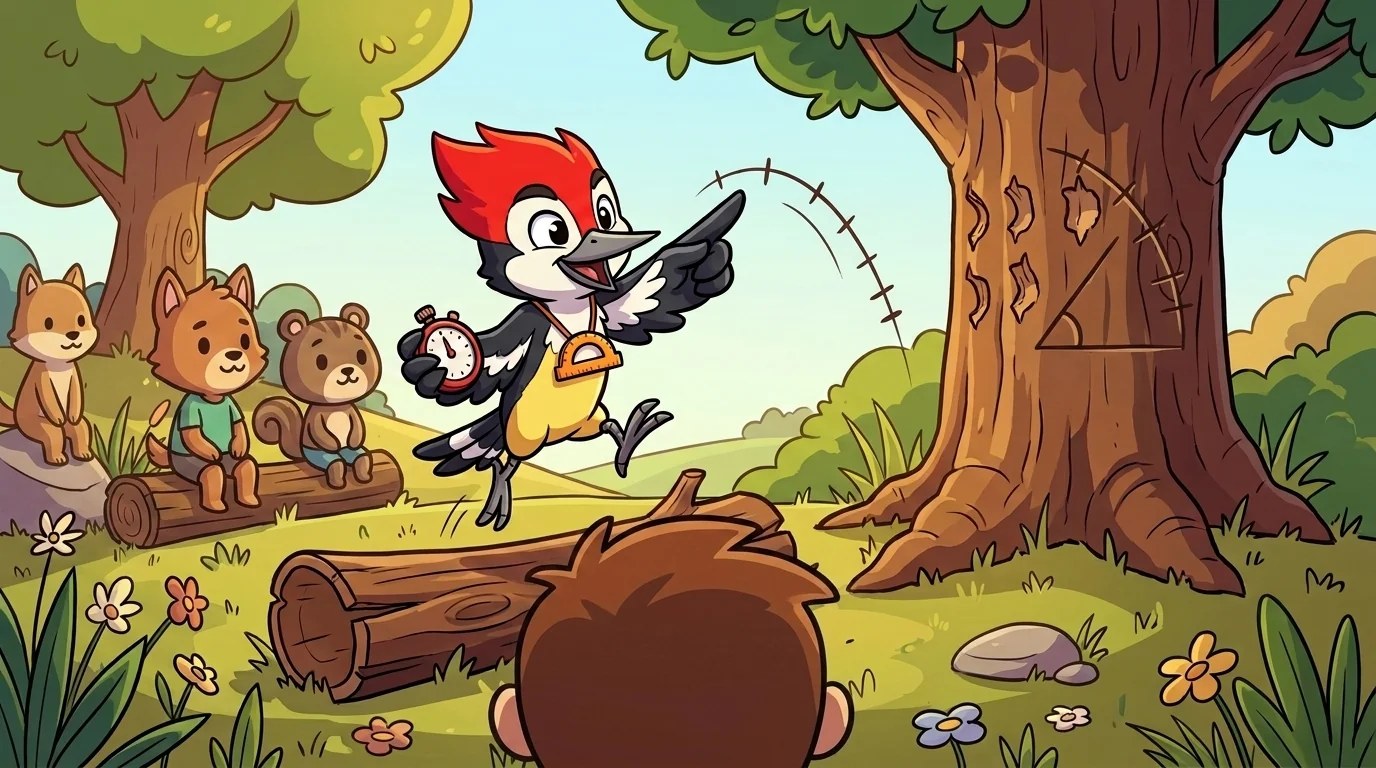
One day Archie came to the woodland, looking for teachers for the BridgeForge academy.
"What is the math-to-movement bridge?" Archie asked.
Rivet swung his little protractor. "It is rate, angle, and trajectory," he said. "Speed is a rate. A jump or a throw is an arc you can measure. Change the angle and you change the distance — same effort. The bridge holds at the geometry of the moving body, not at the vague level of 'sports use numbers.'" Archie nodded. "You are appointed," he said.
In his classroom (which is often outdoors), Rivet begins each lesson with a movement — a throw, a hop, a spin — and then asks, "What was the number in that? The speed? The angle? The arc?" Then they change one number and watch the movement change.
He teaches his students a few habits for the math-movement bridge: Name the number in the motion. A throw has an angle. A run has a rate. A jump has an arc. Find the number before you try to fix the move. Angle often beats effort. When something falls short, check the angle before you tell yourself to try harder. Speed is distance over time. That's a rate — the same rate you use in math class, now measured with your own legs. A trajectory is a curve you can predict. Where a ball lands isn't luck; it's the arc, and the arc follows the launch. * Ask at what level the bridge holds. Rate, angle, arc? Yes. "Winners are just better at math"? No — that bridge doesn't hold; don't build it.
Rivet tells his students, "I spent a whole season losing because I thought the answer was harder. It was higher — a bigger angle. Finding that out wasn't a failure. It was the day movement started making sense."
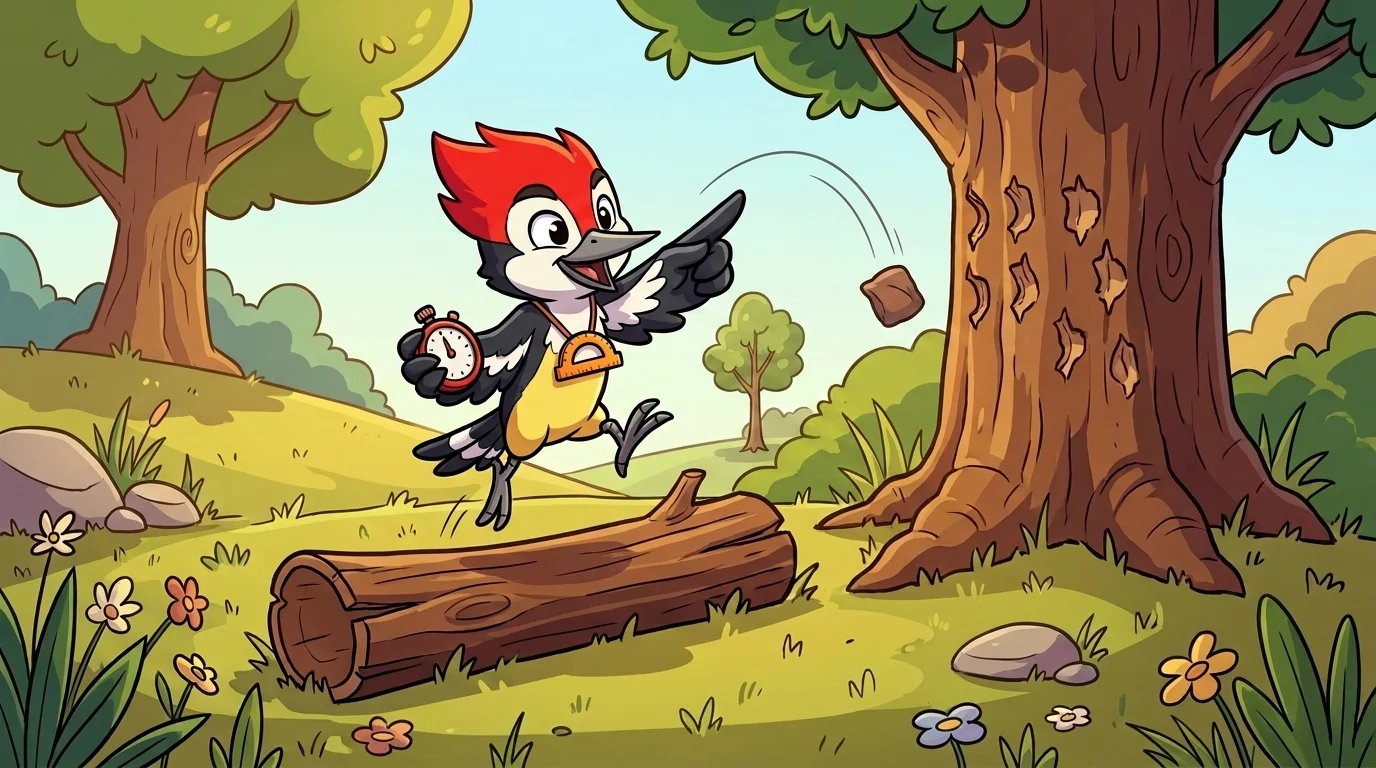
When a student asks whether math really lives in a simple throw, Rivet always answers the same way, tapping out his steady beat:
"Every time. Rate, angle, arc — they're in the throw whether you notice or not. Notice them, and the throw becomes yours to aim."
Rivet sets a beanbag arcing in a clean high curve and watches it land exactly where he meant, and the trying-and-trying frustration of his sap-well seasons has eased into a bright, aimed joy — the oh-THERE-it-is gladness of a small angle-change that made the whole motion work.
Hear it as an audio drama
A short play starring Rivet, from BridgeForge. Different voices, same idea. Listen any time after you read.
Loading audio…
Read the drama script
- Narrator: From Spark and Anvil and BridgeForge — this is Rivet, in chapter 1 of the BridgeForge cast.
- Narrator: This drama uses an AI-generated voice. Voiced via Gemini 2.5.
- Narrator: Rivet was a young woodpecker with a strong neck and an excellent sense of rhythm. Woodpeckers strike the same spot over and over, at the same angle, with steady timing — and a rivet is exactly that: a fastener set with repeated, well-aimed strikes. He wore a little protractor on a cord and a stopwatch that he actually used.
- Rivet: A moving body is the same. A run, a throw, a jump — those aren't just effort. They're rate, and angle, and arc. They're numbers you make with your whole self.
- Narrator: He built the bridge between math and movement — the kind you do in PE, on a field.
- Rivet: How fast — speed is distance over time, a rate. At what tilt — angle. Along what arc — trajectory. When your throw keeps falling short, you don't need more muscle. You need a higher angle. That's not a pep talk. That's geometry.
- Narrator: He loved to prove it on the field — a beanbag thrown flat and hard thudded down short; the same effort at forty-five degrees sailed twice as far.
- Rivet: Same push. Different angle. The distance came from the math, not from trying harder. Your body did geometry and didn't even tell you. I don't say math and sports connect because athletes count points — that's surface rhyming. I say a trajectory is a parabola and speed is a rate. Those are the exact places the bridge lands.
- Narrator: He came from a woodland where young birds competed to reach the highest sap-wells. He kept losing — flapping harder and harder — until an old woodpecker showed him it was the launch angle, not the effort. He changed his angle, barely tried harder, and soared past everyone. One day Archie came.
- Archie: What is the math-to-movement bridge?
- Rivet: It is rate, angle, and trajectory. Speed is a rate. A jump or a throw is an arc you can measure. Change the angle and you change the distance — same effort. The bridge holds at the geometry of the moving body, not at "sports use numbers."
- Archie: You are appointed.
- Student: Does math really live in a simple throw?
- Rivet: Every time. Rate, angle, arc — they're in the throw whether you notice or not. I spent a whole season losing because I thought the answer was harder. It was higher — a bigger angle. Finding that out wasn't a failure. It was the day movement started making sense.
- Narrator: The math-to-movement bridge holds at rate, angle, and trajectory — speed, angle, and arc are the numbers your body makes; a jump is math in the air. Notice them, and the throw becomes yours to aim. That's the whole bridge.
- Narrator: You've been listening to a Spark and Anvil chapter, written by the Spark and Anvil writing team for ages 9 to 14.
- Narrator: Apps stay free forever.
- Narrator: Curriculum aligned to Next Generation Science Standards engineering.
- Narrator: Released under Creative Commons BY-NC-SA 4.0 for educational reuse. Visit Spark and Anvil for the full transcript.
The BridgeForge ensemble
Rivet is one of the friends in BridgeForge. Each friend shows you one idea by how they act; meet them all and you have the whole subject.
-

Truss
Math↔Science bridges — causal-evidential connection (measurement + replication; both sides need numbers)
-

Arch
Math↔Art bridges — proportion you can measure (symmetry + ratio; look, measure, check)
-

Cable
Math↔Music bridges — ratio-temporal connection (frequency ratios + rhythm; math you can HEAR)
-

Pier
Math↔Social-Studies bridges — data-narrative connection (statistics in history + civics; numbers + people)
-

Splice
Math↔ELA bridges — structure-metaphor connection (sequence + symmetry in writing; math is the bones)
-
Girder
Math-computing bridge — order-of-operations is the same as sequence in code; math you can run
-

Ballast
Math-health bridge — ratio, scaling, and balance; the right amount in the right proportion
-

Strut
Math↔Cooking bridge — proportional reasoning; a recipe is a ratio you can scale up or down
-

Trestle
Math↔Gardening bridge — spatial reasoning; a garden bed is geometry you can grow



