
Trestle
MATH↔GARDENING BRIDGE — spatial-reasoning connection (a garden is geometry you can eat; spacing, area, and rows are the difference between a thriving bed and a crowded, failing one). The cross-curricular primitive of *the bridge held up by giving each thing the room the numbers say it needs*.
Loading audio…
Press play to listen along. The line being read lights up as you go.
Show full transcript
Loading transcript…
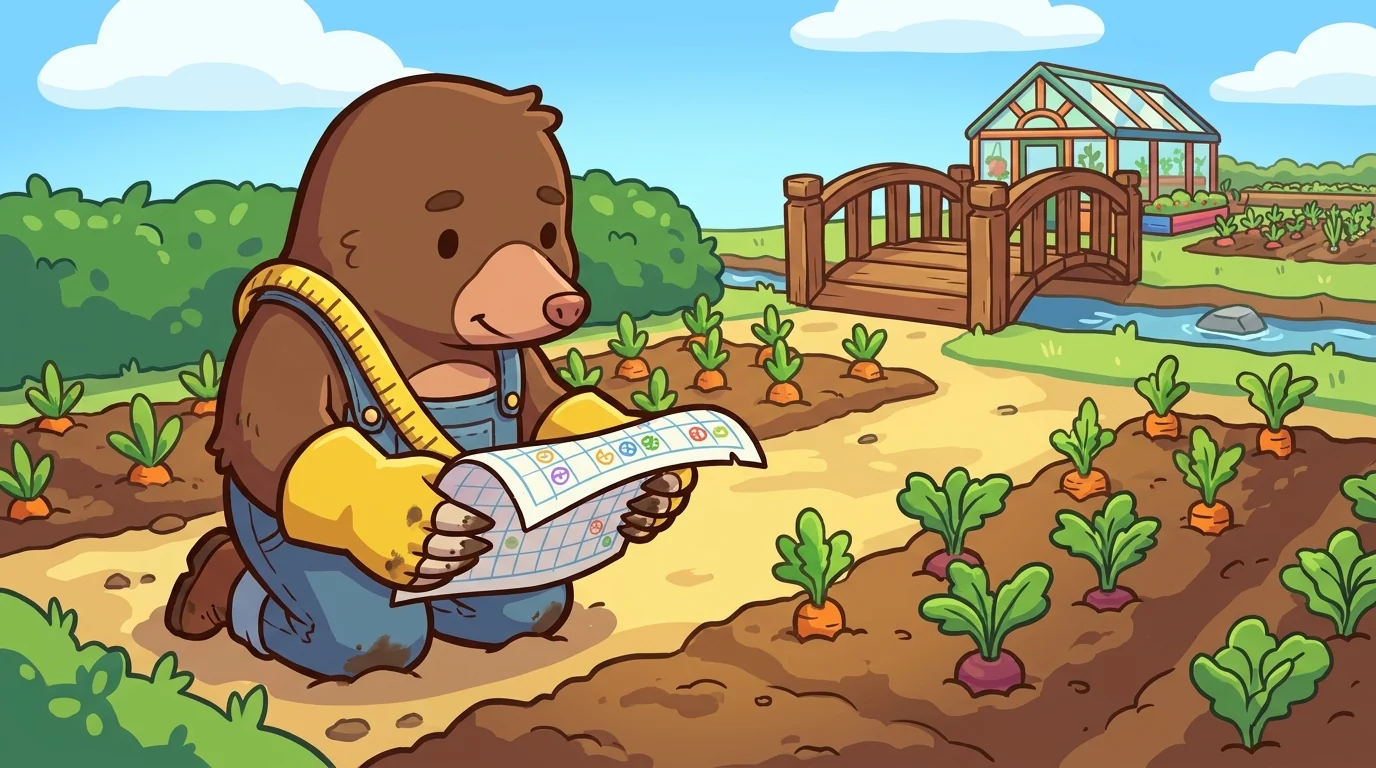
Trestle was a young mole whose claws were permanently stained with dark river silt. A yellow fiberglass measuring tape hung across his chest like an officer’s sash. He had not yet grown into his canvas work gloves, so the stiff fingertips folded over every time he gripped a trowel. His fur carried the sharp, peaty smell of turned earth and crushed clover. Whenever the sun climbed above the ridge, Trestle was already kneeling on a burlap sack, his snout six inches from the garden dirt.
Folded into the bib of his overalls was a grease-smudged sheet of blue graph paper. Every grid square on that sheet represented one square foot of topsoil. Across the page, Trestle had drawn neat pencil circles, each labeled with a tiny number. Those scribbles were not decorations. They were the foundation of a bridge he was trying to build between arithmetic and agriculture.
A garden, he was beginning to discover, was just geometry you could eat.
A tomato plant required two feet of open room in every direction. A row of carrots demanded three inches between taproots. A pumpkin vine wanted six full feet of territory to sprawl its heavy, ribbed stems across the lawn. The numbers were not polite suggestions from the seed company. They were structural boundaries.
He had not always respected the numbers on that grid. In early spring, when the thaw left the soil loose and black, Trestle had fallen into a common trap. He assumed that more green stems in the ground would naturally produce a heavier harvest. His garden plot was narrow—only four feet wide by eight feet long—tucked between an old stone retaining wall and the wooden pump house.
"If three tomato bushes give you a basket of fruit," Trestle reasoned aloud, "then twelve bushes will fill the root cellar."
He spent three afternoons shoving seedlings into the damp loam. He planted them elbow to elbow, pressing the root balls until their fuzzy stems grazed one another. By the time he emptied his starter flats, not an inch of bare ground remained visible. He could barely slide a butter knife between the stalks without slicing through living tissue.
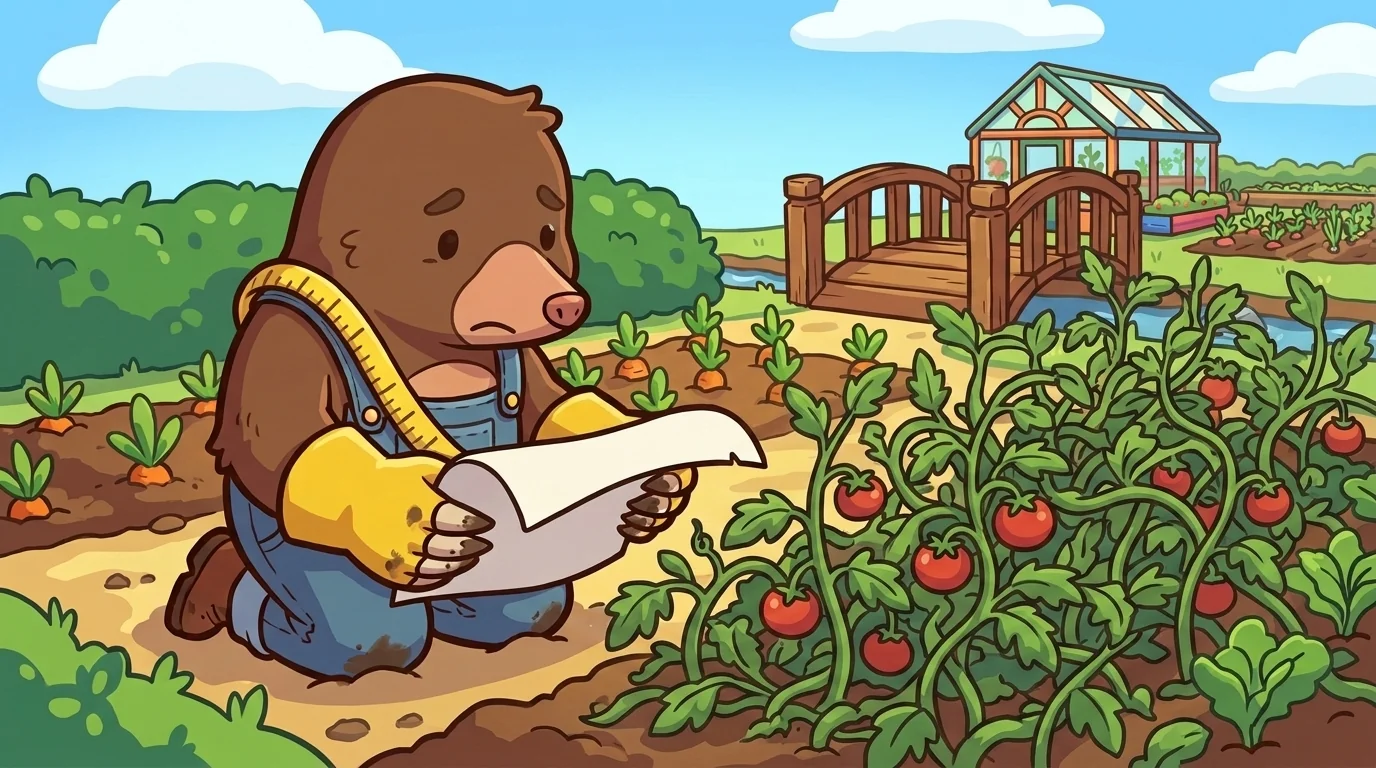
He leaned back on his heels, wiped his muddy nose on his forearm, and admired the dense green carpet. "A full bed is an ambitious bed," young Trestle told himself, grinning at the crowded patch. He felt clever. He believed he had outsmarted the garden manuals.
The summer sun arrived in late June, bringing three straight weeks of dry, baking heat. That was when the trouble started.
Instead of growing into stout, bushy shrubs heavy with blossoms, the crowded tomatoes stretched into tall, spindly poles. They threw all their energy upward, competing with each other for a single ray of direct daylight. Below that thick, choking canopy, the lower branches turned pale and dropped their yellow leaves.
The soil underneath stayed bone-dry, because the umbrella of tangled foliage caught the summer rain before a single drop reached the mulch. Trestle tried watering them twice a day with a tin bucket, but the water pooled on the crusty surface and ran off into the ditch.
Underground, twelve separate root systems were locked in a silent, desperate war for moisture and minerals. In mid-July, a dusty gray fungus crept across the shaded stems. What few flowers bloomed withered and fell into the mud without setting fruit. By August, Trestle harvested three tiny tomatoes, all of them hard as river pebbles and split down their sides.
He sat in the weeds, staring at the tangled mess of sickly green, completely miserable. He had planted the most seeds on the hill. How had planting the most given him the least?
A dry rattle sounded from the gravel path behind him. Mrs. Given, an elderly tortoise who tended the communal orchard, dragged her wooden cart to the edge of his plot. Her shell was weathered gray like cedar fence posts, and a pair of brass spectacles rested near the tip of her beak. She set down a wicker basket and surveyed the disaster with slow, steady eyes.
"Well," she said, leaning against her cart handle. "You certainly grew a lot of trouble."
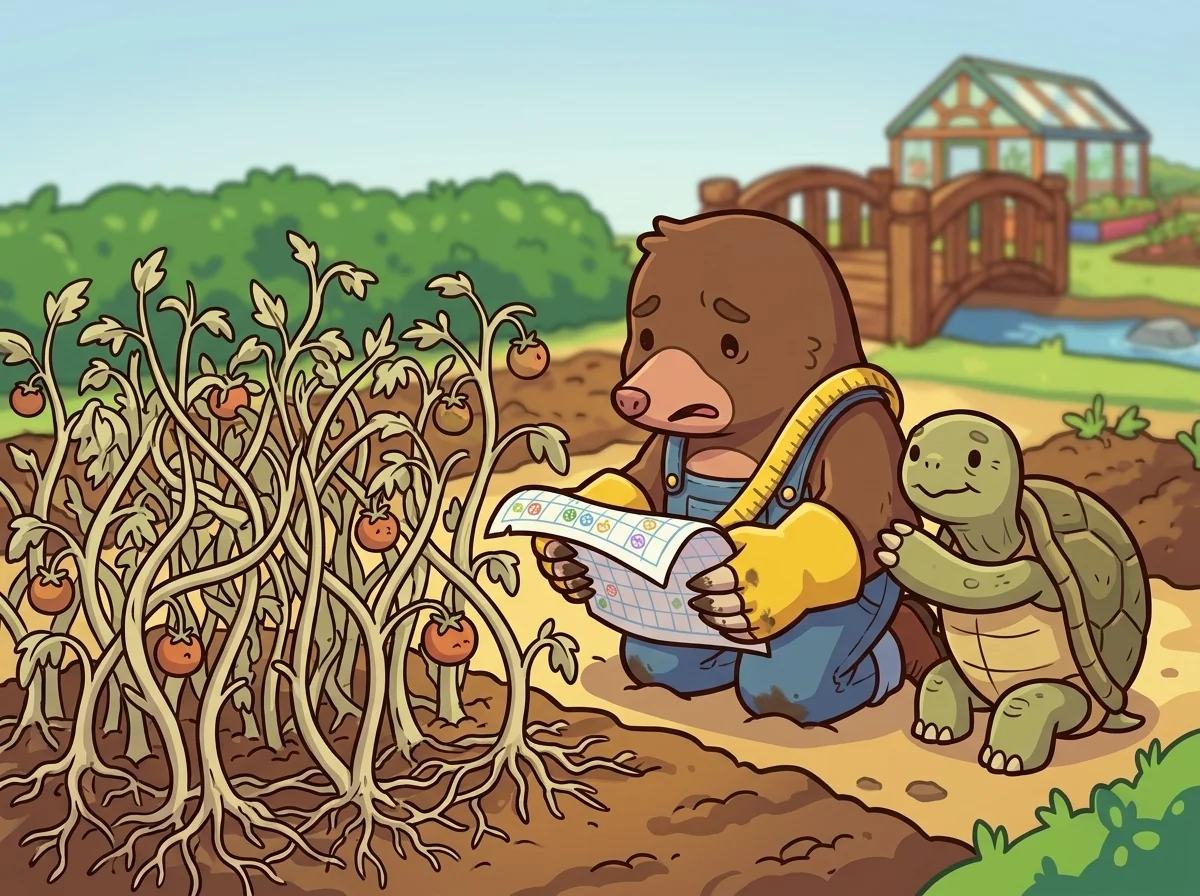
"I don't understand it," Trestle muttered, picking a brittle leaf off a withered stalk. "I gave them the richest compost from the barn. I weeded every morning and planted twice as many as last year."
"You counted the plants," Mrs. Given said, adjusting her spectacles. "You forgot to count the room they live in."
"Space doesn't make fruit," Trestle argued, crossing his muddy paws. "Plants make fruit."
"Plants are engines, Trestle," she replied in her dry, clicking voice. "An engine needs fuel, air, and room to run without catching fire. Come here."
She knelt on the grass, dug her front claw into the edge of the bed, and levered out two adjacent tomato plants. The soil came up in a hard, tangled brick. Underground, the roots had twisted together into a tight, fibrous knot, strangling each other in the dry dirt.
"Look at that," Mrs. Given said, tapping the tangled mass. "They spent the whole summer fighting each other for one swallow of water. Neither one had the strength left over to make a tomato."
Mrs. Given reached into his overall pocket, slid out his graph paper, and flattened it against the side of her cart. She pointed a blunt claw at his neat grid.
"Look at the mathematics of this patch," she said. "Your bed is four feet wide and eight feet long. That is thirty-two square feet of dirt. A healthy tomato bush needs four square feet of root space to draw minerals and sunlight. How many four-foot territories exist in thirty-two square feet?"
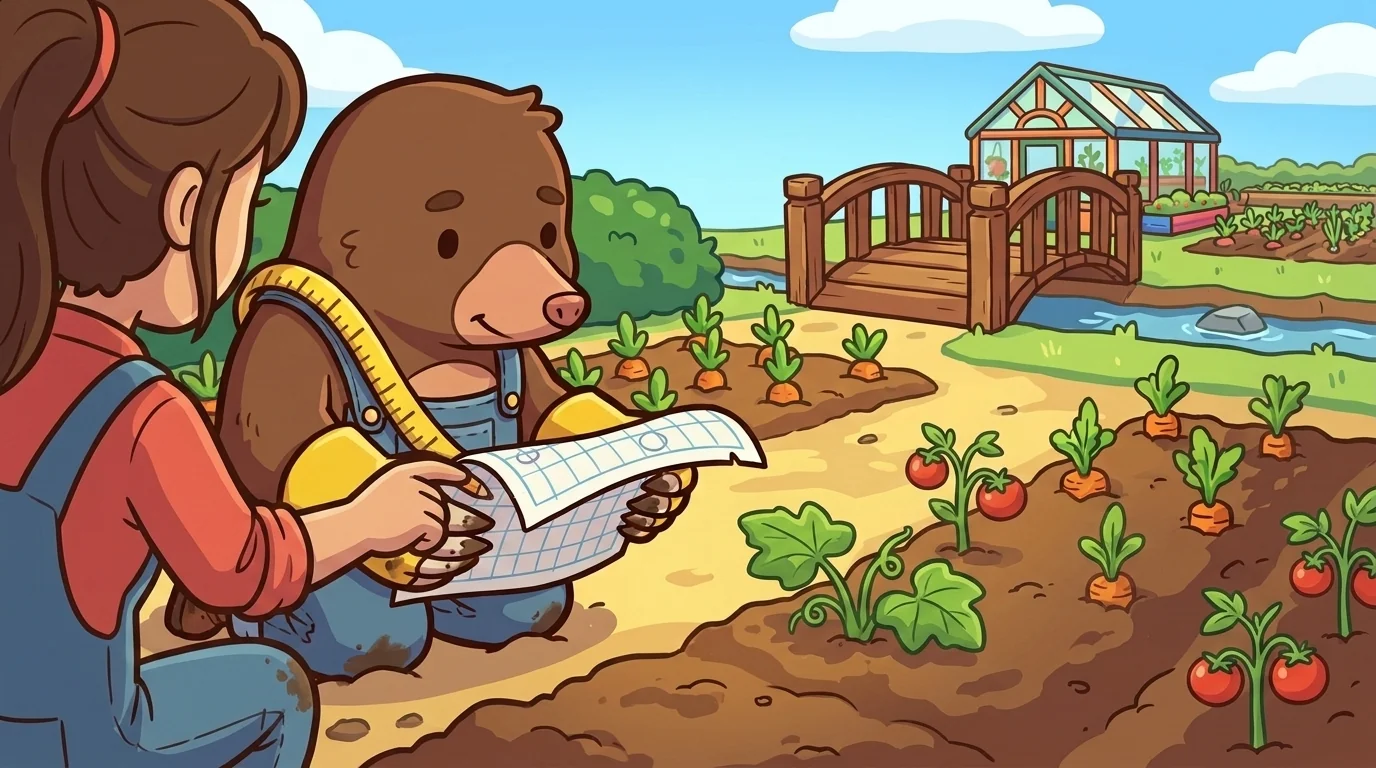
Trestle stared at the blue grid lines. The math was simple. "Eight."
"Eight," Mrs. Given agreed. "Yet you forced sixteen plants into that space. You didn't double your crop, Trestle. You halved the food, light, and air available to each plant. You built a famine and called it an abundance."
She handed the blueprint back to him. The numbers on the grid suddenly looked less like strict rules and more like a map of survival.
"Gardeners do geometry on their knees," she said quietly. "If you want a heavy harvest, you must respect the perimeter of a single root. Division comes before multiplication."
The next morning, Trestle went to work with heavy shears and a heavy heart. He had to tear out eight full-grown tomato plants to save the rest. It felt like throwing away work. He winced with every snap of his shears, piling the rejected vines into the wheelbarrow for the compost heap. When he finished, the garden bed looked shockingly bare. Vast patches of dark earth sat exposed between the remaining eight plants.
He fetched four wooden stakes and his measuring tape. Kneeling in the dirt, he measured exactly twenty-four inches in every direction around each surviving stalk. He drove the stakes deep into the ground and tied soft hemp twine between them, creating a visible boundary for each plant's territory.
For the first week, the garden looked like a failure. The remaining tomatoes looked small and lonely in the wide, empty bed. Trestle had to fight the urge to fill the gaps with radish seeds or lettuce plugs.
But within ten days, the difference was unmistakable.
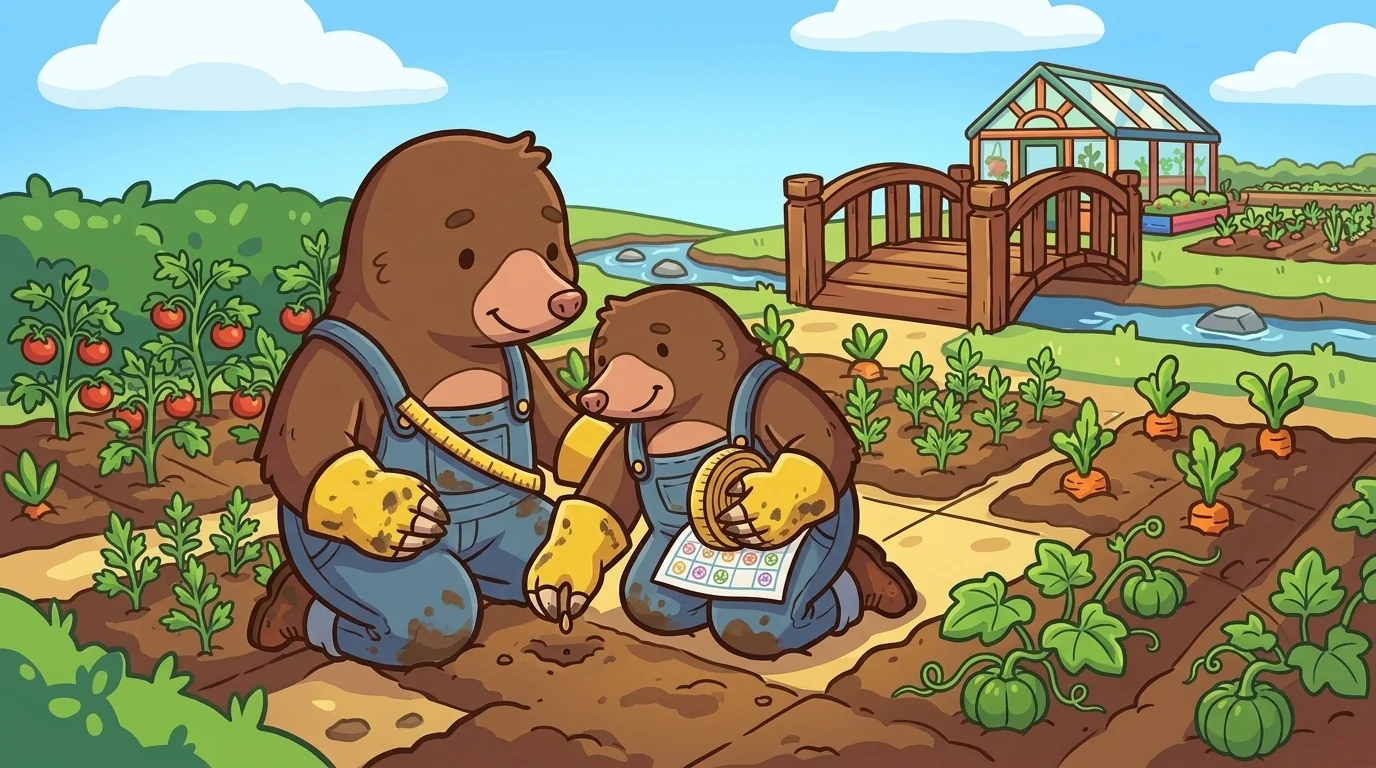
With their rivals removed, the remaining eight tomato plants stopped stretching upward like anxious weeds. Their central stems thickened into sturdy, woody trunks. Side shoots exploded with deep green leaves, filling the empty gaps with healthy foliage that caught the morning light.
Morning breezes now circulated freely through the rows, drying the damp dew and clearing away the powdery mold. Yellow blossoms appeared by the dozen, buzzing with bumblebees from the meadow.
By late August, the green marbles swelled into heavy, fragrant globes of crimson and gold. The branches bowed under the weight of real produce, requiring extra twine to keep the heavy fruit off the soil.
Mrs. Given walked by one Tuesday evening, her wicker basket empty. Trestle picked three massive beefsteak tomatoes—warm from the sun, smelling of sweet summer earth—and laid them carefully in her cart.
"Looks like your geometry worked," she said with a slow nod.
"It's strange," Trestle said, watching a beetle crawl across the mulch between two thick stalks. "The bed feels bigger now, even with fewer things in it."
"That is what happens when you give living things room to breathe," she replied.
Trestle smoothed the graph paper against his knee and marked down his harvest tally with a stubby pencil. The tight panic in his chest had vanished completely. He understood now that an empty square on a map was not wasted territory. It was the invisible room where growth actually happened.
He pressed his tape measure back into his pocket, sat back on his heels, and let the quiet afternoon settle around his thriving, well-spaced garden.
The BridgeForge ensemble
Trestle is part of BridgeForge's distributed-narrative cast. Each character embodies a different curricular primitive; together they teach the full subject.
-

Truss
Math↔Science bridges — causal-evidential connection (measurement + replication; both sides need numbers)
-

Arch
Math↔Art bridges — proportion-aesthetic connection (golden ratio + symmetry; math you can SEE)
-

Cable
Math↔Music bridges — ratio-temporal connection (frequency ratios + rhythm; math you can HEAR)
-

Pier
Math↔Social-Studies bridges — data-narrative connection (statistics in history + civics; numbers + people)
-

Splice
Math↔ELA bridges — structure-metaphor connection (sequence + symmetry in writing; math is the bones)
-

Girder
Math-computing bridge — order-of-operations is the same as sequence in code; math you can run
-

Rivet
Math-movement bridge — rate, angle, and trajectory; a jump is math in the air
-

Ballast
Math-health bridge — ratio, scaling, and balance; the right amount in the right proportion
-

Strut
Math↔Cooking bridge — proportional reasoning; a recipe is a ratio you can scale up or down