
Evens the Long-Run-Settler
THE LONG RUN — one try is wild and unpredictable, but over many, many tries, the results settle toward what you'd expect on average. A short streak proves nothing; the long run is where chance keeps its promises.
A story read by Evens the Long-Run-Settler
Loading audio…
Press play to listen along. The line being read lights up as you go.
Show full transcript
Loading transcript…
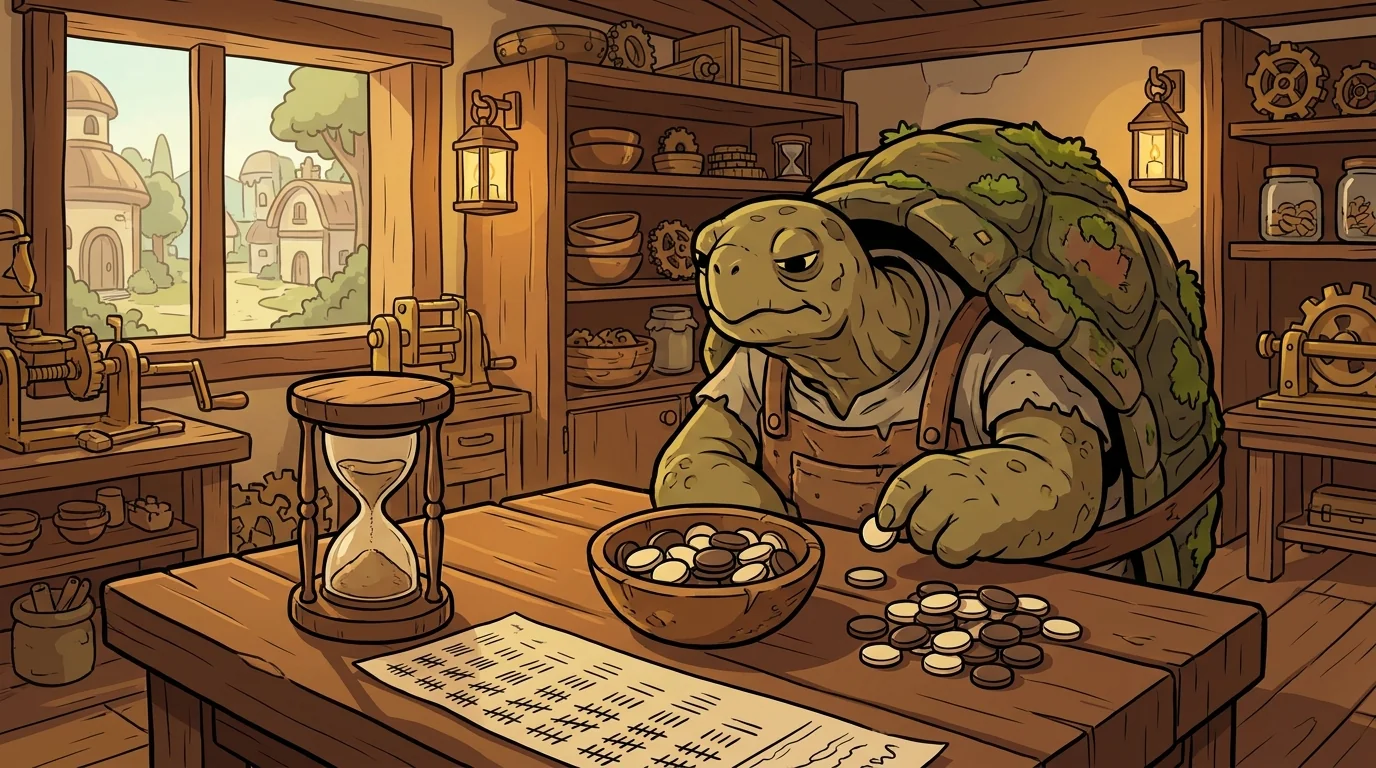
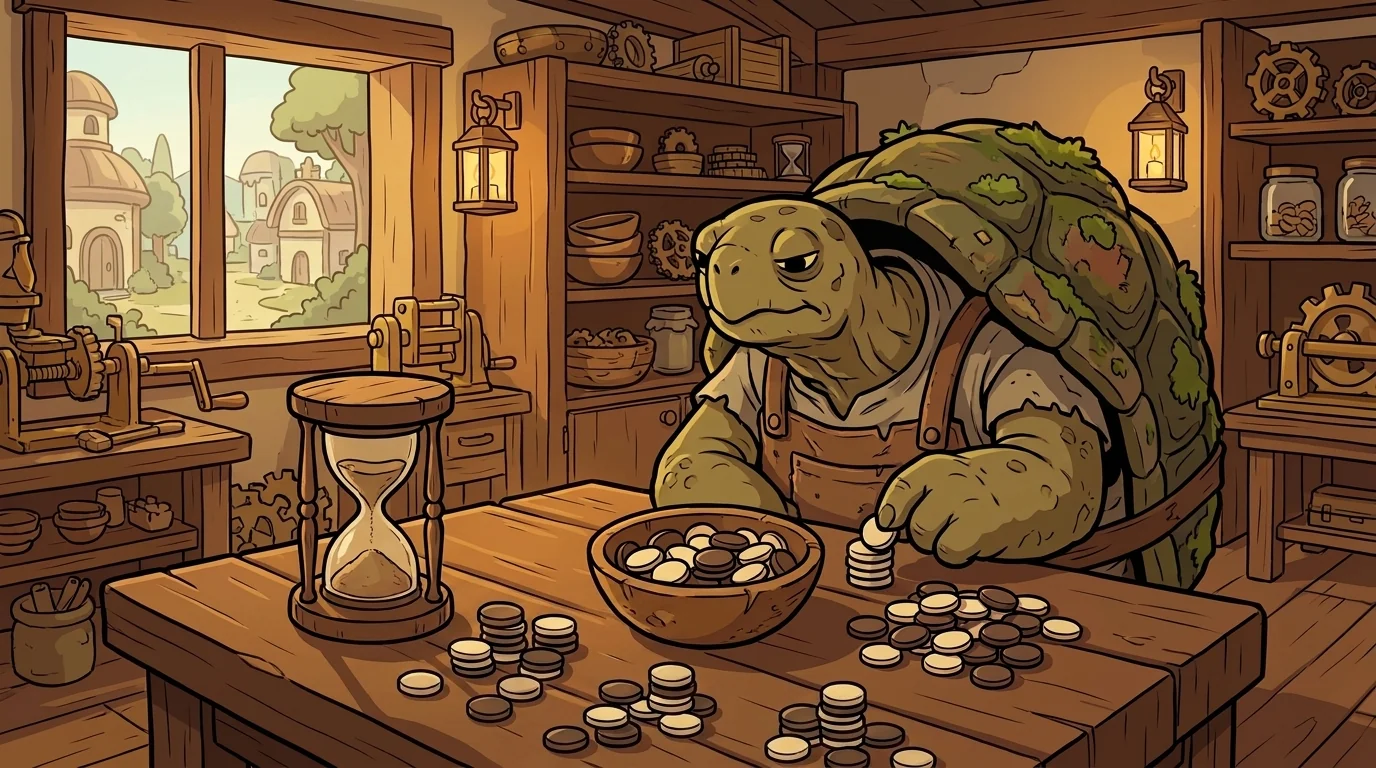
The ChanceForge workshop was always cool, even in the middle of July, and it smelled of shaved pine and copper coins. Evens sat behind his workbench, which was carved from a single block of ancient oak. In front of him sat a wide, shallow bowl of dark walnut, which was filled with hundreds of small wooden chips. Half of these chips were painted the color of fresh cream, while the other half were as dark as charcoal. Evens reached into the bowl without looking, his three-toed claw making a dry, rustling sound against the smooth wood. He pulled out a cream chip, laid it on his desk, and made a single charcoal mark on a long roll of parchment. He had been doing this for forty years, and he never grew tired of the slow, steady rhythm. He did not care about the single chip in his hand, because he only cared about the thousands that came before.
The heavy oak door banged open, rattling the glass panes and letting in a sudden gust of warm summer wind. Skip the rabbit skidded inside with his long ears pinned flat, panting so hard his left sneaker came untied.
"Evens, you have to help me," Skip gasped, slamming a copper coin onto the workbench. "My coin is broken, and it has to be cursed," he cried, pointing a trembling paw at the metal.
Evens did not look up from his parchment, but his hand reached into the bowl to draw another dark chip.
"Coins do not break, Skip," Evens rumbled, setting the new chip down. "They are made of metal, not glass."
"This one did," Skip insisted, bouncing on his heels so hard the floorboards creaked beneath his feet. "I flipped it five times in the yard, and every single time it landed on tails," Skip said, his voice rising. He leaned closer to the workbench, his long white whiskers twitching with a mixture of fear and excitement. "That means heads is impossible now, right?" he asked, staring at the coin. "The next flip has to be tails."
Evens sighed, a slow, rumbling sound that vibrated through his heavy shell and warmed the chilly air. He set his charcoal pencil down with a soft click.
"Five flips is a blink of an eye," Evens said. "The coin has no brain, and it cannot remember where it landed."
"But five in a row!" Skip cried.
"A streak is just the short run being noisy, like a dog barking at a passing carriage," Evens said. "You are looking at a tiny puddle of water and forgetting the vast ocean that lies right behind it."
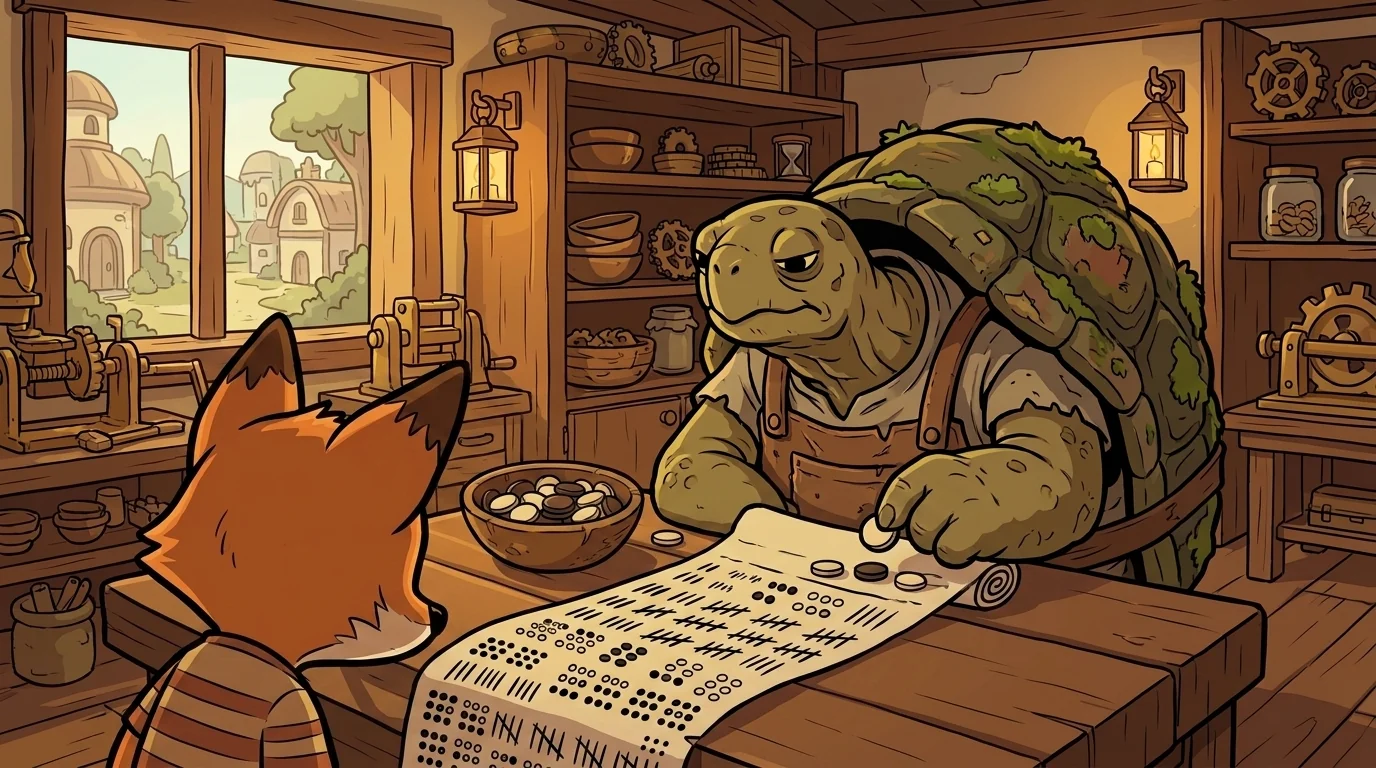
He pointed a thick, wrinkled finger toward the long roll of parchment that stretched across his wooden desk. It spilled onto the floor in dusty curls, covered in thousands of tiny black marks grouped in tens.
"This is the law of large numbers," Evens said, tapping the paper. "It means that if you only try a few times, anything can happen," he explained. "You might get five tails, or ten, or none at all."
He picked up the copper coin and turned it over in his heavy palm.
"If you flip this coin a thousand times, the noise disappears, and the results settle right in the middle."
Skip looked at the giant scroll, his eyes tracing the long rows of charcoal marks.
"So my five tails do not mean the coin is cursed?" he asked quietly.
"They mean you saw a tiny, wild slice of the world," Evens said, smiling gently. "Now sit down on that stool and stay for the long part."
Evens remembered when he was Skip's age, though that was more than a century ago. He had lived by the grey cliffs of the northern sea, where the water was always cold enough to sting. Every morning, young Evens would crawl down to the rocky tide pools with a small hemp net in his claw. He wanted to catch the tiny, silver shrimp that darted through the thick ribbons of brown seaweed. Some days, his net would come up heavy and wriggling with dozens of shrimp. Other days, he would find nothing but cold saltwater and a few pieces of rotting kelp.
On the third empty day in a row, young Evens had sat on a wet rock and cried.
"The sea is empty," he had screamed at the crashing waves, tears hot on his cold face. "The shrimp are gone forever, and we are going to starve this winter."
His grandfather had been resting on a nearby ledge, his shell covered in green moss and sharp barnacles. The old tortoise did not even open his eyes to look at the weeping boy.
"You are reading the streak, youngster," his grandfather rumbled, his voice deeper than the ocean. "A few bad days have passed, and you already believe the world has turned against you."
"But three empty days in a row is a very long time!" Evens had shouted back.
"Three days is just a single drop in the sea," his grandfather said, stretching his neck. He pointed a heavy, wrinkled claw toward the horizon where the grey water met the sky. "Watch the season, not the day," his grandfather said. "The tide goes out, and the tide comes in. One tide tells you nothing, but a hundred tides will tell you the truth."
Evens had stayed by that rocky pool for the rest of the long, windy summer. He kept a tally of his shrimp catch by scratching marks into a flat piece of slate. By the end of August, the grey slate was completely covered in tiny white scratches. Some weeks had been terrible, filled with freezing rain and nets that came up empty. Other weeks had been so rich that the silver shrimp practically jumped into his wooden bucket. But when he counted them all up, the average catch was almost exactly what it always was.
The bad week had not been the end of the world after all. It had been nothing more than a noisy clump of bad luck in a long season. Stretched over the whole summer, the wildness of each day had melted away into something steady.
Something deep inside young Evens had loosened during those long months by the sea. He stopped worrying about the next throw of his net, because he trusted the water. He had found the one truth that would keep him steady for the rest of his life.
Years later, when Evens was old and his shell had grown dull, he took over the ChanceForge workshop. People came from all over the valley to ask him about their fortunes and their futures.
One afternoon, a tall grey heron with sharp yellow eyes landed on his dusty windowsill. She carried a leather notebook under her wing and looked very proud of her own intelligence.
"I am writing a scientific study on luck," the heron said, her long beak clicking together. "Tell me, old tortoise, what is this long run that you are always talking about?"
Evens did not look up from his wooden bowl as he continued his slow work. He drew a dark chip, then a light one, and then another dark one.
"The long run is simply where chance keeps its promises," Evens said, his voice calm. "Any single try is wild and can be absolutely anything," he explained to her. "A short streak can look like magic, or it can look like a terrible curse."
The heron leaned into the room, her long neck bending like a reed in the wind.
"But surely some streaks are real," she said, tapping her notebook with a claw. "What about a hot hand or a run of good fortune?"
"They are real in the moment, but they do not last," Evens said. "The more times you try, the closer your results will get to what you expect."
He tapped the side of his walnut bowl with his thick claw.
"If I draw one chip, it is either light or dark, which is a fifty-percent chance. But that single draw is still a total surprise."
He paused for a moment, letting the heron write his words in her notebook.
"But if I draw ten thousand chips, I will have almost exactly five thousand of each," he said. "The surprise disappears completely, and the wildness washes out of the tally."
The heron frowned at her notes, her sharp yellow eyes narrowing in confusion. "So a hot streak is just a mistake of the mind?" she asked.
"It is just the short run showing off for a moment," Evens said with a dry smile. "The chips have no memory, and they do not know they are on a streak. Only we are foolish enough to believe in it."
The hardest part of Evens's job was not explaining the math to the visitors. It was helping the young animals who believed their bad luck was a personal failure.
One rainy afternoon, a young fox named Rue slunk into the quiet workshop. Her bright red fur was damp, and her tail dragged sadly on the muddy floorboards. She sat in the darkest corner, hiding her face behind her large, velvety ears.
"I am just a bad person," Rue whispered, her shoulders shaking. "I lost three games of Pebbles in a row today, and I am bad at everything."
Evens set down his bowl of chips with a soft, hollow thud. He crawled over to her corner, his heavy claws clicking softly on the pine floorboards.
"Three games is a very small number of tries, Rue," he said gently.
"It feels huge to me," she said, her voice cracking as she looked up. "The other kids laughed and said I have a permanent losing streak," she whispered. "I do not want to play that game ever again."
Evens reached onto a low shelf and pulled down a dusty wooden board. It was covered in hundreds of tiny, hand-carved pegs that he had made himself. Some of the pegs were painted bright red, and others were painted deep blue.
"Look closely at this board," Evens said, pointing with a claw. "I have played this game against myself for ten years, so look at these red pegs."
Rue peeked through her paws, her dark eyes reflecting the candlelight. On the board, there were long stretches where the red and blue pegs alternated perfectly. But there were also tight clusters of six or seven red pegs in a row.
"Do you see these clumps of red?" Evens asked her.
"When I was placing them, it felt like the blue pegs were gone forever," he said. "But they weren't, because the board is actually perfectly even."
He touched her trembling shoulder with a warm, heavy claw.
"Three losses is just a clump of red pegs in a very long life of trying," he said. "If you stop playing now, you are letting a tiny streak win."
Rue looked at the wooden board for a long, quiet minute. She reached out and touched a cluster of blue pegs with her nose.
"So I am not a broken player?" she asked. "It is just noise?"
"It is only noise," Evens said, smiling. "You have a very long run ahead of you."
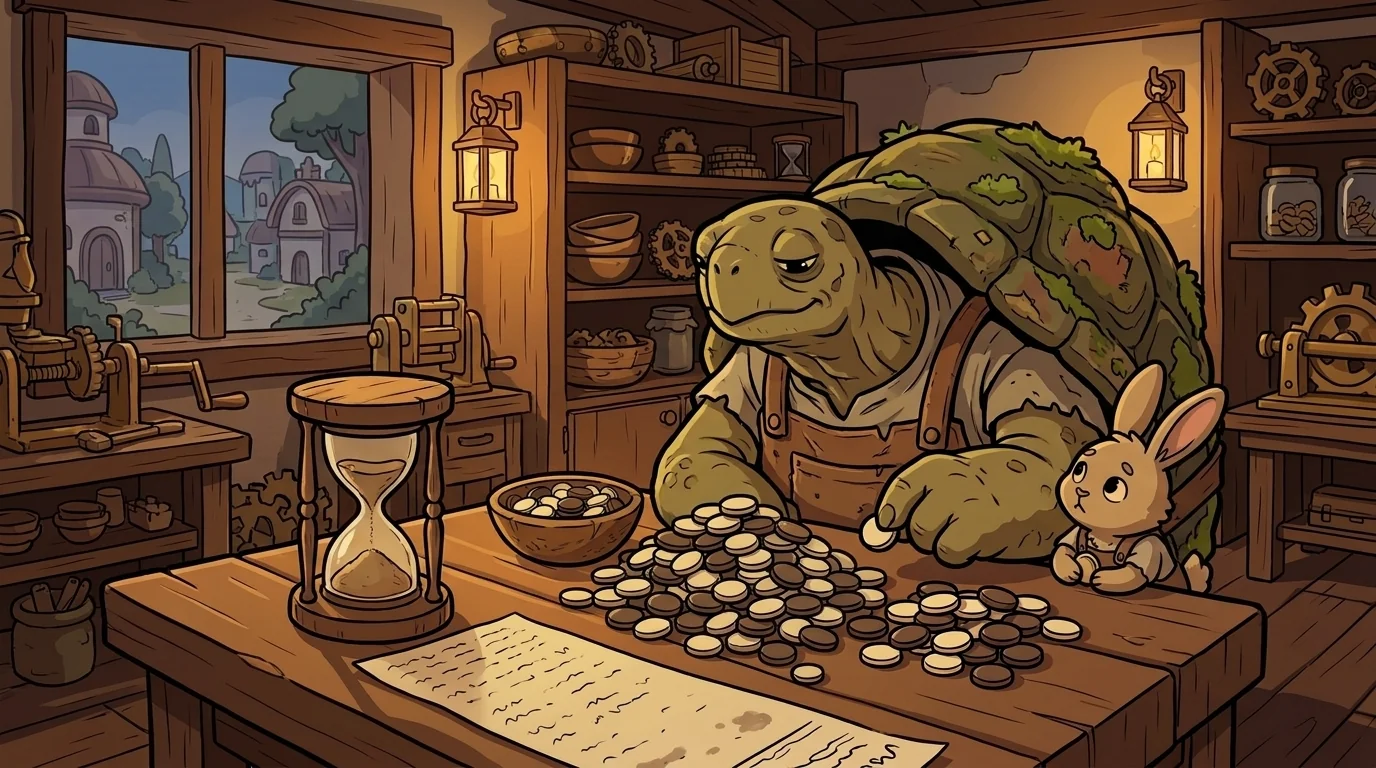
By evening, the rain had stopped, leaving the glass windows streaked with clean, cold water. Skip was still sitting on his stool by the workbench, spinning his copper coin on the wood. He had flipped it fifty times now, recording each result on a scrap of yellow paper.
"Twenty-six heads," Skip muttered, his eyes wide as he looked at the tally. "And twenty-four tails, which means it actually worked."
Evens smiled, his old eyes crinkling at the corners as he watched the boy. He began putting his wooden chips back into the walnut bowl, one by one.
"Does it ever feel a little cold to you?" Skip asked, stopping the coin with his palm. "If everything just evens out in the end, does any single flip even matter to you?"
Evens paused, holding a single dark chip between his thick, grey claws.
"It is the opposite of cold, my young friend," Evens said softly. "When I was young, every bad day felt like the end of the world," he said. "That was the cold feeling, and it was very lonely."
He placed the last chip in the bowl with a soft, satisfying clink.
"The long run is what keeps us warm in the dark," he said. "It tells us that our mistakes do not get to be the whole story of our lives. A bad day is just one try in thousands of tries."
Skip nodded slowly, his long ears finally relaxing as he listened to the tortoise. He tucked his copper coin back into his warm pocket.
The workshop was quiet now, filled only with the steady ticking of the old clock. Evens settled his heavy shell onto his straw mat, feeling the deep peace of the long run. He knew that tomorrow would bring more flips, more streaks, and more wildness to the shop. But he also knew that, in the end, everything would settle down.
The long run always came home to even, just as it always had.
The ChanceForge ensemble
Evens the Long-Run-Settler is part of ChanceForge's distributed-narrative cast. Each character embodies a different curricular primitive; together they teach the full subject.
-

Tally the Counter-of-Outcomes
Data collection + frequency counting (the foundational "what happened, how often?" move)
-

Display the Picture-Maker
Graphs and visual displays (bar charts, histograms, dot plots, line graphs — turning numbers into pictures)
-

Center the Middle-Finder
Central tendency — mean, median, mode (the "what's typical?" question)
-

Sample the Estimator
Sampling, sampling distributions, inference from sample to population
-

Tree the Compound-Brancher
Compound events and probability trees — multiplication rule for independent events, addition for disjoint, conditional dependencies
-

Odds the Likelihood-Reader
Basic probability — placing a chance on the 0-to-1 scale from impossible to certain
-

Scatter the Spread-Reader
Spread and variability — how far apart the data is (range), not just the middle
-

Flipside the Other-Outcome-Counter
The complement rule — find the chance it doesn't happen and subtract from 1
-

Clew the Clue-Follower
Conditional probability — how chances change once you learn a new fact