
Scatter the Spread-Reader
SPREAD — the middle of the data isn't the whole story. Spread is how far apart the values are: tight and bunched, or wide and scattered. Two groups with the very same average can be completely different once you look at how spread out they are.
A story read by Scatter the Spread-Reader
Loading audio…
Press play to listen along. The line being read lights up as you go.
Show full transcript
Loading transcript…
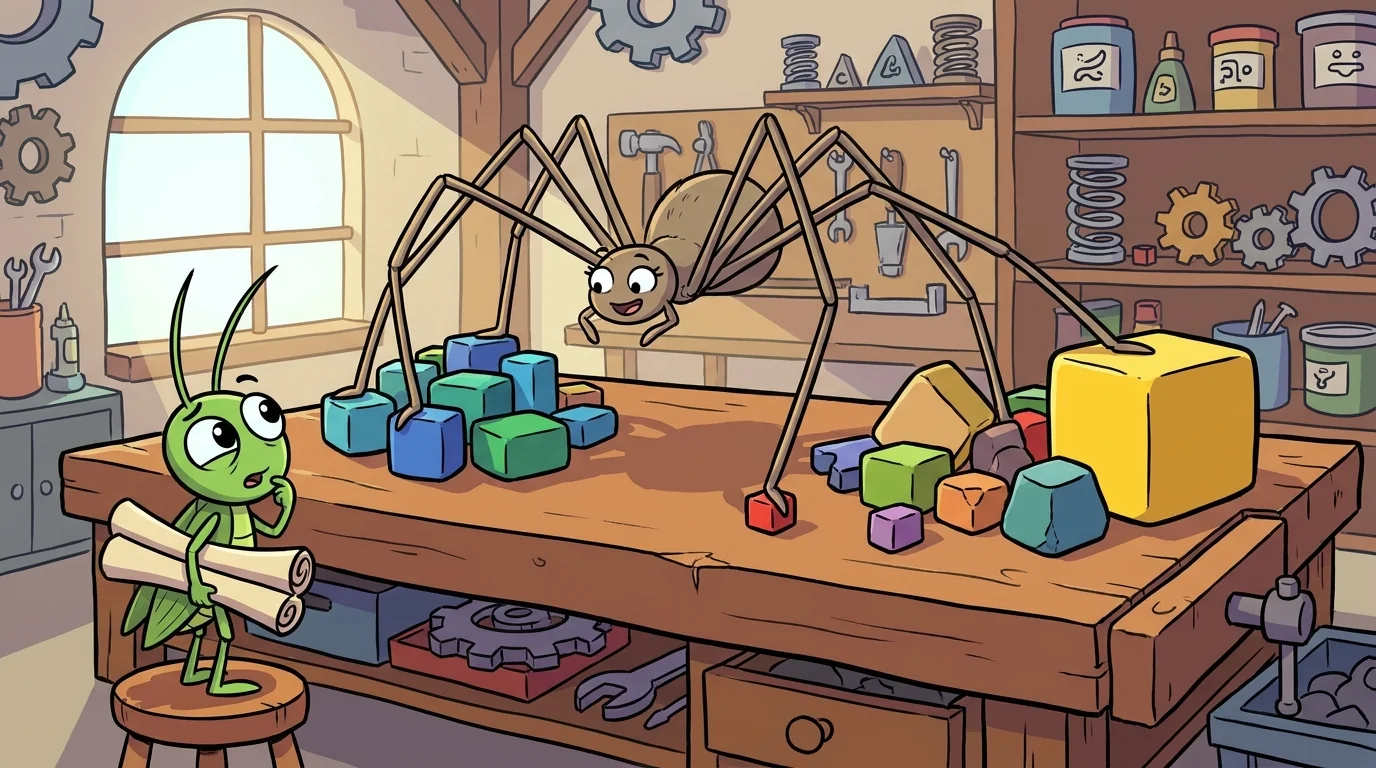
Scatter was a harvestman spider with legs like bent copper wire, and while everyone else looked for the middle, she looked for the width.
Most creatures in the ChanceForge workshop obsessed over what was normal. They wanted the center number, the balance point, the tidy midpoint where everything settled down. Scatter did not care about the center until she knew the edges. She had eight jointed legs that could span the width of an oak workbench without her body shifting an inch. Her favorite habit was planting one claw on the lowest number in a pile and reaching the opposite claw out to the highest. In a single span, she showed everyone in the room exactly how much room the truth took up.
A cricket named Tic hopped up to her measuring table on a damp Tuesday morning. He carried two scorecards scribbled on dried birch bark.
"Our league commissioner says these two teams are identical," Tic said, pushing the bark forward with his foreleg. "Both scored an average of ten points per game over the whole tournament. Ten exactly. So the rematch ought to be a dead heat, right?"
"Are they identical?" Scatter asked.
She tapped her front claws against the wooden table. Then she reached across the first scorecard. Her legs barely opened at all. The four scores on the sheet sat clumped together like sleepy acorns: nine, ten, eleven, ten.
"Look at this one," Scatter said. Her voice was dry and quiet, like dry leaves rustling under a porch. "Every single game landed right on top of ten. Nobody fell apart. Nobody caught fire. This team is tight."
She turned to the second card. She planted her left foreleg on zero and swung her right leg all the way across the table to twenty. The other two scores on the sheet were five and fifteen. Her copper legs formed a wide, trembling arch over the wood.
"Now look at the second team," she said. "Zero points in game one. Twenty points in game two. Five in the third, fifteen in the fourth. Same average. Ten points a game. But if you play them on Friday, do you have any idea who will show up?"
Tic stared at the gap between her claws. "They're completely different."
"The first team gives you ten points every single night," Scatter said, letting her long legs spring back in. "The second team is a coin toss in a thunderstorm. The middle told you they were twins. The spread tells you one is steady and one is wild."
Tic frowned at the cards. "So the average was hiding the truth."
"The average wasn't lying," Scatter told him, nudging the birch bark back into his paws. "It was just keeping its mouth shut about the distance. That's why you need me."
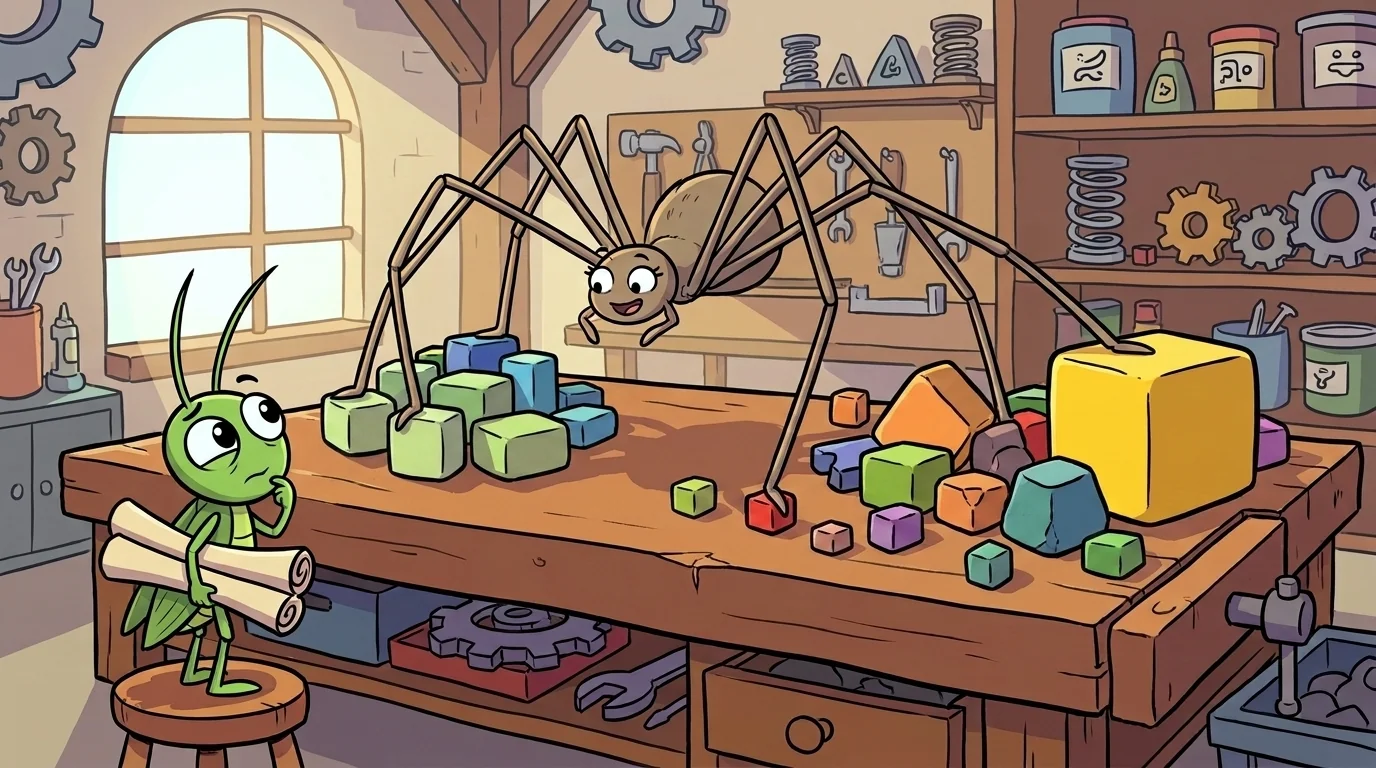
Scatter had cared about width since she was a spiderling in the high canopy of the northern pines.
Her family had lived in a massive wheel web slung between two white pines. It was a family of strict bookkeepers. Her mother and uncles tracked every single insect that hit the silk, and they calculated the average hour of every meal. The average bug arrives at noon, her uncle would announce, polishing his front claws. The average breeze is five miles an hour.
Young Scatter quickly noticed that the average never kept them safe.
On Tuesdays, ten moths would slam into the web during breakfast, ripping the anchor lines to shreds. Then not a single gnat would drift by for three straight days. The family had five bugs a day on average. Yet half the time they were starving, and the other half they spent frantically repairing snapped silk.
"Stop watching the middle," she whispered to herself one afternoon, clinging to a corner anchor while the pine trees whipped in a gale. "The middle doesn't tell you if the web will hold. Watch how far apart the world gets."
She started tracking the distance between the smallest breeze and the hardest gust. She measured the gap between the earliest fly and the latest beetle. When she subtracted the lowest value from the highest, she found the range — the full span of what could happen. A narrow spread meant the wind was polite and steady. A wide spread meant she needed to spin double-thick draglines and brace for impact.
When she tried explaining this to her cousins, they laughed and went back to their noon averages. But Scatter knew better. The center told you where things leaned. The spread told you what you had to survive.
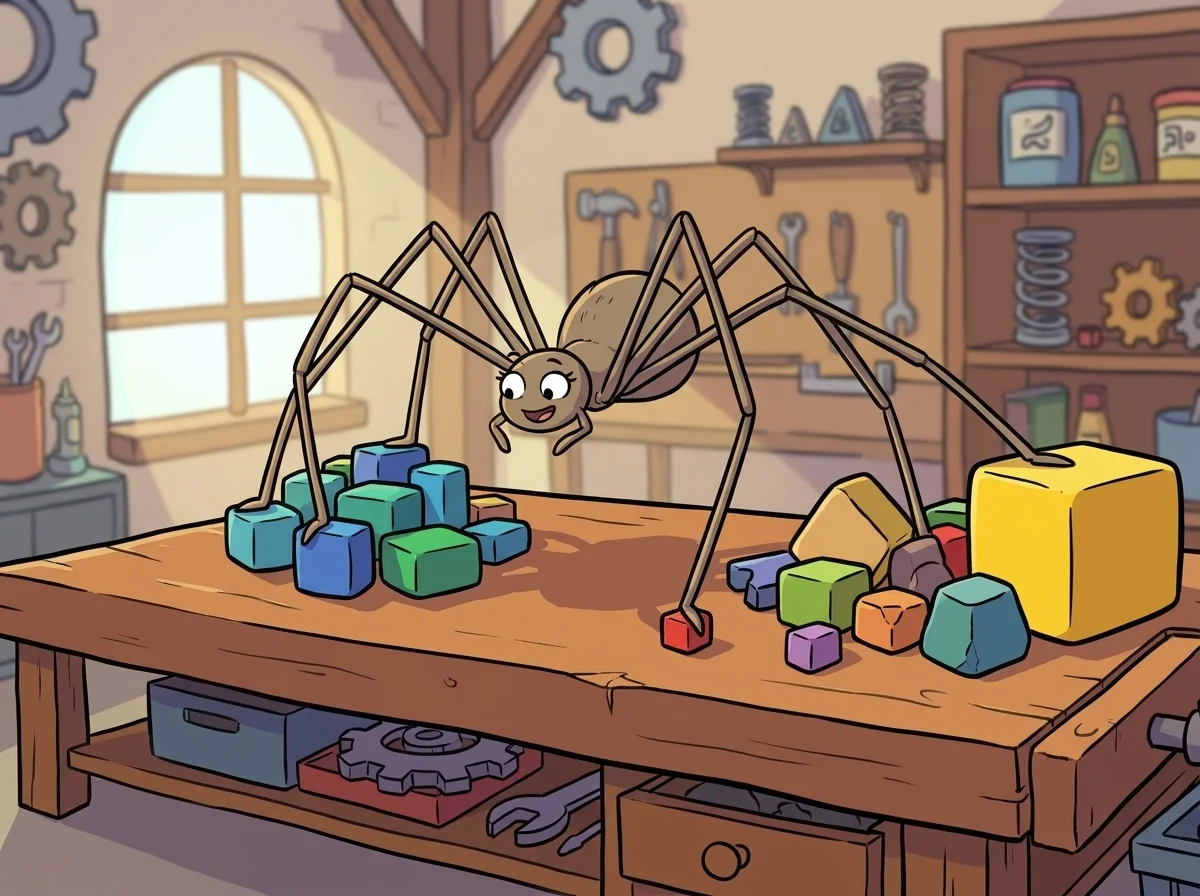
When she grew full-sized, Scatter left the canopy and climbed down to the stone floor of the ChanceForge workshop. She had heard that ChanceForge built instruments for measuring the real world, not just the tidy parts.
An old box tortoise named Odo kept the tools in the forge. When Scatter arrived, he set a cracked slate between them.
"Every young creature comes through here asking for the average," Odo said, his heavy voice scraping like slate on slate. "They want a single number to put in their pocket. Why should I give you bench space for spread?"
Scatter stood tall on four legs and threw the other four wide. Her reach spanned from the left edge of his tool rack to the far rim of his oil lamp.
"Because a single number is an outline with no bones," Scatter said. "The middle tells you where the pile sits on the table. The spread tells you whether it's a neat stack or a pile of rubble. The simplest way to see it is the range. You take the biggest value, you subtract the smallest, and you look at the raw distance."
She snapped her legs together until they lined up like pine needles.
"Tight spread," she said. "The values huddle close. The world behaves. You can make plans."
Then she threw them wide again, catching the amber light of the forge across her joints.
"Wide spread," she said. "The values fly apart. Surprises everywhere. Two things can share the exact same average and live in two completely different universes."
Odo blinked his heavy lids. "And which universe is better?"
"Neither," Scatter answered instantly. "A wide spread isn't broken. It's just honest. It tells you that the world is varied and unpredictable. The only real mistake is averaging the chaos away and pretending everyone is sitting in the center."
Odo grunted, picked up a piece of chalk, and drew an open circle beside her name on the roster.
"Take the bench by the east window," the tortoise said. "You see what everyone else walks over."
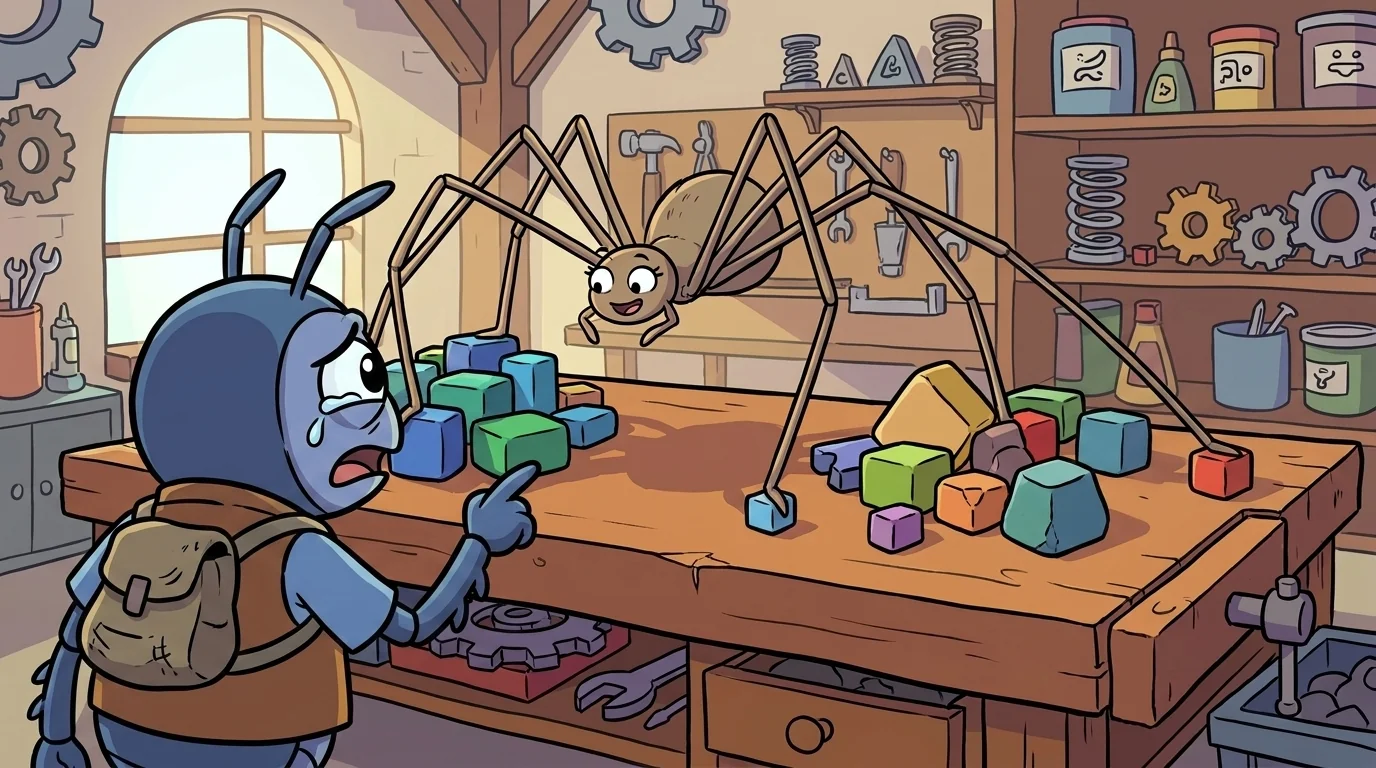
Scatter’s favorite work was rescuing creatures who had been tricked by a neat, flat average.
Two weeks into the autumn term, a stag beetle named Cob dragged himself into the workshop. His brown shell was caked with dried mud, and his antennae drooped toward the floorboards. He collapsed onto the wooden stool beside Scatter's desk and dropped two camp brochures on the blotter.
"I need to file a formal complaint against the weather," Cob muttered.
"Weather rarely reads complaints," Scatter said gently. "What happened?"
"I picked a camp for the summer," Cob said, pointing a trembling claw at the glossy pamphlet. "Both camps advertised an average daily temperature of twenty degrees Celsius. Twenty! That's perfect jacket weather. No frost, no heatstroke. So I went to Pine Ridge."
"And?"
"And it was pure torture," Cob said, his voice rising. "Every single morning my water bowl was frozen solid. Five degrees! Then by three in the afternoon, the sun hit the rocks and the thermometer jumped to thirty-five. I melted every day and shivered every night. How can a brochure print twenty when twenty never actually happened?"
Scatter pulled Cob’s daily log toward her. She tapped the column of numbers with her third right leg.
"Pine Ridge had an average of twenty," Scatter said. "Five plus thirty-five divided by two is twenty. The math was completely accurate. But look at the distance between your morning and your afternoon."
She stretched her long legs across his temperature log. Her claws reached nearly thirty centimeters apart.
"Your range was thirty degrees," Scatter explained. "The camp had a massive spread. The middle sat at twenty, but the weather never stayed there long enough for you to enjoy it. You lived on the two outer edges."
She picked up the brochure for the second camp, Lake Reed. She laid her legs across its daily numbers: eighteen in the morning, twenty-two in the afternoon, nineteen at dusk. Her legs sat tight together, barely four centimeters apart.
"Lake Reed had the exact same average of twenty," Scatter said. "Same center. But its spread was tiny. Morning was cool, afternoon was mild, and nobody froze. That's the camp you were picturing in your head."
Cob stared at her stretched-out legs, then down at his muddy boots. "I looked at one number and thought I understood the whole summer."
"Most people do," Scatter told him. "The middle tells you where to aim. The spread tells you what it actually feels like when you get there."
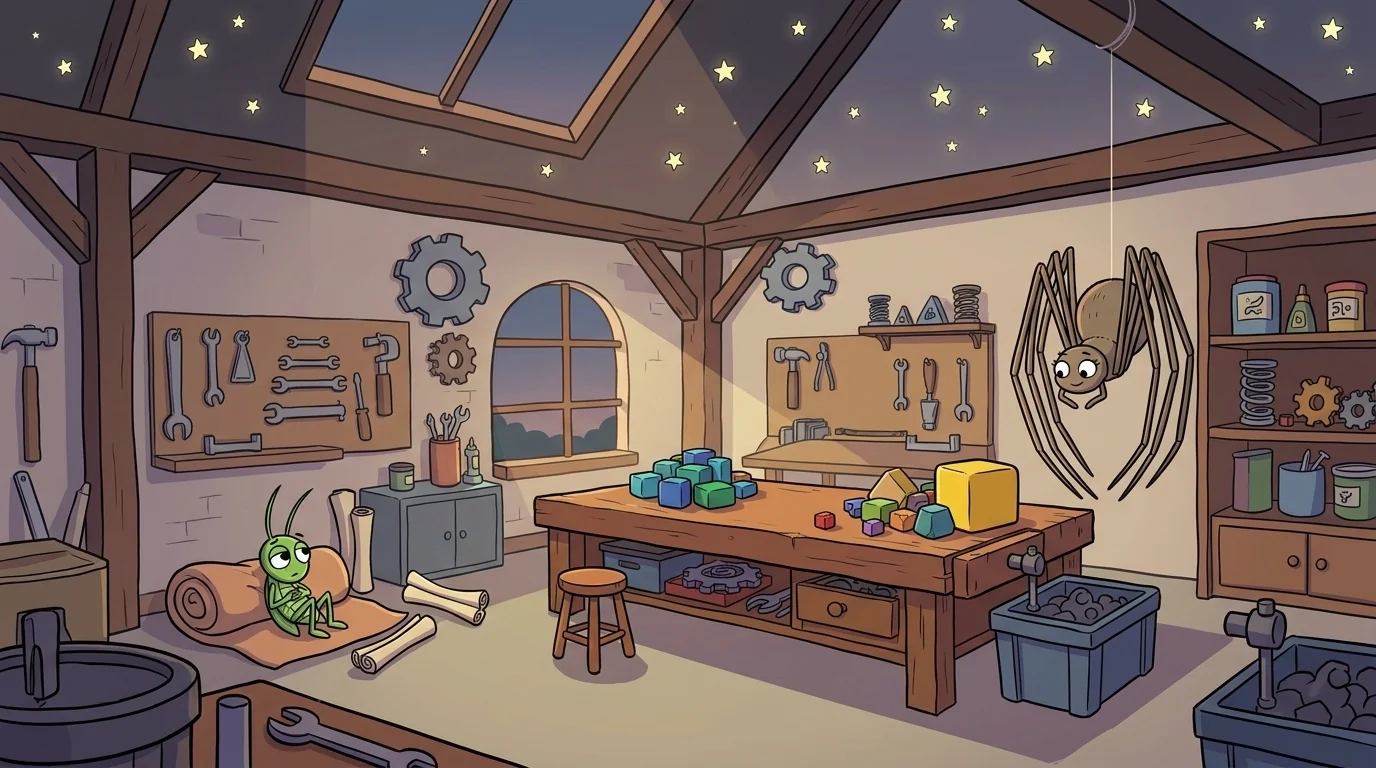
By twilight, the noise in the workshop had faded. The apprentices had packed their rulers and ledgers into cedar chests, and Odo had banked the forge coals under a layer of gray ash.
Scatter climbed up to the rafters above the east window. She hung suspended from a single anchor thread, her eight copper legs tucked neatly against her thorax, watching the valley turn blue.
The workshop door creaked open. Tic slipped inside, his cricket legs clicking against the threshold. He sat beneath her rafter and looked up into the shadows.
"Can I ask you something?" Tic said.
"Always," Scatter answered from the dark.
"I used to think spread was an error," the cricket said, scraping one wing against the other. "When our team played badly, or when scores were all over the place, it felt like something was wrong with us. I wanted everyone to score ten points. Every game, every week. It felt safe."
Scatter loosened her anchor thread and dropped two feet closer to the sill, her long legs unfolding like the ribs of an umbrella.
"I used to think that too," she said softly. "When you're young, variation feels like danger. You think if everything just stayed in the middle, nobody would get hurt and nothing would break."
She reached out, touching the window glass with her front claws. Outside, the first stars were puncturing the dusk. They were scattered across the indigo sky with huge, uneven gaps between them — some clustered near the horizon, others isolated high in the dark.
"If you squeeze everything to the middle, you don't get safety," Scatter said. "You just get an illusion. The fast runners and the slow walkers, the boiling afternoons and the freezing mornings — they all belong to the data. The width isn't a mistake that needs fixing. The width is the only way everybody gets to exist at once."
Tic watched the stars for a long moment, his antennae twitching in the cool draft from the sill. "So we don't try to shrink it?"
"We measure it," Scatter replied. "We respect it. And we never let an average tell us the whole story."
She hung in the quiet air, feeling the steady tension in her thread. Below her, the shop slept. Out in the valley, the world stayed wide, uneven, and entirely itself.
The ChanceForge ensemble
Scatter the Spread-Reader is part of ChanceForge's distributed-narrative cast. Each character embodies a different curricular primitive; together they teach the full subject.
-

Tally the Counter-of-Outcomes
Data collection + frequency counting (the foundational "what happened, how often?" move)
-

Display the Picture-Maker
Graphs and visual displays (bar charts, histograms, dot plots, line graphs — turning numbers into pictures)
-

Center the Middle-Finder
Central tendency — mean, median, mode (the "what's typical?" question)
-

Sample the Estimator
Sampling, sampling distributions, inference from sample to population
-

Tree the Compound-Brancher
Compound events and probability trees — multiplication rule for independent events, addition for disjoint, conditional dependencies
-

Odds the Likelihood-Reader
Basic probability — placing a chance on the 0-to-1 scale from impossible to certain
-

Flipside the Other-Outcome-Counter
The complement rule — find the chance it doesn't happen and subtract from 1
-

Clew the Clue-Follower
Conditional probability — how chances change once you learn a new fact
-
Evens the Long-Run-Settler
Expected value and the long run — results settle toward the average over many tries