Tree
Compound events branch
Loading audio…
Press play to listen along. The line being read lights up as you go.
Show full transcript
Loading transcript…
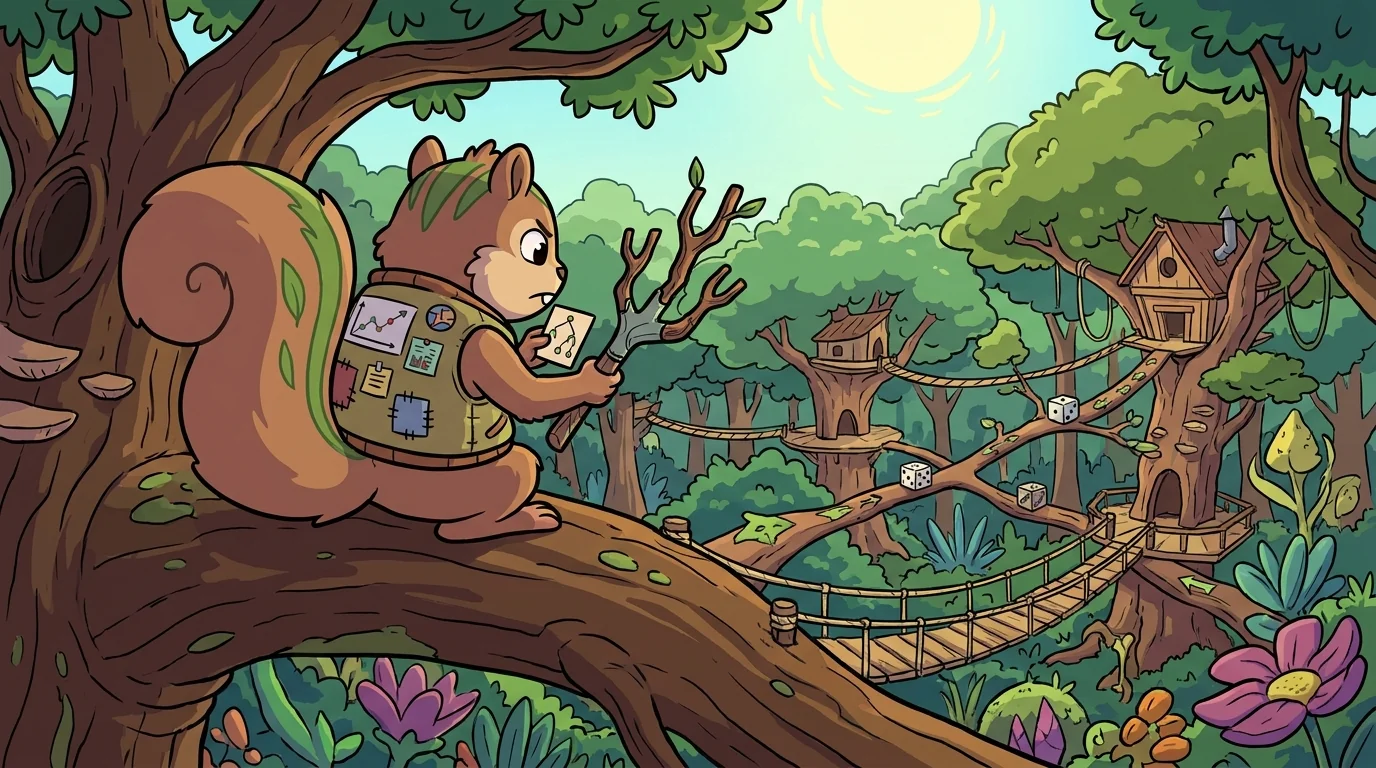
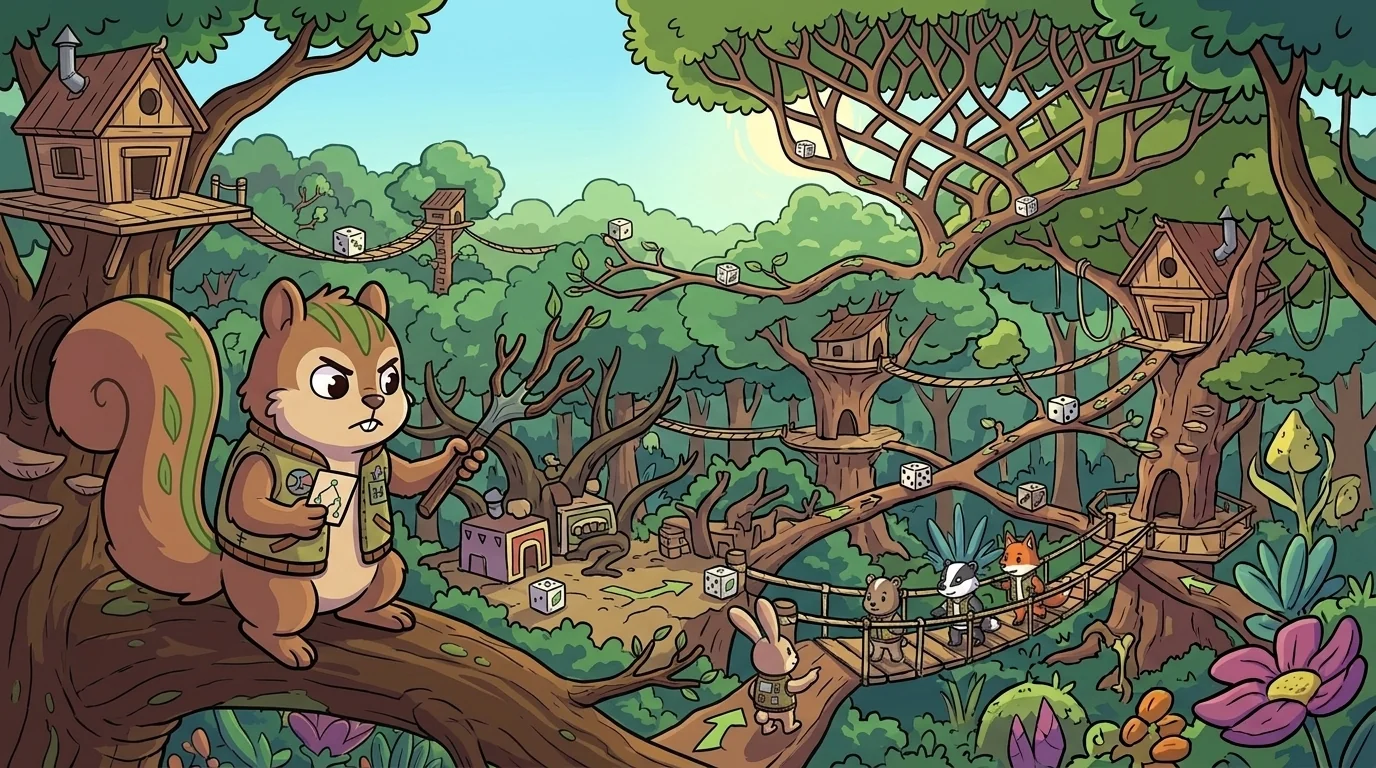
Halfway up the tallest oak behind the ChanceForge workshop, a small squirrel sat on a branch, drawing a picture of the branch he was sitting on.
Not the wood and the bark — the paths. His notebook page had a single line at the bottom that split into two, and each of those split again, and again, until the whole page looked like the oak seen from the inside. Tree's fur was soft and brown, striped with green the color of new leaves, and his vest was covered in tiny charts he added to whenever something interesting happened. He was not sketching the tree he sat in. He was sketching every way the afternoon could still turn out.
A younger squirrel scrabbled up beside him, out of breath. "The acorn contest is today. I picked lucky number seven. I'm going to win."
Tree kept drawing. "Maybe. How many tickets?"
"I don't know. A lot."
"Then you don't have a lucky number," Tree said gently. "You have one small branch on a very wide tree." He turned the page so she could see all the paths fanning out. "The trick isn't to feel lucky. The trick is to draw the tree, and then you can see where your branch is."
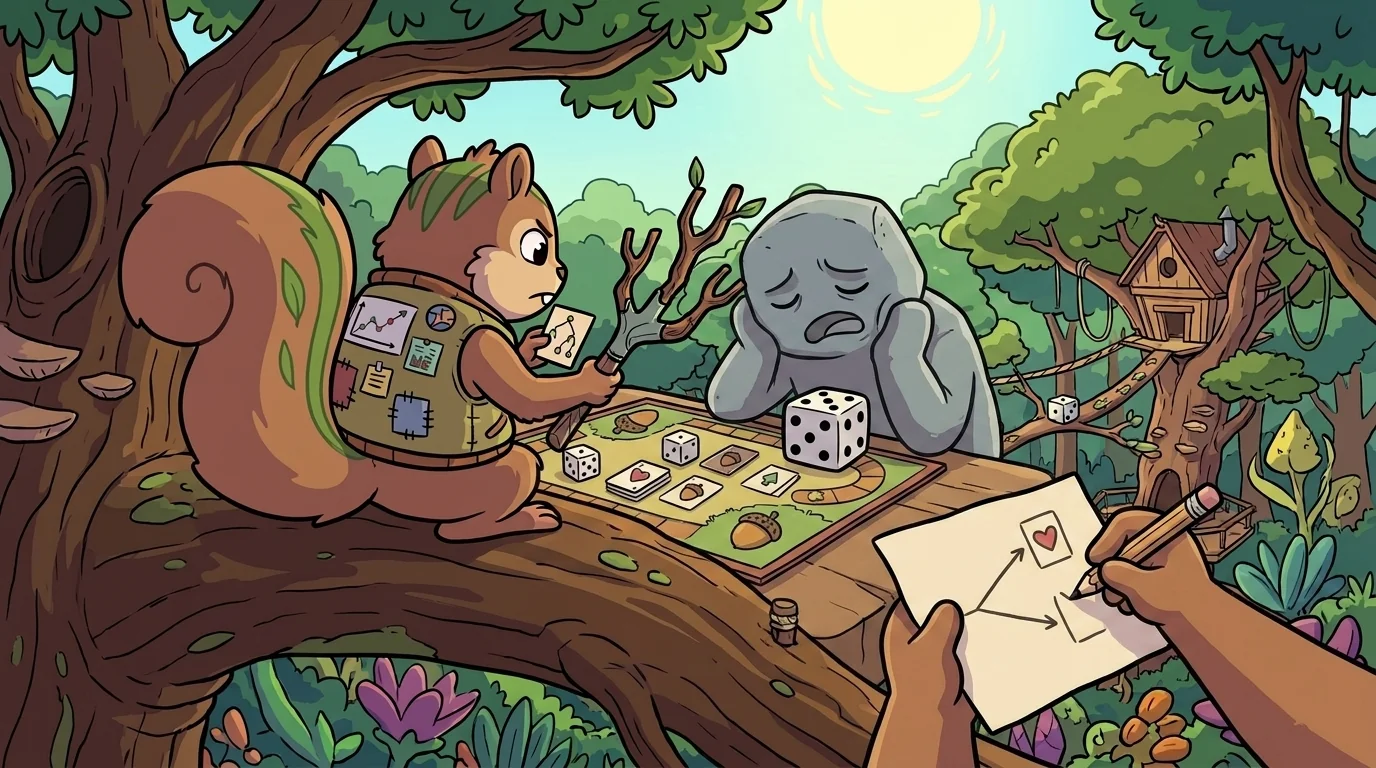
Tree had not always drawn the tree first. Once, he had guessed like everyone else.
When he was small, his family played a game every autumn — first squirrel to gather a red acorn AND a striped acorn won the last slice of honeycake. Tree had wanted that honeycake with his whole heart. He'd told himself he was due, that he could feel his luck coming, the way you feel weather. He lost seven years running. Each autumn the certainty rose up in him again, warm and bright, and each autumn it collapsed, and he could never explain why the sureness kept lying to him.
The eighth year, his grandmother — an old squirrel who had counted acorns for the whole hollow her entire life — sat him down with a stick and a patch of smooth dirt.
"You keep saying you're due," she said. "Show me due. Draw it."
Tree didn't know how. So she took the stick and made one line, then split it. "Red acorn, or not-red. That's your first branch." She split again off the red one. "Striped, or not-striped. That's your second." She stepped back. "Now count the paths. How many end in both?"
Tree counted. Out of all the branches, only one thin twig ended in red-and-striped. One, out of many.
"You were never due," his grandmother said, not unkindly. "You just couldn't see the tree, so you filled the empty space with hope." She pressed the stick into his paw. "Hope is fine. But draw the tree first. Then you'll know exactly what your hope is worth — and it'll stop breaking your heart by surprise."
Tree drew trees in the dirt for the rest of that autumn. The honeycake ache didn't vanish, but it stopped ambushing him. He knew his branch now. He could carry it.
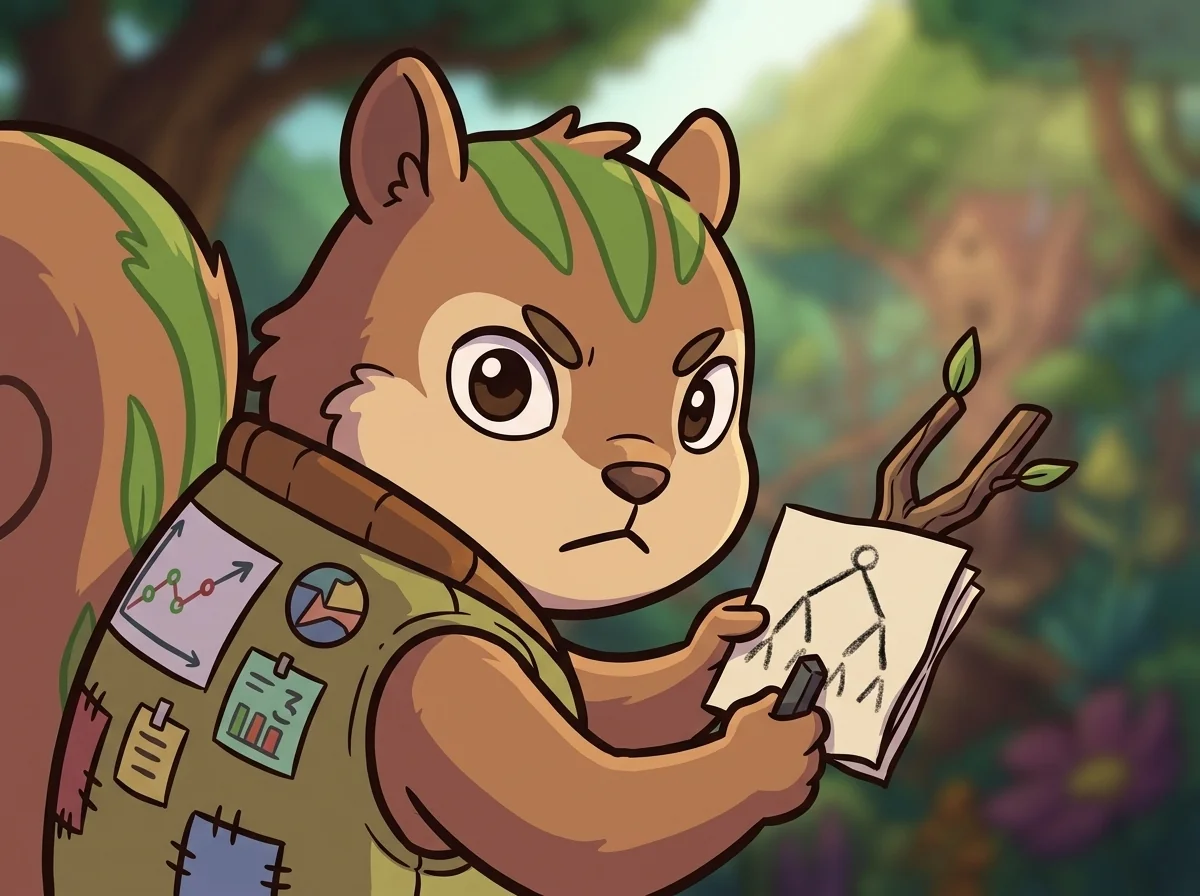
He walked into ChanceForge when he was nearly grown, because a whole workshop full of dice and cards and spinners was exactly the place that most needed someone who drew the tree before anyone rolled.
Sample, one of the older cast, met him at the door and asked the question the cast always asked a newcomer. "Tree — what do you actually teach?"
Tree didn't answer with a definition. He took out a card, licked his pencil, and drew a line splitting into two, then four. "A friend of mine picks lucky number seven every year," he said. "She thinks her number is special. It isn't. It's one twig on a tree this wide." He turned the card around. "I teach people to draw the whole tree instead of falling in love with one branch. Independent chances multiply. Either-or chances add. And the sneaky ones — the ones where the first thing changes the second — those you have to redraw or they'll bite you."
Sample studied the card a long moment. "Most folk here would just say 'it's random' and shrug."
"Random isn't the same as unknowable," Tree said. "The dice don't know what they'll do. But the shape of the chance? I can draw that before we ever roll."
Sample nodded slowly. "You belong here. Half this workshop guesses with its gut. You're the one who'll make them draw the path."
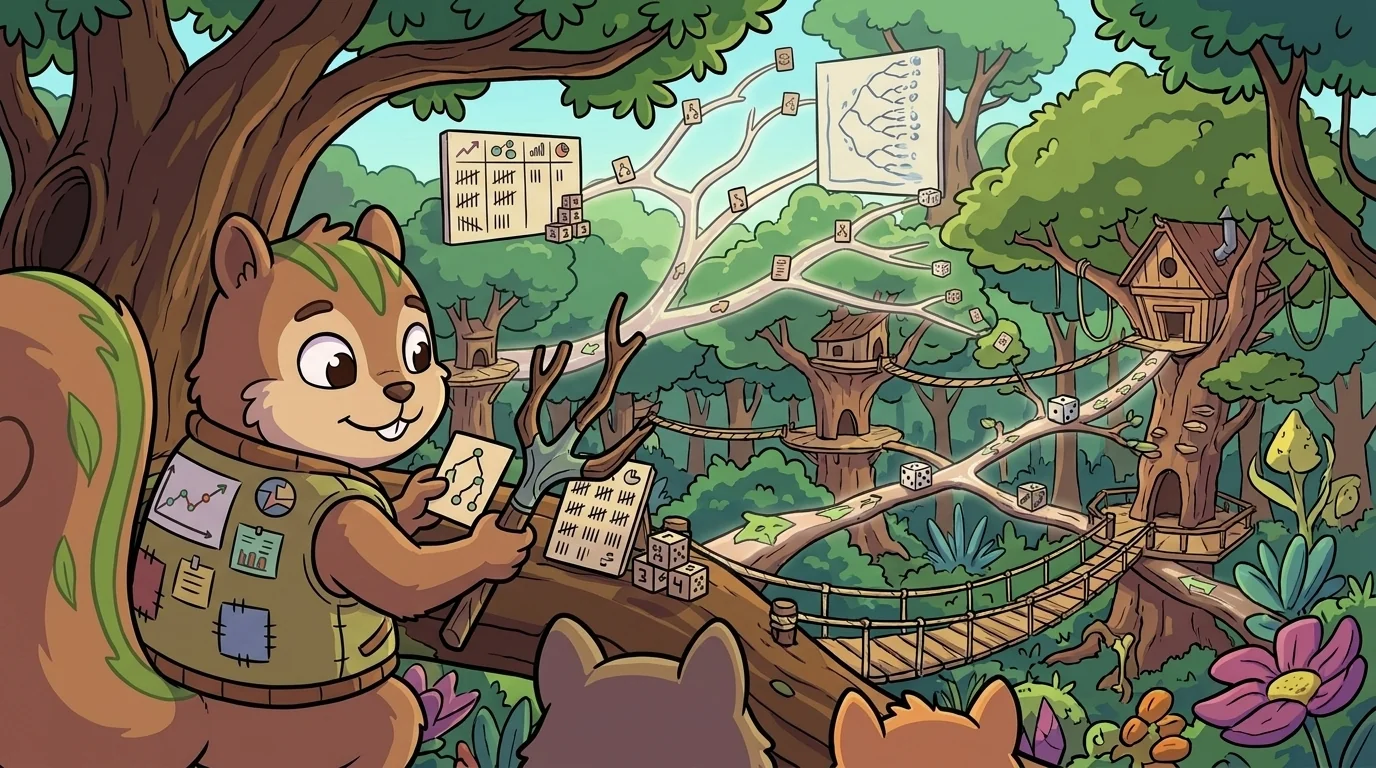
One afternoon the whole cast crowded around a board game — Quest for the Golden Acorn — and Center slumped over the board in despair. To win, he needed to roll a six AND draw a hearts card, both at once.
"What are my chances?" he groaned. "Just tell me it's hopeless."
Tree pulled out a napkin. "Let's draw it and find out. A six on a die — one path in six." He sketched the first branch. "A hearts card — four suits, so one path in four." A second branch forked off the first. "Are these two things connected? Does rolling the die change what the deck holds?"
"No," Center said. "The die doesn't touch the cards."
"Then they're independent, so we multiply. One-sixth of one-fourth is one twenty-fourth." Tree tapped the tiny tree. "One in twenty-four. Not hopeless. Just narrow."
Tally, who had been counting, sat back proud. "So drawing two aces from the deck is easy — four in fifty-two, times four in fifty-two."
Tree shook his head slowly and reached for Tally's diagram. He drew the first branch — ace — then crossed one ace out of the deck for the second branch. "You already took one. It's gone. Now it's three aces left out of fifty-one." The whole answer shrank.
Tally's ears went flat. "Oh. I didn't take it out."
"That's the conditional," Tree said, not unkindly. "The first thing changes the second thing. It's the one that bites — right when you're most sure. So we redraw." He smoothed the napkin. "Nobody guesses a thing they can branch. Not while I'm at the table."
Later, when the game was packed away and the workshop had gone quiet and gold with evening light, Center stayed behind with one smaller question.
"When you were a kid," he said. "Picking your lucky number, sure you were due. Did it — did it hurt, finding out you weren't?"
Tree was quiet a while. He turned to an old page in his notebook, a shaky tree he'd drawn in dirt long ago and copied over to keep. "It hurt every autumn I didn't draw it," he said. "The being-sure and then the falling — that's the part that ached. Once I could see the tree, the ache turned into something else. Not winning. Just... knowing where I stood." He ran a claw along the thin winning twig. "I still hoped. I just stopped being ambushed by my own hope."
Center looked at the tree for a long moment, and something behind his ribs he hadn't known was clenched slowly came unclenched. The loss on the board didn't sting the way it had an hour ago. It just sat there now, plain and bearable, a narrow branch he could see the whole shape of. He let out a long breath he'd been holding since the game began, and his shoulders came down soft and easy, and a quiet, steady warmth spread through his chest — the calm of someone who had finally been handed the whole map, and found he could carry it just fine.
Hear it as an audio drama
A short play starring Tree, from ChanceForge. Different voices, same idea. Listen any time after you read.
Loading audio…
Read the drama script
- Narrator: From Spark and Anvil and ChanceForge — this is Tree, in chapter 1 of the ChanceForge cast.
- Narrator: This drama uses an AI-generated voice. Voiced via Gemini 2.5.
- Narrator: Tree is a careful squirrel-tween in a stats-vest, holding a small card that shows a branching diagram.
- Narrator: They are warm-bark-brown with leaf-green stripes, deeply attentive to how one event leads to the next.
- Tree: Instead of one big, mysterious number, we draw the many small paths an event can take. Don't guess what you can branch.
- Narrator: The cast learned this during a board game. They needed to roll a six AND draw a hearts card.
- Tree: One-sixth for the six. One-fourth for the hearts. The events are independent. The die doesn't know the cards.
- Tree: So we multiply the branches. One-sixth times one-fourth is one-in-twenty-four. That is the shape of the chance.
- Narrator: But Tree also taught them to be cautious, especially when events were not independent.
- Tree: Does the first event change the second? If yes, it's conditional. A different rule. A different tree.
- Narrator: The Professor of Games once asked Tree a single, serious question.
- Professor: What is a casino?
- Tree: A tree the house drew first. The path that wins for the player is just one small branch among many that lose.
- Professor: You understand the branches.
- Narrator: Compound events branch. Don't guess what you can draw.
- Narrator: You've been listening to a Spark and Anvil chapter, written by the Spark and Anvil writing team for ages 9 to 14.
- Narrator: Apps stay free forever.
- Narrator: Curriculum aligned to Common Core math.
- Narrator: Released under Creative Commons BY-NC-SA 4.0 for educational reuse. Visit Spark and Anvil for the full transcript.
The ChanceForge ensemble
Tree is one of the friends in ChanceForge. Each friend shows you one idea by how they act; meet them all and you have the whole subject.
-

Tally the Counter-of-Outcomes
Data collection + frequency counting (the foundational "what happened, how often?" move)
-
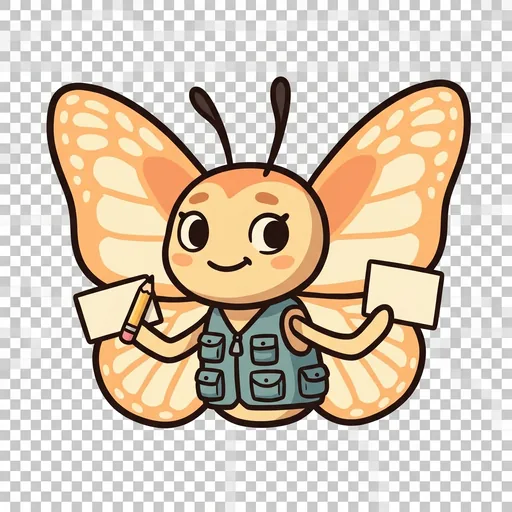
Display the Picture-Maker
Graphs and visual displays (bar charts, histograms, dot plots, line graphs — turning numbers into pictures)
-
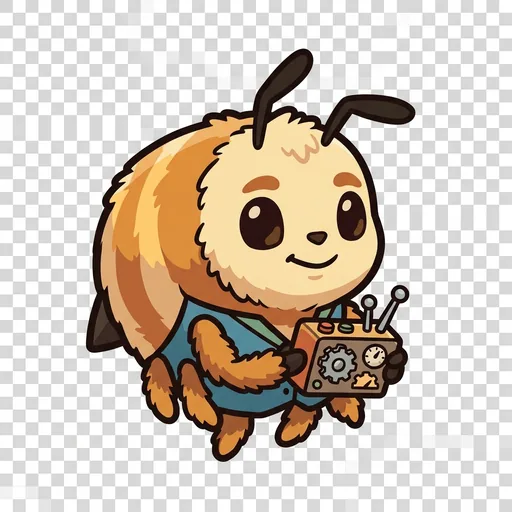
Center the Middle-Finder
Central tendency — mean, median, mode (the "what's typical?" question)
-

Sample the Estimator
Sampling, sampling distributions, inference from sample to population
-

Odds the Likelihood-Reader
Basic probability — placing a chance on the 0-to-1 scale from impossible to certain
-
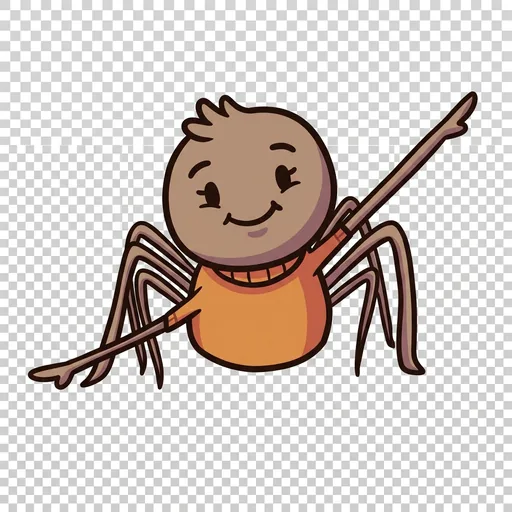
Scatter the Spread-Reader
Spread and variability — how far apart the data is (range), not just the middle
-

Flipside the Other-Outcome-Counter
The complement rule — find the chance it doesn't happen and subtract from 1
-
Clew the Clue-Follower
Conditional probability — how chances change once you learn a new fact
-
Evens the Long-Run-Settler
Expected value and the long run — results settle toward the average over many tries