
Silica
SILICON (Si) — *patient, geometric; the architect who builds quietly.* Four outer-shell electrons (like carbon, one shell deeper); makes 4 bonds; builds silicate-mineral lattices + semiconductor electronics + glass.
Loading audio…
Press play to listen along. The line being read lights up as you go.
Show full transcript
Loading transcript…
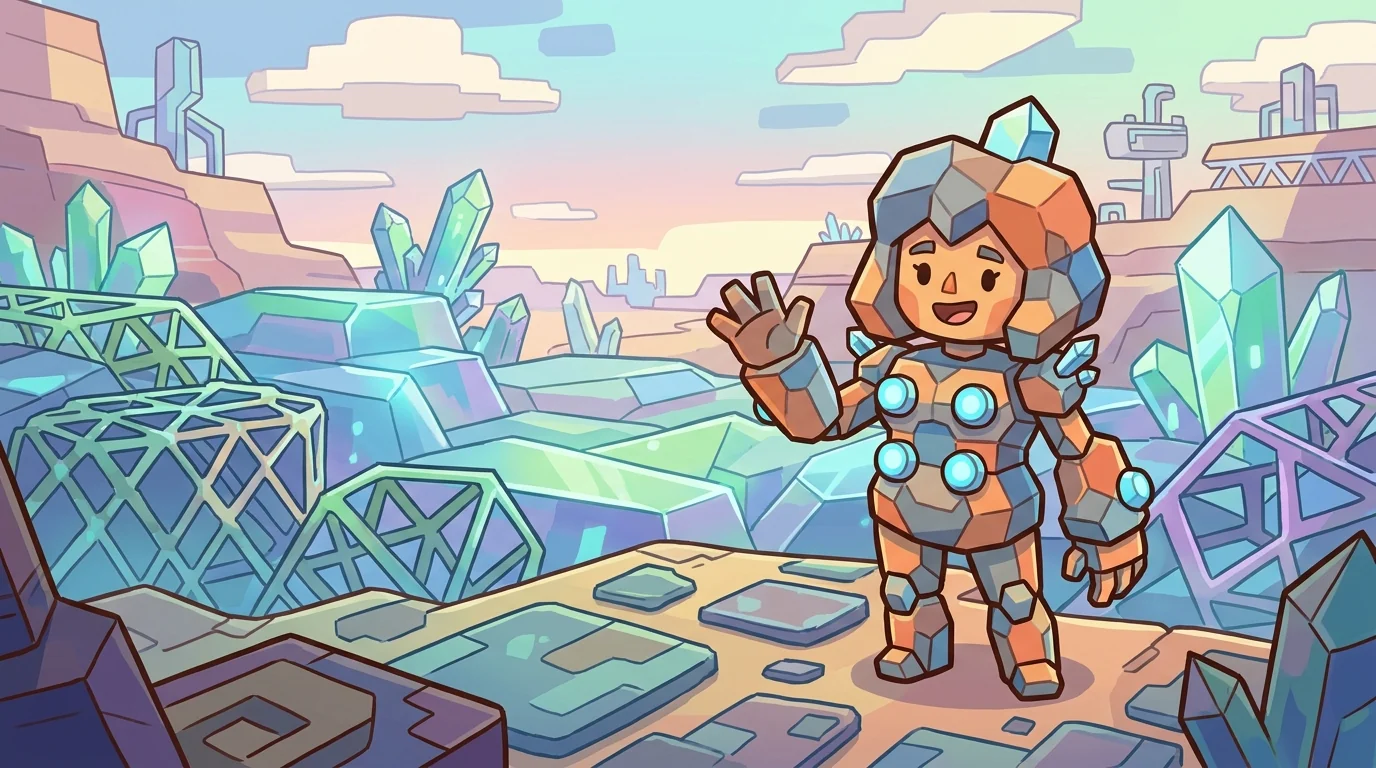
On the corner of the workbench, Silica was building. Piece by careful piece, she fitted small clear beads into a growing lattice — one silicon at the center, four oxygens reaching out from it, then another silicon linked to each oxygen, then more, spreading outward in every direction at once. She never rushed. She turned each bead until its four arms pointed exactly where they should, clicked it home, and reached for the next.
Silica was a small armadillo-tween, soft gray-and-cream, her rounded plates never sharp. At her chest hung a hexagonal quartz crystal, polished to catch the light. Her hands moved with quiet, geometric purpose, and the structure under them grew as steady and true as a wall being laid.
"Four arms each," she said, when a student asked why she worked so slowly. "Silicon holds four bonds — same as carbon. But where carbon's four arms make long, bendy chains for living things, mine lock into rigid frames that go out three ways, not one." She set another silicon-oxygen bead in place; the whole lattice stiffened. "Si-O-Si-O, over and over, in a grid you can't squash. That's stone. That's sand. That's the glass in your window." She turned the growing crystal so it flashed. "I don't build fast. I build to last."
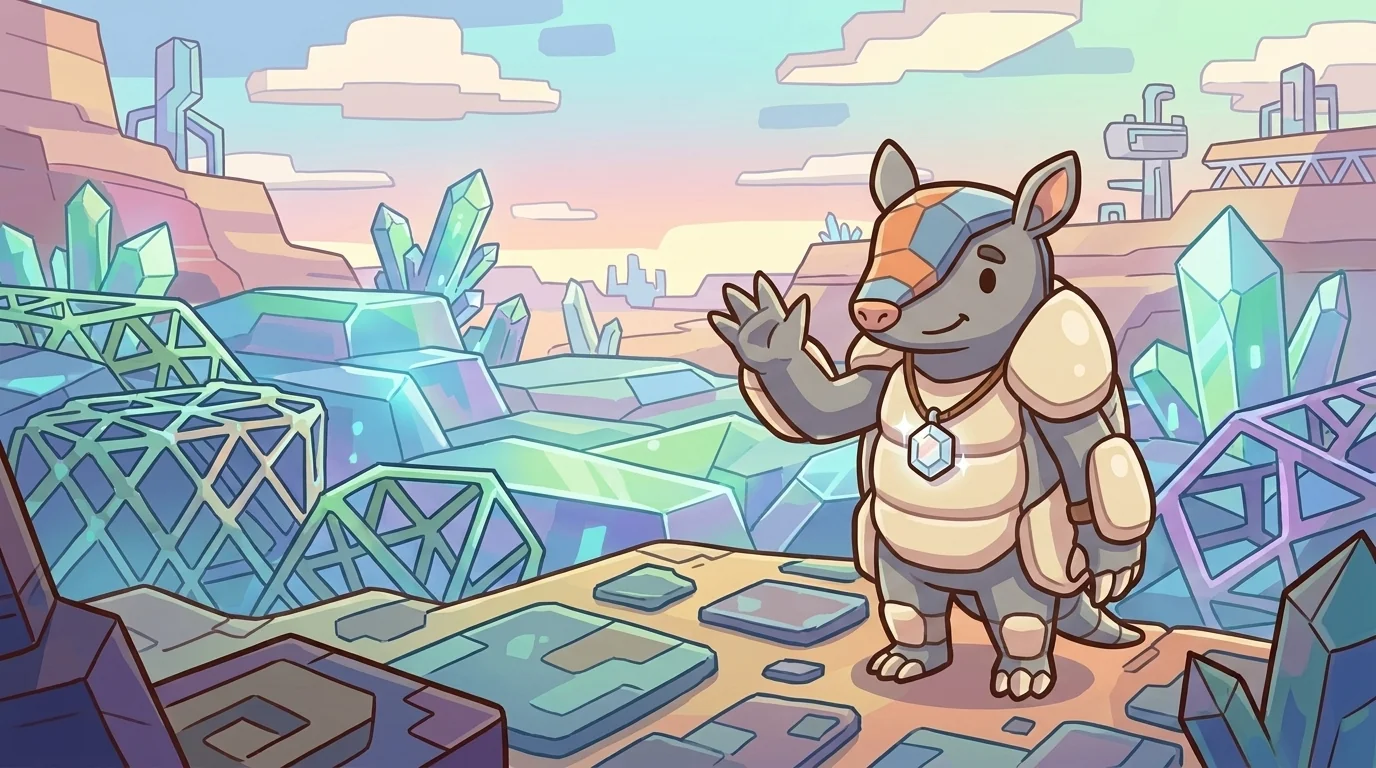
Silica grew up among stone-masons — armadillos who quarried, shaped, and laid the stone for every house, wall, and bridge the village had.
When Silica was small, she got impatient watching her uncle set a garden wall. She grabbed stones and slapped them up in a hurry, proud of her speed. Her uncle said nothing; he just leaned lightly on her wall, and it slumped and tumbled. Then he took a single stone, turned it slowly until its flat faces met its neighbors exactly, and pressed it home. "Strength isn't in the stone," he said. "It's in the fit. Every face touching every face. Rush the fit and you've built nothing." He laid the next stone just as slowly, and the next, and that wall stood for forty years.
Silica rebuilt her own little wall that afternoon, one exact stone at a time, and when her uncle leaned on it, it held. By six she understood the thing she'd carry for life: quiet, geometric fitting — each piece true to its neighbors — is what makes a structure that endures. It isn't dramatic. It's just what keeps the world standing up.

At twenty-two she walked to the ChemQuest academy, where Beaker handed her a heap of loose silicon and oxygen beads and a flimsy paper chain someone had made of carbon. "Build me something silicon does that carbon can't," he said.
Silica set the paper chain aside and began, unhurried, fitting silicon beads to oxygen beads — but instead of a chain she grew the links outward, three-dimensionally, silicon to oxygen to silicon, until a small rigid lattice sat solid on the bench. She pressed down on it; it didn't give. Then she pressed on the paper carbon chain beside it, and it folded flat.
"Carbon bends — good for life, for chains that fold into proteins," she said, holding up the flimsy chain. "But drop mine off a cliff and it's a boulder." She nudged the little quartz lattice toward him; it scraped the wood, hard and heavy. "Four bonds each, like carbon. But mine reach out in a grid and won't collapse. This is what most of the ground under your feet is made of."
Beaker leaned his whole weight on her lattice and it held firm. He'd asked for the difference between carbon and silicon, and she'd handed him a boulder next to a paper chain. He nodded and waved her in.
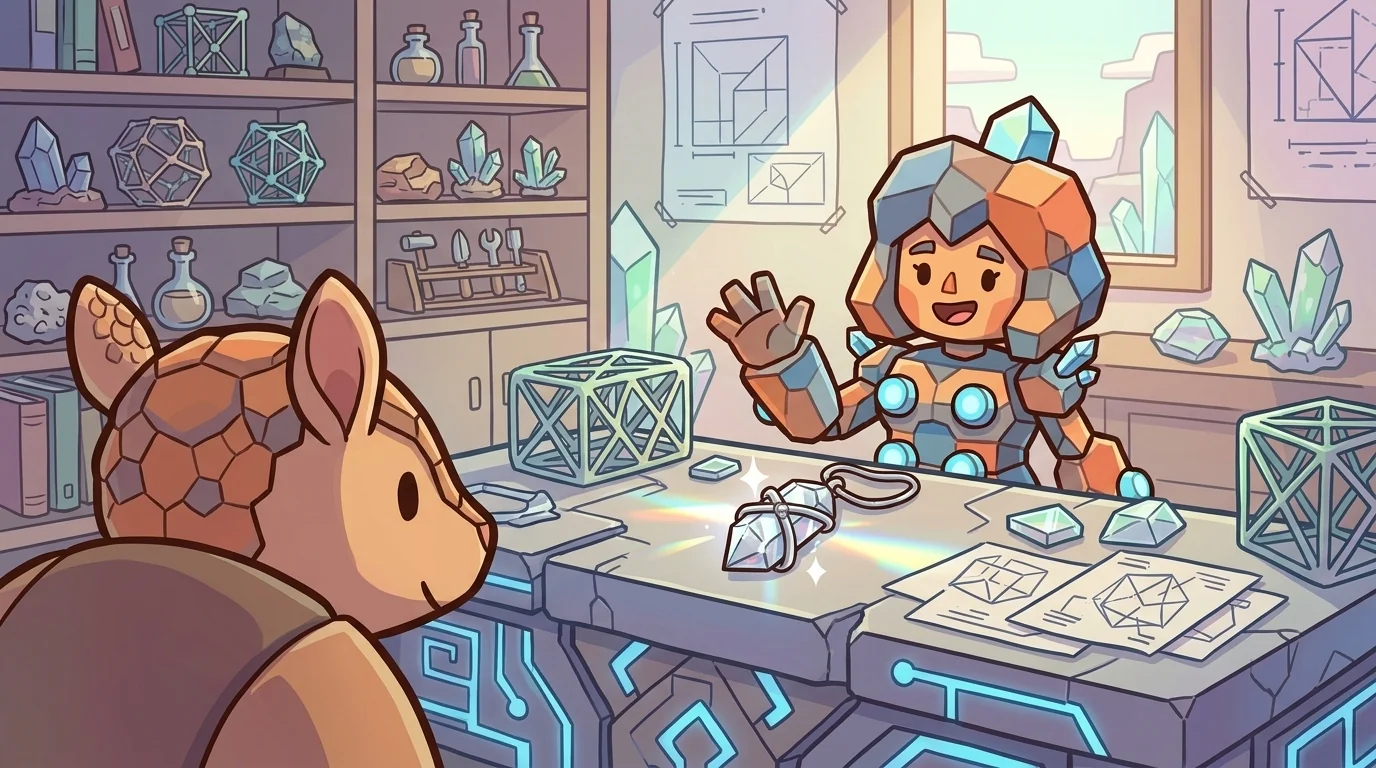
Silica ran her workshop like a patient mason's yard. She began her first lesson by unclipping her quartz pendant and setting it on the bench, letting it sparkle, then handed each student a fistful of beads to build alongside her.
"Fit a silicon to an oxygen," she said, walking the room, "then another silicon to that oxygen. Si-O-Si. Keep going in all directions." As their little lattices grew, she pointed out that silicon and oxygen grip each other with unusually strong bonds — which is exactly why silicates are the most common minerals in all of Earth's crust. "You're building the planet's skeleton right now," she said, and a student laughed in surprise.
She held up samples one by one as they worked. A clear quartz shard: "Same lattice you're building — SiO₂ in a perfect grid." A flake of mica that peeled into thin sheets between her claws: "Same silicon and oxygen, arranged into layers." A crumb of clay, a chip of feldspar: "Still Si and O — just stacked in different patterns. Change how the grid arranges itself and you get every rock there is." She poured a little sand through her fingers. "And this? Mostly broken-down quartz. Those strong Si-O bonds are why beach sand doesn't just crumble to dust."
Then she lit a small furnace and dropped in a spoon of sand. "Heat me past about seventeen hundred degrees and my rigid grid melts. Cool me fast" — she plunged the glowing melt into water — "and my atoms freeze in a jumble instead of a neat grid. That's glass. Same chemistry as quartz, just disordered." She held the little glass bead to the light.
Finally she brought out a polished silicon wafer, mirror-bright. "Grow me perfectly pure, then tuck in a few stray phosphorus or boron atoms — 'doping,' we call it — and I start to conduct electricity in a controllable way. Slice me thin, etch tiny circuits into me, and I become the chip inside your phone. Layer me toward the sun and I become a solar cell." She set the wafer beside the quartz shard. "Stone and screen. Both just me, fitting atoms into a grid — quietly."
When a student asked whether silicon chemistry was hard, Silica clipped her pendant back on and shook her head gently.
"Not hard. Four arms each, locked into a grid that won't collapse, mostly hand in hand with oxygen." She tapped the quartz at her chest. "Earth's crust under you, the screen in your pocket — both built the same slow, careful way."
The pendant caught the light once more, and she turned back to the half-finished lattice waiting on the bench. And as she fitted the next bead exactly into place and watched the structure grow one true piece at a time, Silica felt the deep, settled calm she loved — the quiet, patient gladness of watching something solid and lasting come together beneath her steady hands.
The ChemQuest ensemble
Silica is part of ChemQuest's distributed-narrative cast. Each character embodies a different curricular primitive; together they teach the full subject.
-

Hydra
Hydrogen (H) — lightweight, ubiquitous, always paired up; buddy-system enthusiast
-

Carbo
Carbon (C) — connects to anything; the social atom; backbone of life
-

Oxy
Oxygen (O) — eager bonder; electronegative; the hungry grabber
-

Nitra
Nitrogen (N) — triple-bond loyal; slow-to-warm; locks in deeply once bonded
-
Sodi
Sodium (Na) — generous, impulsive; always giving away electrons
-

Chlora
Chlorine (Cl) — sharp, focused; the collector who finishes what Sodi starts
-

Helio
Helium (He) — noble gas; peaceful, floaty, complete; the contented onlooker
-

Sulfa
Sulfur (S) — earthy, dramatic; the stinky uncle of volcanoes and proteins
-

Phossa
Phosphorus (P) — energetic, restless; the spark of ATP and matches
-

Magna
Magnesium (Mg) — bold, ceremonial; burns bright white; chlorophyll core
-

Alumi
Aluminum (Al) — practical, modest; the workhorse of cans and foil
-

Tugger
Ionic bond — forceful, decisive; full electron transfer; opposites attract
-

Sharer
Covalent bond — cooperative, balanced; equal partnership
-

Streamer
Metallic bond — flowing, communal; delocalized electron sea
-

Whisperer
Hydrogen bond — subtle, persistent; water's superpower; DNA pairing