The Thread-Puller & The Tide-Watcher
TRANSFORM
A story read by The Thread-Puller & The Tide-Watcher
Loading audio…
Press play to listen along. The line being read lights up as you go.
Show full transcript
Loading transcript…
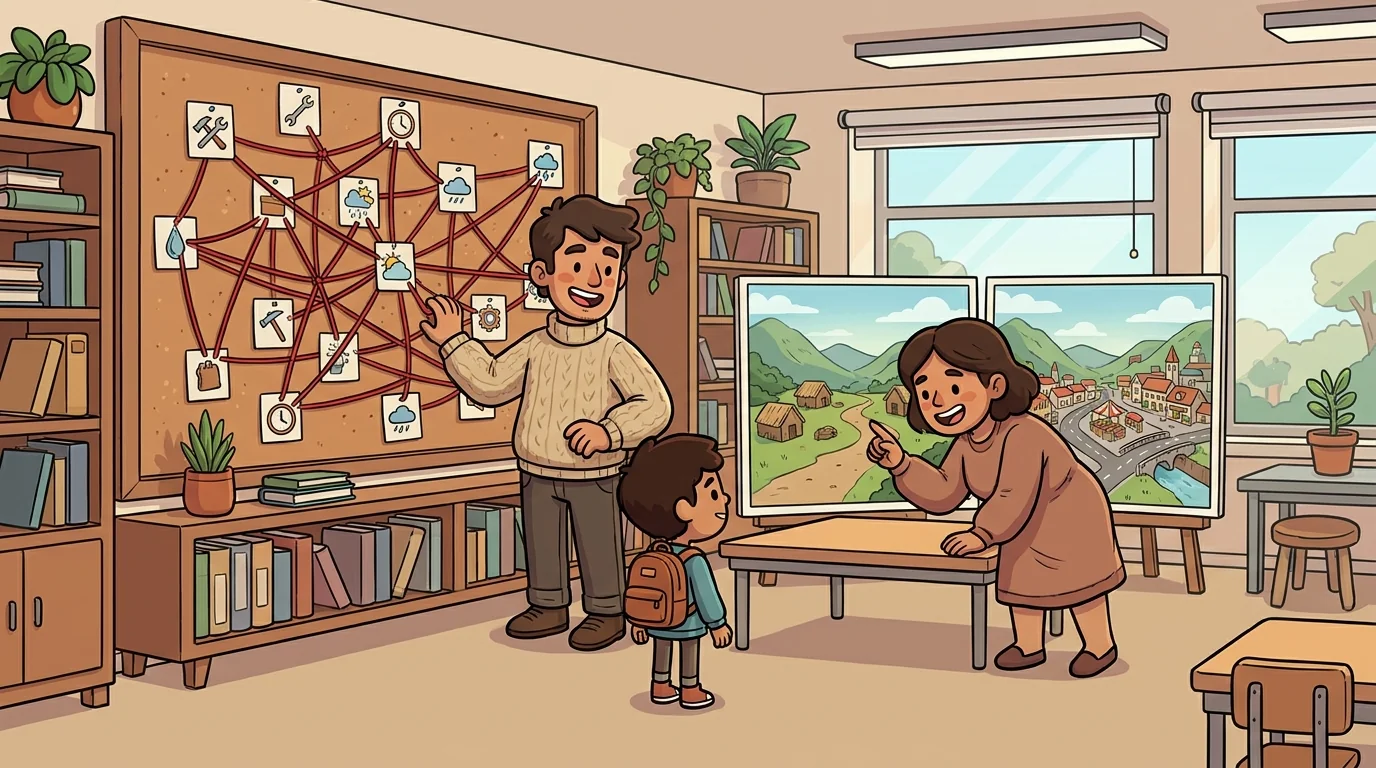
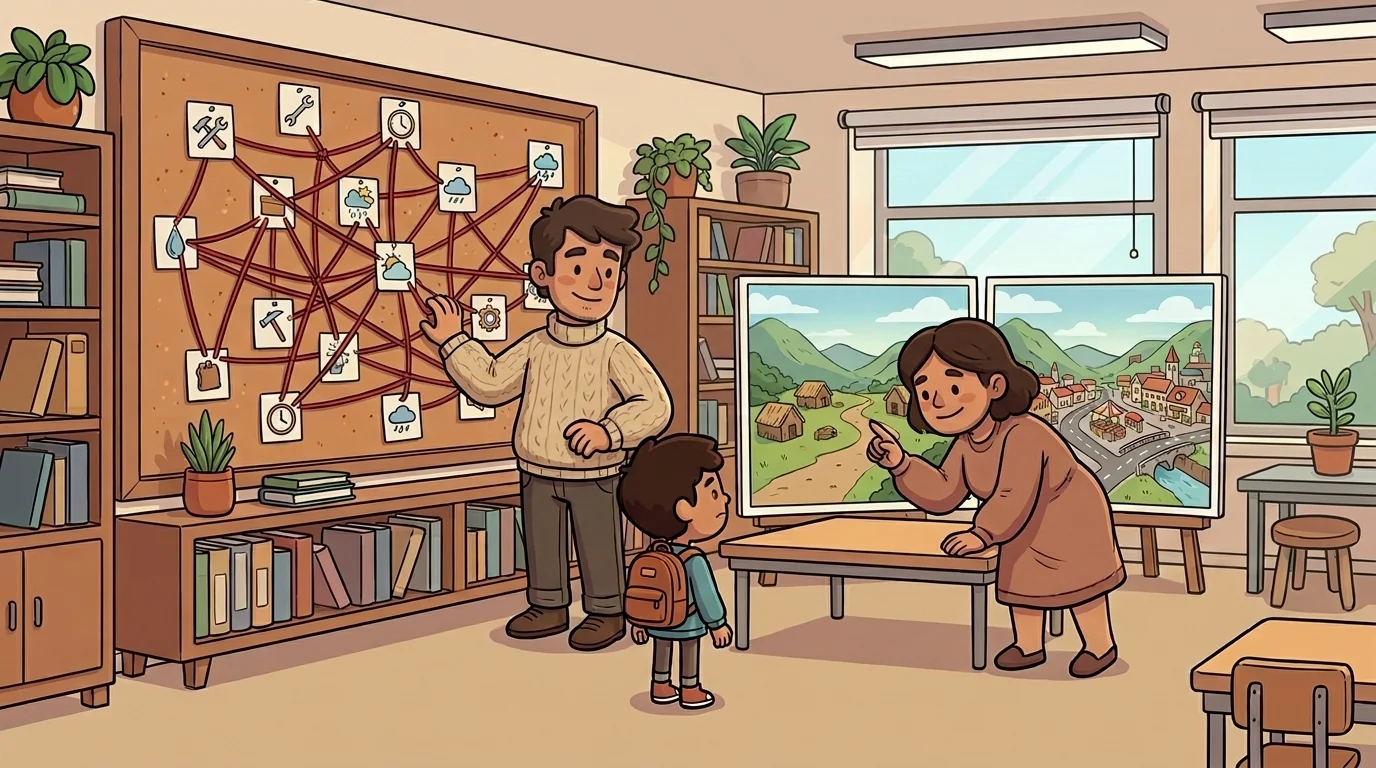
The Thread-Puller pushed his cork wall of red string right up next to the Tide-Watcher's low table of side-by-side pictures, and a student who wandered in found the two of them arguing happily about a single, enormous question.
On the table: two pictures of the same valley, five hundred years apart. In one, a handful of huts and a footpath. In the other, a busy town with roads and bridges and a market square. On the wall behind them: a spiderweb of threads, waiting.
"So the valley changed," the student said, shrugging. "Obviously. What's to argue about?"
"Ah," said the Tide-Watcher, delighted. "That's my half. What changed — and what didn't."
"And this is the argument," said the Thread-Puller, tapping his wall. "Why. A valley doesn't turn into a town by accident. Something pulled it there, thread by thread, year by year."
"He's right, annoyingly," said the Tide-Watcher. "I can show you the what. But a 'what' without a 'why' is just two pictures that don't explain themselves." She smiled at the student. "That's why we pushed our tables together. To understand how an age becomes a different age, you need both of us. You need the change — and you need the reasons that turned the wheel."
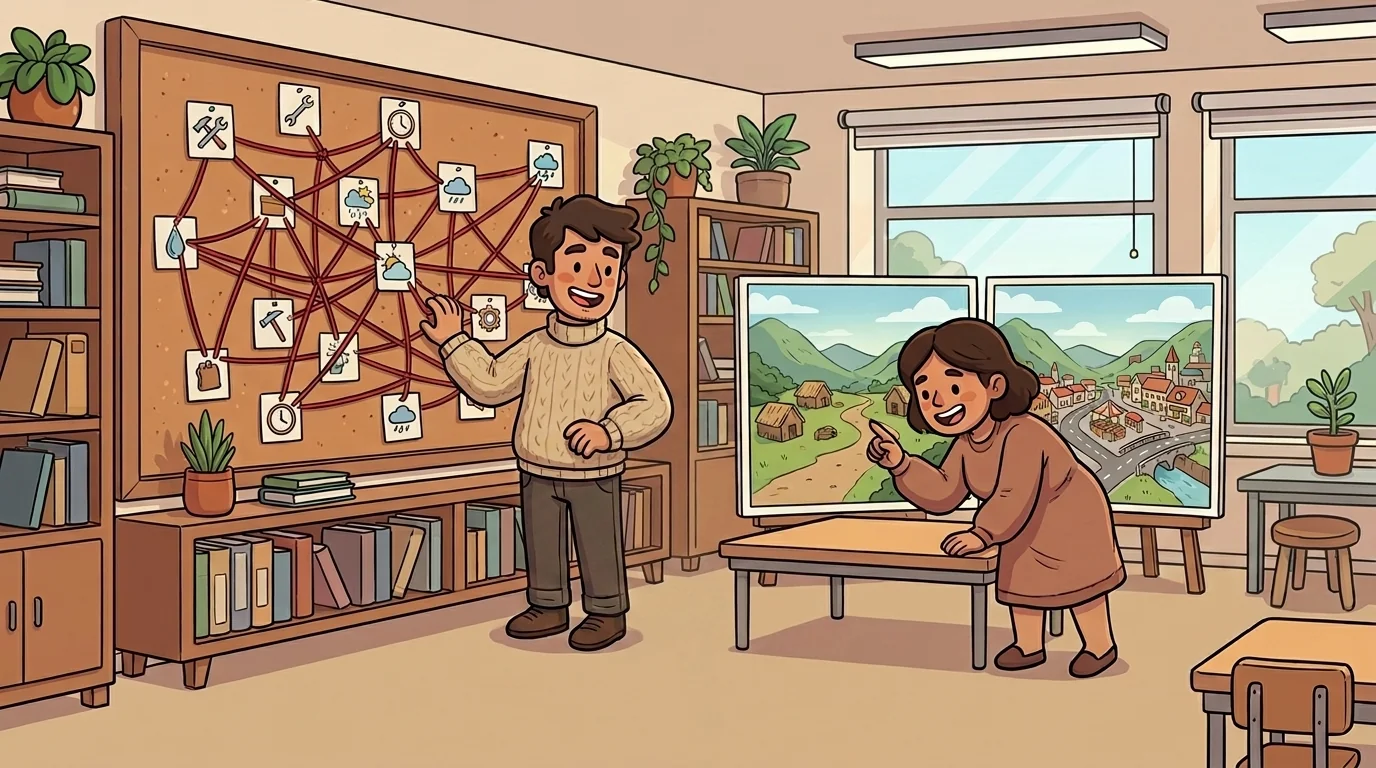
The Tide-Watcher went first, because you have to name the change before you can explain it.
She set the two valley pictures side by side and did her slow back-and-forth. "Here is what changed," she said, pointing. "Huts became houses. A footpath became roads. A few families became a whole town. The tools, the buildings, the number of people — all of it, transformed." Then her finger drifted to the quieter things. "And here is what stayed. The river still runs the same way. People still gather at the water. Children still play where the ground is flat. The shape of the land underneath never moved." She looked up. "So it isn't that everything became different. It's that some things were carried off by the tide, and some things held on. Naming both — that's my whole half of the job. Once you can see exactly what shifted and what endured..." She turned to her table-partner. "...then you can hand it to him."
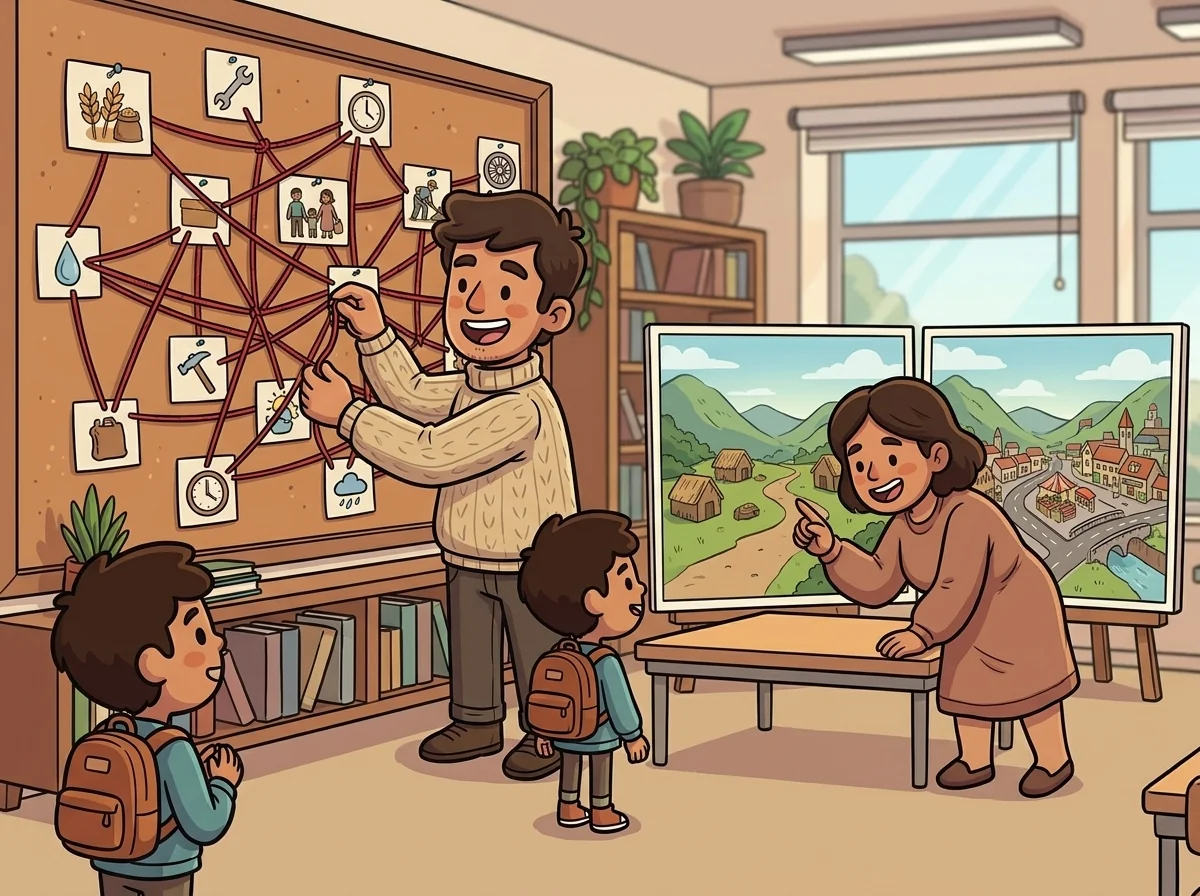
The Thread-Puller took the change she'd named and did what he loved best: he asked it why.
"A footpath became roads," he repeated, and reached for his red thread. "So — why?" He began to tie. "Because more people came. Why did more people come? Because the valley grew food to spare. Why the surplus? Because someone dug channels from the river to the dry fields." He walked the thread up his wall, card to card. "And the channels? Because a clever family arrived, generations back, who knew how to move water — and that's the change the Tide-Watcher can't see in her two pictures, because it happened quietly, in between them." He stepped back and let the student see the whole web. "Every big change she names, I can walk backward into a chain of small reasons. The town didn't appear. It was pulled into being, one decision, one channel, one harvest at a time." He grinned. "She tells you the valley turned. I tell you what turned the wheel."
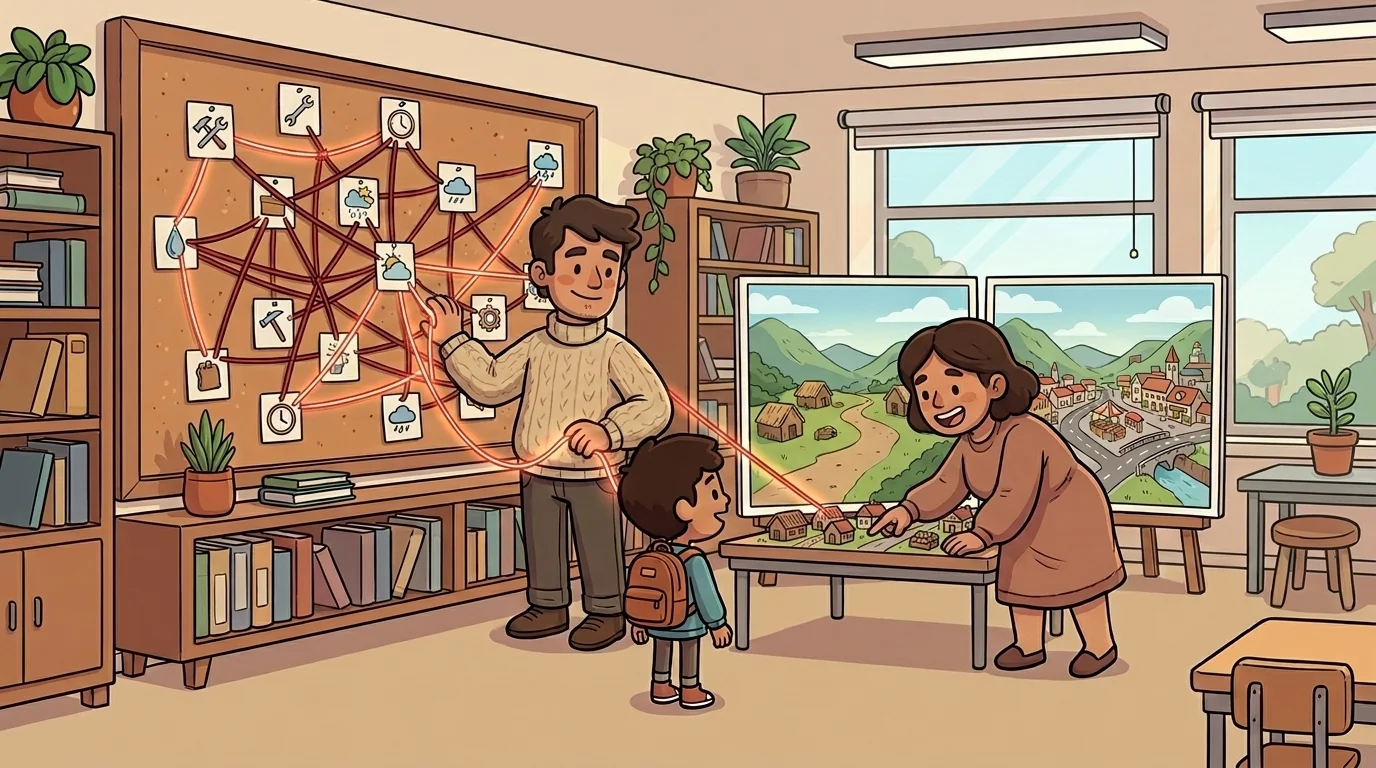
Then they brought their two halves together, and the student watched a valley turn into a town in slow motion.
The Tide-Watcher pointed at each change in turn — huts to houses, path to roads, few to many — and each time, the Thread-Puller reached back to his wall and tugged the thread that pulled it. "Houses," she said. "Because the surplus food let families stay through the winter," he answered, and a thread glowed. "Roads," she said. "Because the market drew traders who needed to haul their carts," he answered, and another thread lit. Change, cause. Change, cause. Down the whole slope of five hundred years.
"See what we're doing?" the Tide-Watcher said softly. "I lay the what on the table. He ties the why to the wall. And when we run them side by side—"
"—the two pictures stop being a riddle," the Thread-Puller finished, "and become a story that moves. Not a valley that magically turned into a town, but a valley that was slowly, reasonably, thread by thread, turned."
The student looked from the glowing wall to the two pictures and back, and something clicked. "The change is the shape of the story," she said, "and the causes are what push it along. You can't have the story with only one of them."
"Both halves," said the Tide-Watcher, and the Thread-Puller nodded, "always both."
Later, when the two tables had gone quiet, the student stayed, looking back and forth between the pictures and the web.
"But which one is the real story?" she asked. "The what, or the why? If I could only keep one?"
The Thread-Puller and the Tide-Watcher looked at each other, and this time it was the Tide-Watcher who spoke.
"That's the trick," she said gently. "You can't keep only one. A change with no reasons is a magic trick — a valley that becomes a town for no cause at all. Nobody learns anything from magic." She touched her pictures. "And reasons with no change are just a list of small events going nowhere in particular."
"You need both," said the Thread-Puller, "sitting at the same table. What shifted, what stayed — and the thread of reasons underneath, slowly turning the one into the other." He rested a hand on his wall. "That's when the past stops being a set of surprising pictures and becomes something you can actually understand. Something that moved for reasons, the way your own life moves for reasons."
"It's my favorite feeling," the Tide-Watcher admitted, and the Thread-Puller nodded like he'd been about to say the same. "That deep, satisfied settling in your chest — when a change you'd only stared at before suddenly makes sense. When you can see both the wave and the reason it broke where it did." She smiled. "The valley didn't just become a town. It became a town because, over years, for reasons you can name. And once you can hold the change and its causes together, the whole long history of a place opens up in front of you like a road you can walk."
The student looked from the pictures to the glowing web and back, and for the first time the five hundred years between the two valleys didn't feel like a gap. It felt like a slope she could see all the way down.
"Show me another one," she said. "A change and its reasons. Both halves."
"Both halves," the two of them said together, and pulled their tables a little closer.
Hear it as an audio drama
A short play starring The Thread-Puller & The Tide-Watcher, from ChronoQuest. Different voices, same idea. Listen any time after you read.
Loading audio…
Read the drama script
- Narrator: From Spark and Anvil and ChronoQuest — this is The Thread-Puller & The Tide-Watcher, in chapter 1 of the ChronoQuest cast.
- Narrator: This drama uses an AI-generated voice. Voiced via Gemini 2.5.
- Narrator: This story covers difficult moments in history. Parents may want to listen first.
- Narrator: The Thread-Puller pushed his cork wall of red string right up against the Tide-Watcher's low table of side-by-side pictures. A student wandered in to find the two of them arguing happily over one enormous question.
- Narrator: On the table: two pictures of the same valley, five hundred years apart. In one, a few huts and a footpath. In the other, a town with roads, bridges, and a market square.
- Student: So the valley changed. Obviously. What's to argue about?
- Tide-Watcher: Ah — that's my half. What changed, and what didn't.
- Thread-Puller: And this is the argument. Why. A valley doesn't become a town by accident. Something pulled it there, thread by thread, year by year.
- Tide-Watcher: He's right, annoyingly. I can show you the what. But a what with no why is just two pictures that refuse to explain themselves.
- Narrator: The Tide-Watcher went first, because you must name the change before you can explain it.
- Tide-Watcher: Huts became houses. A footpath became roads. A few families became a whole town. And here is what endured — the river still runs the same way. People still gather at the water. The shape of the land never moved.
- Narrator: Then the Thread-Puller took the change she'd named and asked it why.
- Thread-Puller: A footpath became roads — so, why? Because more people came. Why? Because the valley grew food to spare. Why the surplus? Because someone dug channels from the river to the dry fields.
- Thread-Puller: The town didn't appear. It was pulled into being — one decision, one channel, one harvest at a time. She tells you the valley turned. I tell you what turned the wheel.
- Narrator: Then they brought their halves together, and the student watched a valley become a town in slow motion.
- Tide-Watcher: Houses.
- Thread-Puller: Because the surplus food let families stay through the winter.
- Tide-Watcher: Roads.
- Thread-Puller: Because the market drew traders who needed to haul carts.
- Student: The change is the shape of the story, and the causes are what push it along. You can't have the story with only one of them.
- Tide-Watcher: Both halves. Always both.
- Student: But which is the real story — the what, or the why? If I could only keep one?
- Thread-Puller: You can't keep only one. A change with no reasons is a magic trick — a valley that becomes a town for no cause at all. And reasons with no change are just a list of small events going nowhere.
- Tide-Watcher: You need both, at the same table. What shifted, what stayed — and the thread of reasons underneath, slowly turning one into the other.
- Narrator: And the student looked from the pictures to the glowing web, and the five hundred years stopped feeling like a gap. It felt like a slope she could see all the way down.
- Student: Show me another one. A change and its reasons. Both halves.
- Thread-Puller: Both halves.
- Tide-Watcher: Both halves.
- Narrator: You've been listening to a Spark and Anvil chapter, written by the Spark and Anvil writing team for ages 9 to 14.
- Narrator: Apps stay free forever.
- Narrator: Curriculum aligned to C3 social studies.
- Narrator: If anything in this story brought up big feelings, talking to a trusted adult helps. You can also reach support lines anytime.
- Narrator: Released under Creative Commons BY-NC-SA 4.0 for educational reuse. Visit Spark and Anvil for the full transcript.
The ChronoQuest ensemble
The Thread-Puller & The Tide-Watcher is one of the friends in ChronoQuest. Each friend shows you one idea by how they act; meet them all and you have the whole subject.
-

The Cartographer
Frame-setter — where + when before what + why; methodological starting point
-

The Witness
Primary-source lens — what did people THERE see + write?
-

The Storykeeper
Oral-tradition lens — multi-tradition keeper-archetype; invented + non-mascotizing
-

The Trade-Wind
Connection lens — what moved between civilizations? goods, ideas, diseases
-

The Counter-Voice
Critical-analysis lens — who benefits from this version? historian's method, NOT cynicism
-

The Chronicler-of-the-Defeated
Stewardship lens — whose story doesn't survive in the winners' archive?
-

The Translator
Cross-language + cross-meaning lens — how do concepts travel between cultures?
-

The Question-Asker
Meta-inquiry lens — what question are we actually asking? late-arriving capstone guide
-

The Thread-Puller
Cause-and-consequence lens — follow the thread back to its causes and forward to its effects
-
The Tide-Watcher
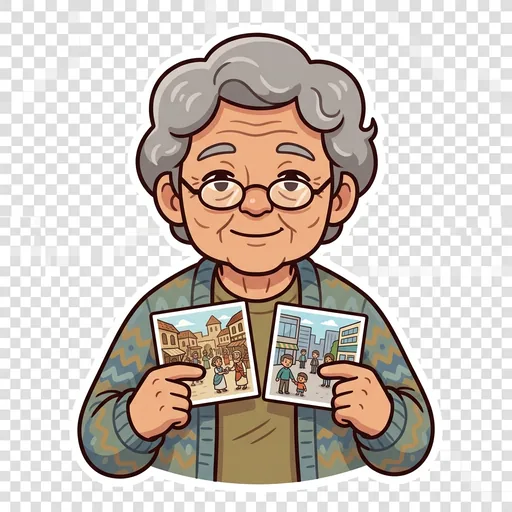
Change-and-continuity lens — hold two times side by side and mark what shifted and what stayed