
Berm
RESILIENCE — *designing a city to bend and absorb instead of break; raised earth, green banks, and room-for-water so a storm passes through without wrecking the place. Planning for the flood before it comes.*
Loading audio…
Press play to listen along. The line being read lights up as you go.
Show full transcript
Loading transcript…
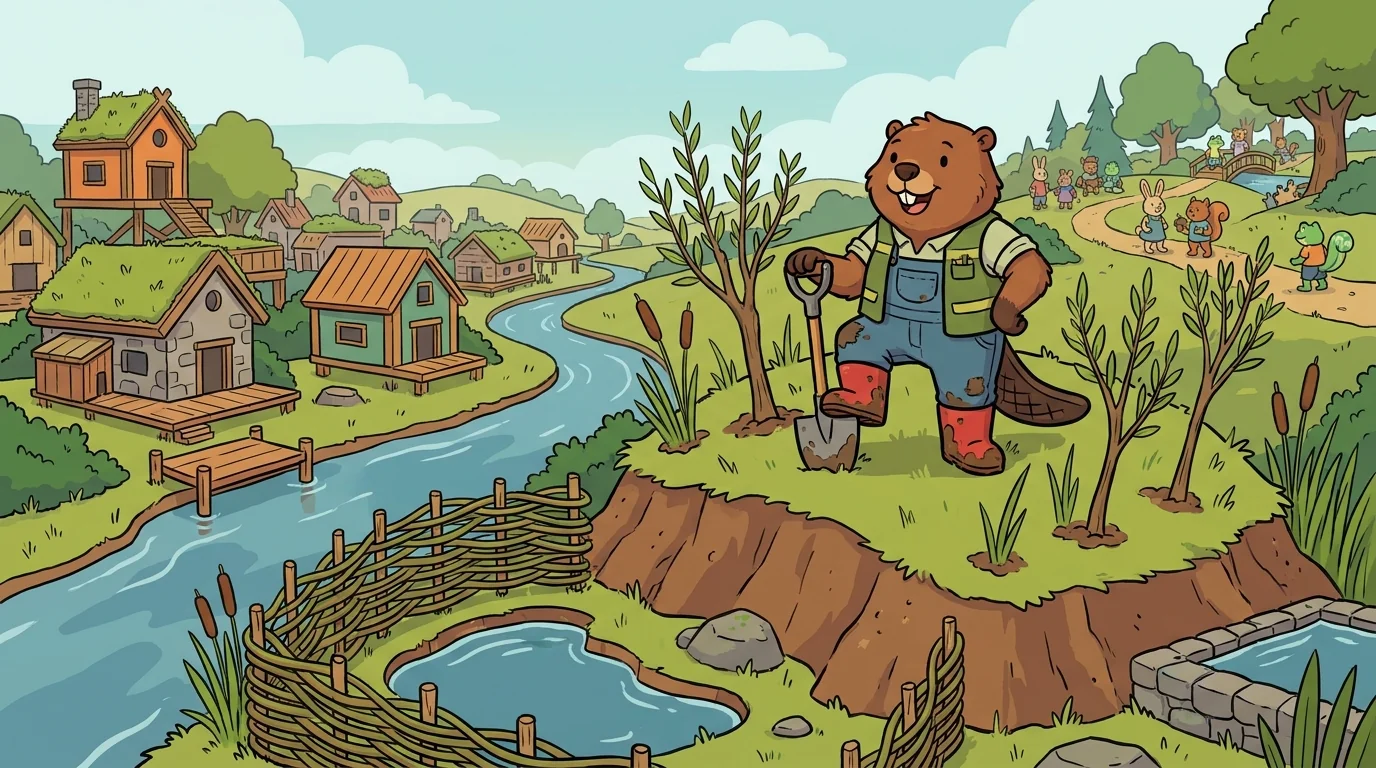
Berm wore knee-high rubber boots caked with three distinct shades of river mud. She spent her mornings out on the lower floodplain of Cityforge, leaning on a flat-bladed spade. While the rest of the town argued about blueprints and budgets, Berm shoveled.
She was building what looked to most passersby like an enormous, lazy pile of dirt.
"That's not an engineering project," Alden Gable told her on a chilly Tuesday morning. Gable was the town's chief surveyor, and he carried a brass transit under his arm like a ceremonial sword. "That is an irregular lump. It looks like a sleeping mule under a green blanket."
Berm wiped her brow with the back of her canvas glove. "It's a berm, Mr. Gable. A raised embankment of compacted subsoil, sloped at three to one, planted with deep-root switchgrass."
"It's dirt, Berm." Gable tapped the sole of his polished boot against the slope. "When the river rises, dirt washes away. Concrete stays where you put it."
"Concrete stays where you put it until the river breaks it," Berm said mildly. "Then it goes wherever the water wants."
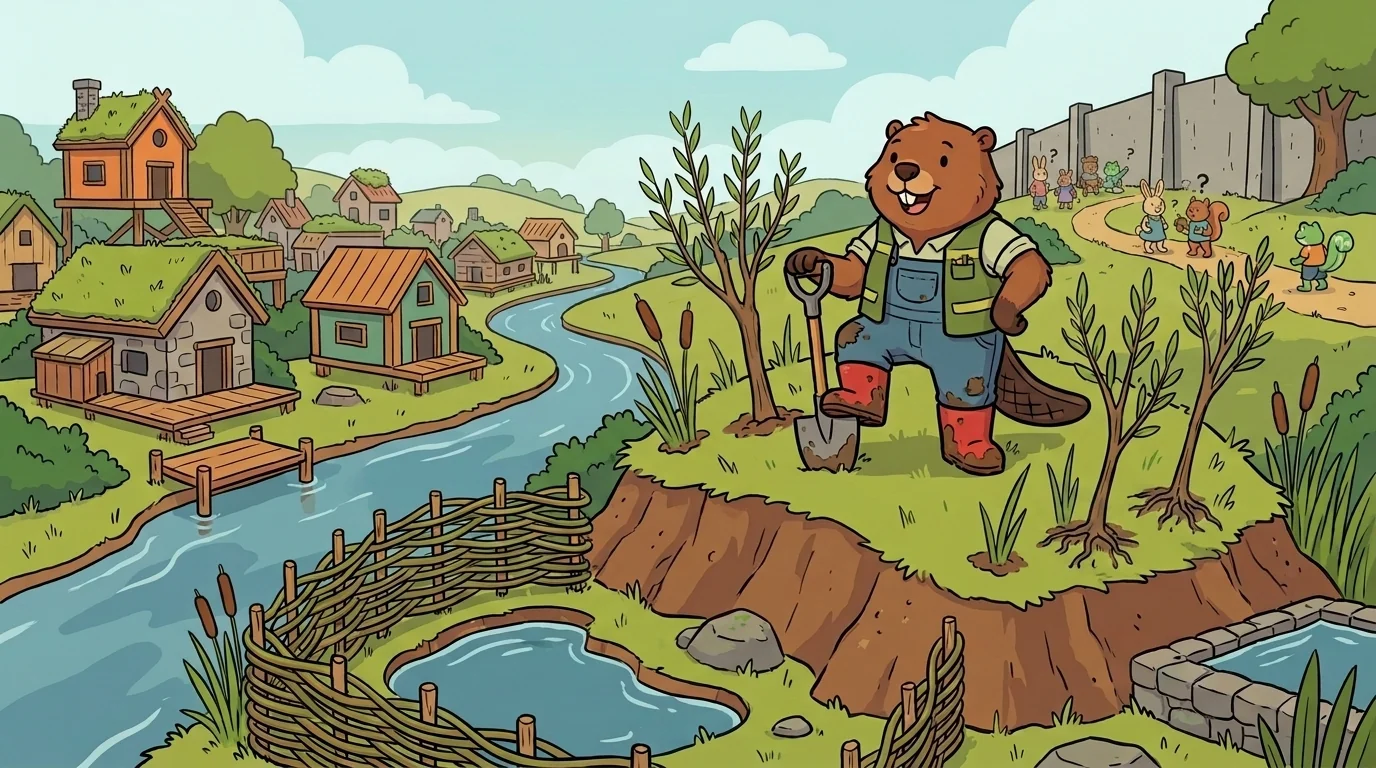
Cityforge sat tucked inside a sharp bend of the Blackwater River. Every spring, snowmelt from the high ridges turned the stream into a churning brown soup. Every few autumns, three straight days of rain pushed the channel past its banks. Everyone in town knew a catastrophic flood was coming sooner or later. The only disagreement was what to do about it.
The City Council had already voted for Gable's plan. They called it the Great North Rampart.
For eight straight months, heavy flatbed trucks hauled gray Portland cement and steel rebar down to the riverfront. Crews poured a vertical barrier seven feet high, straight as a ruler, sealing off the waterfront completely. It stood stiff and gray against the sky. It felt like an army fortress. From behind the wall, the merchants on River Street couldn't see the water anymore, but they felt safe. A wall was something you could rap your knuckles against. A wall was an iron fist in the face of nature.
Berm, meanwhile, worked two hundred yards downstream in the municipal flats.
She had not been given a concrete budget. She had been given permission to landscape the overflow acreage because the council thought it would keep her quiet. Berm used her time to dig sunken swales, step the banks into broad terraces, and grade wide, shallow bowls into the soccer fields. Along the crests she piled heavy clay, packing it down with a hand-tamper before seeding it with dogwood, willow stakes, and stiff wetland reeds.
Her crew consisted of two teenagers from the harbor district and an old flat-bottom barge full of river gravel.
"If you make a wall tall enough," one of the young diggers asked, resting on his shovel, "doesn't the water have to stop?"
"Water doesn't know how to stop," Berm replied, setting a bundle of dormant willow cuttings into a trench. "It only knows how to fall downhill and fill empty space. If you pinch a garden hose, the water shoots out faster, right?"
The boy nodded.
"A vertical wall pinches the river," she said. "The channel gets narrower. The current gets deeper and moves faster. It builds up hydraulic head—pressure that stacks up behind the face. You're just daring the river to find a single hairline fracture."
"And what are we doing here?"
"We're setting the table," Berm said with a faint grin. "Giving it somewhere harmless to sit down."

The storm arrived in late October. It did not come as a sudden cloudburst. It began as a cold, relentless drizzle that soaked the high pine woods for four straight days. By Friday night, the soil in the hills was fully saturated. Runoff poured down the gullies, stripping topsoil and snapping cedar branches.
The Blackwater River swelled until its current turned the color of milky coffee.
Down on River Street, townspeople gathered on their balconies to watch the water test the Rampart. Gable stood near the center pier with an umbrella and a spotlight, checking the expansion joints. The river was four feet higher than normal and climbing by three inches an hour.
Against the Great North Rampart, the river had nowhere to go. It hit the flat concrete face with a wet, heavy thud, throwing spray up into the streetlamps. Because the channel had been narrowed by the wall, the water could not spread out. Its energy concentrated into a fast, violent chute. Logs and debris rammed the concrete like battering rams. With every passing hour, the depth increased, and with depth came crushing force.
Downstream, the water reached Berm's green terraces.
There was no drama in the meeting. The rising brown water crested the low bank and slid into the first sunken swale. The switchgrass bent under the current, laying flat to form a protective carpet over the topsoil. The river spread wide, spilling out across fifty yards of graded gravel and open parkland.
As the floodwater widened, it slowed down. The violent current lost its punch. Thousands of gallons spilled gently into the empty soccer field, filling the shallow bowl until it looked like a calm lake. Willow roots anchored the earth underneath, drinking up moisture and knitting the mud together.
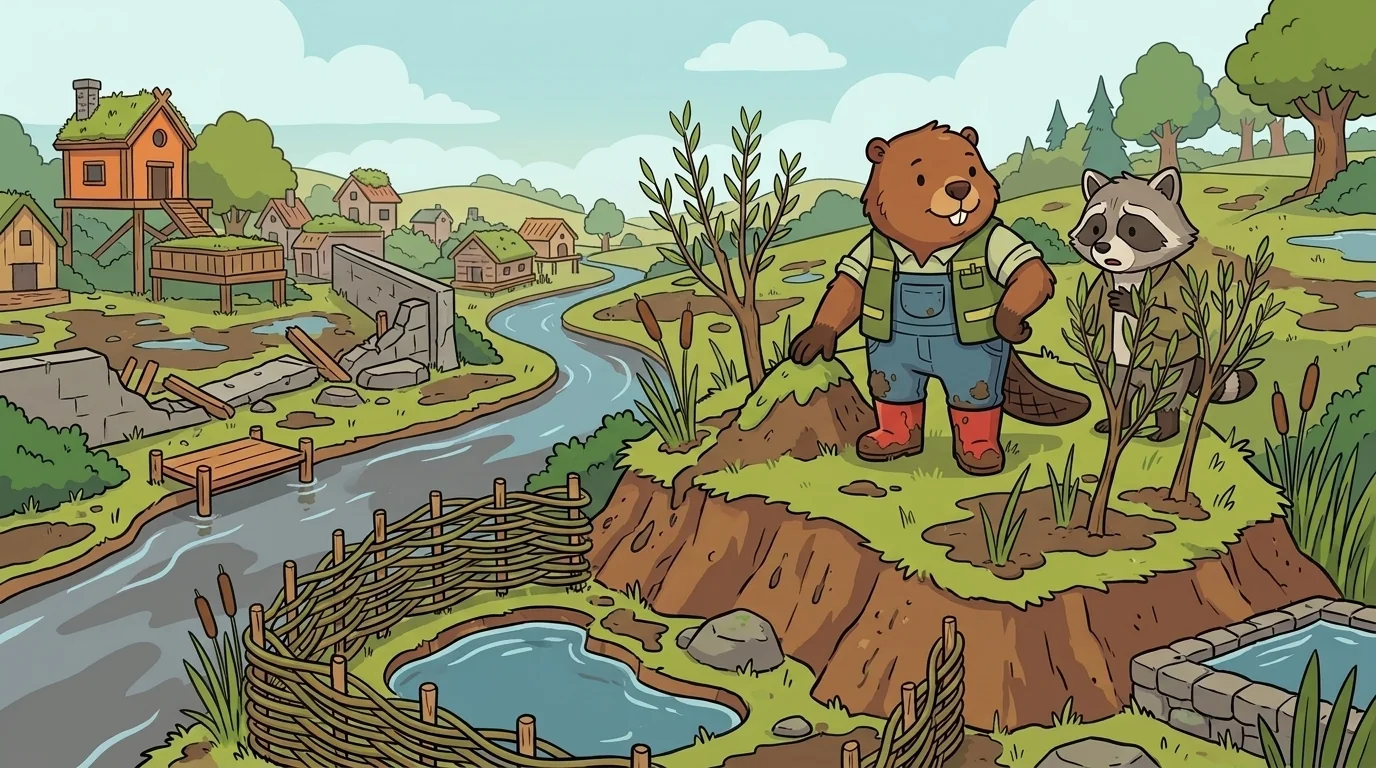
Around three in the morning, the wind picked up. The river rose another six inches, reaching the top lip of Gable's concrete fortress.
Berm stood on the high ridge of her main embankment, shining her lantern across the lower flats. Her boots were sunk two inches into the wet turf, but the crest held firm. Water was lapping at the second terrace below her, moving sluggishly through the reed beds. The river was massive, but it was quiet.
A sharp, booming crack echoed from upstream.
It sounded like a cannon shot in a tunnel. Berm turned her head toward River Street.
A fifty-foot section of the Great North Rampart had developed a shear crack along its base. Under the immense hydraulic pressure of the penned-in river, the concrete gave way all at once. It did not leak or weep. It simply snapped.
The wall blew outward in jagged slabs. The pent-up river roared through the gap in a churning wall of brown water. It swept over the curb, swamping storefronts, knocking over delivery wagons, and flooding the basements of four city blocks in less than two minutes.
The rigid thing had held perfectly until the moment it shattered completely.
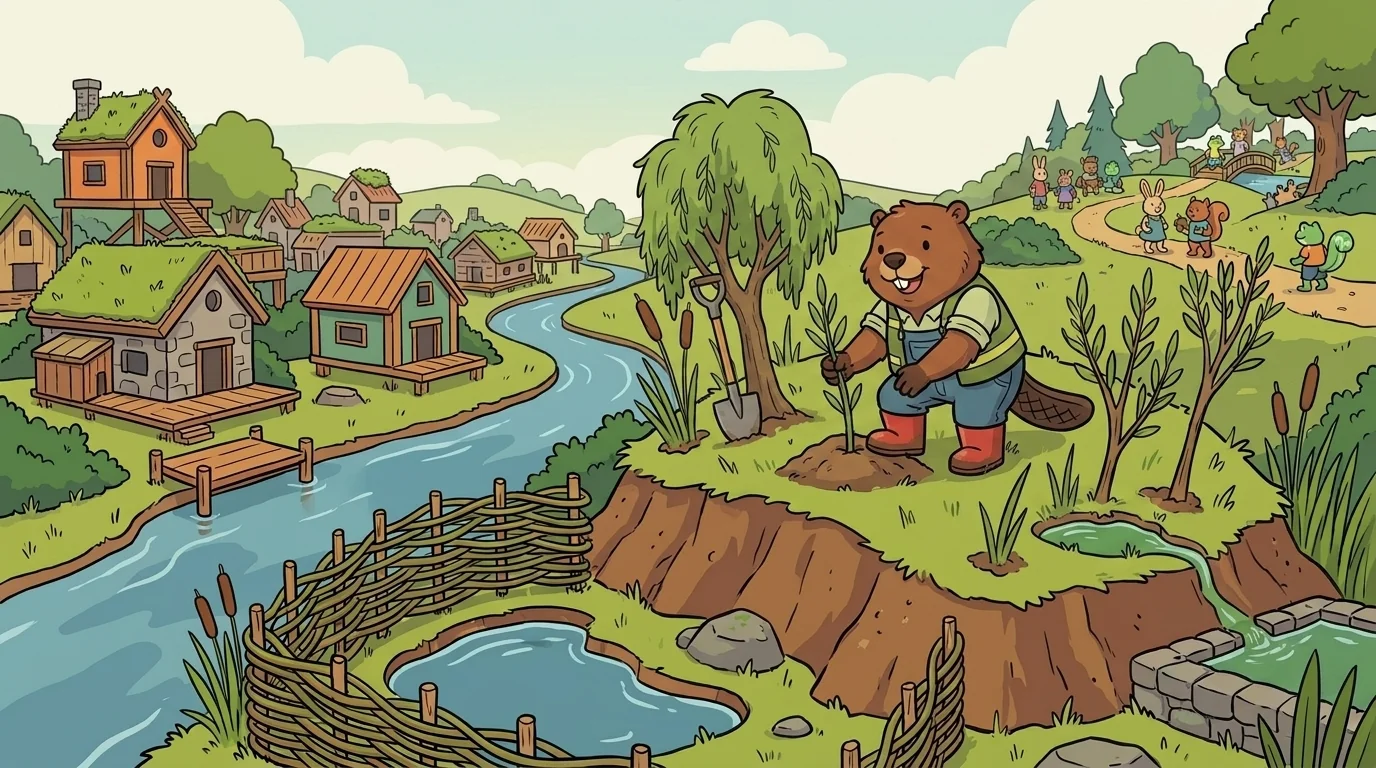
By Sunday afternoon, the storm clouds parted into a pale autumn blue. The river began its slow retreat back into its summer banks.
Down on River Street, the damage was catastrophic. Shovels scraped silt from ruined bakery floors. Gable sat on an overturned crate near the shattered wall, his ledger soaked and his uniform streaked with mud.
He walked downstream an hour later, his boots dragging through the debris.
Berm was down in the park with a wheelbarrow, raking drifted twigs off the young willows. The soccer field was still full of standing water, but it was draining steadily through the gravel sumps she had buried beneath the turf. The main earthen bank was entirely intact. The grass had sprung back up, green and glistening in the sun. Behind her embankment, the lower residential streets were bone-dry.
Gable stared at the low, grassy ridge. "The concrete was eight inches thick," he said, his voice flat with disbelief. "We reinforced it with steel rods every six inches. Your bank is just dirt and grass."
"That's why it survived," Berm said, setting her rake aside.
Gable frowned at the mud on his sleeves. "Dirt has no tensile strength."
"Individually, no," Berm said. "A handful of dirt is nothing. But packed into a slope and bound with root systems, it breathes. It absorbs water. It lets the river spread out and lose its speed. Your wall tried to pick a fight with gravity. My berm made an agreement with it."
Gable looked out across the flooded park. A pair of wild mallards had already landed in the temporary lake, paddling calmly among the submerged goalposts.
"You planned for it to flood right here," he said softly.
"Of course," Berm said. "The river needs a place to go. If you don't give it one, it will make its own."
She picked up a bundle of willow cuttings and her mallet. Walking to a spot where the silt had gathered along the lower swale, she drove a fresh stake deep into the soft, rich earth. She didn't need a monument. She just needed room for the world to bend.
The CityForge ensemble
Berm is part of CityForge's distributed-narrative cast. Each character embodies a different curricular primitive; together they teach the full subject.
-

Block
Zoning + density — the badger-tween with clay-block models who teaches zoning as 'plan for the neighbors first, not the buildings'
-

Stoop
Public space + community — the capybara-elder on a wooden stoop who treats public space as the city's living room, foregrounding existing stoop-cultures (Brooklyn / Latin American plazas / Italian piazzas / West African gathering trees)
-

Lane
Walkability + mobility — the rabbit-tween in safety-vest with a chalk-spool who teaches streets-as-spaces ('streets are rooms; cars are guests, not owners')
-

Hub
Transit nodes — the pangolin-tween in conductor-vest who teaches that transit is about ACCESS, not about cars-vs-trains ('many ways, equal ways; the bus matters as much as the train')
-

Dwell
Housing equity + repair — the owl-elder in a mended quilted-coat who teaches anti-displacement, repair-not-replace urbanism ('repair before replace; listen before plan; the people who live here ARE the design')
-

Canopy
Green infrastructure — trees and parks cool the city and soak up rain; shade placed where it is needed most
-

Mix
Mixed-use land use — weave homes, shops, and work close so daily life is a short walk
-

Seam
Edges and connection — a highway can rip two neighborhoods apart; design can stitch them back
-

Conduit
Infrastructure — the badger who tends the hidden pipes, wires, and drains beneath every street