Mix
MIXED-USE — *weave homes, shops, and work together so daily life is a short walk, not a long drive.* The urban-equity primitive of *land-use variety — the fifteen-minute neighborhood where what you need is close, which matters most to people who can't drive.*
Loading audio…
Press play to listen along. The line being read lights up as you go.
Show full transcript
Loading transcript…
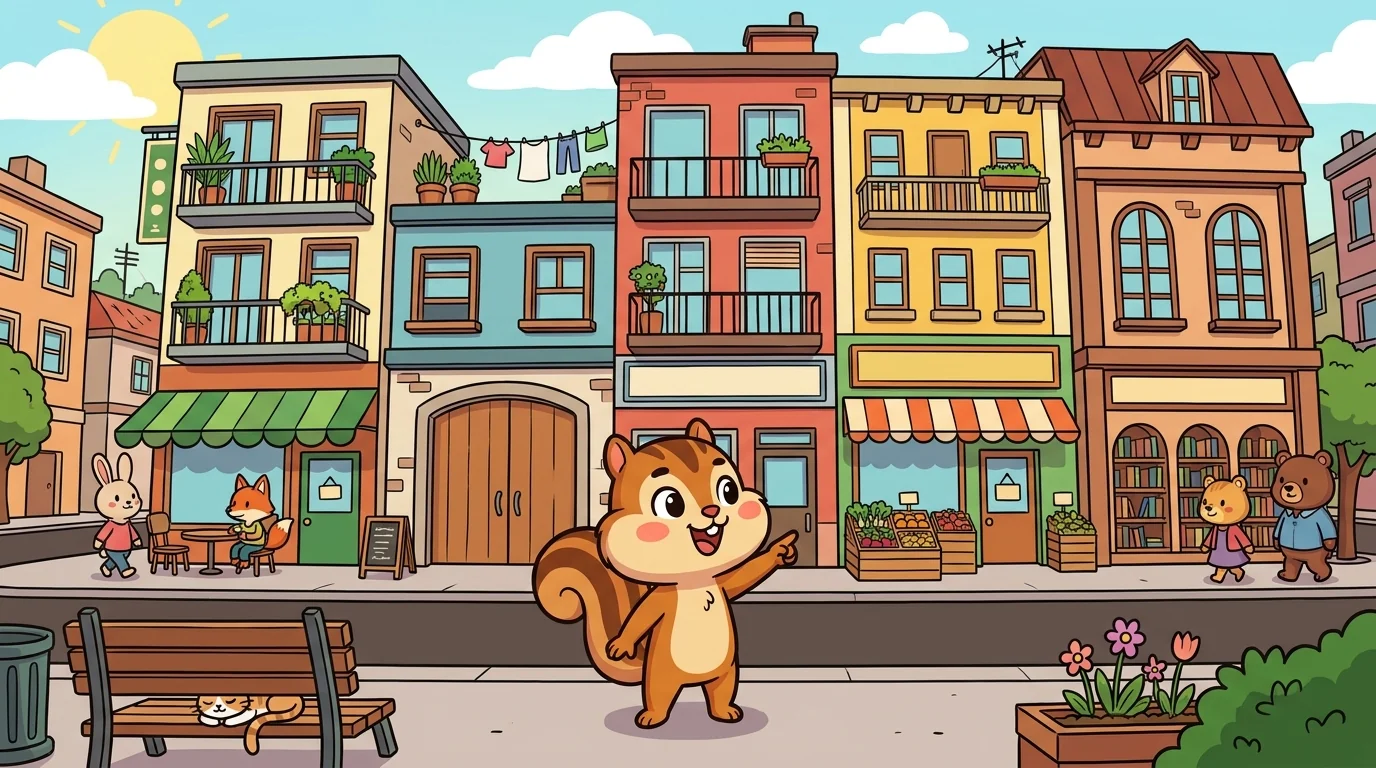
Mix was a young chipmunk who could never do just one thing at a time, and thought a good street shouldn't either.
She scampered along a lively block with her cheeks full and her eyes bright, pointing: "Homes up there. A little shop here. A workshop next door. A café, a library, a bench — all on one street." She loved a street that did many jobs at once. "This," she'd say, "is mixed-use. Homes and shops and work, all woven together, so daily life is a short walk instead of a long drive."
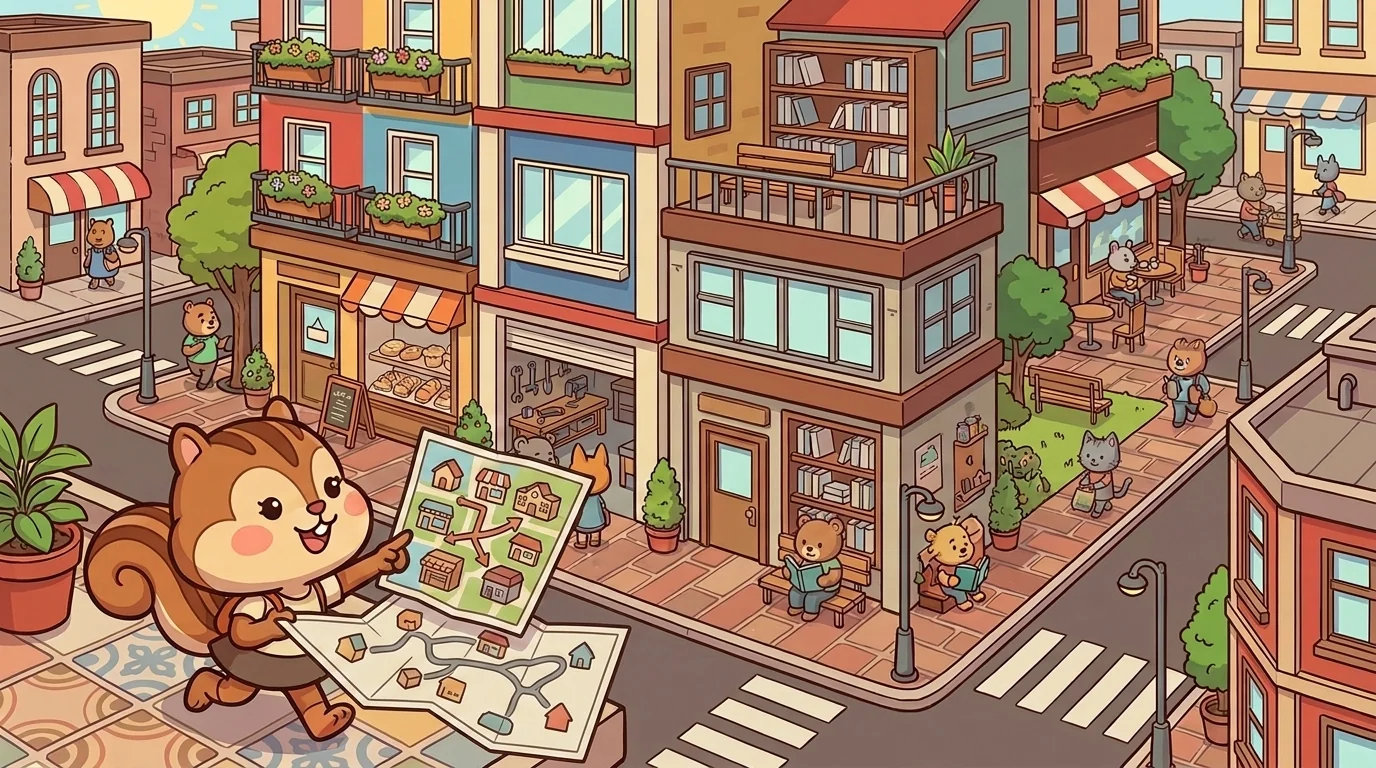
Mix taught mixed-use land use — the idea that a neighborhood works best when different things sit close together, rather than being sorted into a zone of only-houses here and only-shops far over there. "When everything is separate," she explained, "you have to travel for every little thing — and that's fine if you have a car. But if you're a kid, or you're old, or you just can't drive, a spread-out neighborhood traps you." She called the good version the fifteen-minute neighborhood: the everyday things you need, reachable in a short walk.
She loved to prove it with two maps. One showed a place where homes, shops, and school were far apart — "a place you can only live in with a car." The other wove them together — "a place a nine-year-old can actually get around." Same amount of stuff, she'd point out. Just closer, and mixed. "Nearness is freedom," she said, "especially for whoever can't drive."

Mix held the urban-equity gate carefully. "Mixed-use isn't about cramming everything in," she said. "It's about who gets to be independent. A spread-out, car-only neighborhood quietly says only drivers belong here. A mixed one says everyone can get around." And she honored what was already there — the corner store that had served a block for forty years, the workshop that was part of the street's life. "Repair the mix that exists before you bulldoze for a new one," she'd say, echoing Dwell. "The old corner store is the mix. Don't replace it — protect it."
Mix came from a burrow-network where every tunnel led to several things at once — pantry, nursery, workshop, all close. When she visited a cousin's colony built as long, single-purpose tunnels — sleep way over here, food way over there — she watched the youngest and oldest get stranded, unable to make the long trips alone. She understood her craft then: a neighborhood should let the people who can't travel far still reach what they need.
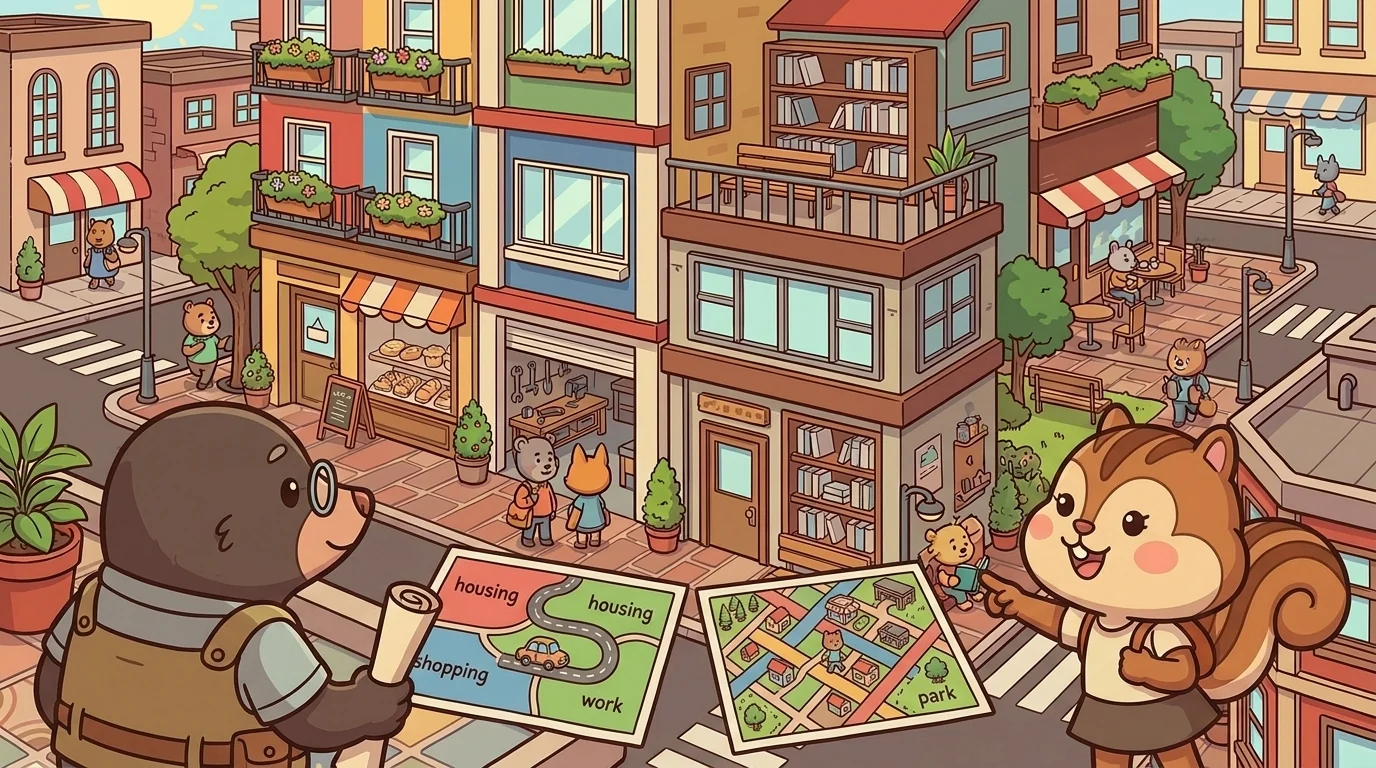
One day Plumb, the CityForge mentor, scurried up beside her.
"What is mixed-use?" Plumb asked.
Mix pointed down her lively street. "It's weaving homes, shops, and work close together so daily life is a short walk, not a long drive," she said. "It's the fifteen-minute neighborhood — and it matters most to whoever can't drive: kids, elders, anyone without a car. Nearness is freedom." Plumb nodded. "You are appointed," he said.
In her lessons, Mix hands out the two maps — spread-out vs woven — and asks the students to imagine getting around each one as a nine-year-old with no ride. Then they redesign the spread-out one to bring daily life within a walk.
She teaches her students a few habits about mixed-use: Weave, don't sort. Homes, shops, and work close together beat everything sorted into far-apart zones. Aim for the fifteen-minute walk. The everyday things — food, school, a friend, a bench — should be reachable on foot. Nearness is freedom, especially for non-drivers. Ask "could a kid or an elder get around here alone?" If not, it's too spread out. Protect the mix you already have. The old corner store, the neighborhood workshop — those ARE mixed-use. Repair before replace. * Mixed-use makes streets alive and safer. People around all day — living, shopping, working — means more eyes and more life than an empty single-use zone.
Mix tells her students, "My first designs sorted everything neatly into zones, and they looked so tidy — and they stranded everyone who couldn't drive. That's not a failure. That's the tidy map showing you who it forgot. You weave it back together."
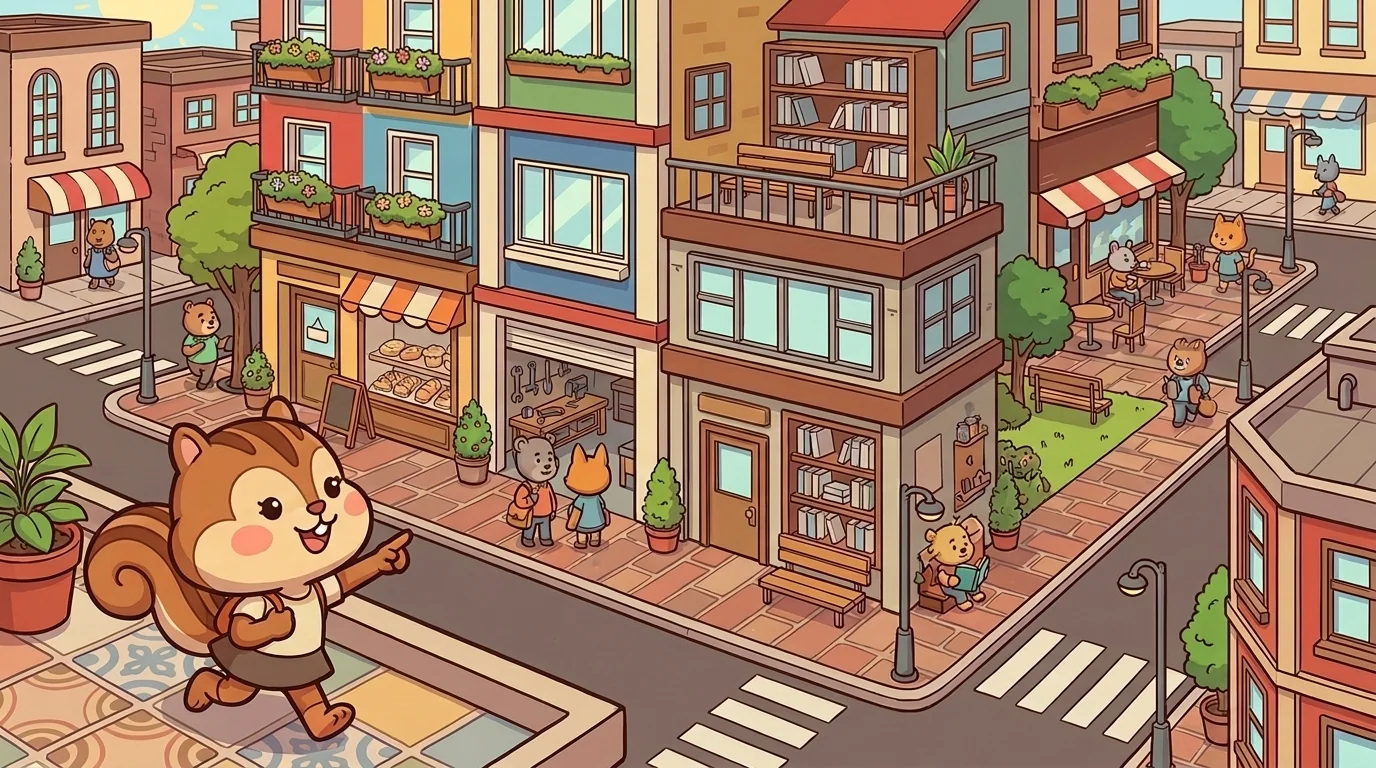
When a student asks whether mixing things up just makes a messy neighborhood, Mix always answers the same bright, quick way:
"Not messy — alive. And free. When what you need is close, a kid can reach it, an elder can reach it, everyone can. That closeness is the whole gift."
Mix pauses on her lively corner where a neighbor waves, a shop door swings, and a bench sits a few steps away, everything within reach, and the stranded feeling she watched in the long single-purpose tunnels has warmed into an everything-within-reach gladness — the contentment of a street that lets everyone get around.
The CityForge ensemble
Mix is part of CityForge's distributed-narrative cast. Each character embodies a different curricular primitive; together they teach the full subject.
-

Block
Zoning + density — the badger-tween with clay-block models who teaches zoning as 'plan for the neighbors first, not the buildings'
-

Stoop
Public space + community — the capybara-elder on a wooden stoop who treats public space as the city's living room, foregrounding existing stoop-cultures (Brooklyn / Latin American plazas / Italian piazzas / West African gathering trees)
-

Lane
Walkability + mobility — the rabbit-tween in safety-vest with a chalk-spool who teaches streets-as-spaces ('streets are rooms; cars are guests, not owners')
-

Hub
Transit nodes — the pangolin-tween in conductor-vest who teaches that transit is about ACCESS, not about cars-vs-trains ('many ways, equal ways; the bus matters as much as the train')
-

Dwell
Housing equity + repair — the owl-elder in a mended quilted-coat who teaches anti-displacement, repair-not-replace urbanism ('repair before replace; listen before plan; the people who live here ARE the design')
-

Canopy
Green infrastructure — trees and parks cool the city and soak up rain; shade placed where it is needed most
-

Seam
Edges and connection — a highway can rip two neighborhoods apart; design can stitch them back
-

Berm
Climate resilience — the beaver who builds soft green earthworks that bend and soak up floods instead of walling them out
-

Conduit
Infrastructure — the badger who tends the hidden pipes, wires, and drains beneath every street