
Block
ZONING + DENSITY — *plan for the neighbors first, not the buildings.* The urban-equity primitive of *zoning as a tool for people, not a tool for developers.*
Loading audio…
Press play to listen along. The line being read lights up as you go.
Show full transcript
Loading transcript…
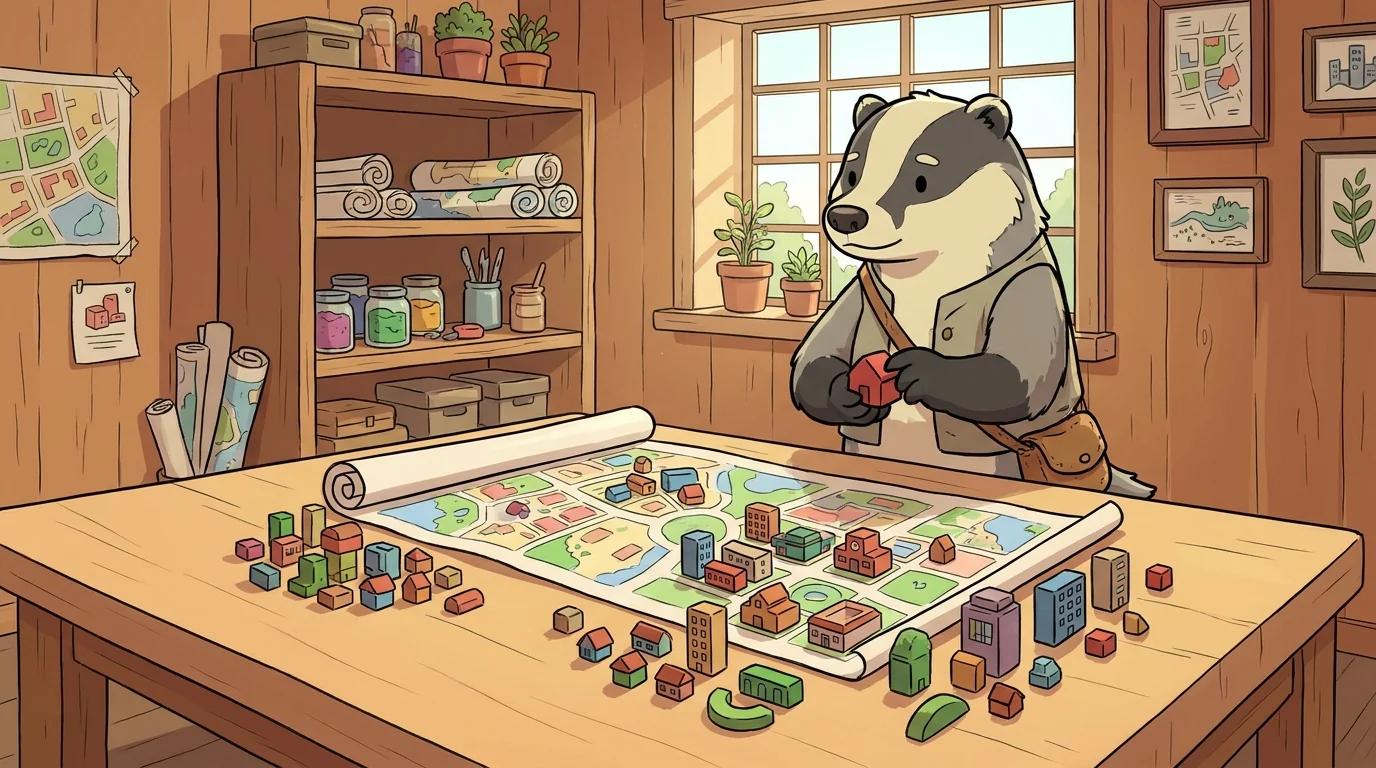
The demolition crew had already cleared three lots when Block arrived, and the developer's map showed a wall of identical towers going up where the corner had been. Block knelt on the cracked pavement instead, opened the worn leather pouch on her belt, and began setting out clay-blocks in the dust. She was a badger-tween, small and sturdy, gray and cream and soft black, with steady eyes that kept drifting to the people rather than the blueprints — the grandmother watering pots on a stoop, the kids cutting across the lot to school, the man who ran the little shop that wasn't on anyone's map.
"Before we build," Block said, not looking up, "who already lives here?"
The foreman blinked. Nobody had asked him that. Block laid a flat square down for the school that was still standing, a long rectangle for the shop, a scatter of tiny house-blocks for the row of homes the towers were meant to replace. She left them there, solid, in the middle of her clay landscape, then set the taller apartment-blocks into the gaps around them — never on top of what worked.
"Density isn't height," she said, tapping a stubby mid-rise block. "It's how many people can live close to what they need." She walked two fingers from a house-block to the school-block to the shop. "Walkable. Everything within a short stroll. That's a fifteen-minute neighborhood, and you can build it with low buildings and no parking deserts at all."
The foreman looked from his tower-map to the modest, mixed, breathing thing taking shape in the dust — homes beside shops beside a park-oval beside the school — and slowly folded the map back into his pocket.
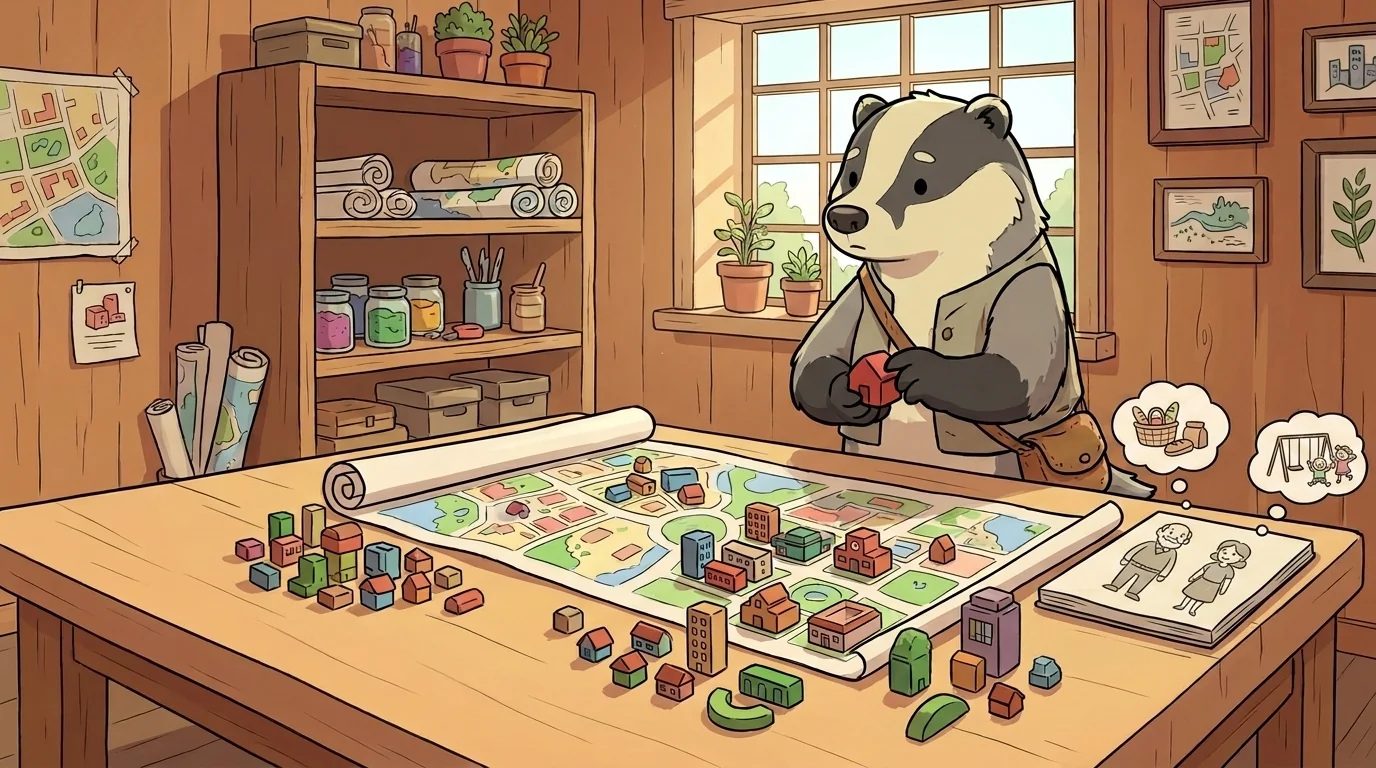
Block had learned this on her knees in a garden, long before she ever saw a city.
Her family were the allotment-keepers of a small village, the badgers who arranged the communal growing plots. It was quiet, patient work: deciding where the shared path ran, how wide the private beds could be, where to set the one long bench so the old ones could rest without crowding the young ones' planting. When Block was six, she moved a bench two feet to give a wider family more room — and by midsummer discovered she had thrown a whole row of lettuce into shade. The lettuce failed. The family it had belonged to said nothing, but Block saw the empty bed every day for a season.
She never forgot it. One decision, made about people without asking them, and something living quietly died for it.
So she changed how she worked. Before she rearranged a single plot the next spring, she walked the allotments and asked — the grandmother who needed morning sun, the boys who wanted a corner for their beans, the woman who couldn't bend to a low bed. Then she drew what was already thriving and only touched the empty spaces. That season nothing failed. Her grandmother watched her sketch the layout and said, "You plan for the neighbors, not the beds." Block had thought, quietly: that's the whole of it, isn't it.

She walked into CityForge at twenty-two, dust still on her knees.
Plumb, the old founder, met her at the door with a challenge instead of a greeting. "There's a vacant block behind the workshop," Plumb said. "Developers want six towers on it. Show me what you'd do."
Block didn't argue and didn't sketch towers. She went to the block, sat on its curb, and spent the whole afternoon watching — the shortcut people wore across the weeds, the bench-shaped absence where the bus stop had no seat, the corner where a shop would catch every passerby. Only at dusk did she lay her clay-blocks: homes and a shop and a small green square, mid-rise, close-woven, nothing taller than four stories, everything a short walk from everything else.
Plumb crouched, studied it a long time, and touched the little park-oval at its heart. "You put the people down first," she said. It wasn't a question. Block nodded. Plumb stayed crouched a moment longer, then rose. There was a place for her at CityForge now, and both of them knew it.
Her workshop table filled quickly the first morning a group of kids crowded around it.
"Where do we start?" one of them asked, reaching for the shiniest tall block — the tower.
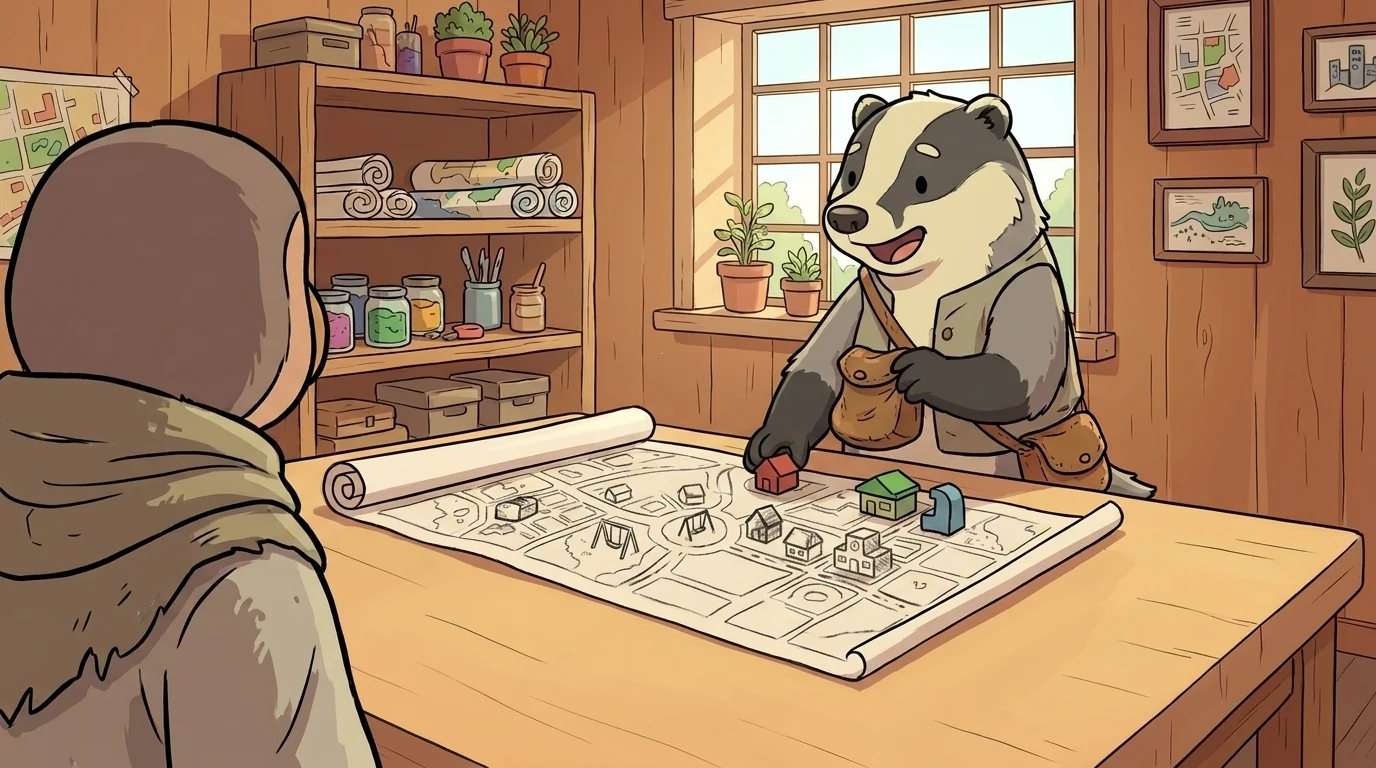
Block gently took it from her hand and set it aside. "Not there. Watch." She uncapped a charcoal pencil and drew the neighborhood that already existed: three houses, a corner shop, a school. Then she wrote small words beside each one — widow, alone; family of five; kids walk here at eight. "This is who's here," she said. "Before we add anyone, we know them."
She sat back. "Now — what's missing from their day?"
"A park?" someone offered. "Somewhere to buy food that isn't far?"
"Good." Block began setting clay into the empty spaces — a park-oval where the kids already cut through, a grocery-rectangle a short walk from every house. She reached for a mid-rise apartment-block and set it beside the shop, not looming over the widow's roof. "More homes, yes. But close, and low, and mixed in — housing next to shops next to school. A place where you only ever need only your own two feet." She turned the plain block in her fingers. "These are simple shapes on purpose. If they were fancy buildings you'd stare at the architecture. I want you staring at the distances between people and the things they need."
A kid frowned at the untouched tower. "So the tall one's bad?"
"Not bad," Block said. "Just a guest that thinks it owns the room. Invite it once you've made sure everyone else still fits."
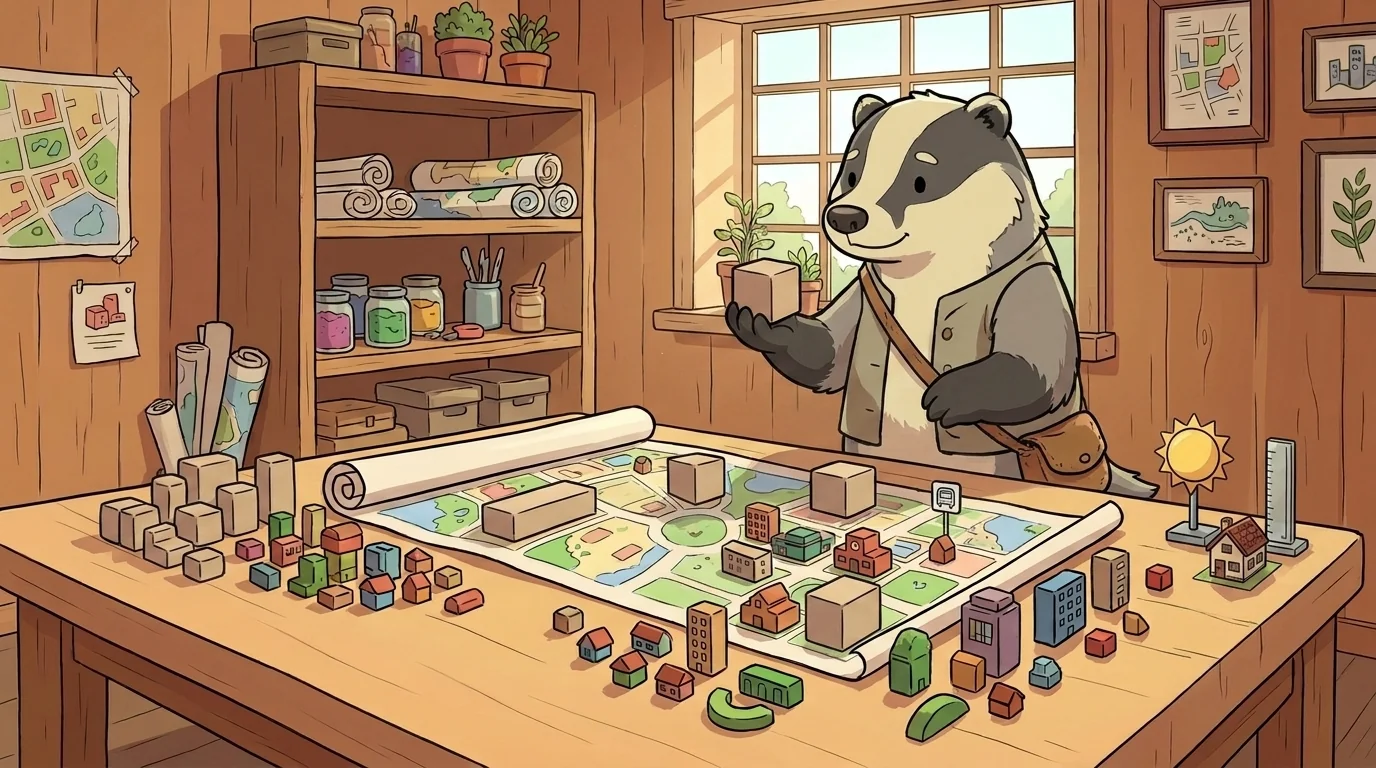
Later, when the others had gone, one small badger stayed behind, turning a house-block over and over.
"How do you know you got it right?" she asked. "How do you know a plan is good?"
Block was quiet. She thought of the lettuce, the empty bed, the season she'd watched it. "You don't, from a drawing," she said. "You find out when you go back and the grandmother still gets her sun, and the kids still cut through the park, and nobody had to leave to make room for a tower." She set her own house-block down beside the girl's, two little homes side by side.
"I plan neighbors first because I once planned something else first," she said, "and I have never once regretted asking who was already there."
The girl looked at the two blocks a long moment, then set a tiny park-oval between them without being told. Block felt something warm and steady settle in her chest — the same feeling as a garden bed that would not, this year, fail.
The CityForge ensemble
Block is part of CityForge's distributed-narrative cast. Each character embodies a different curricular primitive; together they teach the full subject.
-

Stoop
Public space + community — the capybara-elder on a wooden stoop who treats public space as the city's living room, foregrounding existing stoop-cultures (Brooklyn / Latin American plazas / Italian piazzas / West African gathering trees)
-
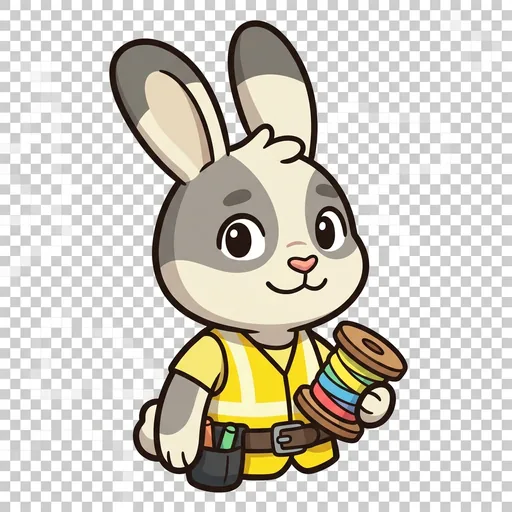
Lane
Walkability + mobility — the rabbit-tween in safety-vest with a chalk-spool who teaches streets-as-spaces ('streets are rooms; cars are guests, not owners')
-

Hub
Transit nodes — the pangolin-tween in conductor-vest who teaches that transit is about ACCESS, not about cars-vs-trains ('many ways, equal ways; the bus matters as much as the train')
-

Dwell
Housing equity + repair — the owl-elder in a mended quilted-coat who teaches anti-displacement, repair-not-replace urbanism ('repair before replace; listen before plan; the people who live here ARE the design')
-

Canopy
Green infrastructure — trees and parks cool the city and soak up rain; shade placed where it is needed most
-

Mix
Mixed-use land use — weave homes, shops, and work close so daily life is a short walk
-

Seam
Edges and connection — a highway can rip two neighborhoods apart; design can stitch them back
-

Berm
Climate resilience — the beaver who builds soft green earthworks that bend and soak up floods instead of walling them out
-

Conduit
Infrastructure — the badger who tends the hidden pipes, wires, and drains beneath every street