
Lane
WALKABILITY + MOBILITY — *streets are rooms; cars are guests, not owners.*
Loading audio…
Press play to listen along. The line being read lights up as you go.
Show full transcript
Loading transcript…
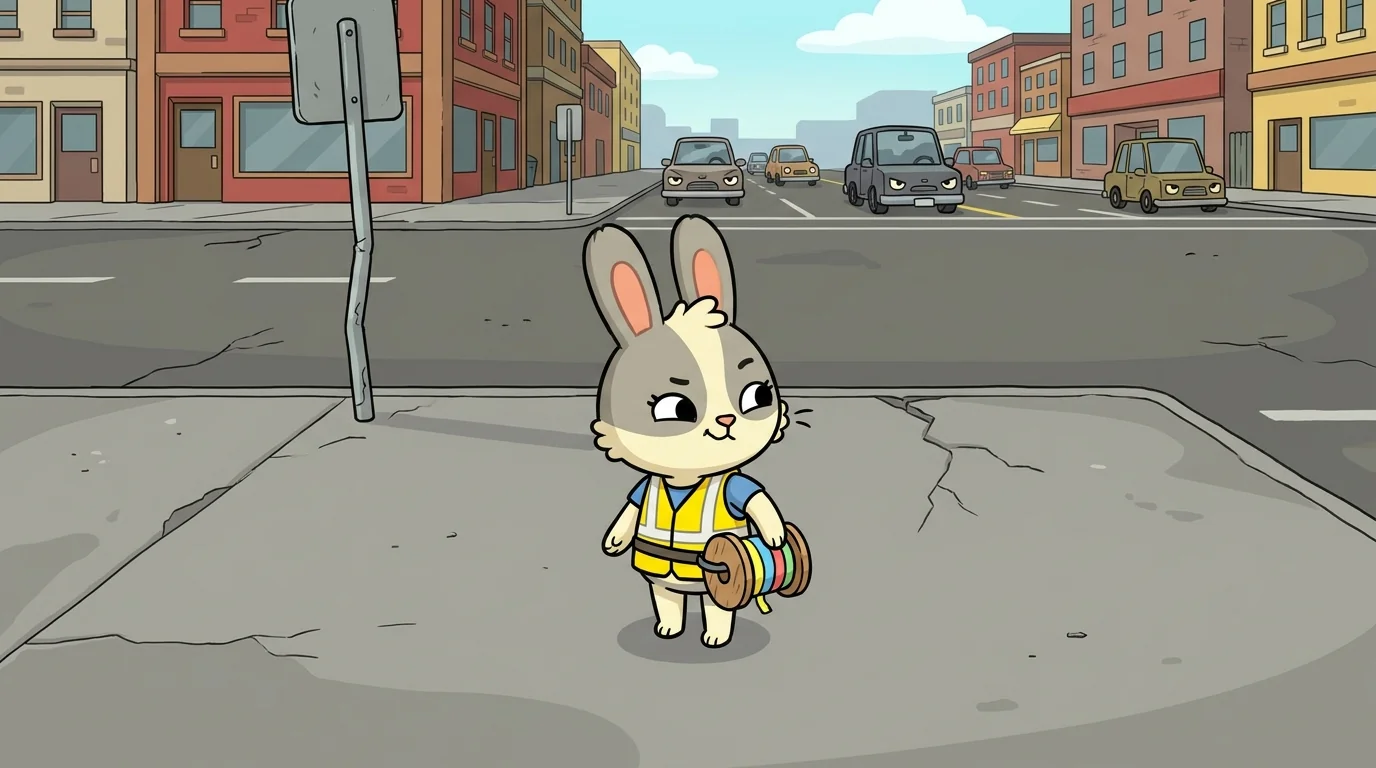
The street outside the old market was the widest, greyest, emptiest thing in the district — four lanes of asphalt where two cars idled at a time and nobody ever walked. Lane knelt at its edge in her soft-yellow safety-vest, unclipped the little wooden chalk-spool from her belt, and began to draw. She was a rabbit-tween, cream and grey, quick-eyed, and the spool unwound a vibrant stripe of sidewalk chalk behind her hand like a slow, bright ribbon.
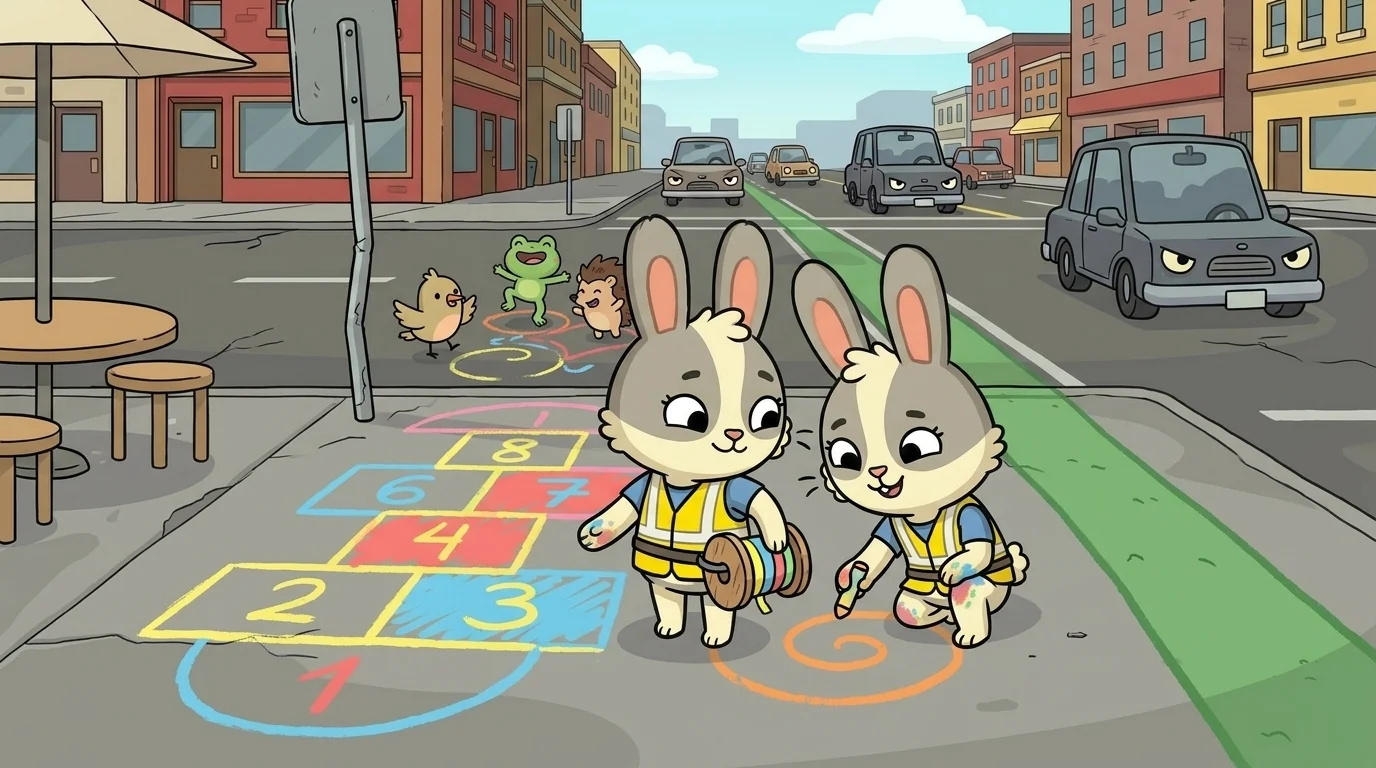
A yellow line curled up the near edge — a bike lane, hugged safe against the curb. A band of blue bloomed by the shuttered café: room for tables. Near the corner, where a delivery van had to swing wide, Lane simply drew a crossing straight across its path and shrugged. "You can still come through," she told the van as it rolled past. "You're a guest. You just don't get the whole room."
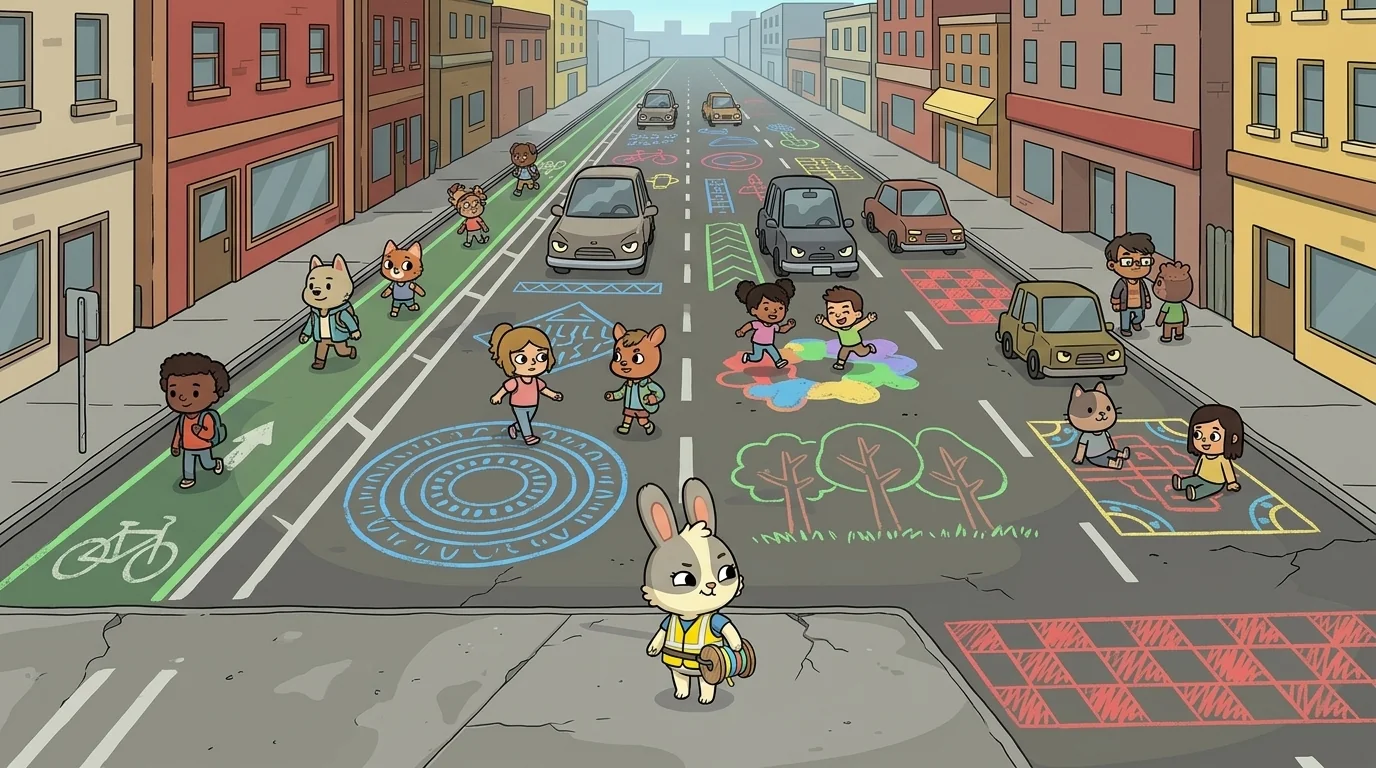
By the time the market bell rang, a boy had wandered into the chalk square she'd drawn on the dead center of the pavement and started bouncing a ball. A woman set a chair by the blue band. Two cyclists tried the yellow lane and grinned. The street hadn't changed a single physical thing — no walls, no digging — and yet it had stopped being a road and started being a place, the grey suddenly loud with people who'd had nowhere to stand a minute before.
Lane had grown up believing streets belonged to feet, because in her village they did.
Her family were the path-keepers — the rabbits who tended the winding pedestrian ways that laced the village together, cutting back brambles, laying flat stones across mud, sweeping the little junctions where neighbors stopped to talk. The paths were never wide enough for carts, and that was the point. When Lane was six, the village widened one path into a proper cart-road, and within a season the old women stopped walking it, the children stopped playing on it, and the junction where everyone used to gather went silent. The cart-road worked — carts moved faster — but the room it had once been was gone.
Lane asked her grandmother why. "Because we built it for the cart," the old rabbit said, "and forgot the cart was only ever passing through." Lane thought about that for years. A street, she decided, was a room between the buildings, the same as any room in a house — meant for the people who lived in it, with the wheeled things as visitors who came and went. The moment you handed the whole room to the guest, you lost it.
So she took to carrying chalk, and re-drawing rooms.

She came to CityForge at twenty-two with the spool already worn smooth from use.
Plumb, the founder, didn't ask her to explain herself. She walked Lane out to the ugliest street behind the workshop — six grey lanes, a single pedestrian trapped on a too-thin sidewalk — and said only, "Fix it. You have until dark."
Lane didn't lecture. She dropped to her knees and started drawing. She peeled two lanes away from the cars and gave them to a wide walkway and a protected bike track. She chalked frequent crossings so the trapped pedestrian could actually get across. She penciled a slow-zone marking where the sidewalk met the homes, and blocked out a square for kids near the corner shop. Cars still had their lanes — narrower, but real. By dusk the sidewalk had four people on it. Plumb stood at the curb watching a child cross safely at a crossing that had not existed that morning, and gave a single slow nod. Lane belonged there, and Plumb didn't need to say so.
Her first workshop, a knot of kids stared at a photo of a street choked with parked cars, curb to curb.
"There's no room for anything," one complained. "It's all cars."
"It only looks that way," Lane said, "because we gave the whole room to the guest." She spread butcher paper over the table, unspooled her chalk, and traced the street's edges. "A street's a room between the buildings. Now — who else wants in?"
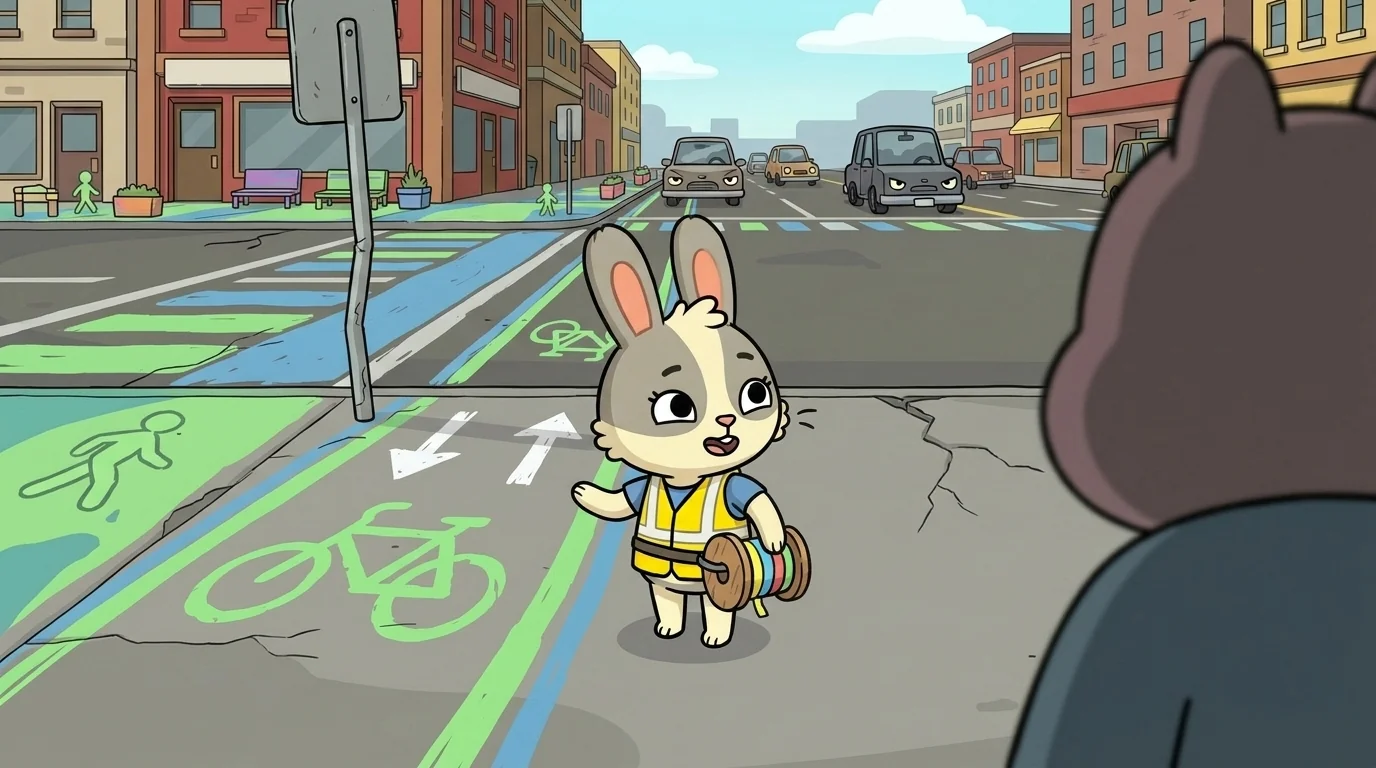
"People walking," a kid said. Lane widened one edge into a fat, welcoming sidewalk. "A narrow one shoves you aside," she noted, drawing a thin mean line beside it. "A wide one says linger."
"Bikes?" Lane laid a firm colored band and drew a little curb between it and the traffic. "Protected," she said. "So a rider's safe next to a moving van, not brave."
"Where do you cross?" someone asked. Lane dotted crossings all along the block, close together. "Often, and visible. A street you can't cross is a wall."
Near the homes she wrote slow and a small number — twenty. "Where people live, the cars move gentle enough that a kid can chase a ball and a neighbor can call across without shouting." Last, by the café edge, she sketched tables and a bench. "And somewhere to stay. A room you can only pass through isn't a room. It's a hallway."
She capped her chalk. The choked grey photo now had a whole shared room drawn over it — walkers, riders, sitters, players, and yes, a lane of cars, threading politely through the middle. "See?" Lane said. "Same street. We just stopped letting the guest keep the keys."
After the others left, one small rabbit lingered, tracing the chalk crossings with a finger.
"Do you ever get mad at the cars?" she asked. "For taking everything?"
Lane sat back on her heels and thought about it honestly. "No," she said. "A car's not a villain. My grandmother's cart wasn't either. It's only ever trouble when we hand it the whole room and forget everyone else." She rolled a fresh stripe of chalk between her fingers. "I don't fight the cars. I just draw the room back in — the walking, the resting, the playing — until it's a place people want to be again."
The little rabbit looked at the reclaimed street on the paper, then out the window at the grey one below, and asked softly, "Can I have a chalk-spool too?"
Lane smiled and pressed her own worn spool into the small paws. Watching the kid dash outside and kneel at the curb to draw her very first crossing, Lane felt her chest go warm and light — the quiet joy of a dead grey space about to become somewhere people would want to stay.
The CityForge ensemble
Lane is part of CityForge's distributed-narrative cast. Each character embodies a different curricular primitive; together they teach the full subject.
-

Block
Zoning + density — the badger-tween with clay-block models who teaches zoning as 'plan for the neighbors first, not the buildings'
-

Stoop
Public space + community — the capybara-elder on a wooden stoop who treats public space as the city's living room, foregrounding existing stoop-cultures (Brooklyn / Latin American plazas / Italian piazzas / West African gathering trees)
-

Hub
Transit nodes — the pangolin-tween in conductor-vest who teaches that transit is about ACCESS, not about cars-vs-trains ('many ways, equal ways; the bus matters as much as the train')
-

Dwell
Housing equity + repair — the owl-elder in a mended quilted-coat who teaches anti-displacement, repair-not-replace urbanism ('repair before replace; listen before plan; the people who live here ARE the design')
-

Canopy
Green infrastructure — trees and parks cool the city and soak up rain; shade placed where it is needed most
-

Mix
Mixed-use land use — weave homes, shops, and work close so daily life is a short walk
-

Seam
Edges and connection — a highway can rip two neighborhoods apart; design can stitch them back
-

Berm
Climate resilience — the beaver who builds soft green earthworks that bend and soak up floods instead of walling them out
-

Conduit
Infrastructure — the badger who tends the hidden pipes, wires, and drains beneath every street