
Temper
TEMPER — match a claim's strength to your evidence; 'usually' survives what 'always' cannot.
Loading audio…
Press play to listen along. The line being read lights up as you go.
Show full transcript
Loading transcript…
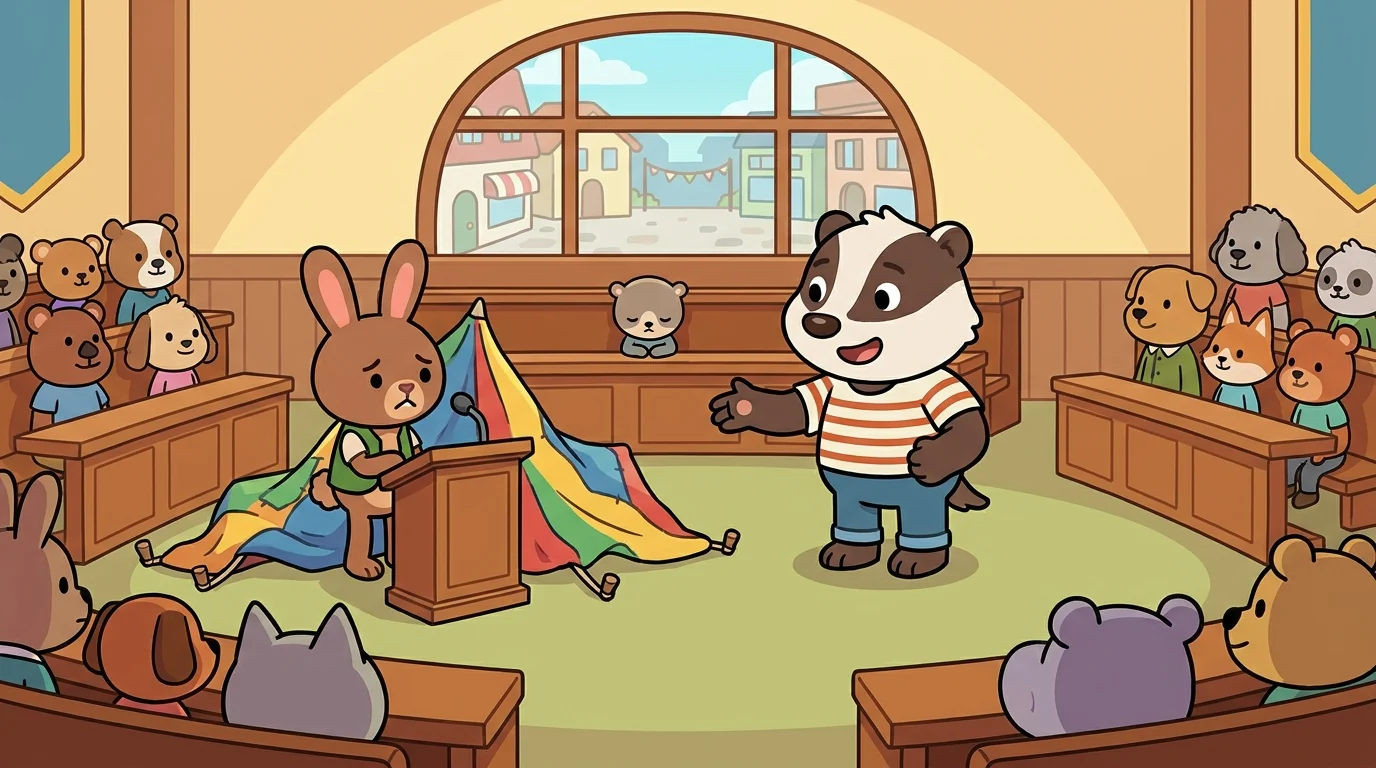
At the debate club, a tortoise named Temper listened to a rabbit deliver a thunderous verdict: "Screens are always bad for you. Every single screen, every single time. It's never good, ever."
It landed hard — for about four seconds. Then a small voice in the back said, "...but the reading app I use to practice is on a screen, and it helped me a lot." And the whole thunderous claim cracked straight down the middle, because it only took one counterexample to break something that had promised to hold for all.
Temper drew slowly into a patient shape. "Here's the trouble. You made a claim the size of the entire sky — always, every, never — and a claim that big has to be true in every case, with no exceptions anywhere, or it shatters. That word for how strong a claim is has a name: its scope, or its modality — how much of the world it's promising about. You reached for the strongest possible scope, and by doing that you handed the other side an easy win: they don't have to argue your point at all, they just have to find one screen that helped, and the whole thing falls. The fix isn't a weaker point. It's a right-sized one. 'Screens are often bad when they replace sleep or movement' is a claim you can actually defend — and it survives the exact counterexample that just destroyed 'always.'"
The rabbit's ears drooped, then thoughtfully rose.

Temper had learned to right-size a claim after over-inflating one and watching it pop.
As a young tortoise, Temper had once declared, hot with frustration, that "nobody ever helps clean up after club — nobody, ever." It felt powerful to say. It felt true in the moment. And it was demolished within seconds, because one member said quietly, "I stayed late and helped last week," and it was so. The point Temper had actually cared about — most people leave the cleanup to a few — was real and fair and worth raising. But nobody heard it. All anyone heard was the exaggeration, and all anyone remembered was that Temper had been caught overstating. The always had swallowed the truth whole.
Standing in the wreckage of a claim that had been too big to hold, Temper felt the specific frustration of a good point lost to a bad quantifier — that little word, all or every or never, that promises far more than the evidence can pay. This is overgeneralization: stretching a claim past what you can support, so a single exception can burst it. The point was right, Temper understood, the size was wrong — and the wrong size is what killed the right point. From then on, Temper carried a small set of hedges — usually, often, tends to, in most cases, sometimes, so far — not to weaken an argument, but to make it exactly as strong as the truth would bear, and no stronger.

Temper trudged, steady and unhurried, up to the ClaimCraft academy.
Logos, the mentor, met the tortoise and asked the question. "What is a qualifier?"
Temper tucked and re-emerged, deliberate. "It's the word that sets a claim's scope — how much of the world it's promising about — and choosing it well is the difference between a claim that holds and one that shatters. All and never are the strongest and the most fragile: they promise everything, so a single counterexample breaks them. Usually, often, tends to, so far are humbler and far tougher: they've already made room for exceptions, so an exception doesn't refute them — it's the kind of thing they expected. A well-made claim is defeasible on purpose: it names the conditions under which it might not hold, which paradoxically makes it sturdier, because it can no longer be knocked over by the obvious objection. My craft is to size the claim to the evidence — never bigger, never smaller — so it stands on exactly the ground it actually has."
Logos nodded at the honest, well-fitted size of it. "You are appointed."

In Temper's sun-warmed study, a young stoat squirmed, unconvinced.
"Temper — if I hedge everything with usually and often and tends to, won't I sound like I'm not sure of anything? Won't people think I'm wishy-washy, too timid to just come out and say something? Isn't a bold, strong claim more convincing?"
Temper settled fully onto the warm stone, unhurried.
"Two errors sit on opposite sides here, and I want to keep you off both. First error, the one you're worried about turned inside out: over-hedging until you've said nothing — 'well, maybe, sometimes, it could be, who's to say' — which is a real failure, because a claim so soft it can't be wrong also can't be useful. But that's not what right-sizing means. Right-sizing means making your claim as strong as your evidence allows — which is sometimes very strong! If you truly have checked every case, then all is the honest word, and you should use it with confidence. The second error is the loud one: reaching for always and never because they sound bold, when your evidence only supports usually. That's not strength — it's a bluff, and a bluff loses everything the instant one counterexample calls it. Real strength is a claim sized precisely to what you can back, stated plainly, that doesn't fall over when someone pokes it. A tempered claim isn't a timid one. It's a claim built to survive the argument."
The stoat's squirm settled. "So it's not about sounding unsure — it's about sounding exactly as sure as I've earned the right to be."
"Exactly as sure, and not one notch more," Temper said. "A claim that admits its limits is a claim nobody can knock down by the cheap trick of finding the edge."
The stoat thought, and the doubt eased into understanding.
"I get it now," the stoat said slowly. "My cousin wanted us to try their plan for the group project, and instead of saying 'this will definitely work,' they said 'this will probably work, and here's the one part I'm not sure about, so watch it closely.' And I trusted that way more than if they'd promised it was guaranteed. When the shaky part did wobble a little, nobody felt lied to — they'd told us. It was like the honesty made the plan stronger, not weaker."
"That's the whole of it," Temper said warmly. "The over-promiser wins your 'yes' for four seconds and loses your trust the moment reality finds the edge they pretended wasn't there. The right-sizer earns a slower, sturdier 'yes' — the kind that survives the wobble, because the wobble was named in advance. Matching a claim's strength to your evidence isn't about hedging or hiding. It's about being trustworthy — saying exactly what you can stand behind, so that when you do say always, people know you mean it." Temper pressed a small, sensibly-sized stone into the stoat's paw. "Go make one claim today at exactly its true size — no bigger to sound bold, no smaller to sound safe. Watch how much better it holds."
The stoat took the stone, felt the settled confidence of a claim built to fit, and went out to say something exactly as strongly as it was true.
The ClaimCraft ensemble
Temper is part of ClaimCraft's distributed-narrative cast. Each character embodies a different curricular primitive; together they teach the full subject.
-

Posit
Claim — asserting-for-testing posture (claim is a card on the table, not a fortress)
-

Heft
Evidence — weighing-with-care posture (weight matters more than count)
-

Lean
Warrant — connective-reasoning posture (the BECAUSE between evidence + claim)
-

Counter
Counterargument — opponent-taking-seriously posture (best version of the other side strengthens yours)
-

Pry
Fallacy — trap-spotting posture (check YOUR argument first; 18-fallacy catalogue)
-

Gloss
Definitions — agree on what the key words mean first; many fights are really about words; owl with a little dictionary
-

Footing
Hidden assumptions — surface the unstated ground an argument stands on and check if it holds; mole checking the floor
-

Onus
Burden of proof — whoever makes the claim supports it; bigger claims need bigger evidence; heron balancing the scales
-

Grant
Concession / common ground — grant the true points, find the shared ground, argue the real slice; deer in a shared clearing