
Ordell
ORTHOGONAL MOVEMENT (Turkish draughts) — most checkers moves diagonally. Turkish draughts changes the single most basic rule: pieces move and capture *straight* — forward and sideways along the ranks and files, never diagonally. Change the direction of the fundamental step and the entire game reorganizes around it — every tactic, every square's value, everything.
Loading audio…
Press play to listen along. The line being read lights up as you go.
Show full transcript
Loading transcript…
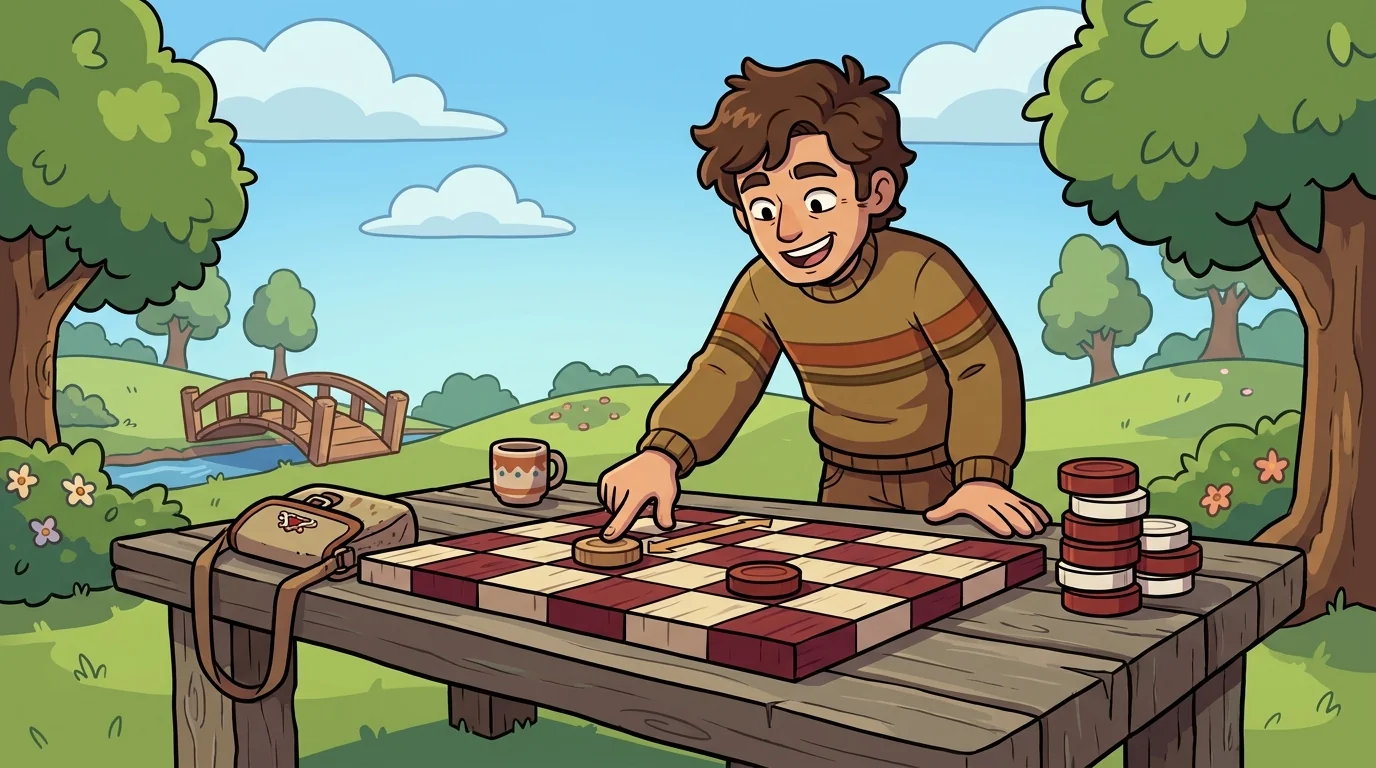
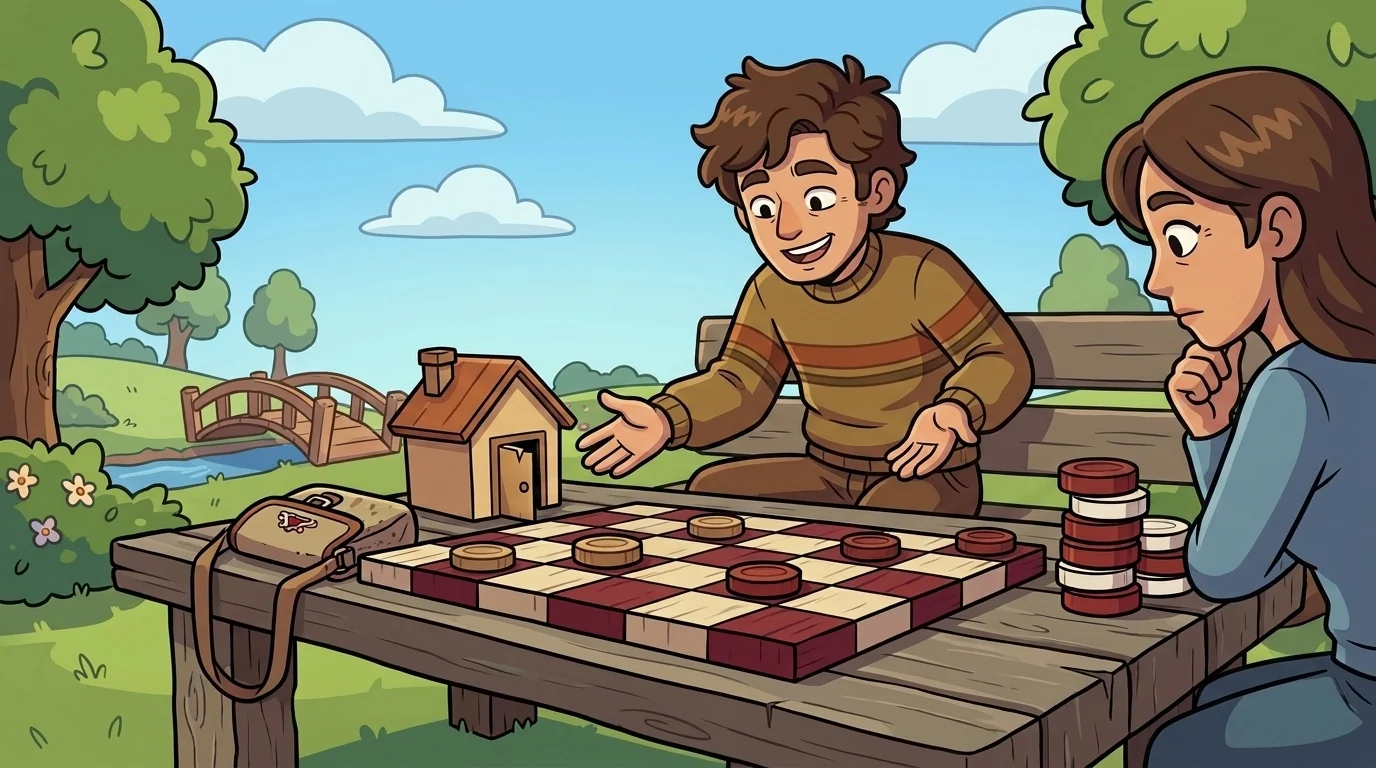
Ordell moved his piece straight forward.
His opponent, a tall twelve-year-old named Bram, froze mid-reach. His hand hung above the board, fingers twitching like a confused spider.
"You can't do that," Bram said, blinking three times. He pointed a thumb at the checkered walnut board between them. "That isn't where the piece goes."
Ordell leaned back on the stone bench and adjusted his woolen vest. "It just went there."
"Checkers moves on the diagonal," Bram insisted. His voice cracked slightly on the last word. "Everyone knows that. You stay on the dark squares. You slide at an angle."
Ordell picked up another dark disk. With a smooth motion, he slid it straight sideways into an open column. The dry clack of boxwood echoed off the chapel wall behind them.
"You keep waiting for me to turn," Ordell said, watching Bram's forehead wrinkle. "You wait because someone handed you a board when you were six and told you that was how the world worked. But that isn't a law of nature. That's just how your neighbors play."
Ordell lifted his disk and jumped straight forward over Bram’s red piece, lifting it from the board.
"This is Turkish draughts," Ordell said quietly. "Same pieces. Same square board. Same race to the far side. But one rule has been turned ninety degrees."
Bram stared at the gap in his ranks. His entire defensive wall had just turned into an open road.
"Watch what happens now," Ordell said. "When you change one single rule at the bottom, the whole game rearranges itself around the change."
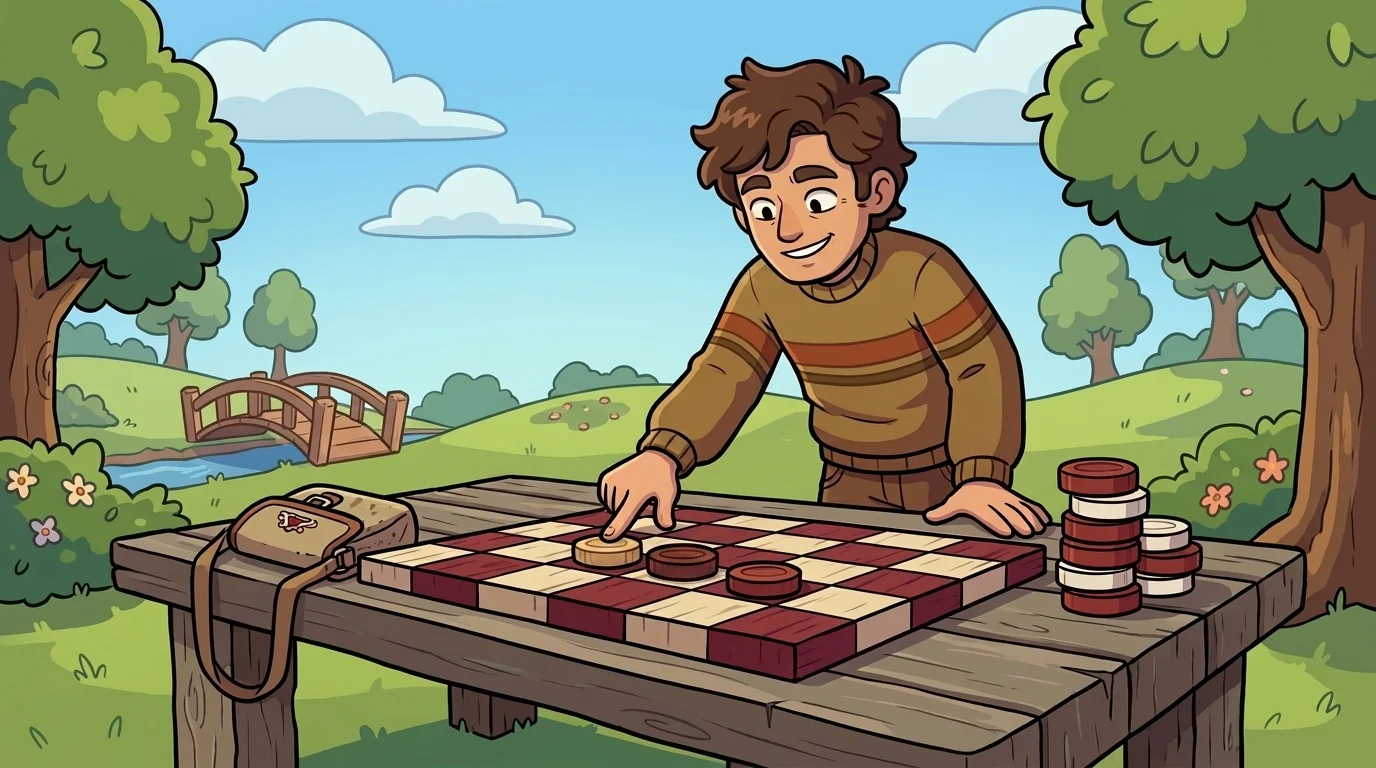
Ordell had learned that lesson long before he ever touched a master’s game set. When he was nine, he spent his summers traveling between two very different grandmothers.
At his maternal grandmother’s house near the harbor, morning tea was a serious ritual. She stacked two copper kettles on the stove. She poured concentrated black tea into small glass cups shaped like tulips, then diluted it with boiling water until it glowed like dark amber.
At his paternal grandmother’s house in the hills, tea came from a soot-blackened iron pot. She dropped a single brown paper bag into a heavy clay mug, filled it to the brim, and dumped in two massive spoons of white sugar.
For two summers, the contrast gave Ordell a tight feeling in his stomach. Every time he sat down to breakfast, he worried he was doing things wrong. He kept waiting for someone to tell him which kitchen had the real truth.
Then came an August afternoon when both grandmothers sat together on the front porch. Neither woman tried to fix the other’s teapot. They sat in silence, drinking their different teas from different cups, perfectly content.
Ordell watched them from the steps. The tight knot in his stomach loosened. Neither kitchen was a mistake. Both systems were complete and made total sense from the inside.
He stopped asking which grandmother was right. Instead, he began asking what each habit allowed a person to do. The world suddenly became much larger and far less frightening.
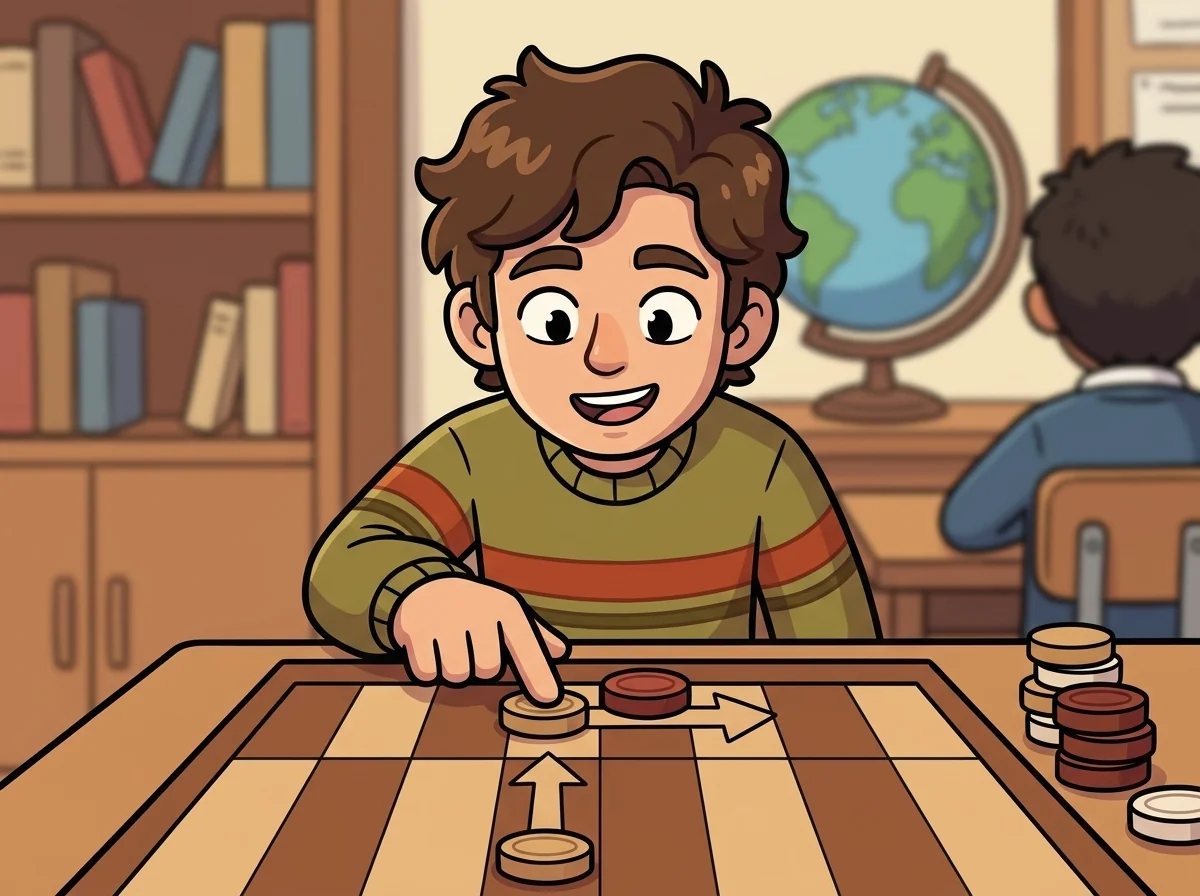
That quiet realization was the reason Master Draughtsmith recruited Ordell to the academy two years later. On Ordell's first morning in the Great Hall, the old master called him to the front of the room.
"Show them," Draughtsmith said, gesturing to thirty curious students seated on long benches. "Show them why your game isn't just standard checkers played by someone who forgot the rules."
Ordell set out thirty-two light and dark pieces on an unlined wooden grid. He placed a single black piece in the middle of the board.
"On a standard diagonal board," Ordell called out, "a central piece controls four diagonal squares. The corners feel safe. The edges give you shelter."
He tapped four squares directly adjacent to his center piece—up, down, left, right.
"Here, a piece controls four straight squares. A square you think is safe behind a diagonal shield is suddenly in the direct line of fire."
He demonstrated by sliding an opposing piece into what looked like a hidden nook. With one quick hop, Ordell captured it.
A ripple of whispers passed through the bench of students.
"It isn't harder," Ordell told them. "It is rewired. Every safe square you memorized as a child is different here. You cannot bring your old habits into this room. You have to open your eyes and see fresh."
Master Draughtsmith stood by the arched window, nodding slowly.
"You didn't teach them a trick, Ordell," the master said in his raspy voice. "You made them doubt something they thought was permanent."
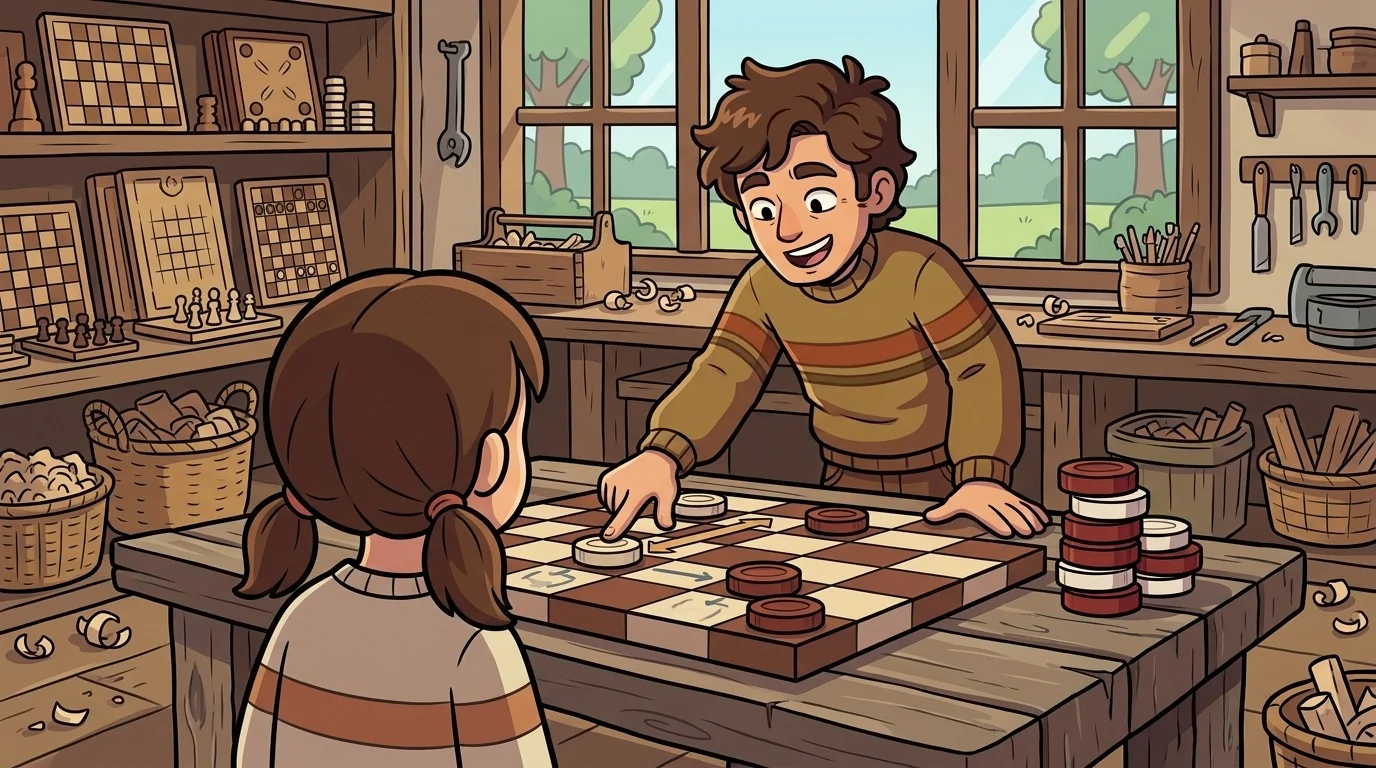
By late autumn, Ordell’s workshop was filled with the smell of cedar shavings and polished lacquer.
A twelve-year-old student named Mina sat at a corner table, staring angrily at her board. She reached out, hesitated, and slammed her hand down on her knee.
"I did it again!" Mina groaned. "My thumb kept trying to push the piece diagonally. It feels wrong to move straight forward. It feels like my hand is arguing with my brain."
Ordell walked over and poured her a mug of warm spiced cider.
"Of course your hand is arguing," he said gently. "You didn't learn diagonal movement as a simple rule. You learned it as a reflex. It lived in your muscles before you ever learned to read."
"It's annoying," Mina said, rubbing her forehead.
"That annoyance is the best part," Ordell replied. "That frustration is the sound of a buried habit being pulled up into the light where you can see it. Most people carry dozens of hidden reflexes. They go through life believing 'this is just how things are done.' A variant is a gift because it breaks the reflex."
He tapped the dark square in front of her piece.
"Once you force yourself to move straight on purpose, you will never assume a rule is permanent again."
Mina took a slow breath. She picked up her piece, held it above the wood, and placed it firmly on the square directly ahead.
"It still feels strange," she admitted.
"Good," Ordell smiled. "Strange means you're paying attention."
A week later, Mina stayed late to help sort game sets into their felt pouches. The autumn rain tapped softly against the high workshop windows.
"Master Ordell?" Mina asked, tightening a drawstring.
"Yes, Mina?"
"If you can change the direction a piece moves, can't you change any rule? Doesn't that mean all games are just made up?"
Ordell set down his wooden brass-caliper. He looked at her with a quiet smile. It was the fundamental question underneath everything they taught.
"They are made up," Ordell said. "But that doesn't make them fake. It means the rules are choices."
He walked to the wall shelves and pulled down three different game boards.
"Diagonal checkers, Turkish straight-checkers, the big international board—they aren't a ladder where one sits on top," he said. "They are a family."
He laid the three boards side by side under the lamp.
"Each board keeps the heart of the game," Ordell said. "You take turns. You jump to capture. You race to reach the back line. But each game changes one big rule, and that single change sprouts a whole new tree of tactics."
Mina looked down at the three grids.
"So none of them is the 'real' one?" she asked.
"None of them," Ordell said. "And that isn't scary. It is freedom. Once you realize the rules are made of choices, you stop being a person who only follows instructions. You become a person who understands how things are built."
Mina walked home through the wet streets that evening. In the market square, she watched two merchants arguing over how to stack timber crates on a cart.
She paused on the wet cobblestones and watched them squabble. For the first time in her life, a small dry smile touched her face as she asked herself a new question: Who decided that was the only way to stack them, and what happens if we do it differently?
The CrownTales ensemble
Ordell is part of CrownTales's distributed-narrative cast. Each character embodies a different curricular primitive; together they teach the full subject.
-

Bastian
The double-corner fortress: drawing a lost-looking game by holding the safe square
-

Kingsley
Crowning: a man that reaches the far row becomes a king that moves both ways
-

Leapford
The forced capture: a man captures by leaping over a neighbor
-

Prong
The fork: one move that threatens two pieces at once
-
Regina
Opposition and tempo: winning the endgame by controlling who must move
-

Skipjack
The multi-jump chain: capturing several pieces in one turn
-

Slant
Diagonal movement: how an ordinary man steps one square diagonally
-

Volant
The flying king: the long-range king of International 10x10 draughts