Slant
DIAGONAL MOVEMENT
Loading audio…
Press play to listen along. The line being read lights up as you go.
Show full transcript
Loading transcript…
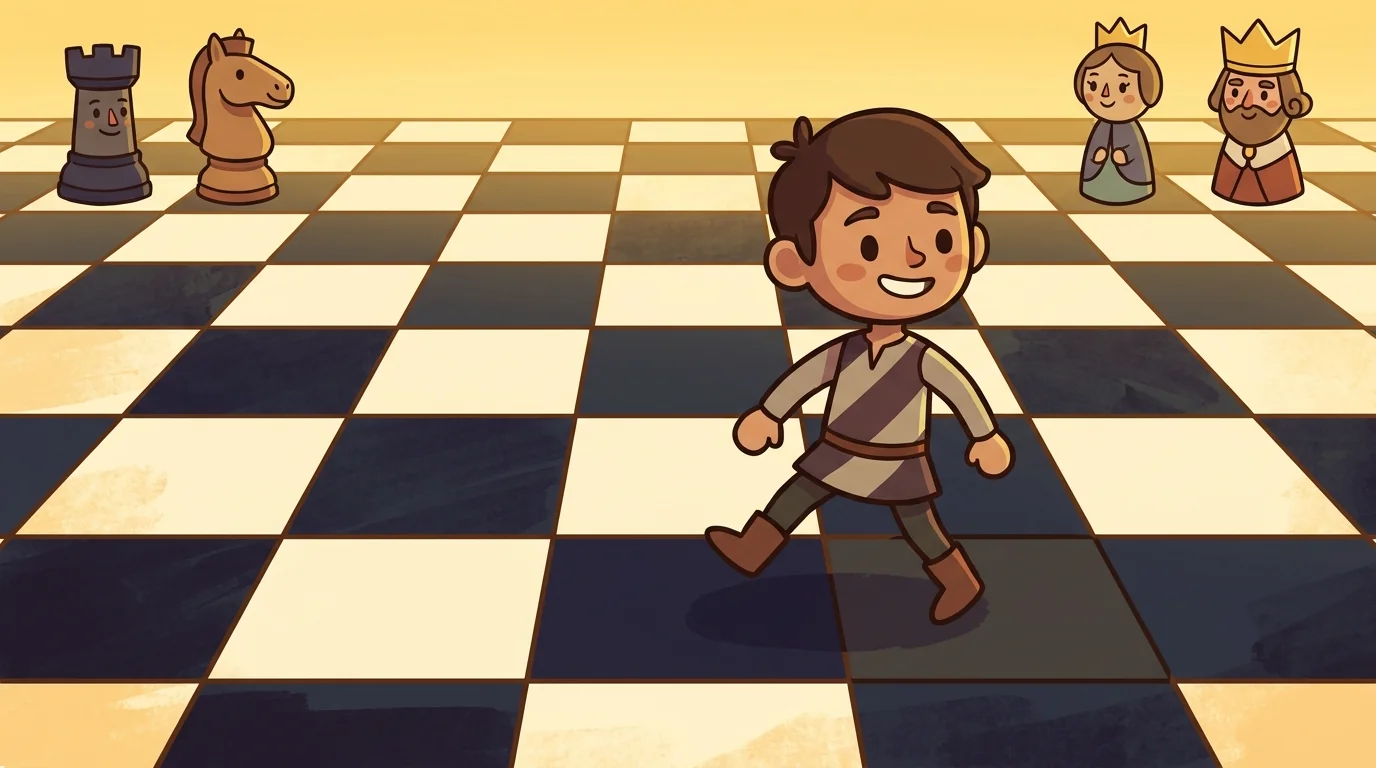
Slant never moves in a straight line, and he has made peace with it.
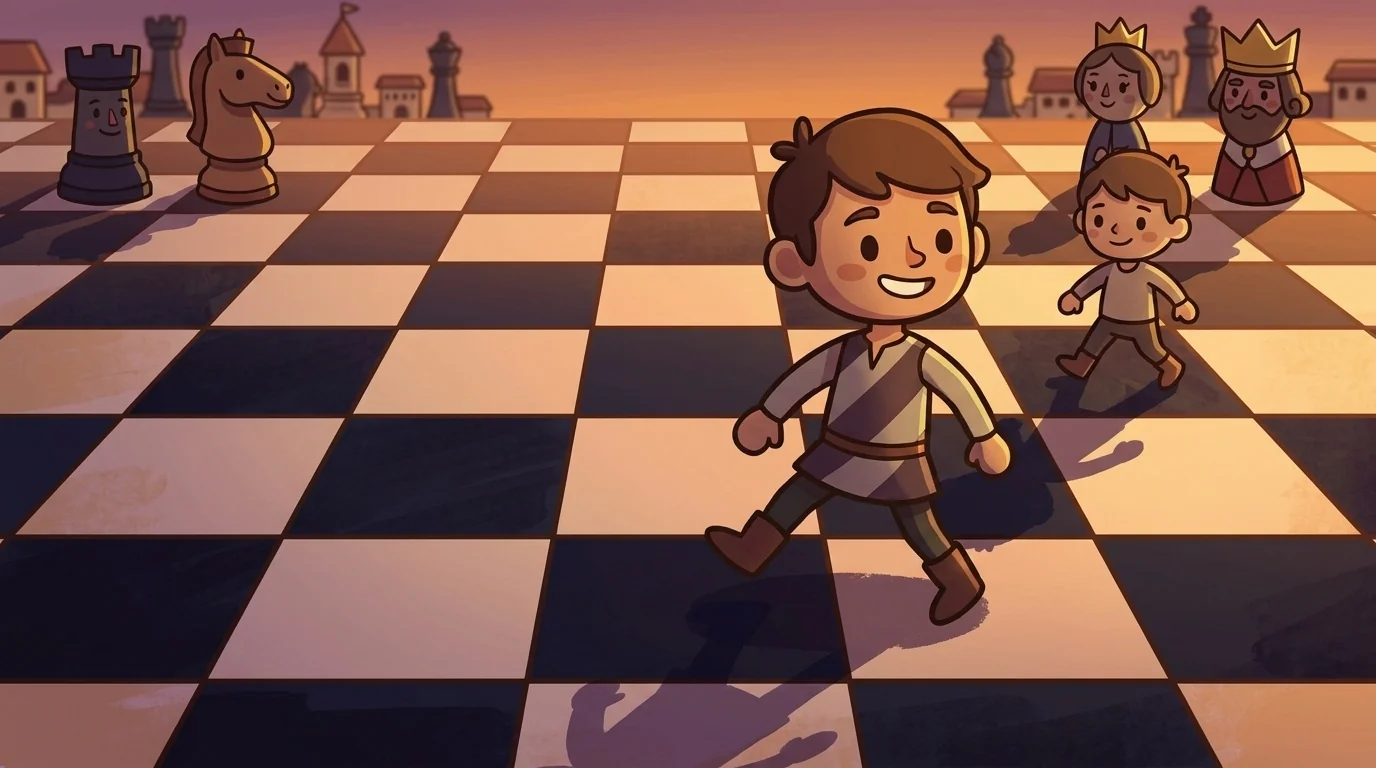
On the great dark-and-light board where he lives, the other pieces sometimes wish they could march straight ahead — but Slant only ever slides diagonally, one square at a time, corner to corner across the dark squares. It's not a limitation, the way he sees it. It's a signature. "Straight ahead is everybody's road," he says, sliding one square along his diagonal. "The diagonal is mine. And here's the funny thing — it can take me anywhere on this board that matters."
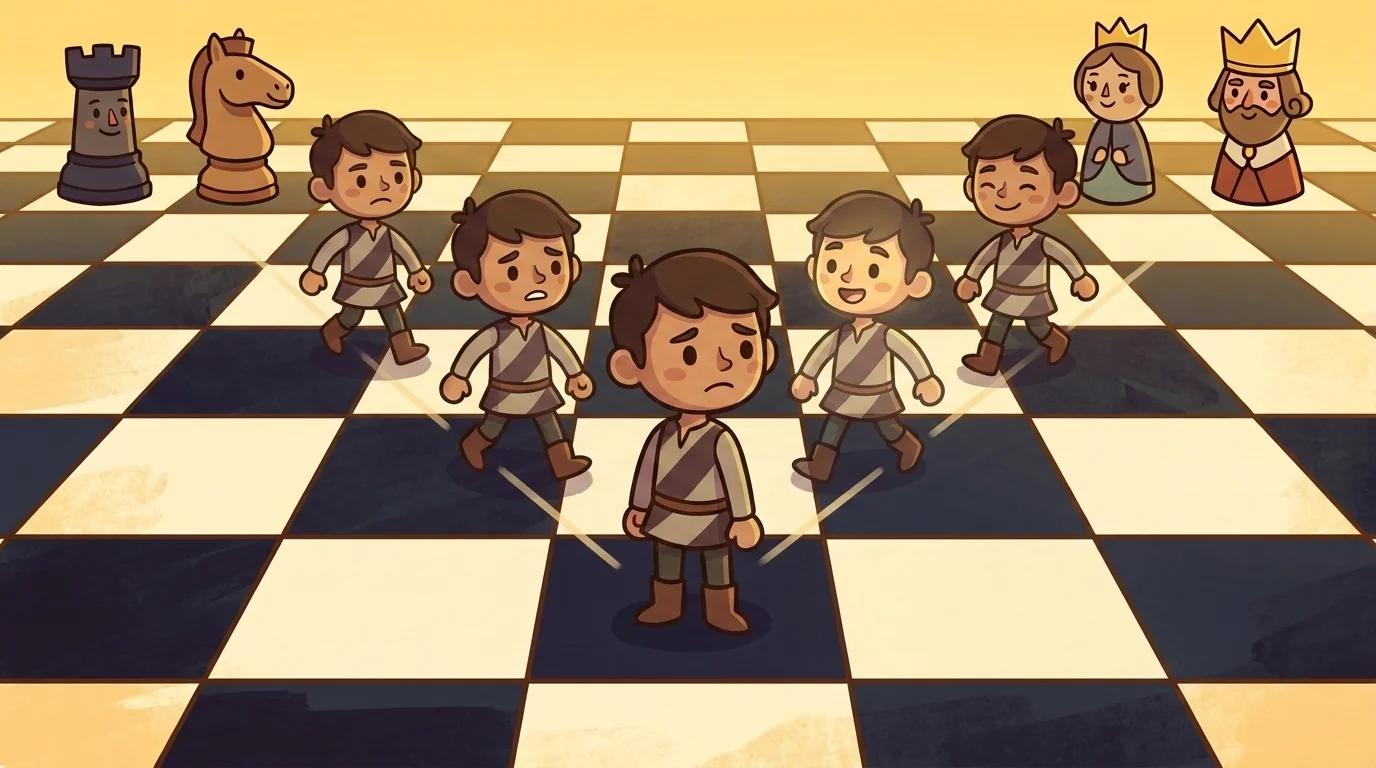
Slant spent his early days feeling like he was doing everything the wrong way.
He'd watch pieces that moved straight — bold, obvious, forward — and feel like his sideways-slanting path was somehow lesser, a mistake, a crooked version of what he was supposed to be. He tried, once, to move straight like them. He couldn't. It simply wasn't how he was made. And he decided that meant something was wrong with him.
An old piece, worn smooth at the edges, set him straight — or rather, set him diagonal. "Watch what your diagonal does," she told him. "It keeps you on your own colour, always. It lets you reach every corner of the fight. Every capture in this whole game happens on a diagonal — yours. You're not a broken straight-mover. You're the shape the whole game is built on." Slant looked at the board with new eyes and realized his "crooked" path wasn't a flaw at all. It was the foundation.
He came to the CrownTales academy as the piece who teaches the very first thing: how a man moves. On his first day the head asked him to show a new player the most basic rule of all.
Slant didn't lecture. He just slid — one square, diagonally, onto a dark square. Then another. "That's it," he said. "One square. Along the diagonal. Forward, until you're crowned." The new player asked, "That's all? It seems so simple." Slant smiled. "Simple isn't small. Everything else in this game — the jumps, the kings, the great endgame duels — is built on this. Learn the diagonal, and you've learned the ground everything else stands on."
The head nodded. "Most teachers rush to the exciting rules. You start where the game actually begins." And that has been Slant's role ever since: the keeper of the first, foundational move.
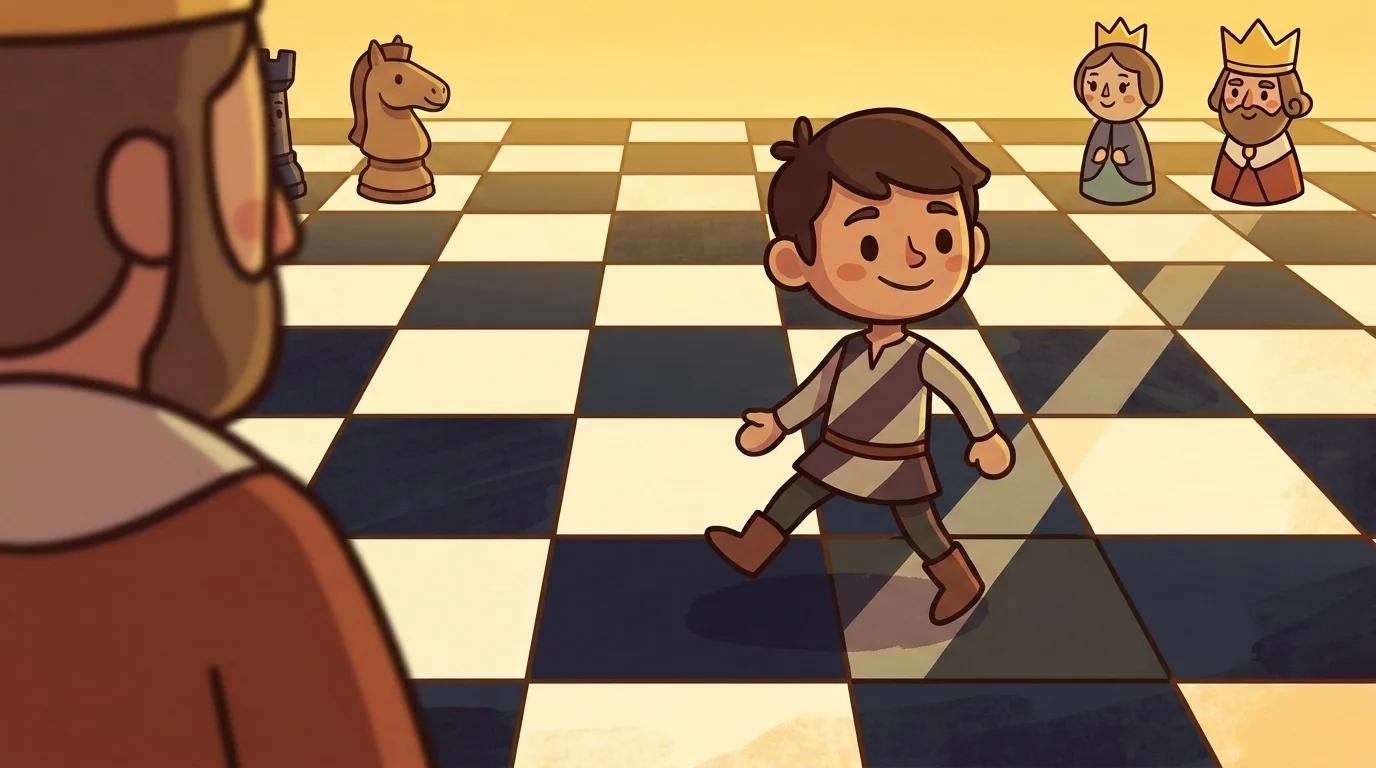
A young piece came to him ashamed. "I keep wanting to move straight, like I think I'm supposed to. I feel like I'm bad at this." Slant recognized that feeling instantly — he'd carried it himself. "You're not bad at it," he said. "You're trying to move like a piece you're not. Watch —" He slid diagonally, smooth and certain. "This is your move. It's not a lesser version of straight. It reaches every square that matters, it keeps you on your colour, and it's where every capture in the game is born. Stop apologizing for the diagonal. Use it."
The young piece tried it — really tried it, not as a failed straight line but as its own confident thing — and slid corner to corner across the board, and for the first time it didn't feel like a mistake. It felt like flying.
Later the young piece said the quiet part. "I always feel like I'm doing it the wrong way."
Slant settled onto his square. For a moment he was the piece who'd once tried to move straight and couldn't. "I know that feeling like I know my own diagonal," he said. "I spent a long time thinking my way of moving was a flaw. And then I understood — the thing I thought made me lesser was the thing the whole game is built on. Your way isn't the broken version of someone else's way. It's yours, and it can carry you anywhere that matters." He slid one square, easy and sure. "Move your own line. Move it with your whole heart. You'll be amazed where a diagonal can take you."
The young piece practiced late into the evening, sliding corner to corner, no longer wishing for a straight line, and feeling — with a quiet, settling pride — entirely, finally, like itself.
Hear it as an audio drama
A short play starring Slant, from CrownTales. Different voices, same idea. Listen any time after you read.
Loading audio…
Read the drama script
- Narrator: From Spark and Anvil and Crowntales — this is Slant, in chapter 1 of the Crowntales cast.
- Narrator: This drama uses an AI-generated voice. Voiced via Gemini 2.5.
- Narrator: In the checkers court, Slant teaches the very first thing — how an ordinary piece moves. It sounds simple. It's the ground everything else stands on.
- Slant: One square. Along the diagonal. Forward, onto the corner of the next square. That's it. And here's the quiet secret: because you always move diagonally, you stay forever on your own colour of square. A dark-square piece lives its whole life on dark squares.
- Narrator: One colour, forever. That single fact shapes the whole game.
- Slant: Every fancy move — jumps, kings, combinations — is built on this one diagonal step. If you understand which squares a piece can EVER reach, you understand where the danger is and where it can't be. The diagonal isn't basic. It's the foundation.
- Narrator: Slant remembers beginners who ignored the diagonal and tried to move straight ahead.
- Slant: They'd push a piece straight forward like a little soldier, and it just... can't. A checker doesn't march. It slants. Once that clicks, the whole board suddenly makes sense — you see the lanes, the crossings, the safe colour.
- Narrator: A small girl kept trying to move her piece straight up the board.
- Slant: Not straight — slant it. One square, corner-to-corner. See? Now it's on the next dark square. And it'll ALWAYS be on a dark square, forever. That's your piece's whole world. Learn the diagonal, and you've learned where everything can go.
- Narrator: The girl slid her piece along the diagonal and, for the first time, saw the board as a set of lanes instead of a grid.
- Slant: One square, on the diagonal, on your own colour. Simple — and everything else is built on top of it.
- Narrator: You've been listening to a Spark and Anvil chapter, written by the Spark and Anvil writing team for ages 9 to 14.
- Narrator: Apps stay free forever.
- Narrator: Curriculum aligned to Common Core and Next Generation Science Standards.
- Narrator: Released under Creative Commons BY-NC-SA 4.0 for educational reuse. Visit Spark and Anvil for the full transcript.
The CrownTales ensemble
Slant is one of the friends in CrownTales. Each friend shows you one idea by how they act; meet them all and you have the whole subject.
-

Bastian
The double-corner fortress: drawing a lost-looking game by holding the safe square
-

Kingsley
Crowning: a man that reaches the far row becomes a king that moves both ways
-

Leapford
The forced capture: a man captures by leaping over a neighbor
-

Ordell
Orthogonal movement: how Turkish-draughts pieces step straight, not diagonally
-

Prong
The fork: one move that threatens two pieces at once
-
Regina
Opposition and tempo: winning the endgame by controlling who must move
-

Skipjack
The multi-jump chain: capturing several pieces in one turn
-

Volant
The flying king: the long-range king of International 10x10 draughts