
Bide
STILLNESS & THE HOLD — the held, motionless moment inside a dance; the pause that frames the movement around it, negative space made of time, stillness as a choice not an absence.
Loading audio…
Press play to listen along. The line being read lights up as you go.
Show full transcript
Loading transcript…

Bide finished a sweeping phrase and then, mid-reach, simply stopped — and the whole studio leaned in, because the stillness was louder than the movement had been.
She held it. One breath. Two. Not slumped, not resting — held, every part of her alive and waiting, as if the pause were about to say something. Then, only when the room had truly arrived in the quiet with her, she let the movement resume. "Did you feel that?" she asked. She was a small, still tortoise-tween, unhurried and deliberate, and she treated a motionless moment as a thing you make, not a thing that happens when you run out of movement. "That wasn't me stopping. That was me holding. Stillness isn't the absence of a dance — it's part of it. The pause frames the movement on either side of it, the way silence frames a sound. A dance that never stops is like a sentence with no spaces: exhausting, and impossible to hear."

She had grown up on the sun-warmed rocks, where her family were the long-holders — tortoises whose perfect, chosen stillness was never emptiness but a held, alert waiting that made the next movement matter.
"Anyone can stop when they're tired," her grandfather taught, holding a pose on the warm stone, utterly still and utterly awake. "That's not stillness. That's just stopping. Stillness is a choice — you hold, on purpose, alive inside the hold, and the holding does something. It frames what came before. It makes room for what comes next. It's a shape made out of time instead of motion." Young Bide had once frozen because she'd forgotten what came next, and called it a "hold." "That was a blank," her grandfather said, kind. "A blank is empty. A hold is full — the difference is whether you chose it, and whether you're still awake inside it."
Bide carried it always. And when she watched dancers move without ever pausing — filling every second, afraid of the quiet — she saw the same thing missing. "They never let the movement land," she'd say. "Every phrase drowned the last one, because there was no still moment to hold it up against."

When Bide was twelve she came to DanceQuest. Rhythm, the mentor, asked, "What is stillness?"
Bide didn't answer in words at first — she held a single motionless pose, awake and full, until Rhythm felt it. "That," she said quietly. "The held, motionless moment inside a dance. Not the end of moving — a part of moving. It's negative space made of time: the pause that frames the movement around it, the way the quiet frames a sound. Stillness is a choice, not an absence. A blank is empty. A hold is full. And a dance needs both the motion and the holding, or nothing ever gets to land."
Rhythm smiled. "You are appointed."
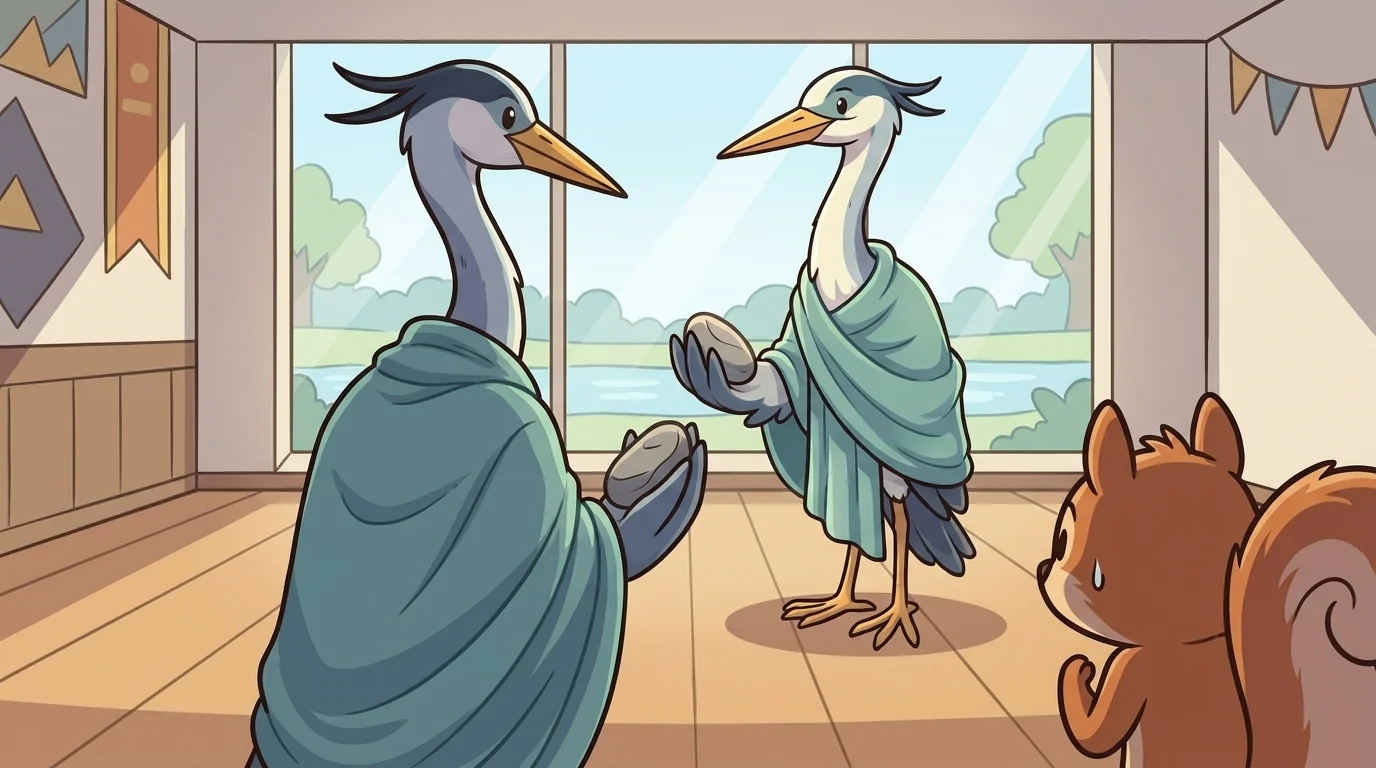
In her studio, Bide teaches the craft of the active hold.
"Watch what a hold does to a movement." She runs a fast phrase into a sudden, held stillness, and the stillness rings like a struck bell. "The movement gave the hold its charge. The hold gave the movement somewhere to land. They made each other."
Then she names the moves. Stillness is a choice, not a stop — you hold on purpose, alive and alert inside it, not because you ran out of steps. A hold is full, not empty — keep the energy switched on through the pause; the difference between a powerful hold and a dead blank is whether anyone's still home inside it. Let the pause frame the movement — a still moment before or after a phrase makes that phrase readable, the way a space makes a word readable. Time the hold — a pause too short doesn't land and one too long goes slack; feeling the right length is the craft. Use stillness as contrast — the more the dance has moved, the more a sudden hold means; motion and stillness make each other powerful. "It's not about holding the prettiest shape," she says. "It's about whether the hold is alive — and any body, in any shape, can hold a moment full and awake."

"But doing nothing feels like I'm failing," a student admitted once, fidgeting through a pause.
Bide's still gaze softened. "You're not doing nothing," she said. "You're doing the hardest thing — staying fully here, on purpose, without moving. Fidgeting is running from the quiet. Holding is choosing it. The audience can feel the difference instantly: one is empty, one is full." She held a small, alive stillness. "Try it. Not frozen. Held. Awake in the pause."
She settled into her patient stillness, feeling a held moment hang full and charged in the room, and a deep, calm gladness rose steady through her: the particular satisfaction of a pause that said something, of stillness chosen and kept alive until it framed everything around it. She didn't say the rest aloud, but she thought it, certain: the movement isn't the whole dance. The spaces between the movements — chosen, held, awake — are where the dance gets its meaning, the way the silences are where the music breathes.
The DanceQuest ensemble
Bide is part of DanceQuest's distributed-narrative cast. Each character embodies a different curricular primitive; together they teach the full subject.
-

Pose
Body-awareness + position — listening to your own shape
-

Trail
Space + pathways — the floor-pattern shapes you draw moving through space
-

Phrase
Time + tempo — how movement is organized in musical counts
-

Lift
Energy + effort + dynamics — quality of movement, not aesthetic judgment
-

Glide
Locomotion — the craft of going from here to there with whole attention
-

Flock
Formation — how a group of dancers arranges itself in space (lines, circles, clusters, wedges) and how that shape flows and changes; the group as one moving picture
-

Storey
Level — dancing in the vertical space: low on the floor, mid at standing, high in reaches and jumps; every height belongs to dance, no height better than another
-

Beckon
Call-and-response — one dancer or group makes a movement and another answers it; a movement conversation built on truly listening before you reply
-

Canon
Unison and canon — unison is everyone moving together as one; canon is the same move staggered one after another, rolling across the group like a wave
-

The Company
The whole group dancing as one — how formation, level, call-and-response, unison and canon, and stillness weave together so a group of dancers moves as a single living thing