Beckon
CALL-AND-RESPONSE
Loading audio…
Press play to listen along. The line being read lights up as you go.
Show full transcript
Loading transcript…
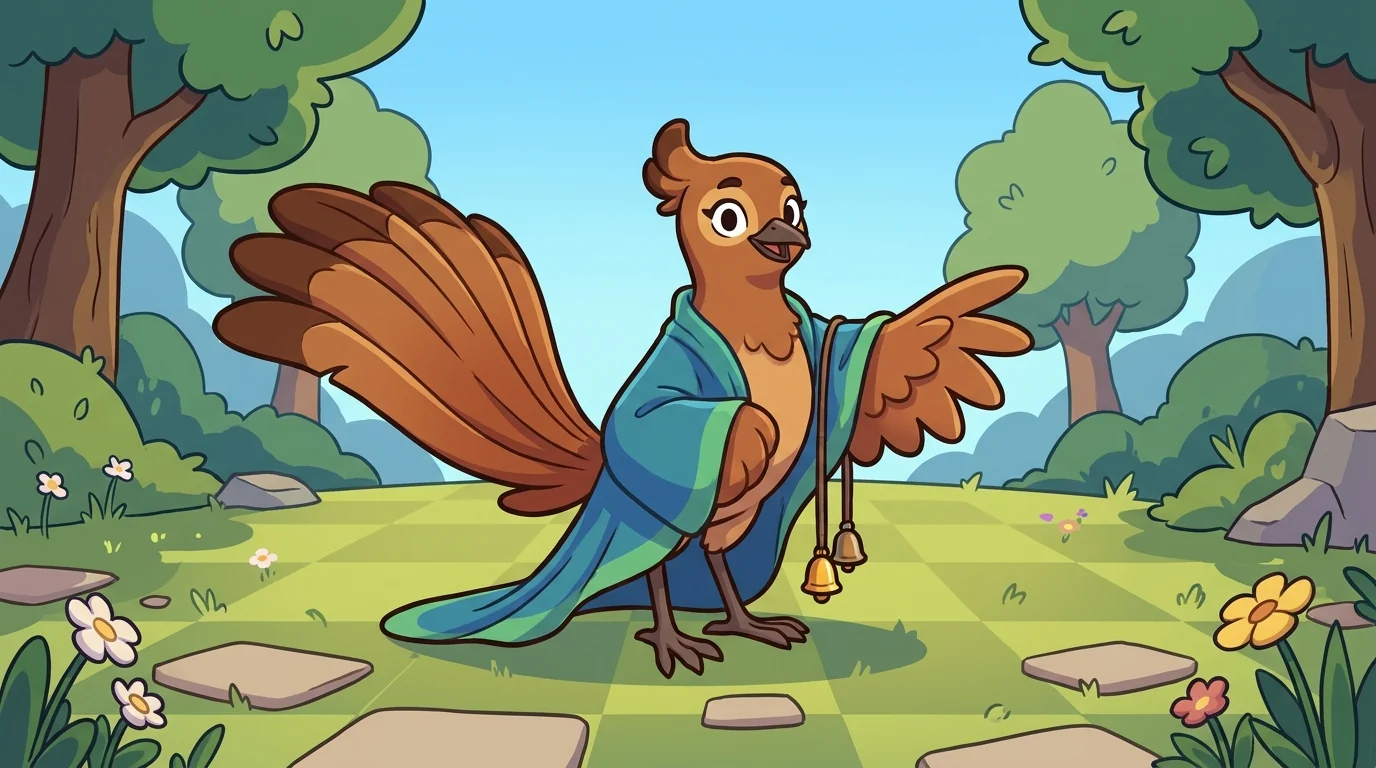
Beckon was a lyrebird-tween, warm-brown and soft-bodied, with a big expressive tail she could sweep in wide inviting arcs. She wore a loose flowing wrap that trailed when she gestured, and everything about her seemed to be offering — reaching a wing out and then waiting, bright-eyed, to see what came back. She never rushed to fill a silence; she made a movement and then paused, open, expectant. On a cord at her side she carried two little bells, one bright and one deep, and she'd ring one — call — and wait for someone to ring the other — response.
"Call-and-response is a conversation you have with your body," Beckon liked to say, sweeping her tail out in invitation. "One dancer makes a movement — that's the call. Another dancer answers it — copies it, or flips it, or grows it bigger — that's the response. Back and forth, like talking, but in movement. It only works if you truly listen to what the other person offered, with your eyes and your whole self, and answer that — not just do your own thing when it's your turn."
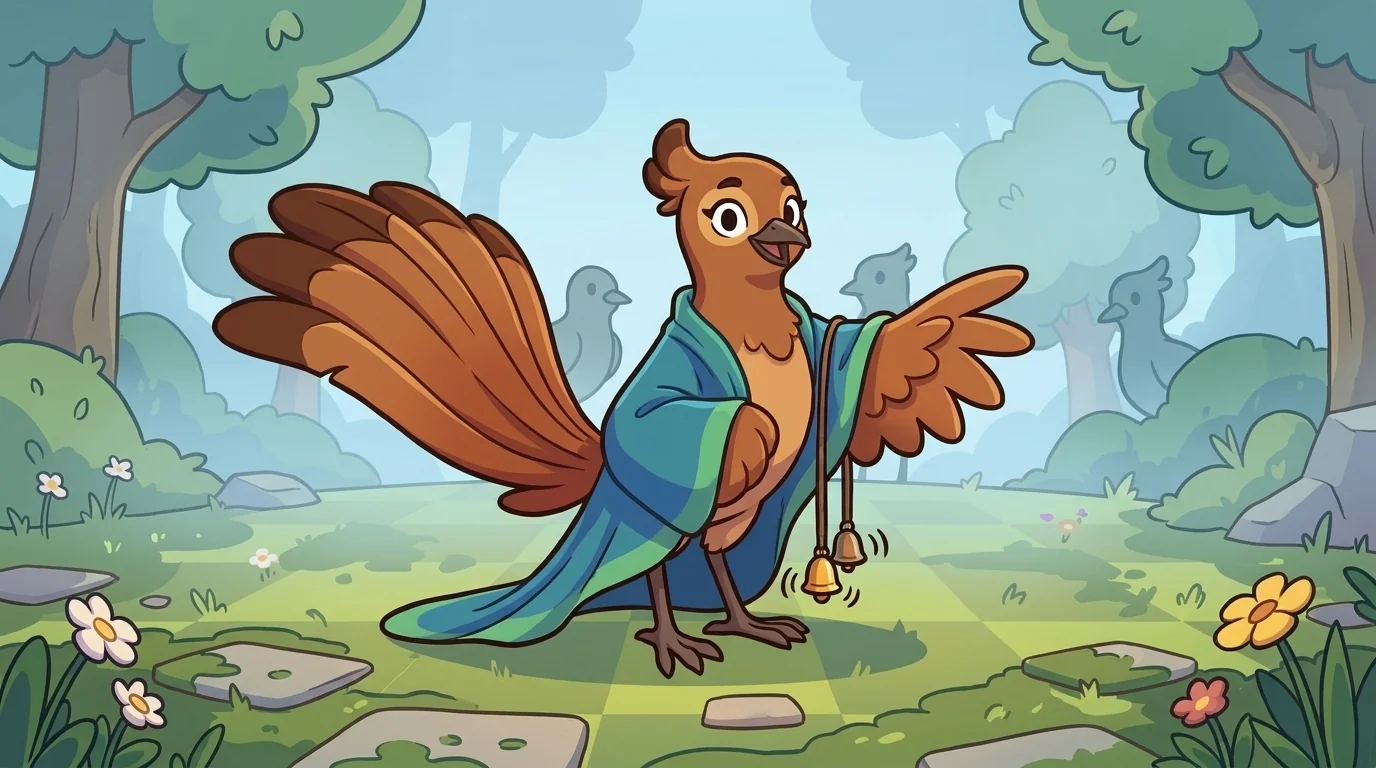
Beckon grew up in the misty forest, where her family were the song-callers — lyrebirds famous for their calls that echoed across the valley and were always answered. A call sent into the empty forest and ignored was a lonely, sad thing. But a call that came back, answered by another bird, turned into a duet, a conversation, a whole morning chorus of birds building on each other's songs.
Little Beckon learned the hard way that a good answer requires real listening. She used to send her call and then, instead of listening to what came back, just launch straight into her next showy call. "You're not having a conversation," her mother told her. "You're taking turns talking at each other. Listen to what your partner actually sang. Answer that. Maybe echo it. Maybe turn it upside down. Maybe make it bigger. But answer what they gave you." When Beckon finally learned to truly listen and answer, her calls turned into real duets — two voices weaving together — and it was the most alive she'd ever felt. She never forgot that the magic was in the listening, not the calling.

At twelve, Beckon swept her way to DanceQuest, two bells jingling. Rhythm met her and asked.
"What is call-and-response?"
Beckon rang the bright bell, then the deep one. "It's a conversation in movement," she said. "One dancer makes a call — a movement. Another answers it — echoes it, flips it, grows it. Back and forth, like talking. And it only works if you truly listen to what the other dancer offered, and answer that, instead of just doing your own thing on your turn."
Rhythm smiled. "You are appointed."
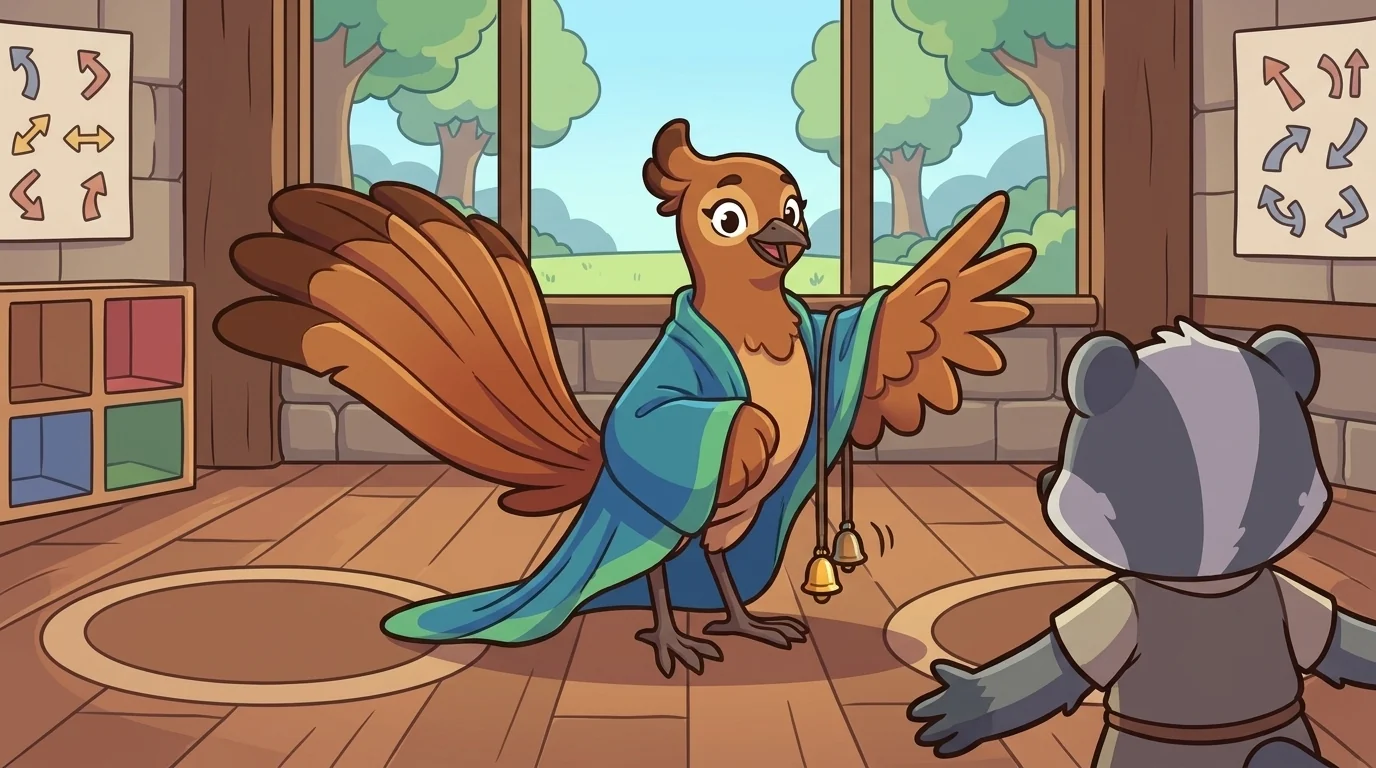
Beckon's studio had two facing spots on the floor, a caller's and an answerer's, and today a serious badger-tween named Sumi stood on the answering spot, arms crossed.
"Me and my partner are supposed to do call-and-response," Sumi said, "but it just looks like two separate solos glued together. She does her move, and then while she's doing it I'm already planning my move, and then I do mine, and it doesn't... connect. Rhythm says there's 'no conversation.' But I am taking turns!"
"Taking turns isn't the same as answering," Beckon said gently. "Right now you're waiting for your turn to perform, not listening to what she gives you. Let's fix that." She rang the bright bell. "I'll call. Watch my whole movement — not to copy it exactly, but to really see what I offered." Beckon swept one arm slowly up and to the left, then opened her wing wide — a big, reaching, hopeful call. Then she waited, open, watching Sumi. "Now — answer that. What did I give you?"
Sumi paused. She'd actually watched this time. "It was... big and reaching and hopeful," she said. And instead of a planned move, she answered it — she took that same reaching bigness and swept it back the other way, then folded it smaller, like a gentle reply. It matched. It connected. It was suddenly a conversation.
"That connected!" Sumi said, startled. "It felt like I was actually talking back to you."
"Because you answered what I gave you, instead of what you'd pre-planned," Beckon said. She gave the badger the rules, ringing a bell between each. Watch the call with your whole self — you can't answer what you didn't truly see. Answer that call: echo it, reverse it, shrink it, grow it — but make it clearly a reply. Don't plan your response during their call; listen first, answer second. And leave a clear little space between call and response, so the conversation has a rhythm and doesn't blur into two people moving at once.
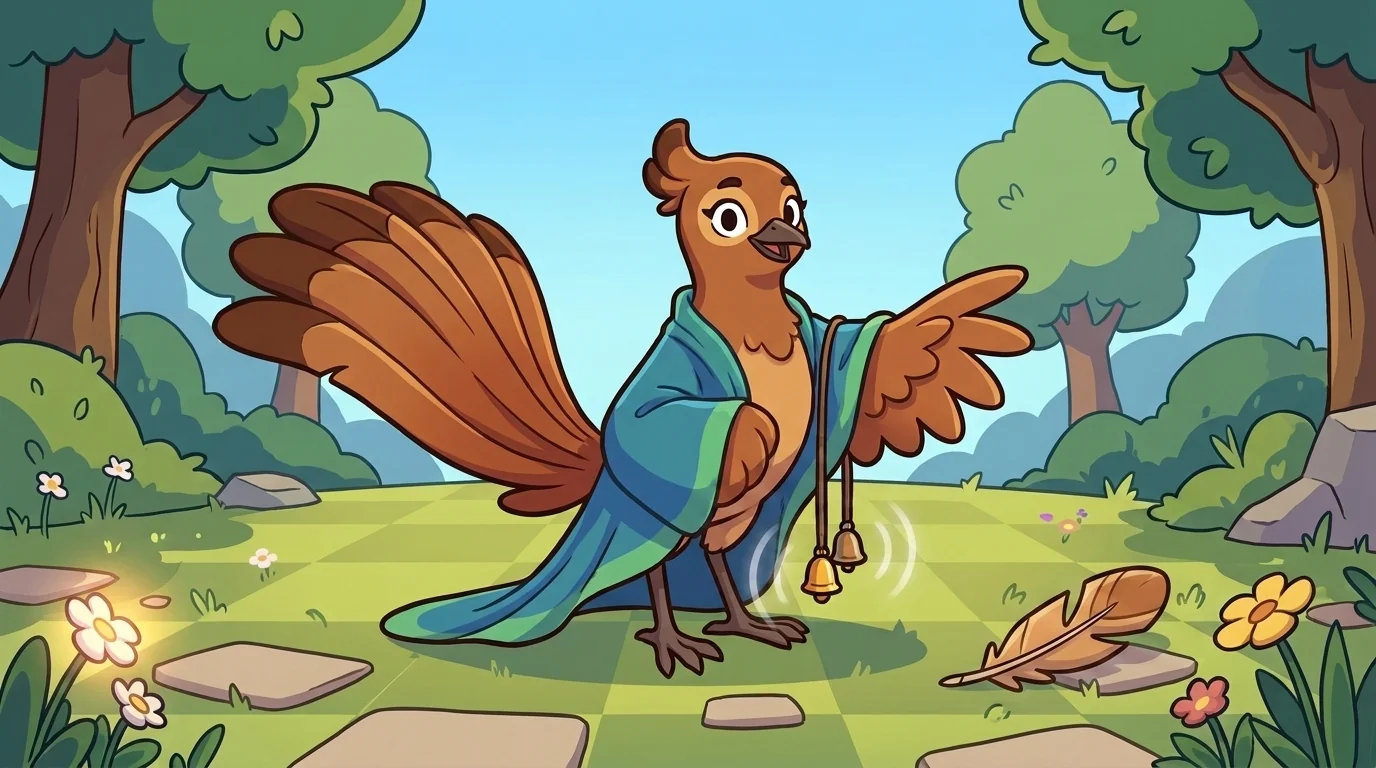
When the studio hushed, Sumi stayed on the answering spot, replaying the movement duet in her head.
"I do that in real conversations too," she admitted quietly. "Wait for my turn instead of really listening. It's why my dances felt lonely, I think. Like two people not really hearing each other."
Beckon settled beside her, tail folding soft. "That's the beautiful secret of call-and-response — it teaches your whole self to listen before answering, and there's almost nothing that feels better than being truly answered. When your partner sees what you offered and builds on it, you feel met. That's not about how anyone looks doing it. It's about two bodies actually hearing each other." She rang both bells softly, bright then deep. "A call that gets answered is never lonely."
Sumi rang an imaginary bell back, and felt the glued-together loneliness of her old dance warm into the alive, connected feeling of a real exchange — the gladness of being heard and answering back.
"Listen first. Answer what they gave you," Beckon said, sweeping her tail in a wide, open arc. "Doesn't it feel good, being truly answered?"
Hear it as an audio drama
A short play starring Beckon, from DanceQuest. Different voices, same idea. Listen any time after you read.
Loading audio…
Read the drama script
- Narrator: From Spark and Anvil and DanceQuest — this is Beckon, in chapter 1 of the DanceQuest cast.
- Narrator: This drama uses an AI-generated voice. Voiced via Gemini 2.5.
- Narrator: This story covers bodies and self-expression. Parents may want to listen first.
- Narrator: Beckon is a lanky heron of long lines and patient listening, and he treats the space between two dancers as a place where something gets said.
- Narrator: He raises a wing in a slow arc, sends it across the floor like a question, and then does the thing most dancers forget. He waits.
- Beckon: I am Beckon. What I teach is call-and-response. One dancer makes a movement, the call. Another answers it, the response.
- Narrator: A response is not a mirror. A mirror copies exactly. A response answers, shaped by having heard the call.
- Beckon: So do not copy me. Answer me. Echo my movement lower, or quicker, or finish it a new way. The change is your listening, made visible.
- Beckon: And leave space for the reply. A conversation needs a pause where the other voice can land. If you never stop moving, no one can answer.
- Narrator: Beckon grew up in the reed-marsh, with the answer-callers, herons whose dawn exchanges rolled across the water, each reply shaped by the last.
- Beckon: My mother taught me young. A call is only half a thing. It is not finished until something answers it, and the answer is never a copy.
- Narrator: He came to DanceQuest at twelve. The mentor Rhythm asked what call-and-response is.
- Beckon: I raised a wing, and waited, and when she sent one back changed, I said: that. A movement conversation across the floor.
- Narrator: Rhythm smiled. He was appointed.
- Beckon: There is no wrong answer in a conversation. Only a real one and a pretend one. A copy is pretend. Your own answer is real.
- Narrator: You've been listening to a Spark and Anvil chapter, written by the Spark and Anvil writing team for ages 9 to 14.
- Narrator: Apps stay free forever.
- Narrator: Curriculum aligned to National Core Arts Standards dance.
- Narrator: If anything in this story brought up big feelings, talking to a trusted adult helps. You can also reach support lines anytime.
- Narrator: Released under Creative Commons BY-NC-SA 4.0 for educational reuse. Visit Spark and Anvil for the full transcript.
The DanceQuest ensemble
Beckon is one of the friends in DanceQuest. Each friend shows you one idea by how they act; meet them all and you have the whole subject.
-

Pose
Body-awareness + position — listening to your own shape
-

Trail
Space + pathways — the floor-pattern shapes you draw moving through space
-

Phrase
Time + tempo — how movement is organized in musical counts
-

Lift
Energy + effort + dynamics — quality of movement, not aesthetic judgment
-

Glide
Locomotion — the craft of going from here to there with whole attention
-

Flock
Formation — how a group of dancers arranges itself in space (lines, circles, clusters, wedges) and how that shape flows and changes; the group as one moving picture
-

Storey
Level — dancing in the vertical space: low on the floor, mid at standing, high in reaches and jumps; every height belongs to dance, no height better than another
-

Canon
Unison and canon — unison is everyone moving together as one; canon is the same move staggered one after another, rolling across the group like a wave
-

Bide
Stillness and the hold — the held, alive, motionless moment inside a dance; negative space made of time; a strong chosen pause, not tiredness or absence
-
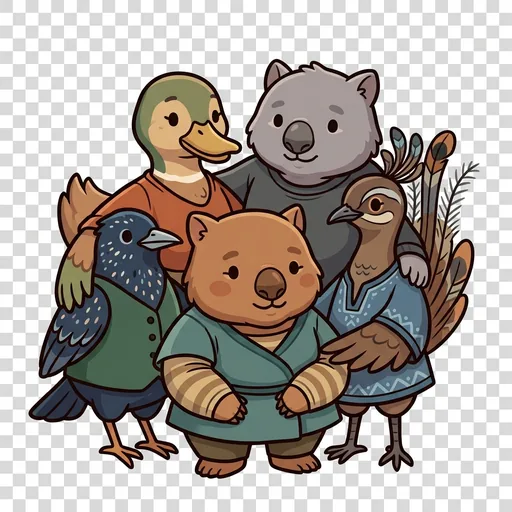
The Company
The whole group dancing as one — how formation, level, call-and-response, unison and canon, and stillness weave together so a group of dancers moves as a single living thing