
Cogent
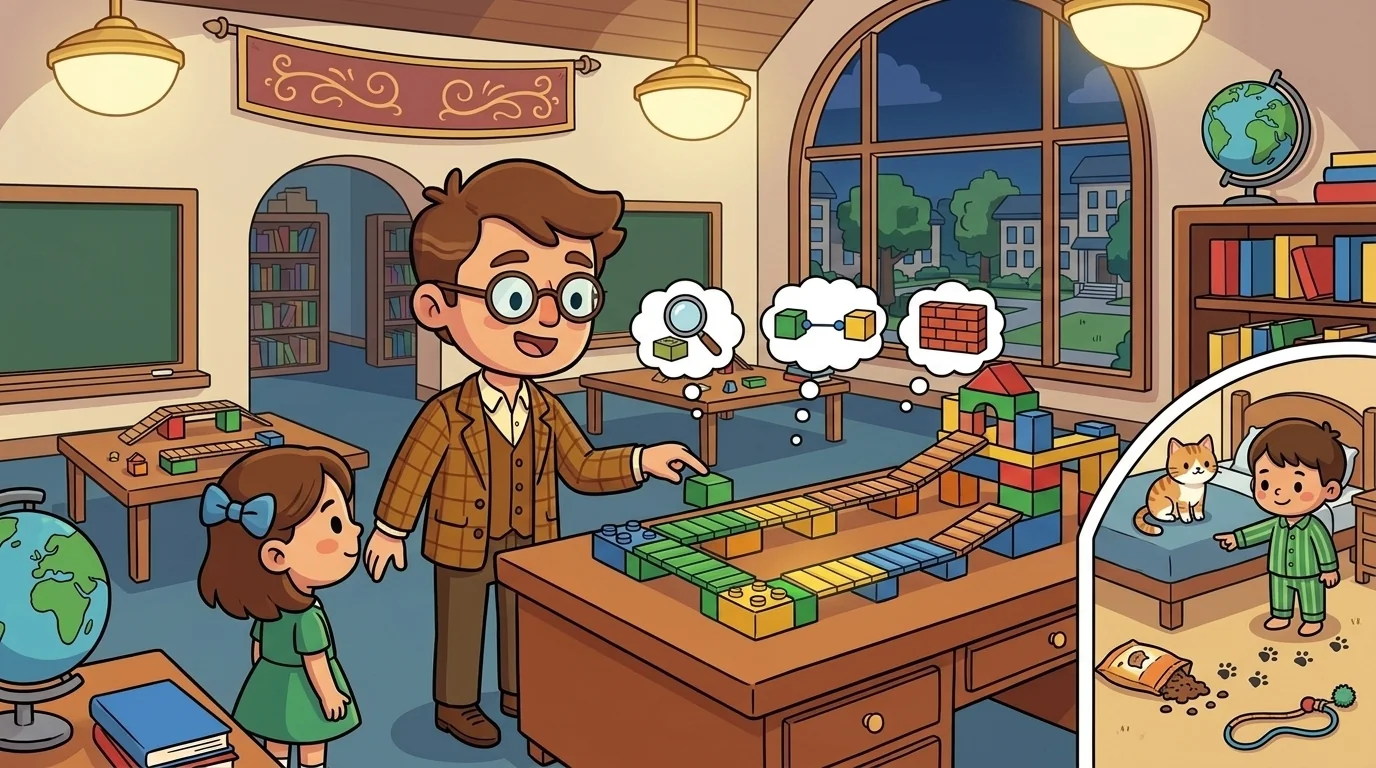
CONSTRUCTING EXPLANATIONS (deductive vs inductive) — an answer isn't finished until you can show *why* — the chain that connects the evidence to the conclusion (the warrant). And you name your certainty honestly: *deductive* reasoning is airtight (if the premises hold, the conclusion MUST follow); *inductive* reasoning is strong-but-not-certain (the evidence makes it *likely,* patterns can break). Knowing which kind you've got is knowing how much to trust it.
Loading audio…
Press play to listen along. The line being read lights up as you go.
Show full transcript
Loading transcript…
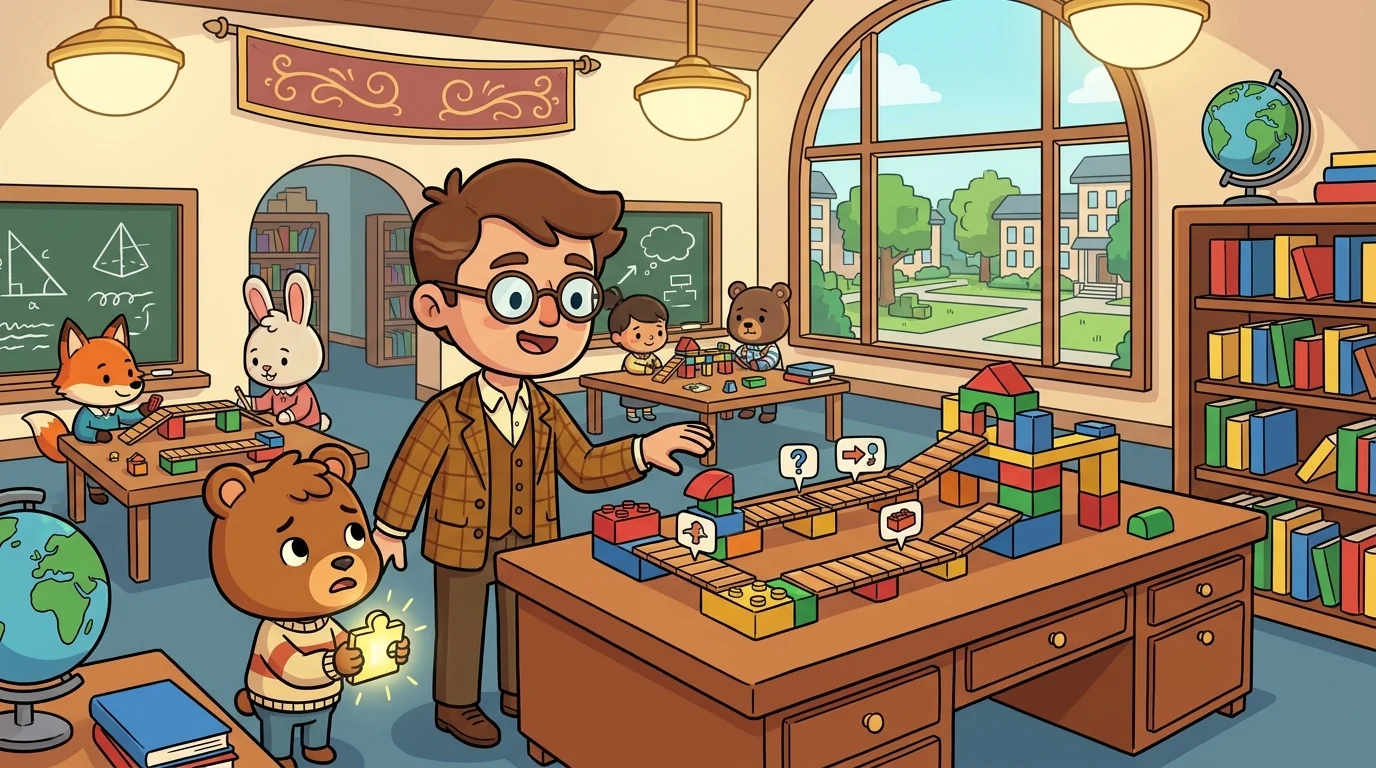
Cogent was not impressed by right answers. A right answer brought to his desk without a reason was like a shiny copper penny pulled from an empty shoe. It was nice to look at, but nobody knew how it got there.
Students at the DeduceQuest academy learned this rule during their very first hour in the workshop. You could lay a perfect solution on the long oak table. Cogent would lean forward, adjust his wire-rimmed spectacles, and offer the four words everyone feared and needed.
"Walk me through it."
He did not say it because he thought you were wrong. Usually he already knew you were right. He said it because an answer you could not explain was just an accident wearing a nice coat. An accident could not be repeated, taught, or trusted.
"The answer is only half the work," Cogent liked to say, tapping a piece of yellow chalk against the board. "The rest is the bridge from what you saw to what you decided. If you can't show me the bridge, you jumped. And people who jump eventually fall."
This habit of constructing explanations was not something Cogent was born with. It was something he had been forced to build out of pure embarrassment.
When he was twelve years old, Cogent had been the kind of student who got top marks on every Friday test without trying. Numbers and patterns simply settled into his head like dust landing on a windowsill. He never knew where they came from. He just knew they were right.
Then came a Tuesday morning in seventh grade. His teacher, Mrs. Gable, stood at the chalkboard, drew a complex diagram of water pipes, and asked him how he had reached his answer.
Young Cogent stood up. The classroom was very quiet. Thirty pairs of sneakers shifted under thirty desks.
"I just knew," he said.
Mrs. Gable held out the chalk. "Show us the steps, please."
Cogent took the chalk. His thumb pressed into the dry white cylinder until his fingernail turned pale. He looked at the board. He looked at his own correct answer written at the bottom. Between his eyes and that number lay a wide, terrifying blank space.
He had no bridge. He had jumped, and now he was hanging in thin air in front of thirty people.
He sat down with burning ears. It was the worst morning of his life, but it was also the most useful. That day he learned that guessing right and understanding why were two entirely different things. From that afternoon on, he refused to write down a final number until he had built every plank of the bridge out loud.
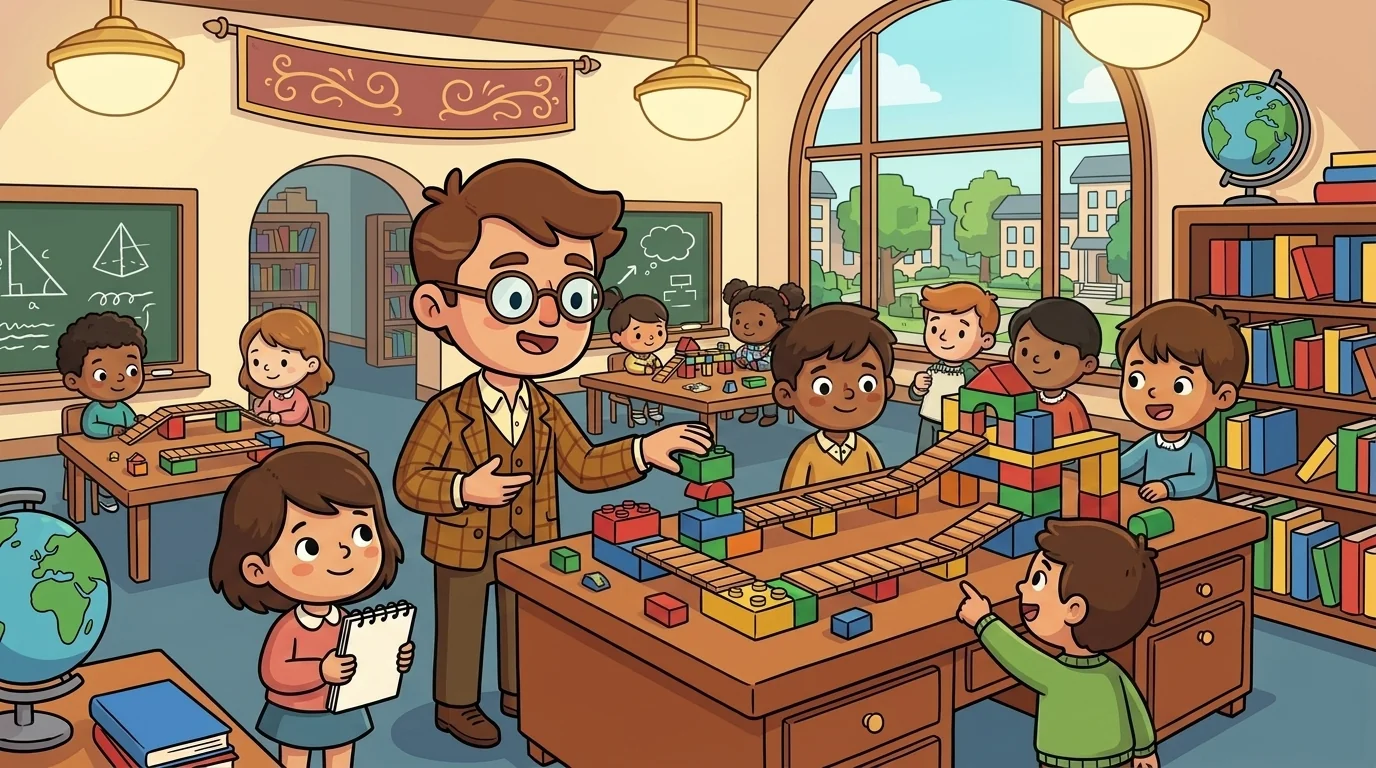
That was the quality that brought him to the academy. Deducia, the founder, had watched him refuse to accept his own correct guess on a lock box until he could trace his path back to the keyhole.
On his first morning, the Head handed Cogent two index cards. Both cards contained statements about a puzzle box on the table. Both statements were completely true.
"Tell me the difference between these two," the Head said.
Cogent read the first card: All the doors in this hallway are locked. This frame holds a door. Therefore, this door is locked.
He tapped the paper. "This one is airtight," Cogent said. "If the first two lines are true, the third line cannot be false. That is deductive reasoning. It holds its own weight."
Then he picked up the second card: The last four puzzle boxes in this room were unlocked by bronze keys. Therefore, the fifth box will also use a bronze key.
"Now look at this one," Cogent said, setting it down next to the first. "This is inductive reasoning. It is strong. It is worth betting your lunch money on. But it is not certain. The person who designed these boxes could easily change their mind on box number five."
The Head watched him closely. "So which card is better?"
"Neither," Cogent said. "They are different tools. But if you treat the second card like the first—if you say the fifth box must be bronze—you are claiming more than your evidence can pay for."
The Head smiled faintly. Cogent had not just solved a puzzle. He had placed an honest price tag on how much his thinking was worth.
In the main workshop, Cogent spent his afternoons helping students build and grade their own bridges.
A first-year student named Maya sat at a low table, staring at a brass cipher disk. She had jammed her pencil into her ponytail and was tapping her heels against the wooden floorboards.
"The secret word is NORTH," Maya announced. She slid her notebook across the oak table.
Cogent looked at the page. The word NORTH was written in dark, neat capital letters.
"Walk me through it," Cogent said softly.
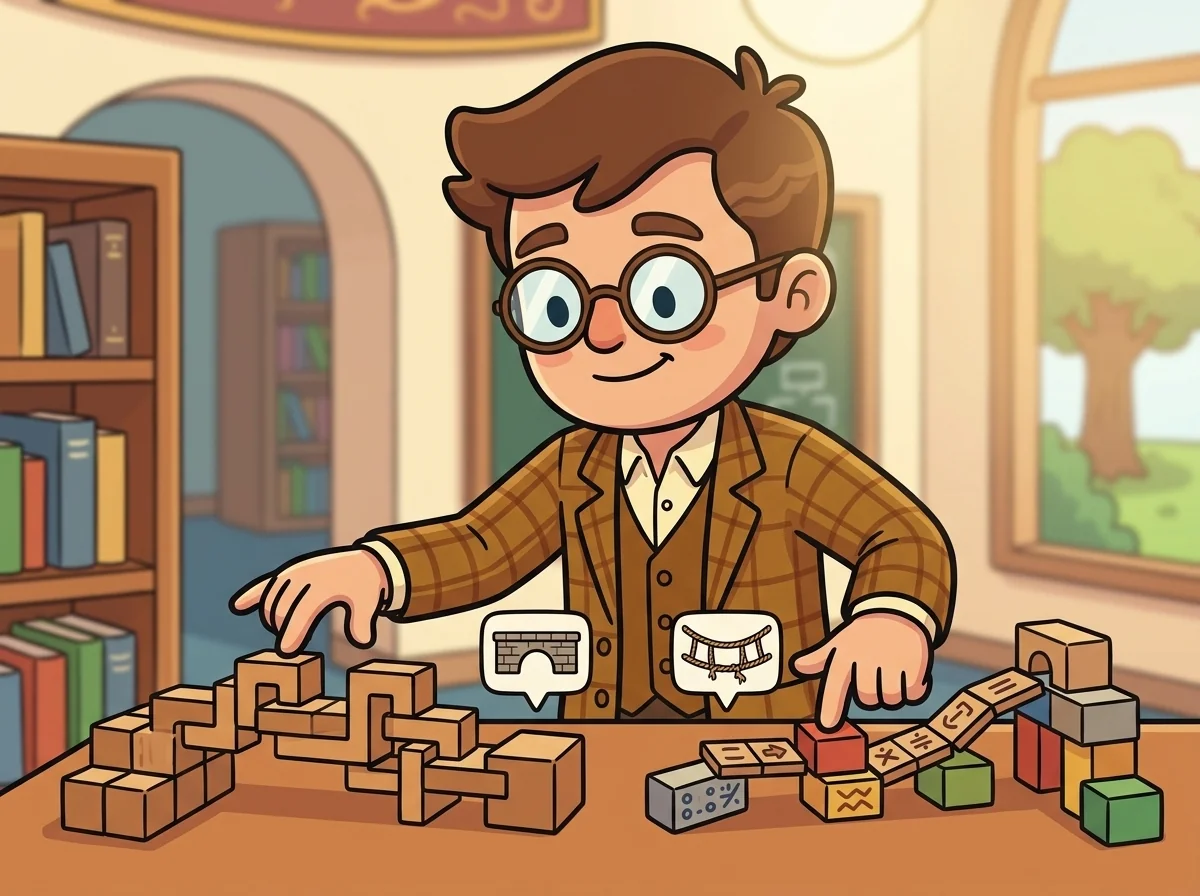
Maya slumped back in her chair. "I can't. I just looked at the dial and saw it. My brain did it while I was tying my shoe."
Cogent did not scold her. His eyes brightened behind his glasses.
"That feeling is very familiar," he said. "Your brain built the bridge so fast that you didn't see the planks go down. So let's turn the crank backward. Let's watch it in slow motion."
He pulled a fresh sheet of paper from a stack on the desk. He drew a small square at the bottom left corner and labeled it START.
"What was the first detail your eyes hit when you opened the box?" he asked.
Maya blinked. "The rust on the brass hinge."
"Good," Cogent said, drawing a line from the start square. "And what did rust on a brass hinge tell you?"
"That the box was kept somewhere damp," Maya said slowly. "Like the river house."
"Which made you check the dial for..."
"Compass points," Maya said, her voice rising slightly. "Because the river house maps always use compass headings instead of numbers. And N was scratched deeper than the other letters."
"So you tried..."
"NORTH," Maya said. A smile pulled at the corner of her mouth. "Because it was the only four-letter compass heading on the dial."
Cogent drew the final box at the top right of the paper and wrote NORTH inside it. Between the start line and the finish line stood four clean black ink lines.
"There is your bridge," Cogent said. "You didn't guess. Your brain just worked faster than your chalk."
Maya picked up the paper and ran her thumb across the pencil lines. "It looks obvious when you draw it out."
"Now comes the important part," Cogent said. He handed her a blue pen. "We label the planks. Look at step three—where you decided the scratch on the letter N meant it was used most often."
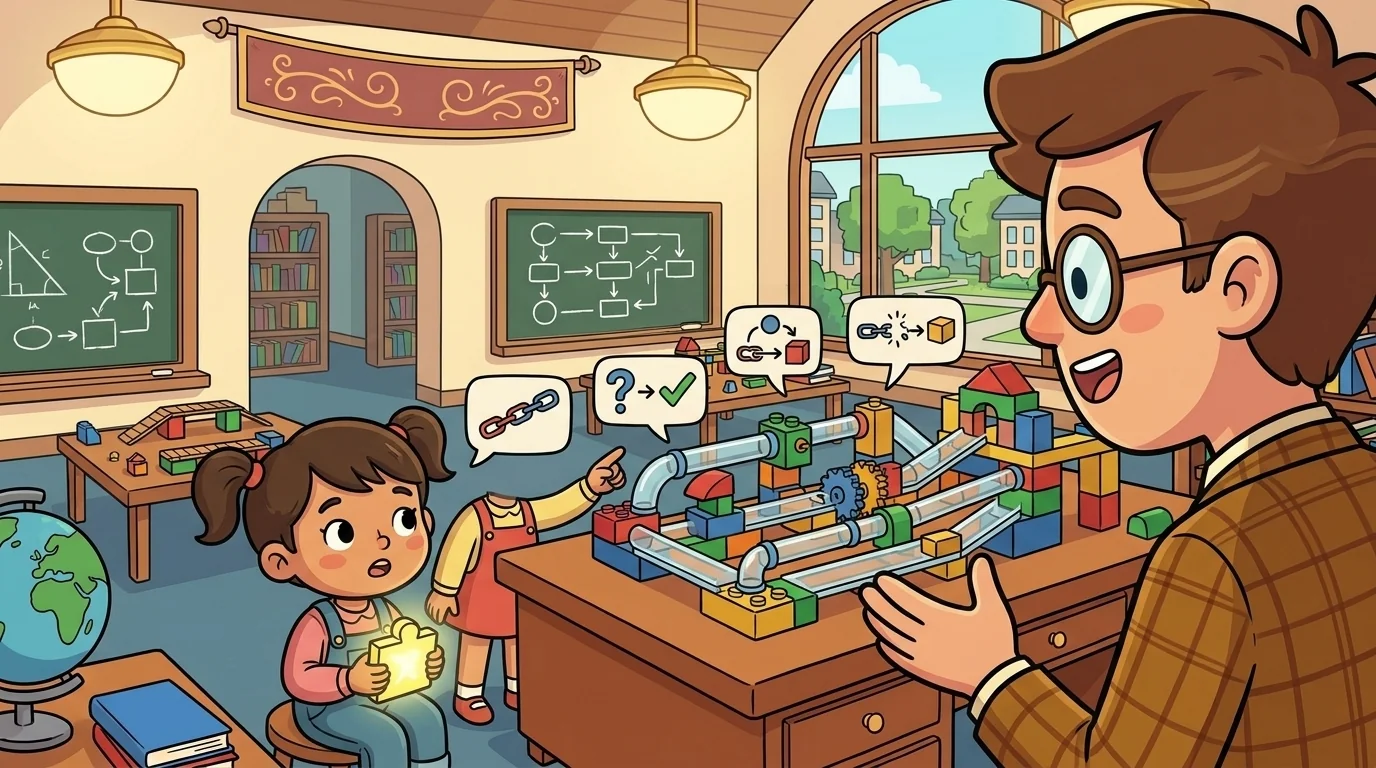
Maya paused, holding the pen above the paper.
"Does that step have to be true?" Cogent asked. "Or does it just probably follow?"
Maya leaned over the desk, examining her own logic. "The scratch could have been an accident," she admitted. "A nail could have slipped when someone was cleaning it. So... it's a strong hunch. It's probable, but not guaranteed."
"And the last step?" Cogent asked. "Where you checked if NORTH was the only four-letter heading on that dial?"
"That part is airtight," Maya said firmly. "I checked every position on the dial. There are no other four-letter direction words on the brass ring. That step is solid."
Cogent clapped his hands together once, the sound echoing off the high stone walls.
"Perfect," he said. "Now you don't just have an answer. You have the answer, the evidence, and an honest label on every step. That is what real understanding looks like."
Maya leaned against the edge of the heavy table. Outside the workshop windows, dusk was turning the quadrangle a dusty purple.
"If inductive steps are only 'probably' true," she said, "doesn't that make them weaker? Shouldn't we try to make every bridge completely airtight?"
Cogent leaned back against the bookshelf, resting his elbows on a row of old atlas spines.
"Airtight is lovely when you can get it," he said. "Mathematics gives you airtight. Formal logic gives you airtight. But the real world rarely hands you clean mathematical proofs."
He picked up an old brass compass from his desk and turned it in his palm.
"When a doctor examines a patient, or a detective walks into an empty room, they almost never get 'this must be true,'" Cogent said. "They get clues. They gather facts, line them up, and build the best explanation available."
He set the compass back down with a soft metallic click.
"The trick isn't pretending your strong hunch is an absolute proof," Cogent added. "The trick is showing every step, and labeling it honestly. You tell people: this part is solid rock, this part is sturdy timber, and this part is a rope bridge swinging in the wind."
Maya smiled dryly. "And if you pretend the rope bridge is made of stone?"
"Then someone steps on it carrying heavy luggage," Cogent said, "and everybody ends up in the river."
That evening, Maya walked back to her quarters at the edge of the academy grounds.
Her younger brother Sam was sitting on the rug in the front hallway. He was staring under the heavy oak chest where their orange cat, Barnaby, usually hid during thunderstorms.
"Barnaby is under there," Sam announced without looking up. "I know he is."
Maya set her satchel on the hall bench. A few weeks ago she would have laughed and asked him how he knew.
Instead she knelt beside him on the cold floorboards.
"Walk me through it," Maya said.
Sam blinked at her. "What?"
"Show me the bridge," Maya said gently. "What did you see first?"
Sam pointed a small finger at the rug. "There's a trail of dry kibble pointing under the chest."
"Good plank," Maya said. "What else?"
"His yellow ball is sitting right by the shadow," Sam said. "And I heard a tiny sneeze two minutes ago."
Maya nodded, drawing imaginary boxes in the air between them. "Okay. The kibble and the ball could belong to anyone, but the sneeze came from under the dark chest. Is it certain he's under there, or probable?"
Sam looked closely at the dark gap beneath the carved oak feet.
"The sneeze makes it very likely," Sam decided, pressing his cheek against the floor. "About eighty percent. The rest is a guess."
Maya smiled and handed him his small flashlight. "Solid reasoning," she said. "Now let's test the last plank."
The DeduceQuest ensemble
Cogent is part of DeduceQuest's distributed-narrative cast. Each character embodies a different curricular primitive; together they teach the full subject.
-

Contra
Proof by contradiction: assume the opposite and watch it break
-
Nona
Nonograms: filling a hidden picture from number clues, cell by cell
-
Odds
Probabilistic reasoning: choosing well when you cannot be certain
-

Reeve
Cross-referencing: corroborating clues against each other
-
Rulewright
Guess-the-rule induction: form a hypothesis, then test it
-

Tablo
Logic-grid deduction: eliminating possibilities in a grid
-

Vary
Controlling variables: changing one thing at a time
-
Whittle
Code-narrowing: you never hunt for the answer, you narrow toward it