
Reeve
CROSS-REFERENCING / CORROBORATION — when clues come from several separate sources (witnesses, records, notes), you lay them side by side and look for where they *agree* and where they *disagree*. Two sources that independently say the same thing make it strong; a source that contradicts the others is where the real question hides. The truth lives at the crossing points.
Loading audio…
Press play to listen along. The line being read lights up as you go.
Show full transcript
Loading transcript…
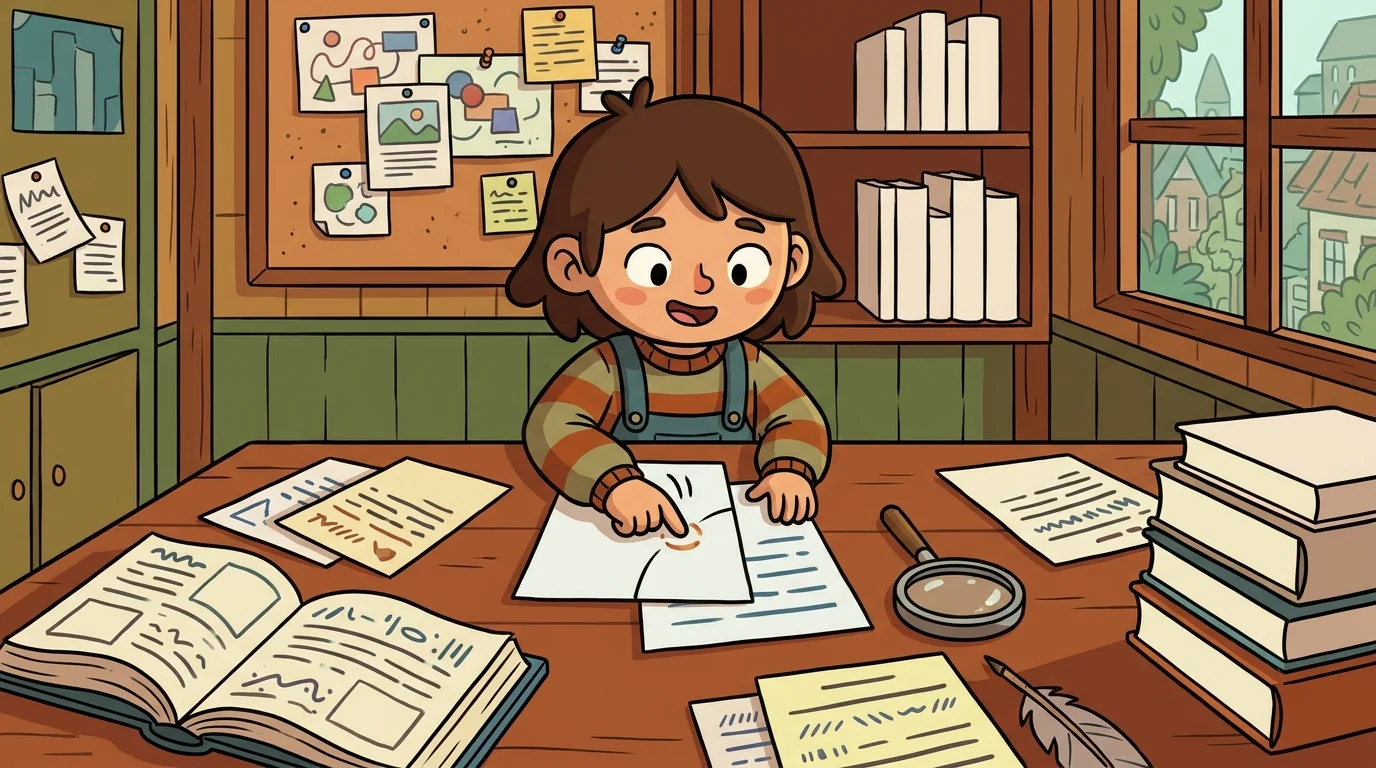
Reeve never believed anything the first time she heard it. She believed it the second time. But that was only if the second account came from somewhere the first account had never touched.
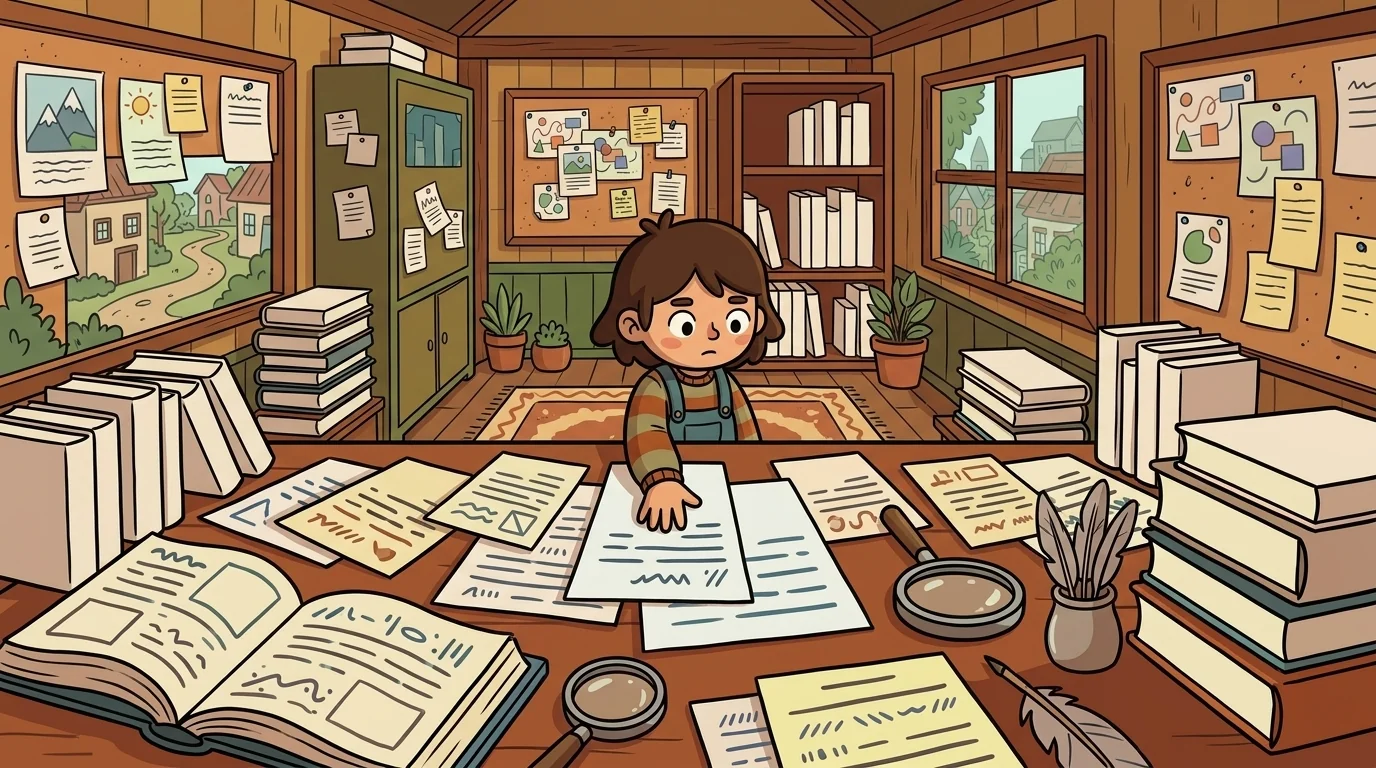
Her desk at the DeduceQuest academy looked like a windstorm had hit a paper mill. Three, four, sometimes five different reports lay side by side under heavy brass paperweights. There was a greasy note from an apprentice, a damp logbook page from a dockworker, and a crumpled receipt someone had dragged out of a trash bucket. Reeve leaned over them with a chewed pencil tucked behind her ear. She read across the papers from left to right, like reading one long sentence written by five different strangers.
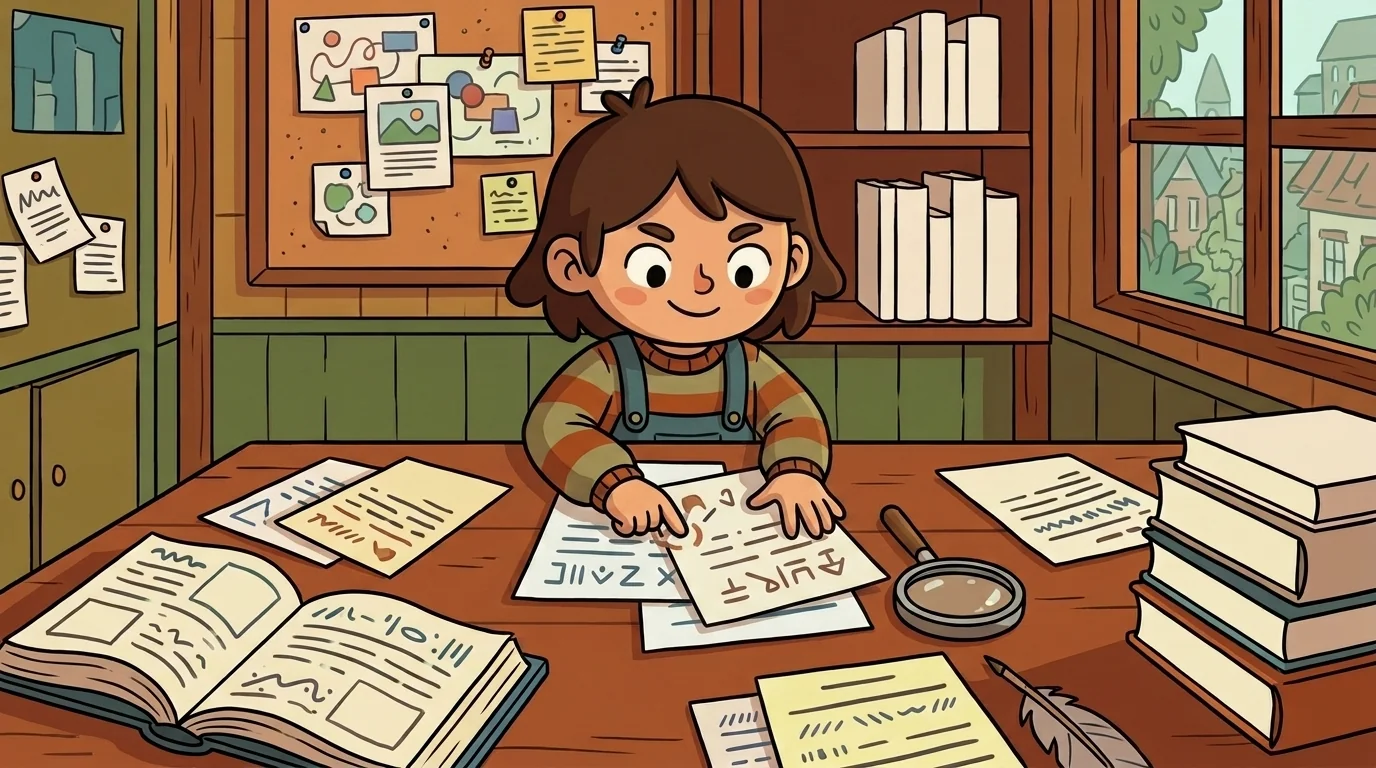
"One story is just a story," Reeve said, sliding two yellowed pages together until their edges overlapped. "Anyone can make up a story. But two stories that never met, saying the exact same thing?" She tapped her knuckles against a line of faded blue ink where the two reports matched. "Now we're getting somewhere. And two stories that disagree?"
She tapped a clear contradiction between two dates, and her pale blue eyes lit up.
"That's not a problem," she grinned. "That's the door."
Reeve had learned this trick long before she ever set foot in the academy. She grew up as the middle child of seven in a loud, crowded house that smelled of burnt porridge and wet wool. In her family, every broken plate came with five different explanations. Every kicked shin led to six different suspects. Her parents usually threw up their hands and punished everyone within arm's reach.
Reeve took a different path. She sat on the third step of the hall stairs and listened. Her older brother Mark claimed he was outside when the kitchen window broke. Her sister Clara claimed Mark threw a turnip at her. But Clara hated Mark, and Mark blamed everyone alive. Their claims were useless on their own.
Then Reeve noticed something small. Mark mentioned that the baker's cart was rolling past when he heard the glass shatter. Clara, who was still shouting about the turnip, also mentioned the baker's cart. They were not speaking to each other. They had not planned a story together. In fact, they were trying to tear each other's hair out.
Yet both remembered the heavy wooden wheels of the cart rattling over the cobblestones at that exact second.
Reeve knew right then that the baker's cart was real.
"A fact that only lives in one place is fragile," Reeve often explained later to wide-eyed recruits. "It could be a mistake. It could be a lie. It might just be a bad memory on a Tuesday. You can't tell. But a fact that shows up in two places that never spoke?" She spread her hands wide across her desk. "That fact had to earn its way into both places. Finding where separate lines meet is called cross-referencing. That agreement across sources that never met? That's corroboration. It's as close to solid ground as an outsider ever gets."
Her gift was the reason Deducia brought her to the academy in the first place. Deducia had watched twelve-year-old Reeve settle a fierce alley argument over a missing copper coin. Reeve had not bothered asking who was lying. She simply found the single weird detail three shouting boys had all mentioned without realizing it: a stray dog with a black ear had trotted past the fence right before the coin disappeared.
On her very first morning at the academy, the Head Examiner tested her. He laid two witness statements on her desk regarding a stolen lemon tart from the head cook's counter.
"Read them," the examiner said, folding his arms. "The witness on the left seems honest. The witness on the right has been caught dodging chores. Tell me which one you choose to believe."
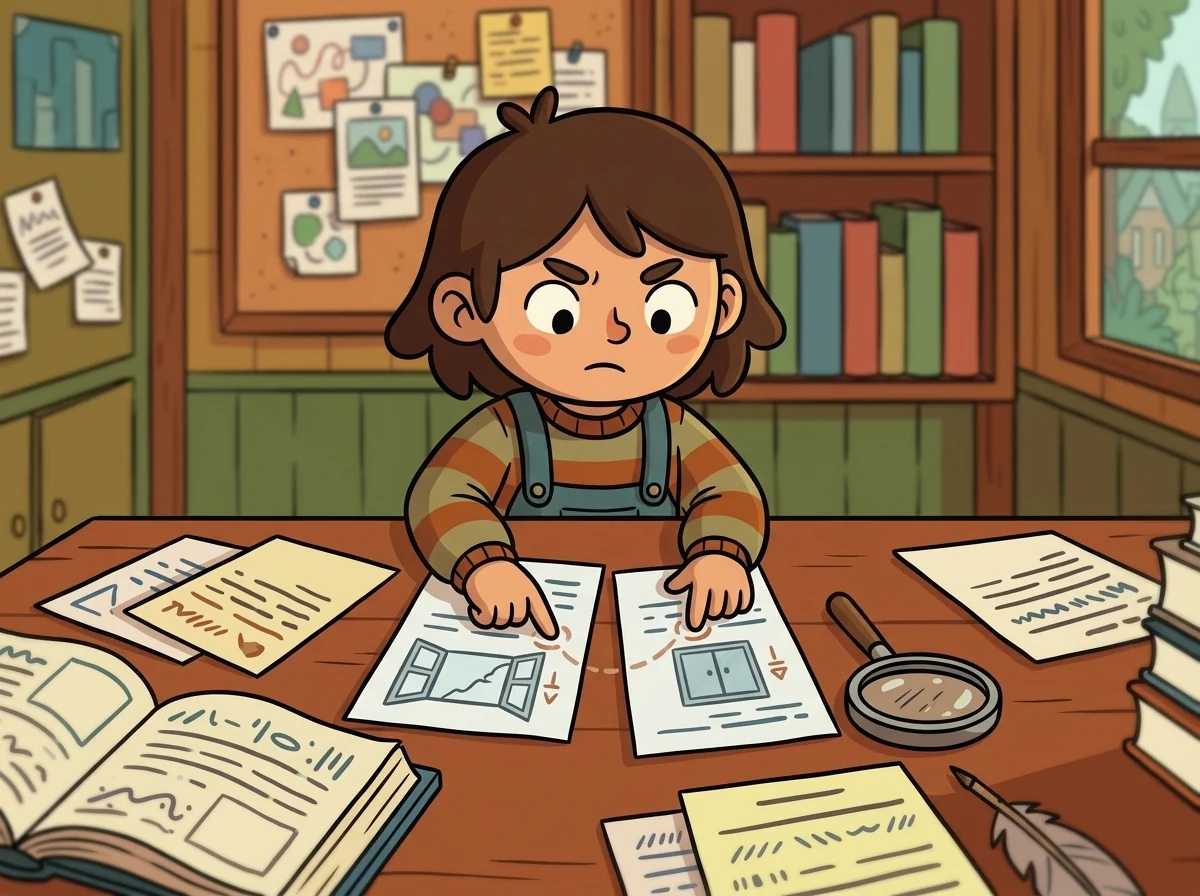
Reeve did not pick either paper up. Instead, she smoothed them flat with her palm and drew a straight pencil line right down the gap between them.
"This first statement says the kitchen window was wide open," Reeve said softly. "This second statement says the room was freezing and the window was shut tight. They agree on everything else. They agree on the time, the blue plate, and the smell of nutmeg."
She tapped her pencil point right on the disagreement about the glass.
"So I don't need to waste time deciding who seems nice," Reeve said. "I need to go look at the latch on that window. That's the only spot where their paths split. The answer is hiding right in the gap."
The examiner had spent three hours the week before watching another apprentice try to figure out which boy had a nicer face. He stared at Reeve for a long moment, then smiled.
"You didn't take a side," he murmured. "You found the seam."
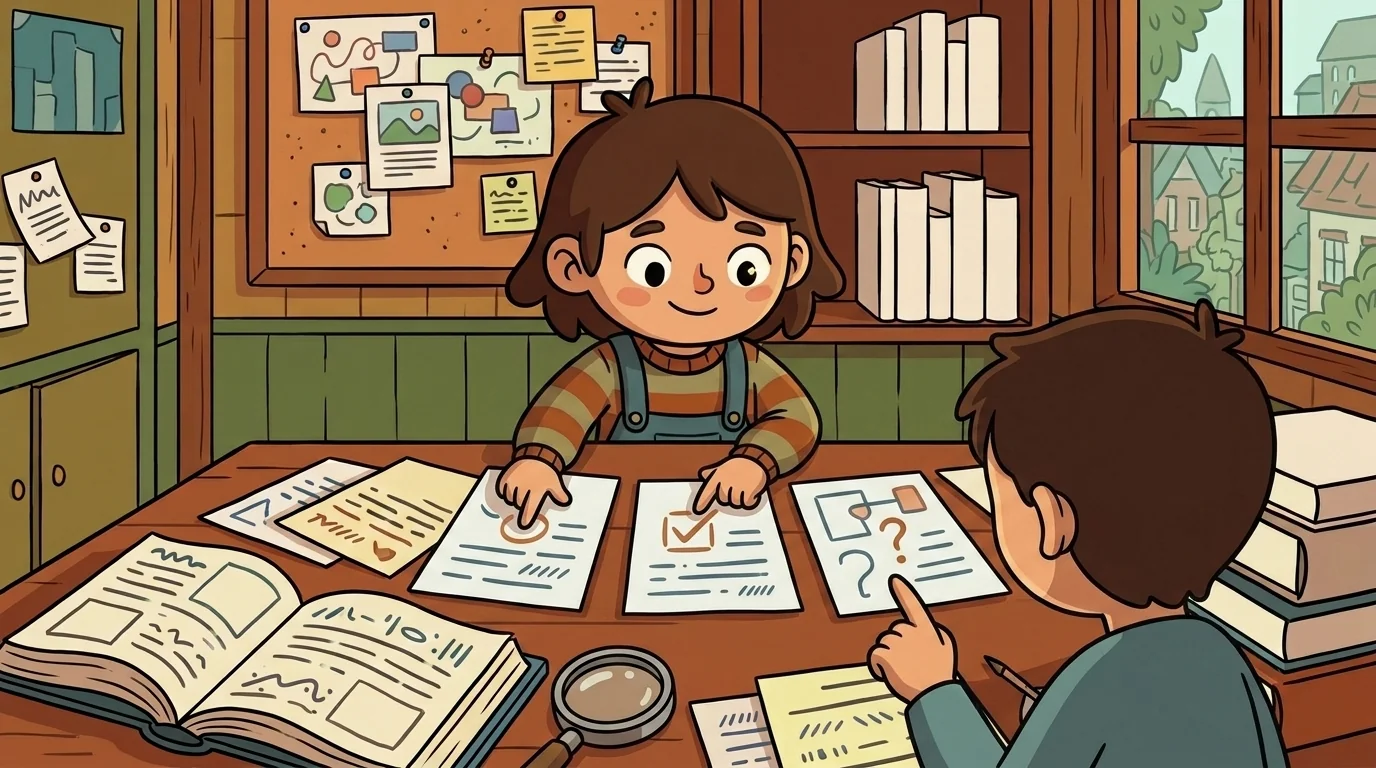
Now, Reeve ran the evidence workshop in the south wing of the academy. It was filled with tall oak cabinets, stacks of shipping manifests, and iron inkwells.
One rainy Tuesday afternoon, an apprentice named Bram slouched into her workshop. He threw a brass ruler onto the table in frustration.
"I looked up the harbor depth in the old port guide," Bram grumbled, kicking the table leg. "I answered the quiz question, but the master marked it wrong. Now I don't trust any of these books."
Reeve nodded slowly, looking at him as if he had just discovered how to walk.
"Good," she said, leaning back in her chair. "You shouldn't trust one single book. One source is just a rumor with good posture."
She pulled three heavy volumes down from the shelf behind her and set them in front of him with three loud thuds. One was a merchant log, one was a navy chart, and the third was a town history written by an old judge.
"Here," she said, tapping the leather covers. "Check all three. Where they say the exact same thing, you can start to believe it. But where one says ten feet and the other two say twenty?"
"That's where I look closer?" Bram asked, wiping a smudge of ink off his thumb.
"That's where you live for a while," Reeve corrected him, her voice warm. "The lonely disagreement is the most exciting thing in the room. Either that one source is right and the other two copied the same old mistake, or that one source is completely wrong. Either way, it's a lead. Boring facts agree without making a sound. It's the arguments between your sources that actually teach you something."
Bram sat down, pulling the three heavy books into a row. He spent twenty minutes comparing dates, names, and water depths. He found that two books agreed on twenty feet because they were printed in the same year, while the third was fifty years out of date. For the first time all week, his shoulders dropped. He had not just received an answer from an adult. He had earned it himself.
He looked up at Reeve, his pencil suspended over his notebook. "Wait. What if all three books are wrong in the exact same way? What if they all agree because they just copied each other?"
Reeve went completely still. It was the posture she took whenever someone finally asked the real question.
"That," she said, pointing her chewing pencil straight at his chest, "is the trap. You just walked right up to it and spotted it yourself."
She leaned across the table, her voice dropping to a whisper.
"Agreement only works if the sources are independent," she said. "They have to come from different places without talking first. Three websites or three books that all copied the same original mistake aren't three sources. They are just one source wearing three different coats."
She knocked her knuckles against the oak table.
"So every time two stories agree, I ask myself a question: Did these two people actually see this happen on their own, or is one person just repeating what the other said? A sailor's log and a dockmaster's receipt written in different rooms? That agreement is gold. Three kids repeating what the loudest kid yelled on the playground? That isn't corroboration. That's just an echo."
She gave him a sharp, dry smile.
"The whole craft is learning how to tell a room full of real voices apart from one voice talking in a hall of mirrors."
That night, Bram went home to his lodgings. His younger brother and his best friend had never met each other. Yet over dinner, both of them separately mentioned a strange blue carriage parked near the river market that afternoon. Bram froze with his soup spoon halfway to his mouth. He felt a quiet, sudden click in his mind—the precise feeling of a fact turning solid under his feet. He had just watched two separate roads meet at the exact same spot.
The DeduceQuest ensemble
Reeve is part of DeduceQuest's distributed-narrative cast. Each character embodies a different curricular primitive; together they teach the full subject.
-
Cogent
Constructing explanations: telling deductive apart from inductive reasoning
-
Contra
Proof by contradiction: assume the opposite and watch it break
-
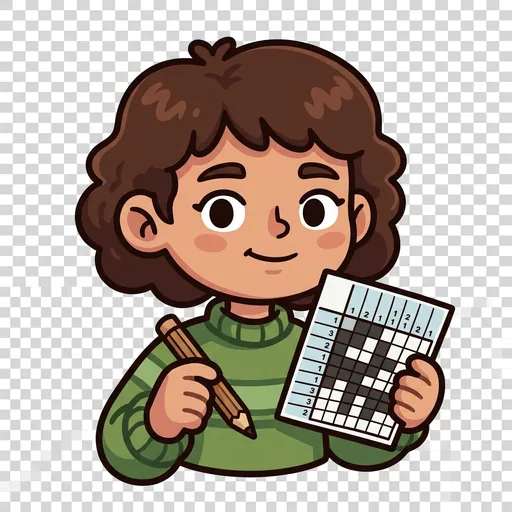
Nona
Nonograms: filling a hidden picture from number clues, cell by cell
-
Odds
Probabilistic reasoning: choosing well when you cannot be certain
-
Rulewright
Guess-the-rule induction: form a hypothesis, then test it
-
Tablo
Logic-grid deduction: eliminating possibilities in a grid
-

Vary
Controlling variables: changing one thing at a time
-
Whittle
Code-narrowing: you never hunt for the answer, you narrow toward it