
Vary
CONTROLLING VARIABLES — to find out what one thing *does,* change only that one thing and hold everything else exactly the same. If you change two things at once and the result shifts, you can't tell which one caused it. The whole power of an experiment comes from the discipline of *one change at a time.*
Loading audio…
Press play to listen along. The line being read lights up as you go.
Show full transcript
Loading transcript…
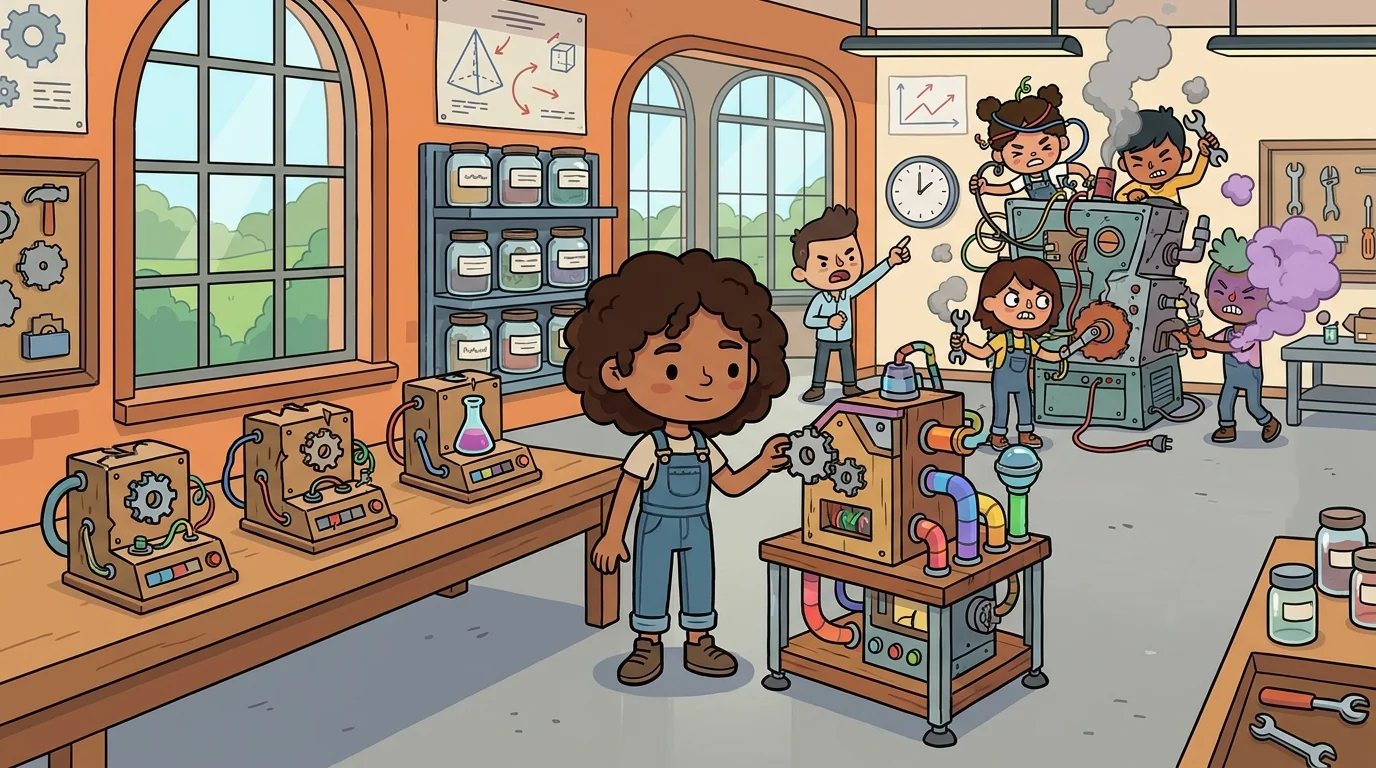
Vary was the most patient person in the academy, and it drove everyone else a little bit crazy.
When something went wrong — a clockwork gear jammed, a bread loaf collapsed, or an experiment fizzled — the other apprentices wanted to fix everything at once. They would swap the flour, adjust the oven temperature, and change the baking pan all in one desperate breath, praying for a miracle.
Vary refused. She would touch exactly one piece, run the test, and watch. Then she would change one piece back and move one other piece forward. Watch again.
"I know it's slower," she said, holding her hands still over her workbench. "But when your way works, you have no idea why it worked. You can't do it again. When my way works, I know exactly which piece did the job, because it was the only piece I touched."
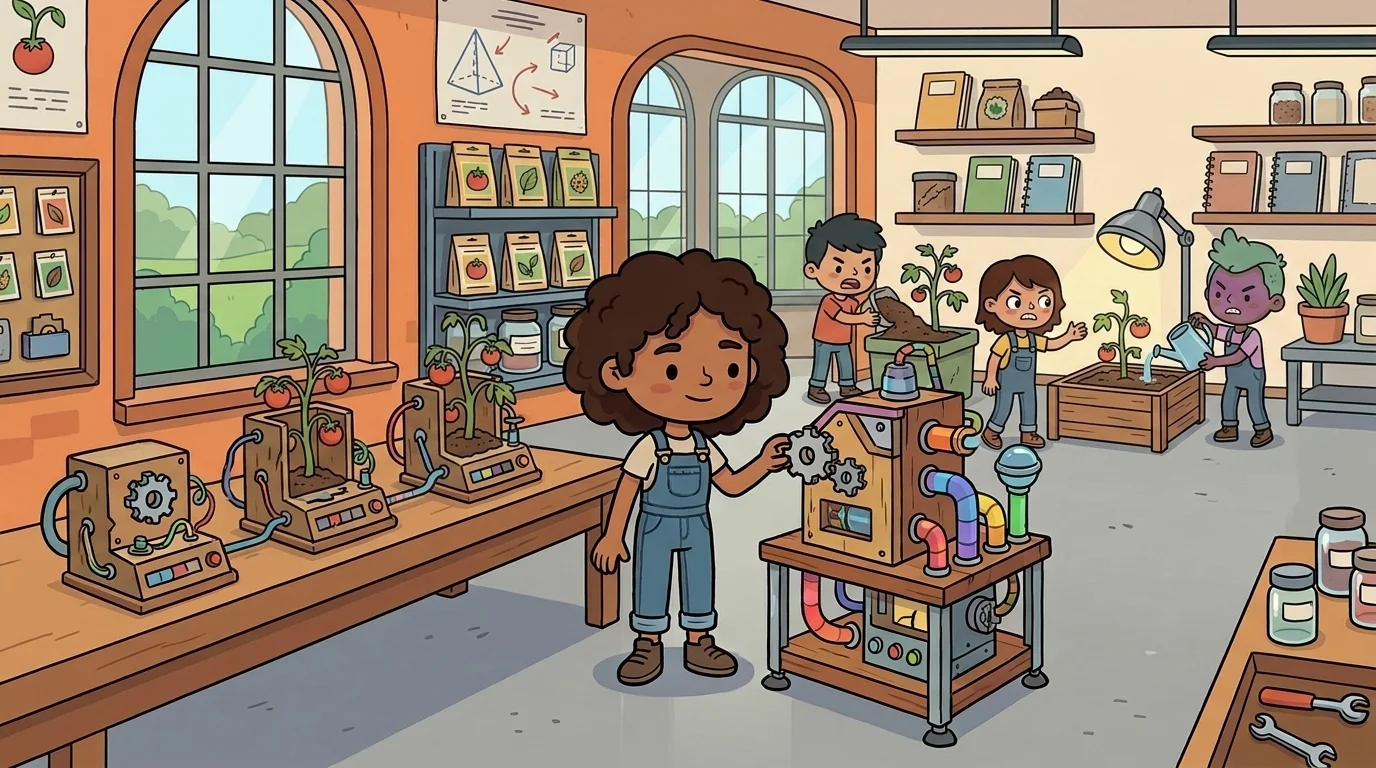
She had learned this lesson the hard way when she was nine years old, standing in a hot backyard beside two sickly tomato plants. Both plants had yellow leaves and stems as thin as twine. Desperate to save them, Vary bought a sack of rich black soil, dumped a bucket of water on the roots, and dragged the heavy clay pot into full sunlight.
Three days later, the plant exploded with bright green shoots. It was a complete triumph. Vary danced around the garden patch, feeling like a master farmer.
Then her grandmother walked out onto the back porch, shaded her eyes against the glare, and looked down at the leaves. "Well look at that," her grandmother said softly. "Which change did the trick?"
Vary stopped dancing. Her mouth opened, then closed. Was it the water? The new soil? The sunlight?
"I... I did all three," Vary whispered.
"Ah," her grandmother said, turning back to the kitchen door. "So you saved the plant, but you didn't learn a single thing."
That realization settled in Vary's chest like a cold stone. She had fixed the immediate problem, but she was just as ignorant as she had been that morning. If a different plant withered next week, she would have to guess all over again. She had traded real understanding for a quick fix.
From that afternoon on, Vary made a quiet promise to herself. She would rather move slowly and actually know than move fast and guess.
She came to the DeduceQuest academy after Deducia watched her diagnose a broken winch that had stumped three adult mechanics. Vary hadn't used magic or clever guessing. She had simply unhooked one iron gear at a time until the heavy drum turned freely.
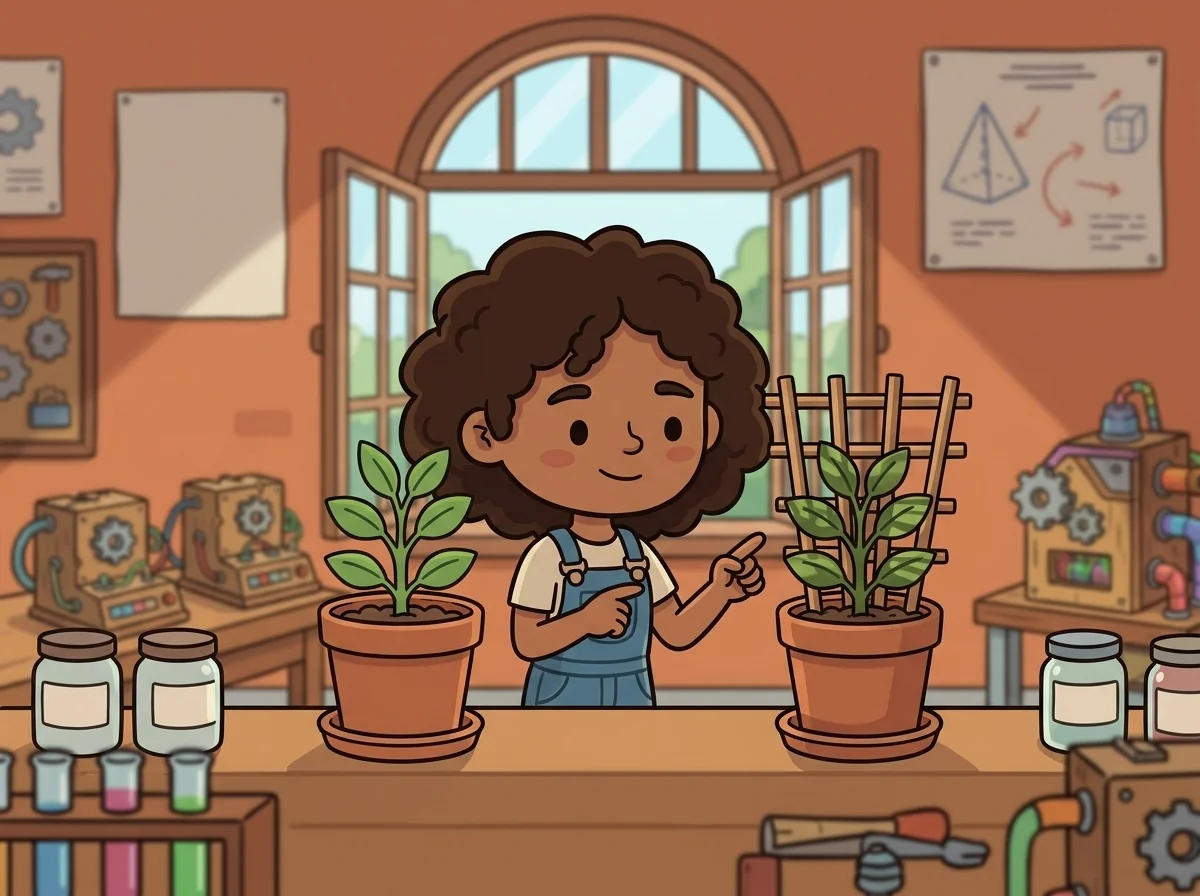
On her first morning at the academy, the host stood in the courtyard holding two clay pots. Each pot held a small leafy shrub. The left shrub was thick and blooming with blue flowers. The right shrub was thin, pale, and dropping dry leaves onto the stone flagstones.
"Tell me why these two plants grew differently," the host announced to the crowd of new students.
The other applicants leaped forward immediately, shouting ideas like sparks from a bonfire.
"The left pot has better soil!" a boy shouted.
"The right one has root rot!" a girl called out. "Or the draft from the main gate chilled it!"
"It's the water!" someone else offered. "And the fertilizer! And the pot size!"
Vary did not jump. She walked slowly around the two ceramic pots, her hands tucked into her apron pockets. She didn't inspect the leaves first. She looked at the identical terra-cotta clay. She looked at the height of the soil lines.
"What was kept the same?" Vary asked cleanly.
The host raised an eyebrow. "Excuse me?"
"The soil came from the same bin," Vary said, stepping closer. "The pots were cast in the same mold. The drainage holes are equal." She pointed a straight finger at the shadow cast by the high courtyard wall. "The only difference is where they sat. This one spent its morning in the shadow of the gatehouse."
She looked up into the host's quiet eyes.
"It’s the shade," Vary said. "Not because I am sure shade matters, but because everything else was held constant. It's the only answer left."
The host smiled. "The others hunted for differences in a sea of guesses," the host said. "You looked for controlled variables."
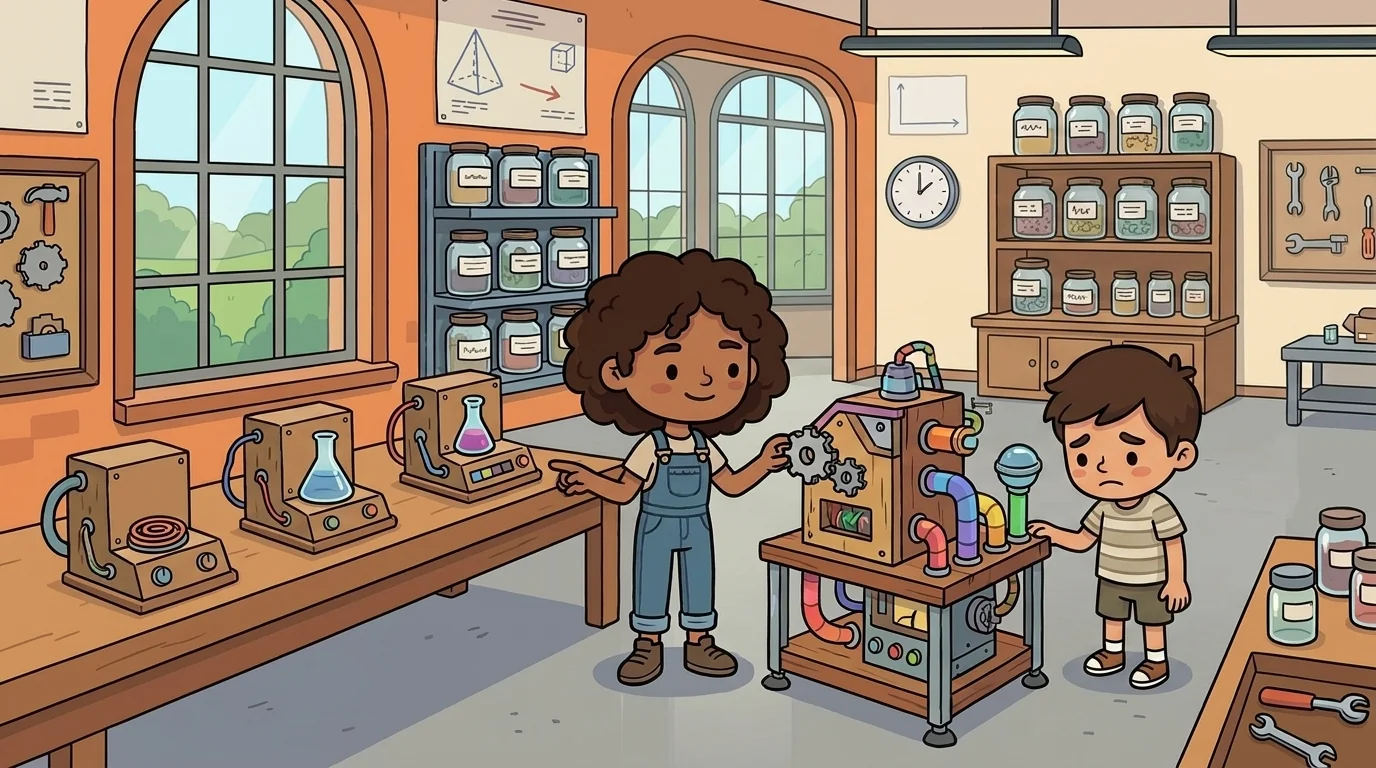
In her workshop, Vary taught younger students the quiet discipline of the single change.
A twelve-year-old named Bram burst through her doorway one rainy afternoon. He slammed a wooden tray onto her worktable, sending glass vials clinking against each other.
"It doesn't work!" Bram fumed, crossing his arms. "Science is stupid. The whole test gave me nothing!"
Vary picked up his lab notebook. Messy numbers ran across the margins like escaping ants. "Show me what you changed, Bram."
"Everything!" Bram snapped. "I wanted to make the yeast foam higher! So I doubled the sugar, warmed up the water, and moved everything into a taller glass jar! It foamed once, but when I tried it again it flatlined. I have no idea why!"
Vary set his notebook down. "You changed the heat, the food, and the container at the exact same time."
"Yeah! To make it better!"
"So when the height changed," Vary asked, her voice calm, "which of those three made it happen?"
Bram opened his mouth, stopped, and let his shoulders slump. "...I don't know."
"Right," Vary said softly. "Your experiment isn't stupid, Bram. It just can't answer you. You asked a question in three different languages at once. You can't be surprised when you get noise back."
She began setting his glass vials into a neat line across the table.
"Pick the one thing you actually care about," Vary told him. "Do you want to know about the sugar, the heat, or the jar?"
"The sugar," Bram grumbled.
"Then freeze everything else," Vary said. "Keep the water temperature identical. Use the exact same jar every single run. Make every detail boring and predictable, except for the sugar."
Bram groaned loud enough to rattle the glass vials. "That's going to take three runs instead of one! That takes forever!"
"It takes three runs," Vary agreed, refusing to be rushed. "And at the end, you will actually know three things. Fast and wrong gets you nowhere. Slow that arrives beats fast that doesn't."
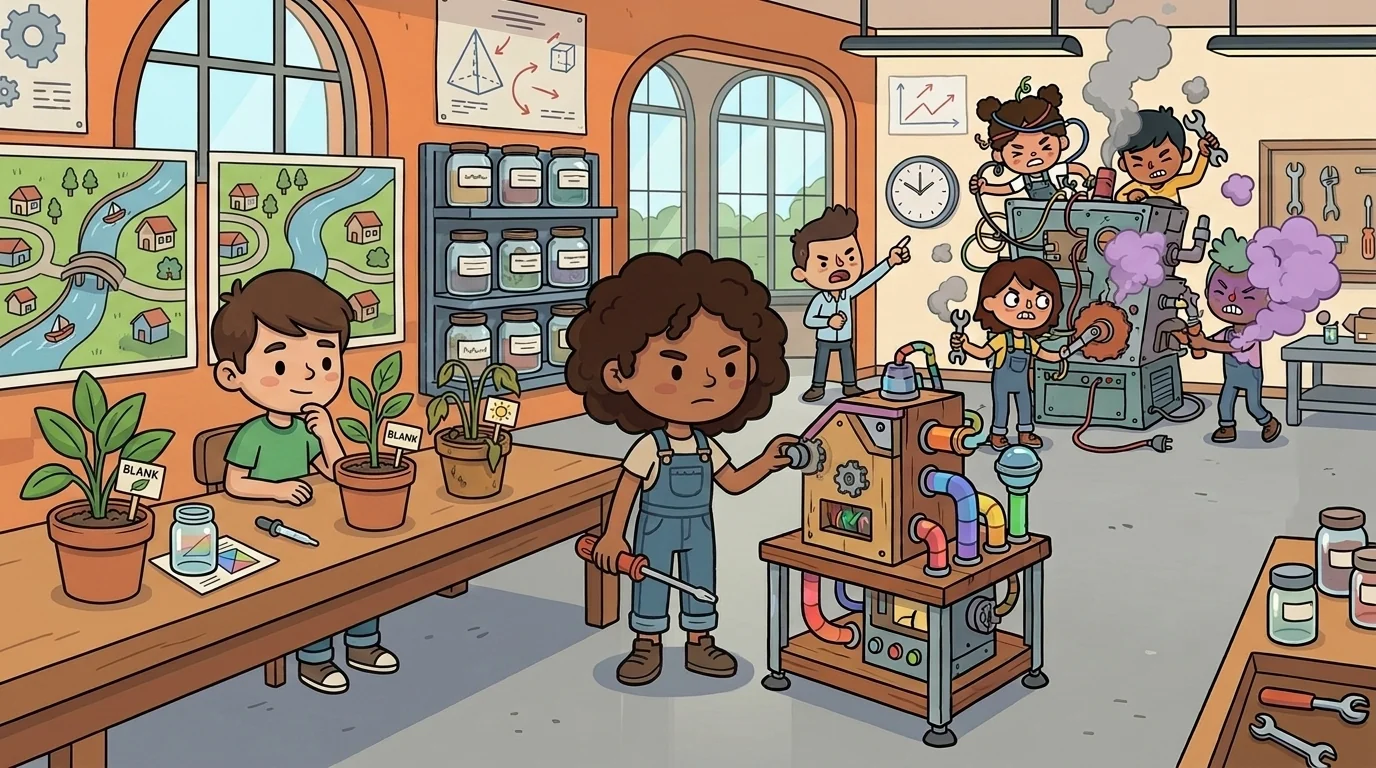
Bram ran his test her way. He kept the water heat steady over a tiny flame. He used identical thin glass cylinders. He changed only the spoonfuls of sugar, quarter-spoon by quarter-spoon, recording each height on his slate.
When he finished, his face cleared like fog lifting off a pond.
"It peaked at two spoons," Bram whispered, staring at his clean grid of numbers. "If I add three spoons, it actually slows down! I can see it right there!"
He wiped his hands on his apron and sat back on his stool. Then he frowned at the rain tapping against the windowpane.
"Wait," Bram said. "This works in a lab because you have glass jars and measuring spoons. But real life has a hundred things changing at once. You can't freeze the whole world just to learn something."
Vary smiled. This was her favorite part.
"You're right," she said. "You usually can't freeze the world. So you do the next best thing. You look for situations where the world accidentally froze things for you."
"How?" Bram asked.
"You hunt for pairs," Vary explained, leaning across the table. "Two classrooms in the same school, with the same books, where only one teacher tries a new reading game. Two towns across the same river, with the same weather, where only one town built a stone bridge."
She tapped the oak table with one knuckle.
"You didn't control the details yourself," she said. "Circumstance did the work for you. Your job is to find the corners of the world where only one thing is different."
"And if you can't find a clean pair?" Bram asked.
"Then you say so," Vary answered firmly. "You look people in the eye and say, 'I don't have enough proof yet.' Honesty about what your facts cannot tell you is half the job."
That evening, Bram walked back to his room in the eastern dormitory. On his windowsill sat two small ferns in twin red pots. One was drooping; one was standing tall.
In the past, he would have poured tea on the soil, moved the pot, and trimmed the leaves all in one frantic evening. Instead, Bram moved just one pot two inches closer to the window glass. He wrote the date on a slip of paper, tucked it under the base, and sat down to wait.
The DeduceQuest ensemble
Vary is part of DeduceQuest's distributed-narrative cast. Each character embodies a different curricular primitive; together they teach the full subject.
-

Cogent
Constructing explanations: telling deductive apart from inductive reasoning
-

Contra
Proof by contradiction: assume the opposite and watch it break
-
Nona
Nonograms: filling a hidden picture from number clues, cell by cell
-

Odds
Probabilistic reasoning: choosing well when you cannot be certain
-

Reeve
Cross-referencing: corroborating clues against each other
-

Rulewright
Guess-the-rule induction: form a hypothesis, then test it
-

Tablo
Logic-grid deduction: eliminating possibilities in a grid
-
Whittle
Code-narrowing: you never hunt for the answer, you narrow toward it