
Dash
INTERRUPTION — in real talk, people cut each other off, finish each other's sentences, and talk over one another. On the page, a dash (—) at the end of a line shows the interruption. Used at the right moment, it makes a conversation feel urgent, excited, or tense.
Loading audio…
Press play to listen along. The line being read lights up as you go.
Show full transcript
Loading transcript…
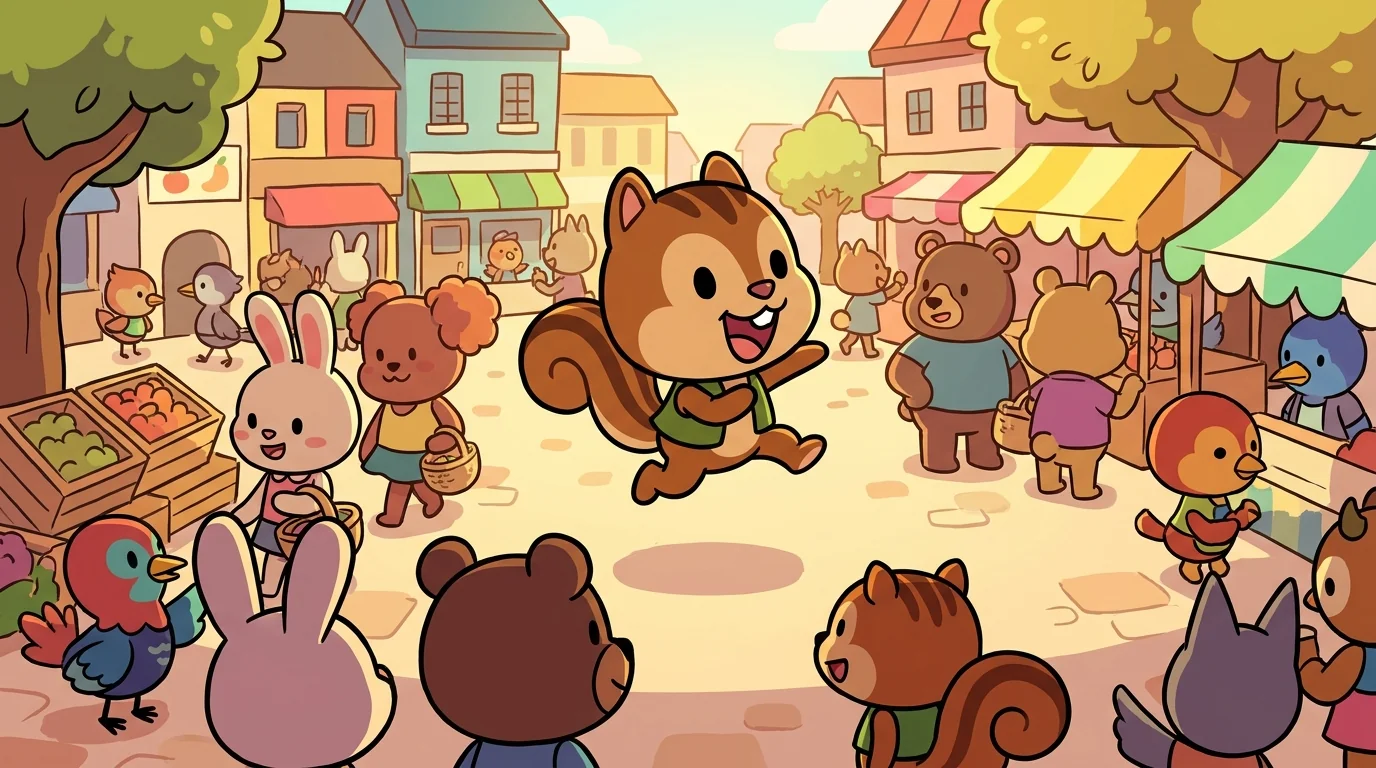
Patter’s workshop was usually a quiet place, filled with the gentle hum of creativity. On Tuesday afternoons, the only sounds were the steady scratch of graphite on yellow paper and the occasional sigh of a frustrated writer. Then, the door didn't just open; it bounced hard off the plaster wall.
A tiny, copper-colored blur streaked across the floorboards and kicked up a small cloud of dust. It scrambled up the leg of Patter's heavy oak desk, sending a stack of blank speech bubbles fluttering into the air.
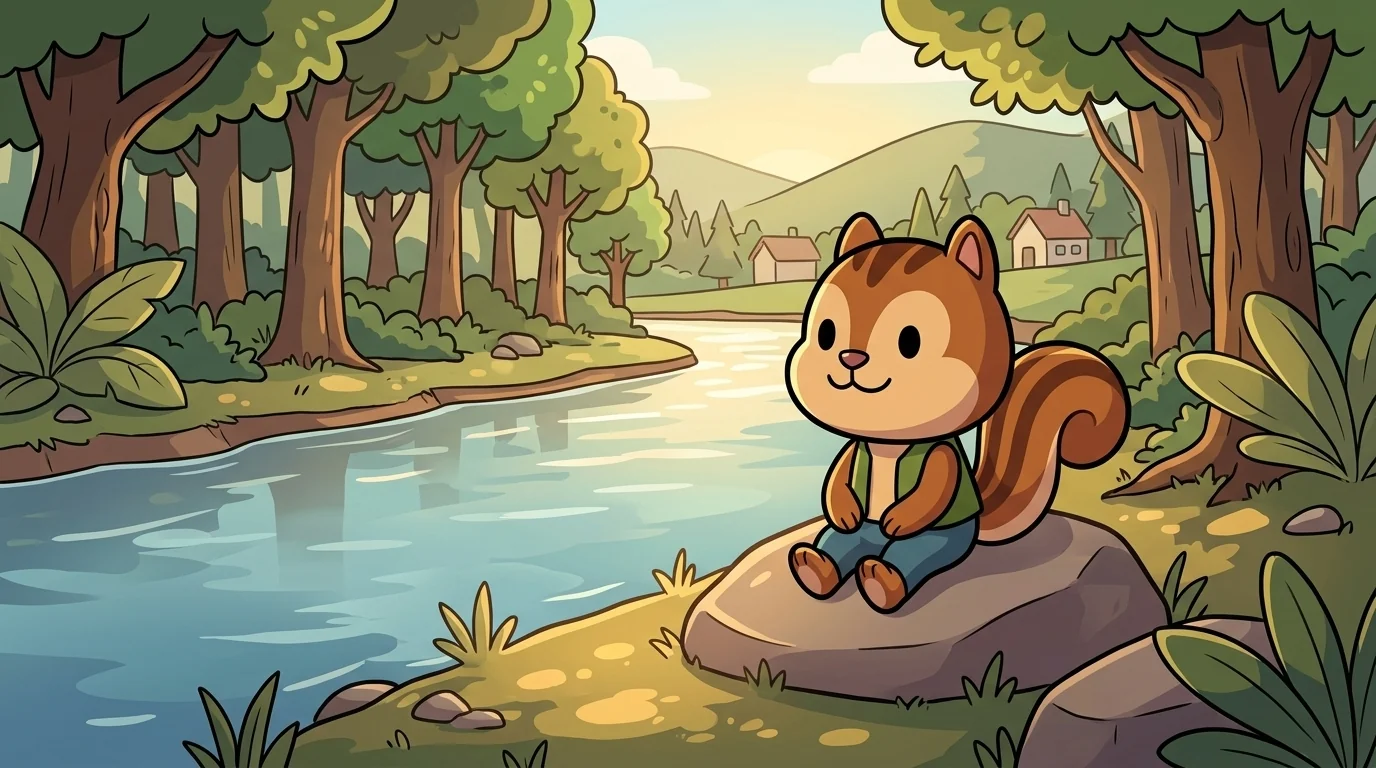
It was Dash, a zippy little chipmunk who looked more like a pocket-sized lightning bolt wrapped in soft brown fur. His tail twitched in high-speed Morse code as he balanced on the edge of a teacup.
"I was wondering if you—" Patter began, reaching out to catch a falling paper.
"—if I keep the interruption? Yes! That's me!" Dash leaped in.
His voice was high and bright, and his speech bubble didn't even bother to wait its turn. It crashed right into the tail end of Patter's bubble, leaving a sharp, straight line where they collided. Patter blinked at the paper in his hand and realized his sentence had been finished before he could even blink.
"You finished my sentence," he said.
"Before I did."
"Couldn't help it—" Dash said.
He caught himself immediately, his ears dropping slightly as he took a slow, deliberate breath to calm his racing heart.
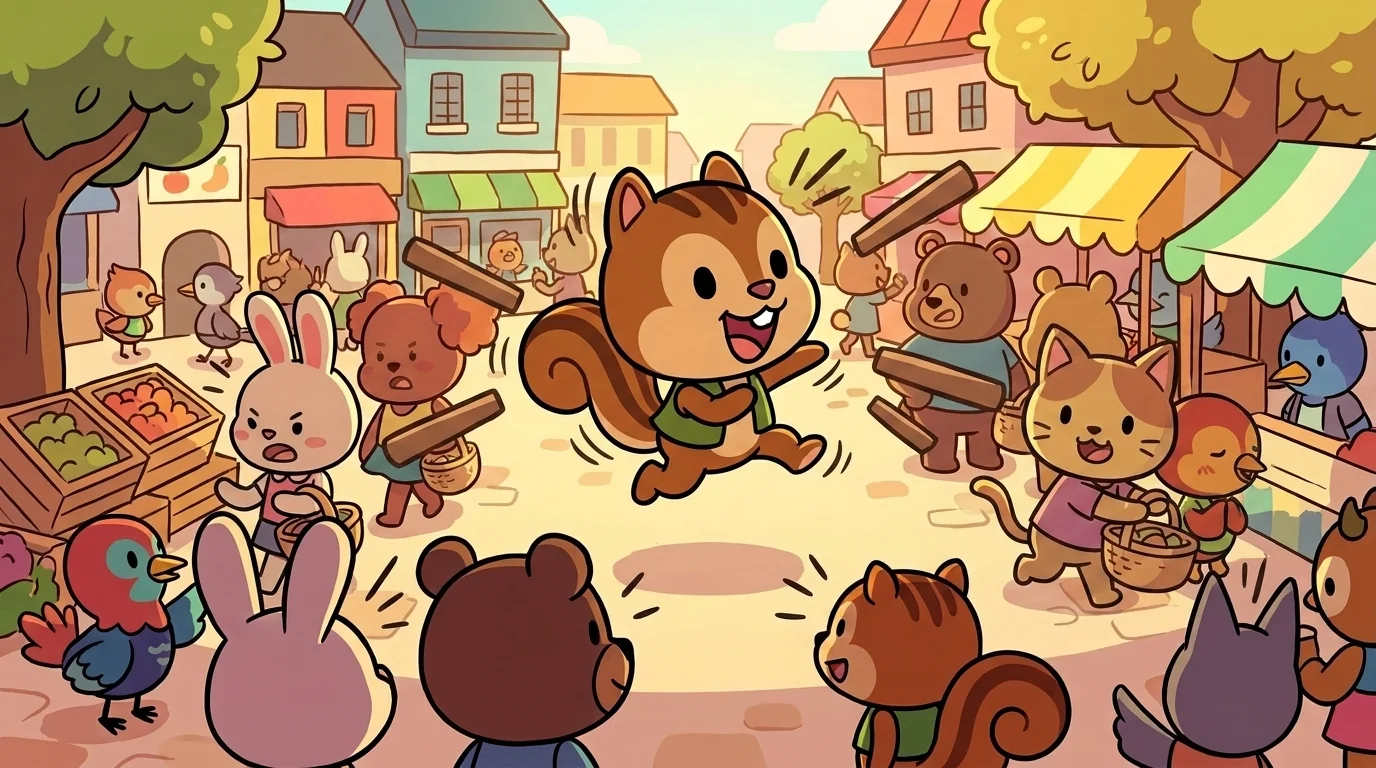
"Sorry," Dash said, his tail drooping. "My name is Dash, and I keep the interruptions." "When someone is too excited to wait, they jump in." "That mark—the dash—that's me."
He pointed to the dark, straight mark hanging in the air between them.
Patter watched, fascinated, as Dash showed him how the mark worked in the real world. Two wooden mannequins sat on a bench nearby, having a calm, polite conversation. They looked like two old friends sharing a park bench on a quiet Sunday afternoon.
"We should probably think about heading home," the first mannequin said, its wooden jaw clicking open and shut.
"Yes, the clouds are turning a very dark shade of gray," the second one replied.
The exchange was neat and orderly, but it was also incredibly boring. Suddenly, Dash zipped between them like a sharp spark of static electricity. The polite rhythm shattered instantly.
"But if we leave now—" the first mannequin blurted out.
"—we'll miss the storm, I know, that's why—" the second one cut in.
"—we have to run!" the first one finished.
The dialogue caught fire as the words tumbled over each other, fast and messy and alive. Patter leaned forward, his eyes wide as he watched the air crackle with sudden urgency.
"See the dashes?" Dash asked, pointing to the jagged black lines that now connected the speech bubbles. "Every single dash is a place where someone simply couldn't wait." "It makes the conversation feel fast and dangerous, like the words are racing down a steep hill."
Then, Dash decided to show Patter the dark side of his power. He scampered over to a group of three paper-cutout figures who were trying to plan a picnic. With a mischievous grin, the little chipmunk began tossing dashes into their conversation like firecrackers.
"I think we should bring—" the first figure started, but the second interrupted with "—sandwiches are best because—" before the third chimed in with "—apples are crunchier and—"
The conversation quickly dissolved into a mess of "—but the basket is too—" and "—and the rain will ruin—" until they finally cried "—so we should just stay—"
The voices piled up on top of one another until they were nothing but a wall of jagged, overlapping noise. None of the figures were actually listening to each other anymore, and they were just waiting for their turn to cut each other off.
"Too much," Dash admitted, dropping his head onto his paws with a soft groan. "If everybody always interrupts, the story turns into pure chaos." "The dash only works when it comes as a surprise."
Patter felt a sudden click of understanding in his mind as he thought about the young writers in his classroom. Their characters never interrupted each other. Every line of dialogue waited politely for the last one to finish, like players in a tennis match played in slow motion.
"Their conversations are too stiff," Patter murmured, staring at the messy pile of paper figures. "A few well-placed dashes would wake them right up."
Patter turned to the chipmunk, who was currently trying to balance a wooden ruler on his nose, and offered him a warm smile.
"Dash, I run a writing workshop for kids where the characters always talk like polite, boring robots," Patter explained. "Would you come to the class and teach them how to crash into each other?"
Dash dropped the ruler. "Yes—" he started, his tail giving a violent twitch. He stopped himself, squeezed his eyes shut, and forced his mouth to slow down. "—I would love to come."
Patter couldn't help but laugh. "Then it's a deal. Let's see if we can teach them how to make some noise."
The next morning, the workshop room was filled with the smell of old paper and grape-scented markers. Twelve young writers sat at long wooden tables, their notebooks open, staring blankly at the chalkboard.
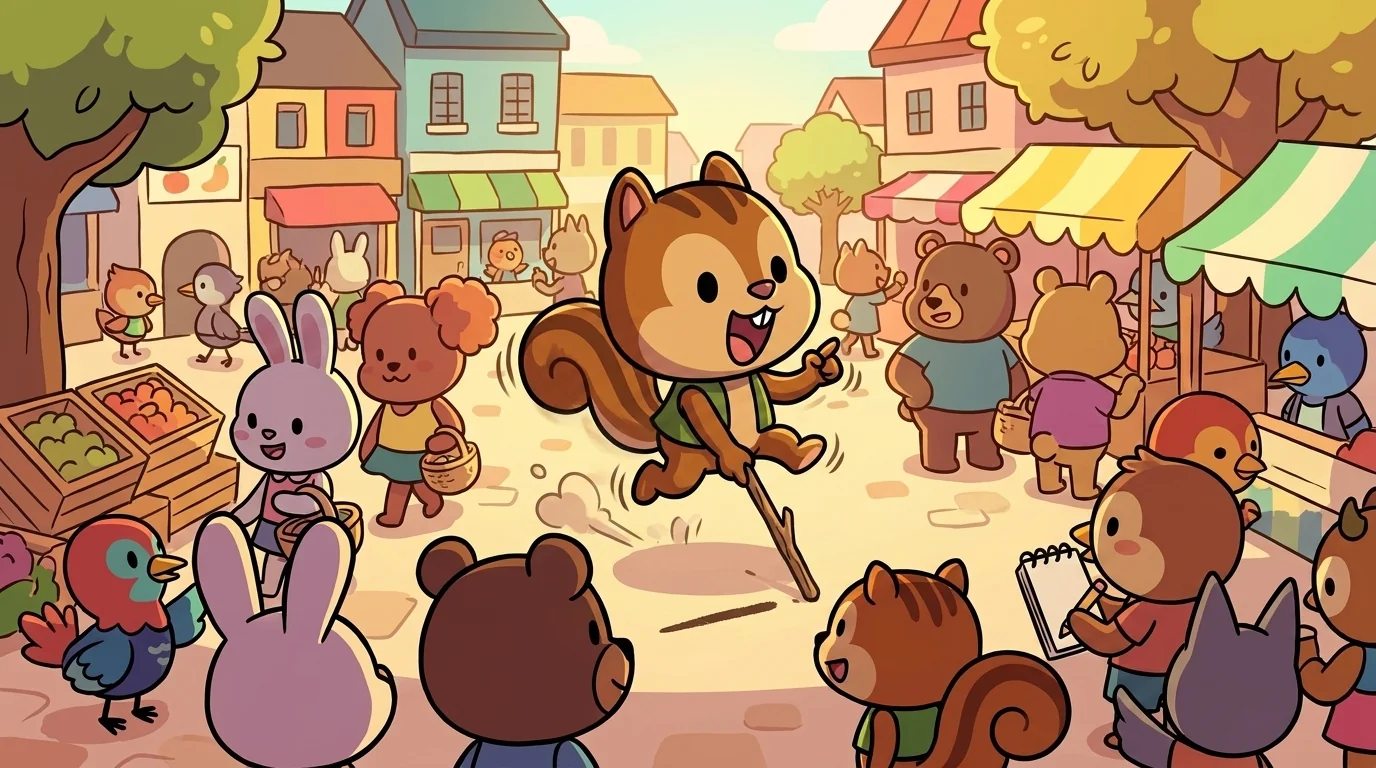
Patter stood at the front of the room, ready to introduce their special visitor. "Class, today we are going to talk about energy, because sometimes our stories feel a little too quiet," Patter said.
Dash didn't wait for Patter to finish. He shot out of Patter's coat pocket, scrambled up the chalk tray, and drew a long, thick line across the slate board.
"This is the dash!" Dash announced, spinning around to face the startled students. "It is the most impatient punctuation mark in the entire world."
A girl in the front row named Maya raised her hand. "But my teacher says interrupting is rude," she said.
"In real life, yes, it can be," Dash said, hopping onto a stack of heavy dictionaries. "But in a story, an interruption is like a spark of electricity that shows a character is bursting with feeling." "They are too scared, or too excited, or too angry to wait their turn."
He pointed to the long line on the board. "Find the most exciting moment in your scene, and end their sentence with a dash so the next character can crash right in."
A boy named Leo looked up from his notebook. "How do we know when we've used too many?"
Dash held himself perfectly still, though his whiskers still vibrated with energy. "An interruption is like a loud noise, and while one loud noise makes you jump, a hundred of them just give you a headache." "Save the dash for when it really matters, because the quiet moments are what make the loud ones count."
He walked along the edge of the table, looking down at Leo's paper. Leo had written a scene where two explorers were running from a giant spider.
Dash tapped the paper with a tiny claw. "They are running for their lives, Leo, so they wouldn't talk like they are having a polite tea party." "Try putting a dash right in the middle of their panic."
Leo chewed his pencil, then crossed out the words and wrote:
“Arthur, the spider is—” “—right behind us, run!”
As Leo wrote the new lines, the other kids leaned over to look, and a quiet murmur of excitement rippled through the room. The scene suddenly felt dangerous. You could hear the heavy breathing of the explorers and the rustle of the giant legs behind them.
By late afternoon, the students had gone home, leaving behind a quiet room filled with the warm glow of the setting sun. Dust motes drifted lazily through the golden beams of light.
Dash sat on the edge of Patter's desk, his long tail wrapped neatly around his feet. The frantic energy of the morning had finally settled, leaving him unusually still.
Patter set down his red grading pen and looked at the little chipmunk. "You were a whirlwind today," Patter said softly, "but you are very quiet now."
Dash stared at his own small paws for a long moment. When he spoke, his voice was low, and there were no dashes to be found.
"I used to think my interrupting meant I was rude, and I thought it showed that I didn't care about what other people had to say." He looked up at Patter, his dark eyes reflecting the warm light of the window. "It made me feel really bad about myself, honestly, so I spent a lot of time trying to be completely quiet."
Patter listened patiently, letting the silence fill the space between them.
"But then I figured out why I do it," Dash continued, a soft smile touching his whiskers. "It's not because I don't care, but because I care so much." "The words just rush out of me because I'm bursting with excitement about the person I'm talking to."
He let out a long, peaceful breath. "The interrupting isn't me ignoring my friends; it's just me caring out loud, too fast to wait."
A warm, settled understanding seemed to fill the small chipmunk, and for once, he didn't feel the need to rush past it.
"Once I realized that, I stopped being ashamed of who I am," Dash said. "Now, I just have to learn when to let the words fly, and when to hold them back so my friends can finish."
They sat together in the quiet room, watching the shadows stretch across the floor, perfectly content to let the silence have the last word.
The DialogueQuest ensemble
Dash is part of DialogueQuest's distributed-narrative cast. Each character embodies a different curricular primitive; together they teach the full subject.
-
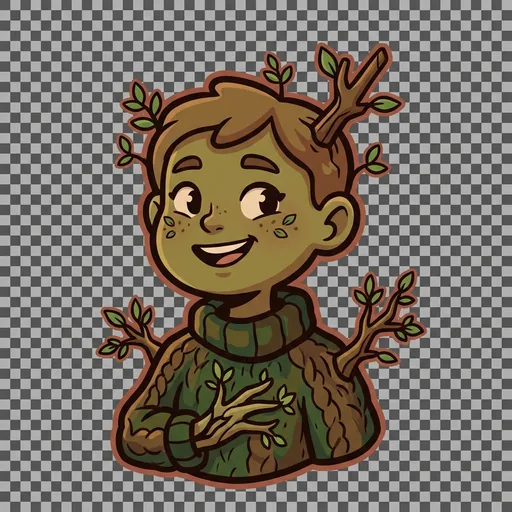
Sprig
Branch meaningfulness — sapling-tween whose visible branching skeleton shifts physically when she picks between dialogue options (the choice re-routes her body)
-
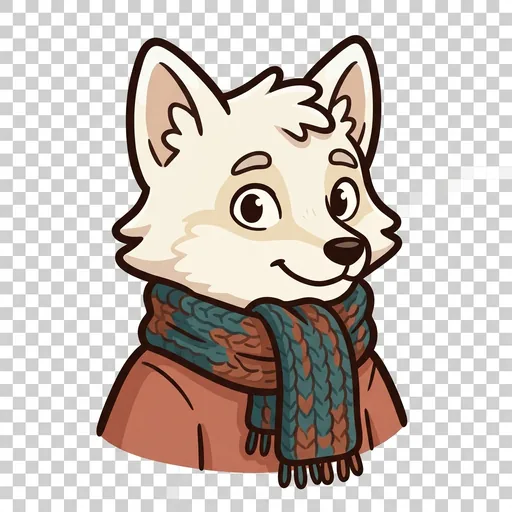
Glance
Subtext — arctic-fox-tween in a thick scarf; speech-bubble visibly half-empty with dotted-line ghost-text floating beside it
-
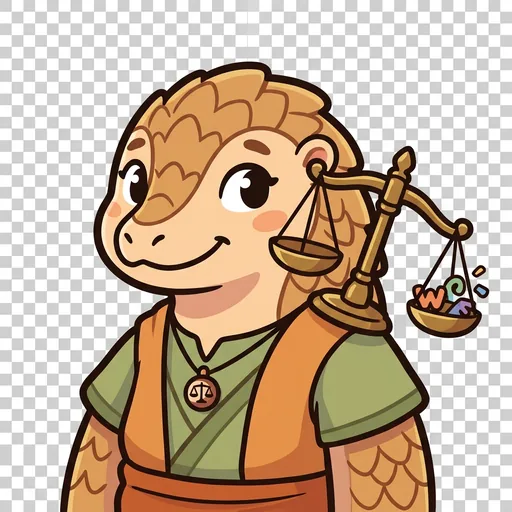
Weigh
Tag balance — pangolin-tween with a brass balance-scale on her shoulder; scales tilt visibly as dialogue happens around her
-
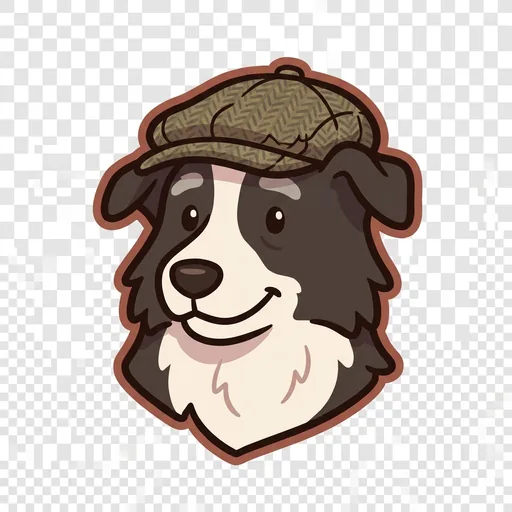
Brogue
Voice consistency — border-collie-elder in a worn flat-cap who uses exactly 4-5 signature words across every appearance (deliberately non-specific old-country accent)
-
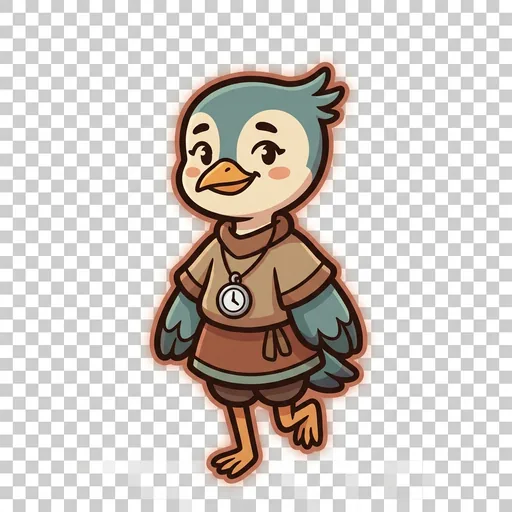
Rest
Rhythm + silence — heron-tween with a small silver pocket-watch around her neck; one foot perpetually raised mid-step; treats the pause as a line of dialogue itself
-
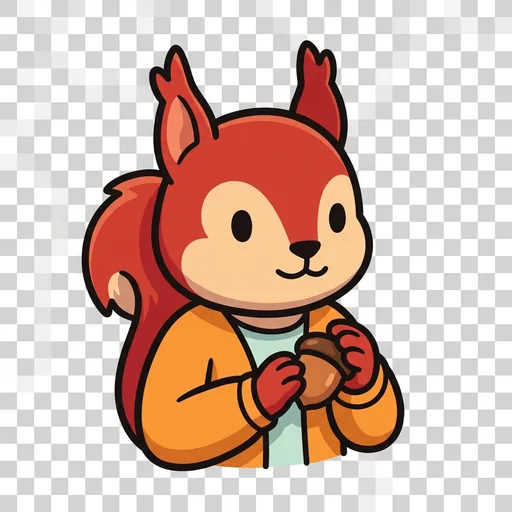
Prop
Action beats — red-squirrel-tween whose paws are always busy with a small acorn; the little actions between lines show feeling and set the rhythm of a talk
-
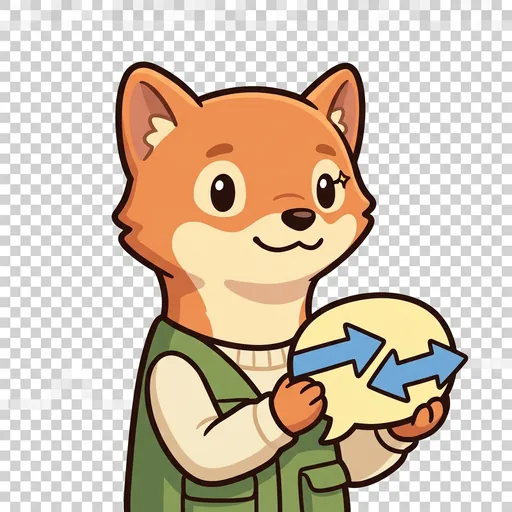
Spar
Conflict / friction — pine-marten-tween whose speech bubbles push against the other speaker's; two characters wanting different things is the engine (the push stays kind)
-
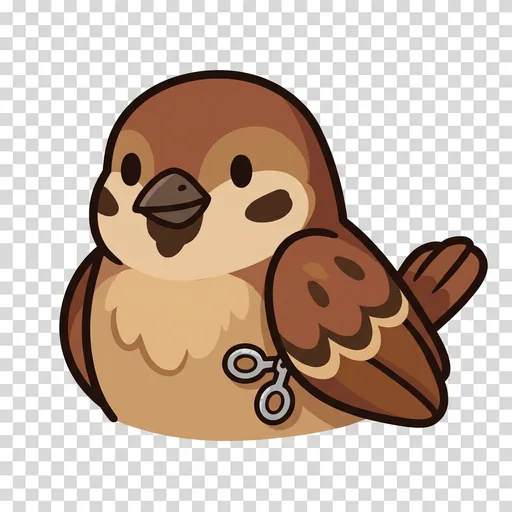
Clip
Economy — sparrow-tween with tiny silver scissors who trims the filler ('hello, how are you, fine') and starts scenes late, right where they get interesting
-
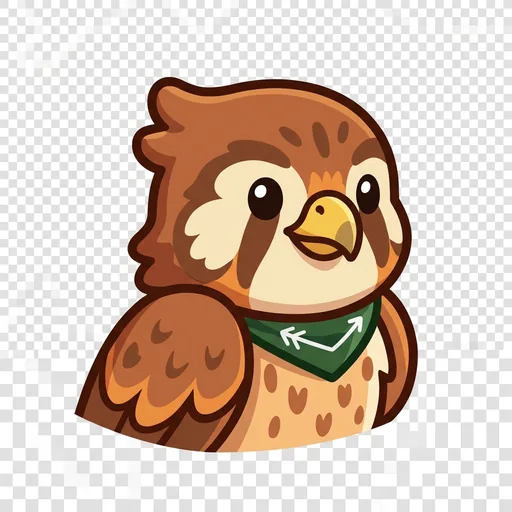
Aim
Line purpose — kestrel-tween with arrow-shaped speech bubbles that point at what each line is really trying to DO (ask, dodge, persuade), not just say