Undo
INVERSE OPERATIONS
Loading audio…
Press play to listen along. The line being read lights up as you go.
Show full transcript
Loading transcript…
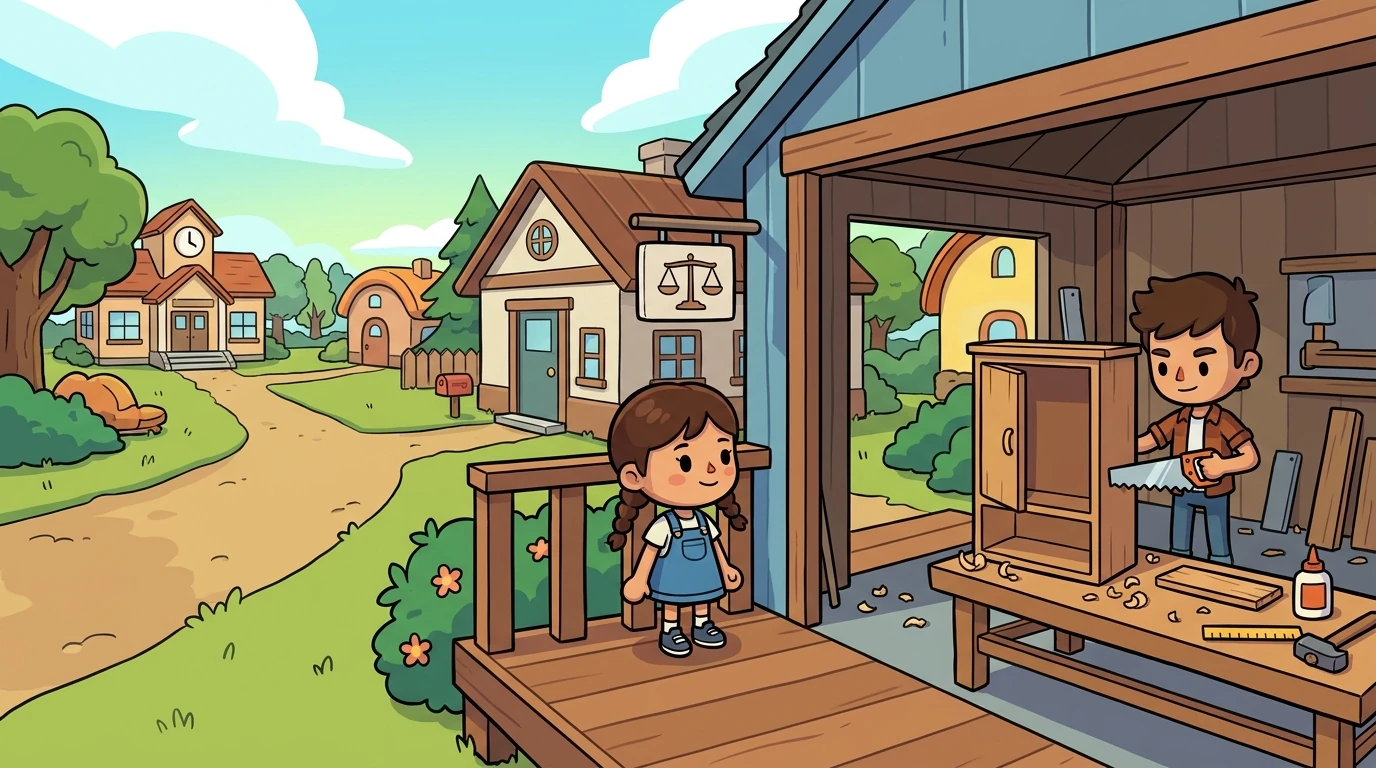
Undo grew up next door to Lever, in the town of Pivot. They have known each other since they were three years old. They walked to school together. They walked home together. They were, in the way that close childhood friends sometimes are, partly the same person in their own thinking, though they each grew up to be very different teachers.
Lever — as you have already heard — grew up watching the brass scales at his family's market. Undo grew up watching her brother build cabinets.
This is the story of how she became the kind of teacher she became.
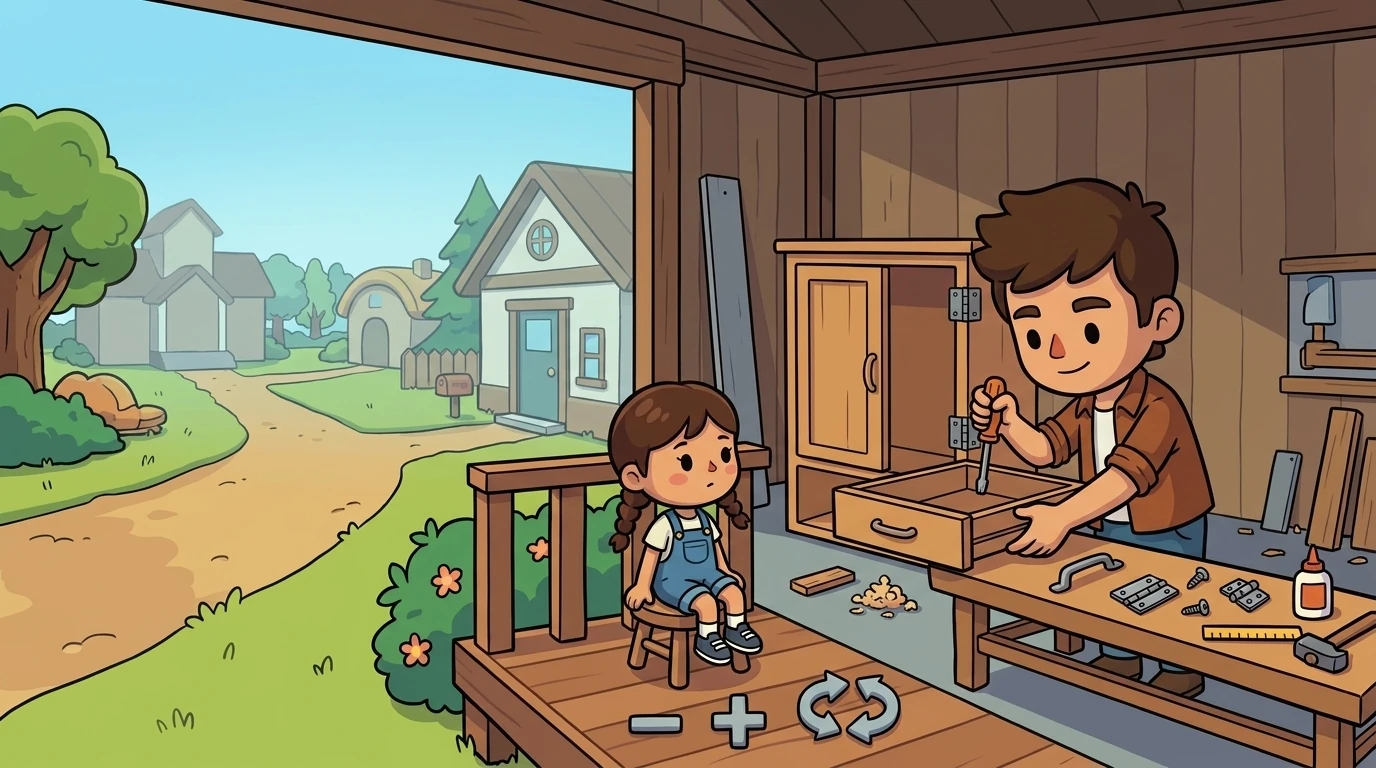
Undo's brother, whose name was Joist, was a carpenter. He was nine years older than Undo. From the time Undo was small, she would sit on a little stool in Joist's workshop and watch him build. He built chairs, tables, shelves, doors. His favourite things to build, though, were cabinets. Cabinets with drawers. Cabinets with hinges. Cabinets with doors that swung and latched and stayed shut and opened cleanly when you wanted them to.
Joist's cabinets were beautiful. Customers came from three towns over. He was, the local carpenters' guild had told their mother, "unusually patient."
What Undo noticed, sitting on her little stool, was that Joist did something at the end of every cabinet that no other carpenter she had watched did.
He unbuilt it.
Not completely. Not destructively. He would, after spending two weeks building a perfect cabinet, take it almost entirely apart again. He would pull each drawer out and slide it back in. He would unscrew each hinge and screw it back on. He would test every joint by pulling on it in the opposite direction it was meant to hold. He would, in short, undo every piece of his own work, and then put it all back together.
Undo, who was seven, asked him why.
Joist said: "I do not trust a joint I have not undone."
She thought about this for the rest of the day.
What she eventually understood — and she understood it slowly, over several years of watching — was that every step in building a cabinet was the opposite of some step in taking one apart. If you nailed a board, the opposite was pulling the nail. If you glued a joint, the opposite was separating the joint with a thin blade. If you screwed in a hinge, the opposite was unscrewing the hinge. For each action, there was an action that exactly reversed it. And Joist insisted on knowing all of them.
This was, Undo realised much later, exactly the principle of inverse operations.
In algebra: if you added five to one side of an equation, the operation that exactly reverses it is subtracting five. If you multiplied one side by three, the operation that exactly reverses it is dividing by three. If you squared a quantity, the operation that exactly reverses it (for positive numbers) is taking the square root. Every step has an undo. Every step. If you do not know the undo, you cannot trust the step.
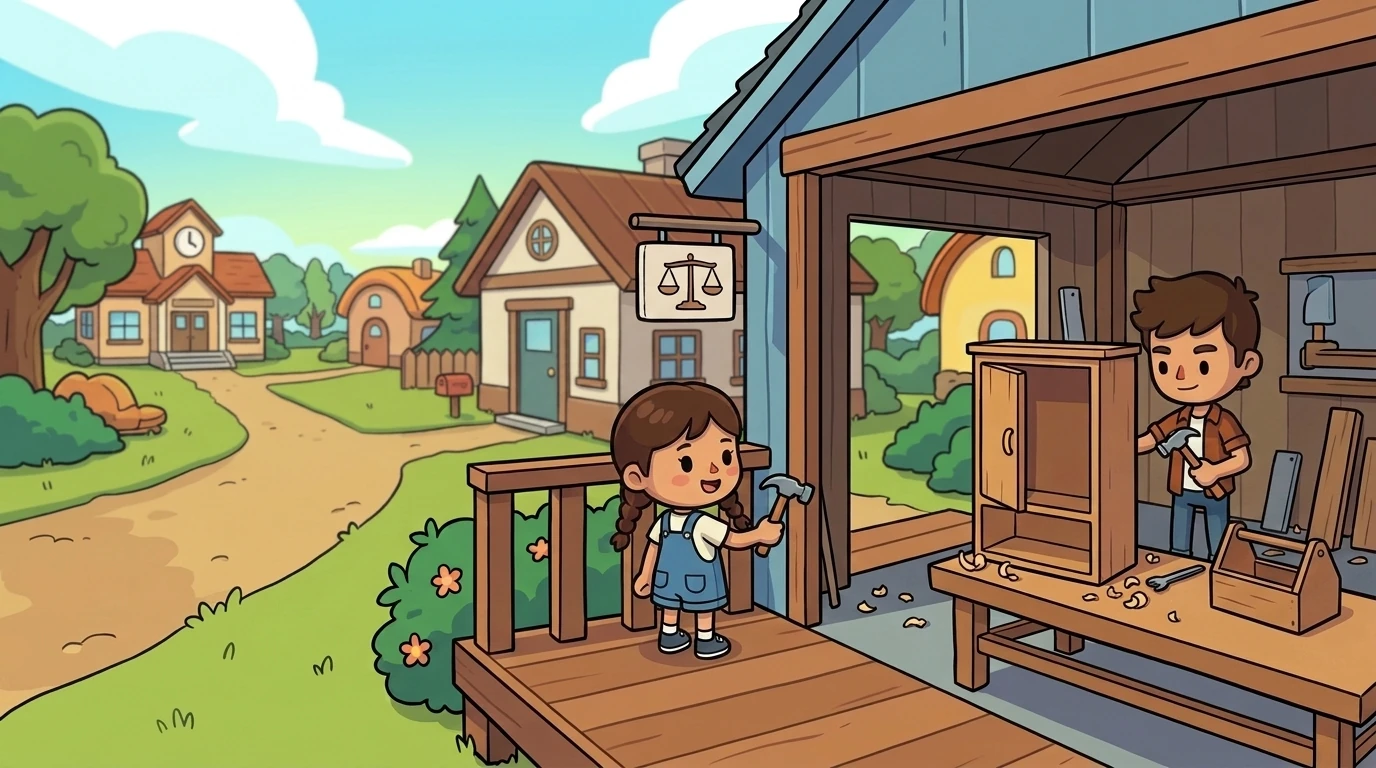
When Undo arrived at the EquationQuest academy at nineteen — with a small toolbox her brother had given her containing six different small implements, each of which was a reverse of some carpentry action — the academy master watched her for a few minutes and said, "You will be teaching inverse operations. Welcome."
Undo has been teaching ever since. She still keeps the toolbox in her classroom. She uses it as a demonstration. She holds up a hammer. She says: "This puts a nail in." She holds up the back end of the hammer, which has a small claw. She says: "This takes a nail out. They are the same tool. They are the same idea, in two directions."
Children remember this. Children draw little hammers in their notebooks.
There is a story she tells, every year, in kit 8. It is a true story. Joist built a cabinet for a customer once — a beautiful corner cabinet — and the customer, after taking it home, sent a letter back saying the cabinet's main door would not open. Joist was, briefly, panicked. He could not understand. He had tested the door. He had opened and closed it a hundred times. He went to the customer's house. He looked at the cabinet.
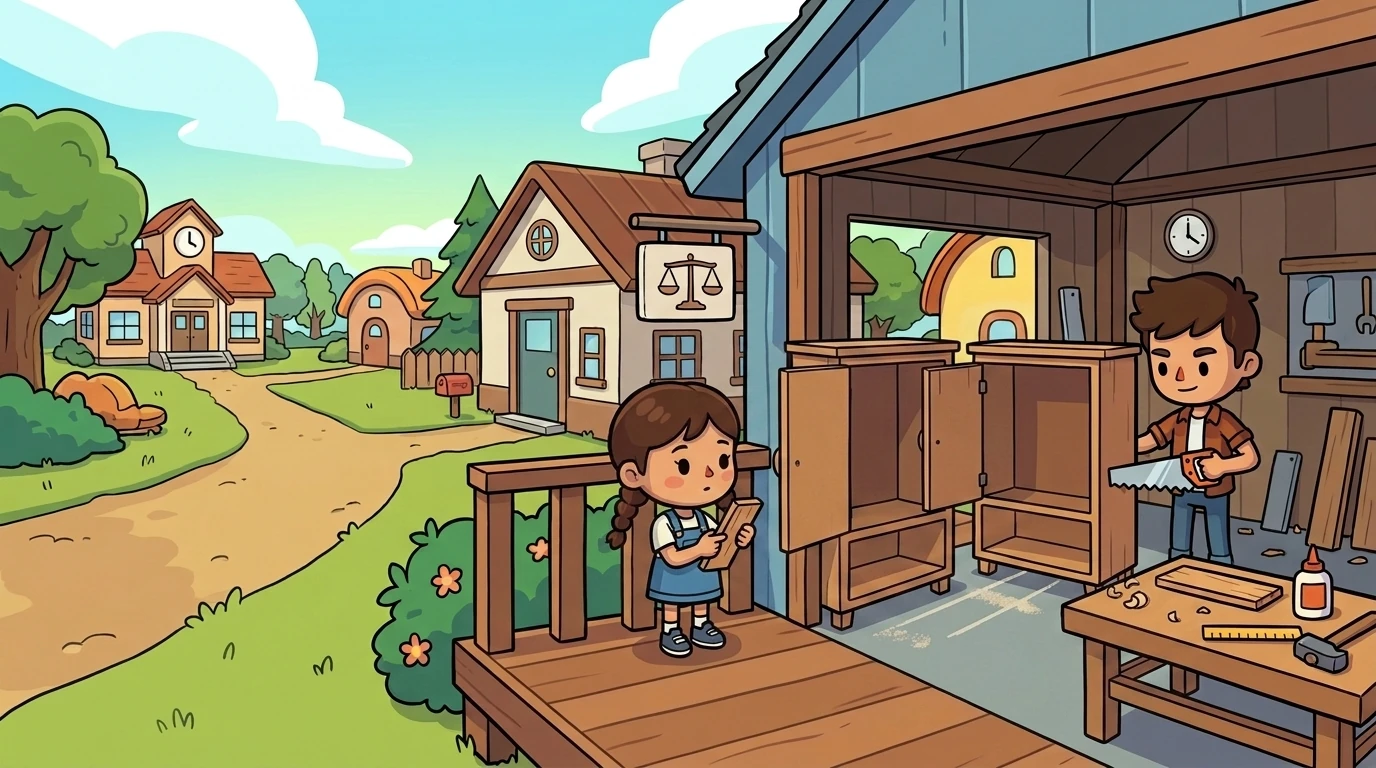
The customer had put it in a corner. The door, when fully open, was supposed to swing out to the left. The wall on the left was four inches away. The door could not open more than a quarter of the way.
The cabinet was fine. The room was the problem. Joist suggested moving the cabinet six inches to the right. The customer did. The door opened cleanly.
Undo tells this story when teaching kit 8. She uses it to explain that sometimes the equation is fine, but the situation is wrong. Sometimes you have to step back and check that the room around the equation makes sense — that the variable can actually take the values you are letting it take. (Mathematicians call this checking the domain. Undo calls it moving the cabinet six inches to the right.)
She still goes home to Pivot twice a year, to help Joist with whatever cabinet he is building that month. She still tests every joint.
She still does not trust a joint she has not undone.
Hear it as an audio drama
A short play starring Undo, from EquationQuest. Different voices, same idea. Listen any time after you read.
Loading audio…
Read the drama script
- Narrator: From Spark and Anvil and EquationQuest — this is Undo, in chapter 1 of the EquationQuest cast.
- Narrator: This drama uses an AI-generated voice. Voiced via Gemini 2.5.
- Narrator: Undo is a teacher who grew up in a carpenter's workshop, smelling of sawdust and lemon oil.
- Narrator: She watched her brother, Joist, build perfect cabinets from a small wooden stool.
- Undo: My brother taught me a crucial lesson: I do not trust a joint I have not undone.
- Narrator: After building something, he would methodically un-build it, testing every connection in reverse.
- Undo: Every action has an opposite. Nailing a board is undone by pulling the nail. Gluing a joint is undone by separating it.
- Undo: In math, adding five is undone by subtracting five. Multiplying by three is undone by dividing by three.
- Narrator: This is the principle of inverse operations. Every step has an undo.
- Narrator: She arrived at the EquationQuest academy carrying a small toolbox, a gift from her brother.
- Master: What is the most important step in making something?
- Undo: Knowing how to un-make it. Every step must have a clear and reliable undo.
- Master: You are appointed to teach inverse operations.
- Narrator: Every step has an undo. If you don't know the undo, you can't trust the step.
- Narrator: You've been listening to a Spark and Anvil chapter, written by the Spark and Anvil writing team for ages 9 to 14.
- Narrator: Apps stay free forever.
- Narrator: Curriculum aligned to Common Core math.
- Narrator: Released under Creative Commons BY-NC-SA 4.0 for educational reuse. Visit Spark and Anvil for the full transcript.
The EquationQuest ensemble
Undo is one of the friends in EquationQuest. Each friend shows you one idea by how they act; meet them all and you have the whole subject.
-

Lever
Maintaining balance — do the same thing to both sides
-

Solo
Isolating the variable — moving everything else away from x
-

Spread
Distribution — multiplying across parentheses
-

Flipper
The sign-flip in inequalities when multiplying/dividing by a negative
-

Corral
Combining like terms — you can only add or subtract terms of the same kind; gather the like ones together
-
Leaven
Exponents — repeated multiplication; the small raised number counts how many times
-

Marshal
Order of operations — the agreed sequence for working an expression (PEMDAS)
-

Prise
Factoring — find the part two or more terms share and pull it out front
-

Stead
Substitution — put a known value in place of a variable, then simplify

