
Facey
FACE → FEELING — *reading the feeling that a face is showing; a face is a little map of how someone feels.*
Listen along — Facey
Loading audio…
Press play to listen along. The line being read lights up as you go.
Show full transcript
Loading transcript…
Facey Reads the Faces
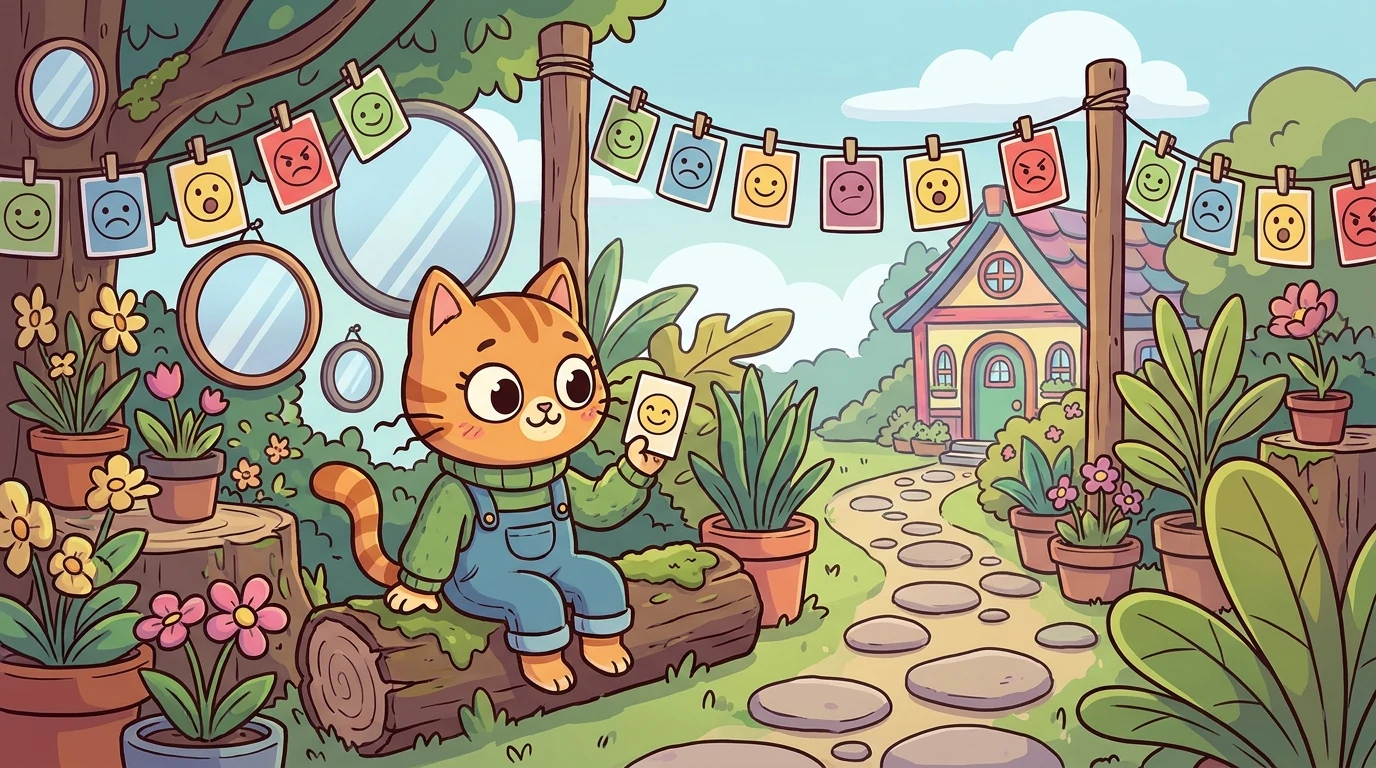
Facey is a stripey orange cat-kid with big round eyes and whiskers that wiggle when she’s thinking. She lives just down the garden path from Momo, in a cozy nook full of round mirrors and little face-cards hanging on a string.
Facey does one special thing, over and over: she looks at a face and finds the feeling it is showing. When a face has an up-curved mouth and crinkly eyes, Facey says, “That face is showing happy!” When a face has a wide-open mouth and high eyebrows, Facey says, “That face is showing surprised!” She matches the face to the feeling every time. “The face shows it,” Facey says, whiskers wiggling. “I just look.”
Facey learned to read faces by watching very, very carefully.
When she was little, faces were confusing. A face would scrunch up and Facey couldn’t tell — was it angry? was it going to sneeze? She got them muddled. So she started collecting face-cards and studying them: this mouth means happy, these eyebrows mean worried, these tears mean sad. Little by little, the faces stopped being a jumble. Now Facey can glance at a face and read it like a favorite picture book.
Today, Momo brings the kid down the path to Facey’s mirror-nook. “Facey knows how to read faces,” Momo says. “Watch what she does.”
“Come look with me,” Facey says warmly, holding up a face-card. “Look at the mouth. Look at the eyes. Then tell me — what feeling is this face showing?”
Facey holds up a card with a down-turned mouth and droopy eyes. She looks slowly — mouth, then eyes — and says, “This face is showing… sad.” A grown-up can play too: the grown-up makes a face, the kid guesses the feeling, then you swap — because reading faces is for playing together, never a quiz. And Facey never says “wrong.” If the kid says “sleepy” for a droopy face, Facey nods: “Ooh, sleepy is close — droopy eyes can mean sleepy OR sad. Let’s look again together.” There is no wrong guess in the mirror-nook. Facey just helps you look a little closer, one part of the face at a time.
At the end of the visit, the kid can read three faces all by themselves, and Facey’s whiskers wiggle with pride.
And here is what Facey loves best: the warm little click inside when you look at a face and just know how someone feels — that cozy, connected feeling of understanding a friend without any words at all. Facey feels it every time a face makes sense. “The face shows it,” she says softly, curling her tail around her paws, happy and warm. That quiet click of understanding — that’s the very best part of reading faces.
The FeelingFriends ensemble
Facey is part of FeelingFriends's distributed-narrative cast. Each character embodies a different curricular primitive; together they teach the full subject.
-

Momo
Naming feelings (hero) — a soft monster who puts a NAME to a feeling; naming the feeling IS emotional awareness
-

Sensa
Situation → feeling — a rabbit who figures out how someone feels from what happened
-

Comfy
Empathy in action — a dog who chooses what would help someone feel better; the helpful choice IS empathy