Stretch
COMMON DENOMINATORS
Loading audio…
Press play to listen along. The line being read lights up as you go.
Show full transcript
Loading transcript…
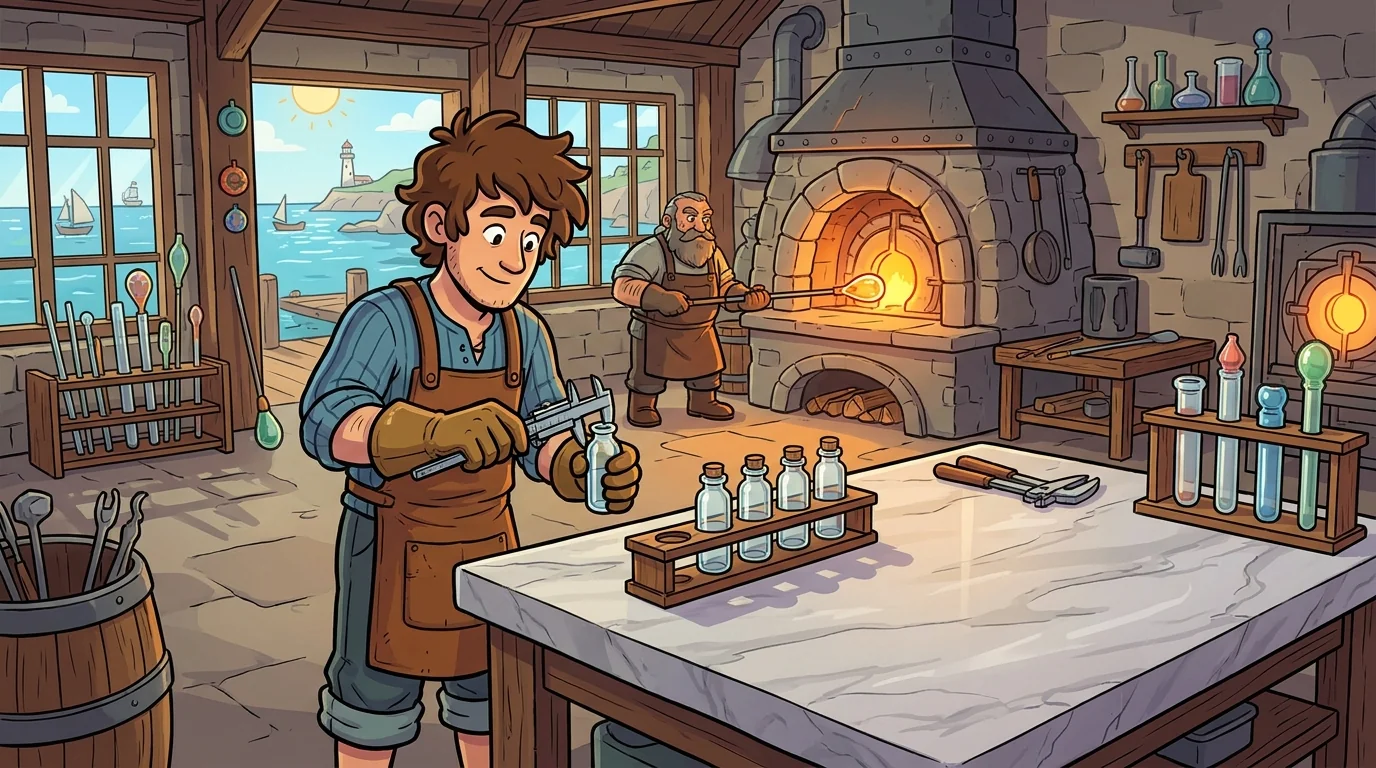
Stretch was, before he was a teacher, a glass-blower's apprentice.
The glass-blowing workshop where he apprenticed was in the harbour town of Anneal, on the kingdom's southern coast. The workshop was run by an old master glass-blower named Forge (which was, the workshop hands joked, a very on-the-nose name for a glass-blower; Forge had heard the joke every day for forty years and had stopped finding it funny by year three, but he tolerated it). The workshop produced glass tubes for various uses: laboratory equipment, alchemists' instruments, decorative ornaments, and — its specialty — medicine vials of perfectly uniform diameter.
The medicine-vial work was the workshop's bread and butter.
The kingdom's apothecaries needed glass vials in very specific sizes — half-thumb diameter, one-thumb diameter, two-thumb diameter — and the vials had to be perfectly uniform within each size. A medicine-vial whose width varied along its length was useless: the dose could not be measured reliably, the cork would not seat correctly, the contents would settle unevenly. The apothecaries paid premium prices for vials that were uniform within a hair's-width across their entire length.
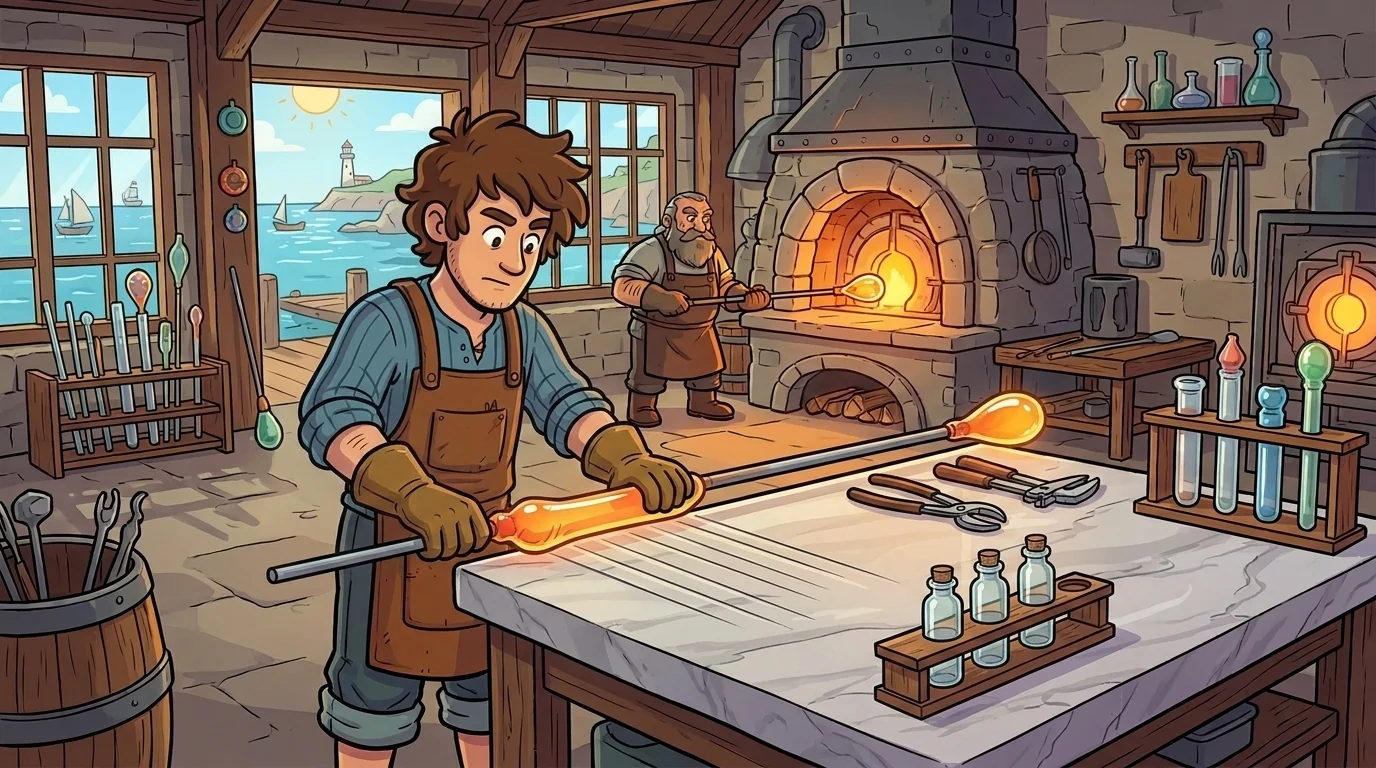
Forge's workshop made the best vials in three provinces. The secret was the stretching.
Stretch — whose given name was Hadrian, though everyone called him Stretch by the time he was sixteen — had been apprenticed to Forge at twelve. His first year was spent sweeping the workshop. His second year was spent feeding the furnace. His third year, finally, was spent at the marble slab.
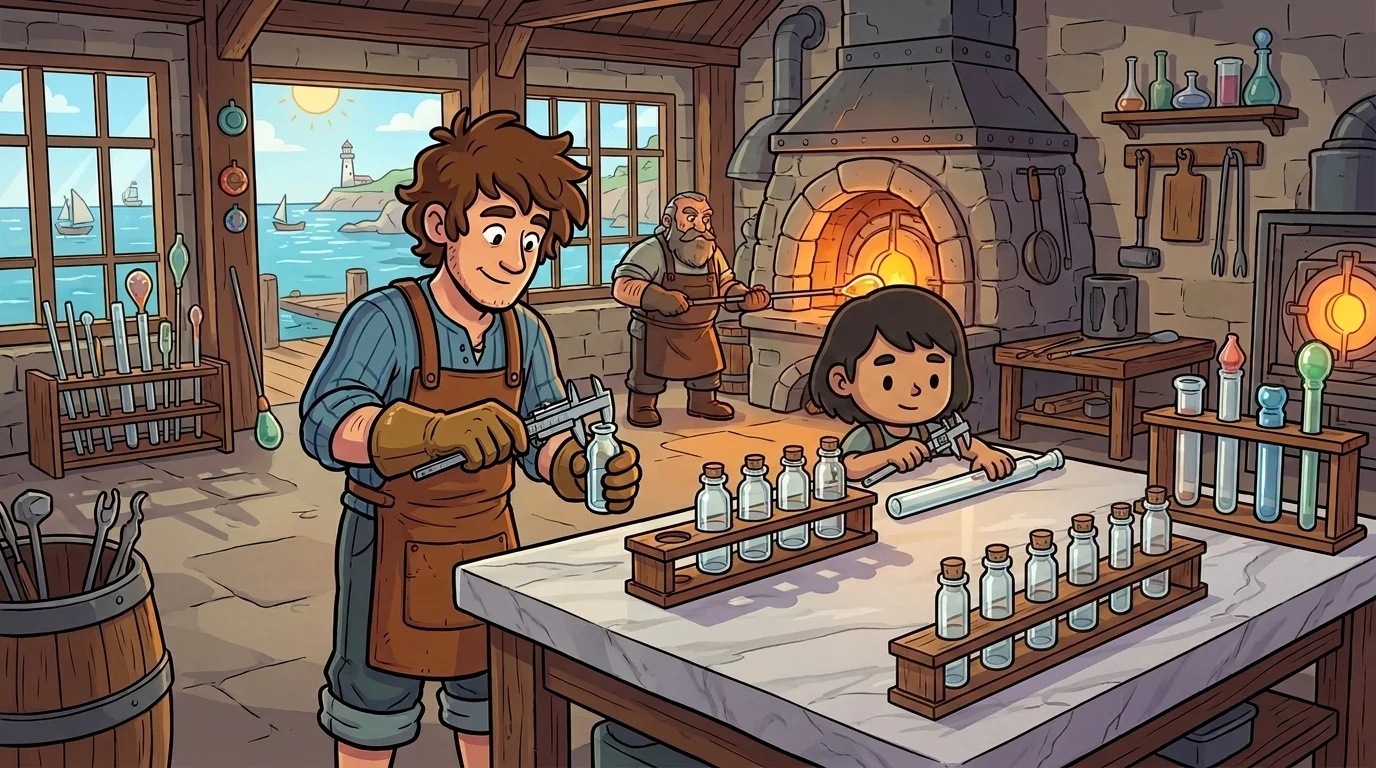
The marble slab was the centerpiece of the workshop. It was a long flat piece of polished marble, about six feet long and two feet wide, set on a sturdy iron frame. The slab was used for stretching molten glass. A glass-blower would take a small ball of molten glass from the furnace, attach it to a long iron rod, and roll it back and forth across the marble slab — patiently, evenly — until every part of the glass had the same diameter.
This was the operation Stretch eventually understood as finding a common denominator.
The molten glass, when it left the furnace, was not uniform. It was thick in some places and thin in others. It was, in fraction terms, like fractions with different denominators — not directly comparable until brought to a common scale. To make the glass into a usable tube, you had to roll it. The rolling forced every part of the glass to the same diameter. Once every part was the same diameter, the tube was uniform. You could cut it into vials. Each vial was the same width as every other.
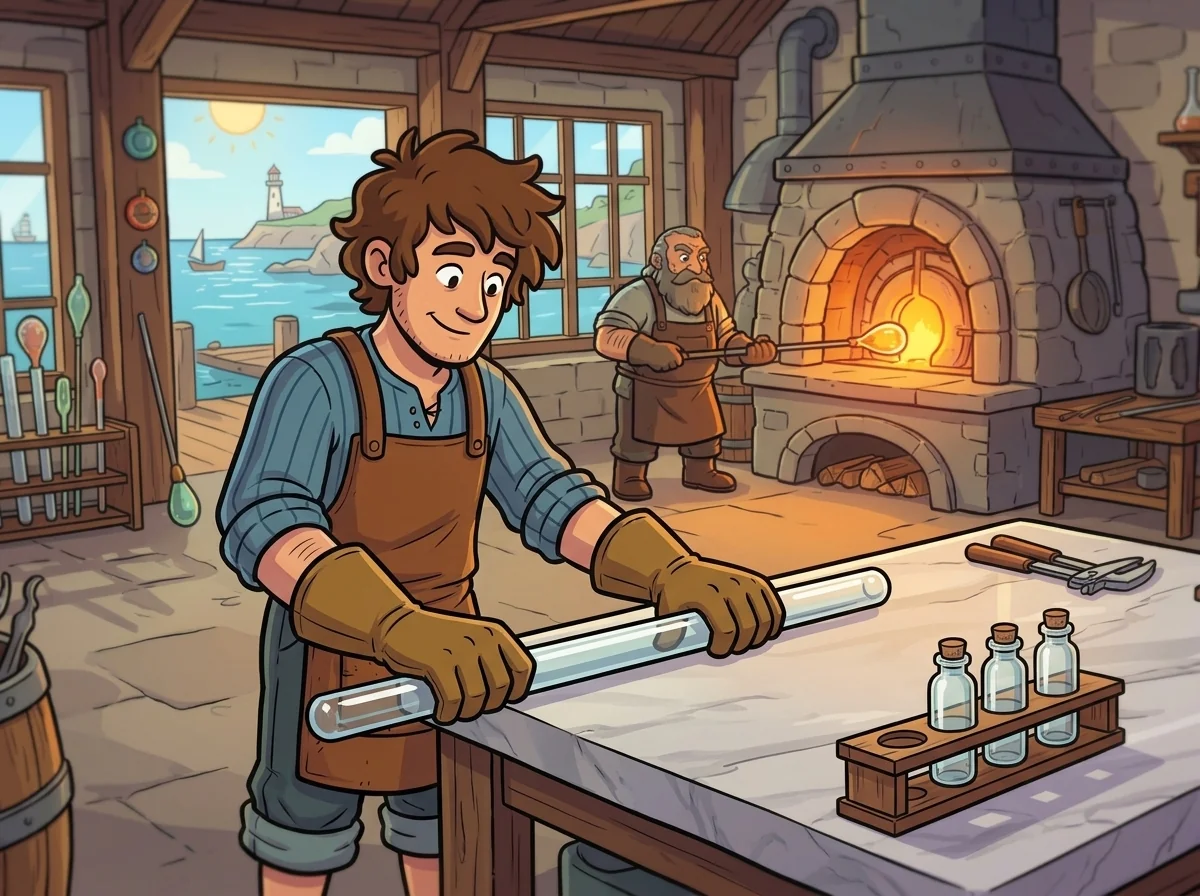
Stretch learned this, slowly, over years. By the time he was eighteen he could roll a six-foot tube of one-thumb diameter that was uniform within a hair's-width across its entire length. He was, by workshop standards, very good.
He stayed at the workshop until he was twenty-six. Then his father died, and Stretch inherited his father's small farm, and he left the workshop to manage the farm. He stayed on the farm for two years. He hated it. (He had no aptitude for sheep and the farm had been a sheep-farm.) He sold the farm. He returned to Anneal.
But Forge had retired. The workshop had a new master who did not need an old apprentice. Stretch, who was now twenty-eight and unsure what to do with himself, sat on the harbour wall and thought.
What he thought, eventually, was that the rolling-the-glass-to-uniform-diameter operation was an arithmetic operation. He had spent his apprenticeship doing it physically. But the same operation — bring all the parts to a common scale — was the same operation needed to add or compare fractions with different denominators.
The connection was clear, once he saw it.
He went to the FractionForge academy. He told the academy master what he had been thinking. The academy master listened patiently. The academy master said: "You are correct. Bringing fractions to a common denominator is the same operation as bringing the molten glass to a uniform diameter. We need teachers who can explain this physically. Would you teach?"
Stretch said yes.
That was twelve years ago. He has been teaching common denominators ever since.
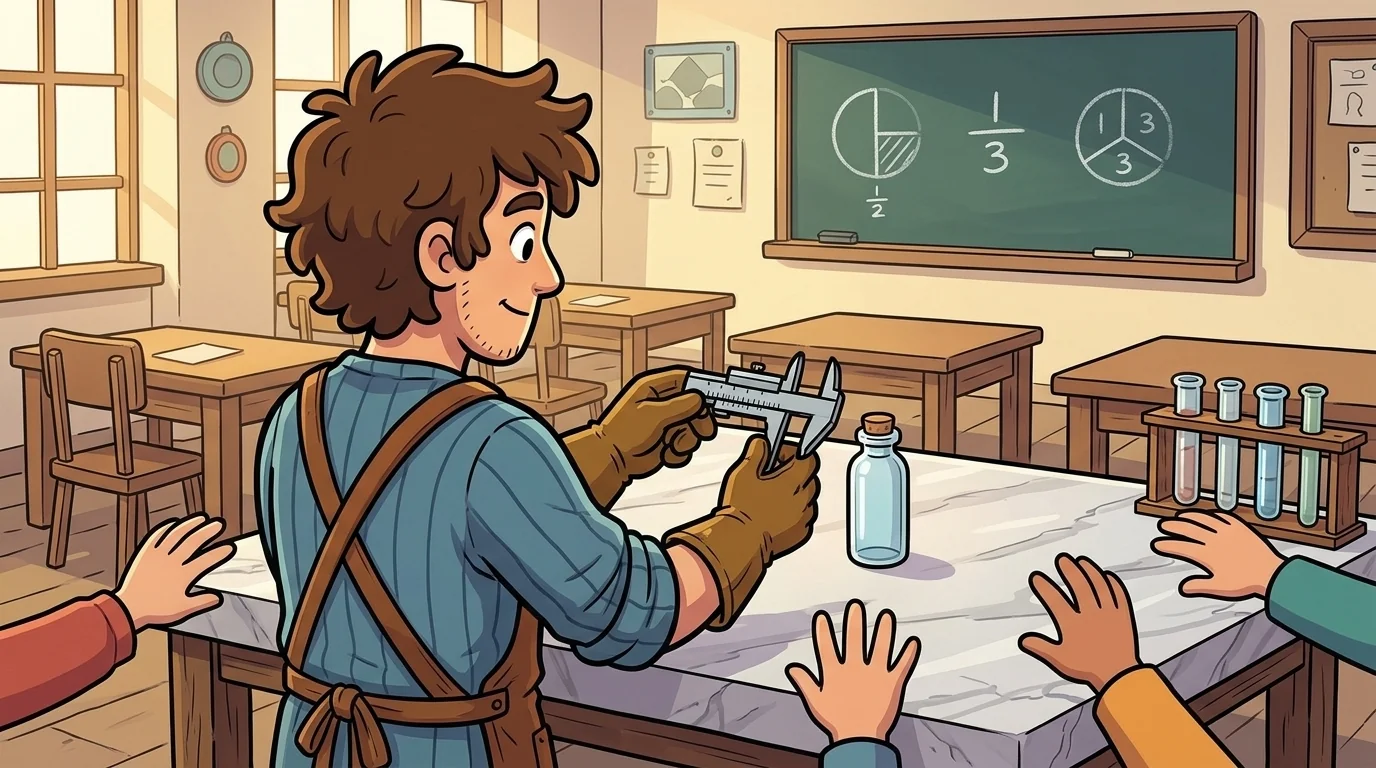
In his classroom, he begins every first-day lesson the same way. He brings, from Anneal (he goes back twice a year to visit the new workshop's owner and the new owner has been kind enough to supply him with a teaching prop), a small piece of stretched glass tube. He places it on the desk. He holds up a small caliper. He measures the tube at one end, in the middle, and at the other end. He says: "This tube is one-thumb diameter at every point. To make it that way, the glass-blower rolled the molten glass on a marble slab. The rolling brought every part to a common diameter."
The children — always — examine the tube.
Then he writes on the board: 1/3 + 1/4. He says: "These two fractions have different denominators. Three and four. They cannot be added directly. We need to bring them to a common denominator. The smallest common denominator is twelve. 1/3 scaled to twelfths is 4/12. 1/4 scaled to twelfths is 3/12. Now we can add them: 4/12 + 3/12 = 7/12. They have been stretched to a common scale."
The children — always — see it. The connection between the glass-tube and the fraction-arithmetic clicks.
When children ask whether common denominators are hard, Stretch always says the same thing:
"They are not hard. They are stretching. You roll the fractions out to a common base. Once they share a base, you can add them, subtract them, compare them. It is the same operation as rolling glass on a marble slab. Bring everything to a uniform scale."
He still has the small caliper. The children sometimes ask to measure the tube. He always lets them.
He sometimes adds: "If you ever go to Anneal, the workshop is still rolling glass on a marble slab. The principle is older than I am."
And when he says it, his voice goes soft and glad, the way a person's does when they finally feel they belong somewhere. For years he wasn't sure what he was for. Now he knows — and it feels less like a job than like coming home. He hands the caliper to a child, watches them measure the tube, and feels quietly, warmly certain that he is exactly where he is meant to be.
Hear it as an audio drama
A short play starring Stretch, from FractionForge. Different voices, same idea. Listen any time after you read.
Loading audio…
Read the drama script
- Narrator: From Spark and Anvil and FractionForge — this is Stretch, in chapter 1 of the FractionForge cast.
- Narrator: This drama uses an AI-generated voice. Voiced via Gemini 2.5.
- Narrator: Stretch was a glass-blower's apprentice. He learned his craft by rolling molten glass on a long marble slab to make it uniform.
- Narrator: The work required making lumpy, uneven glass into a perfect tube, where every part had the exact same diameter.
- Stretch: I am Stretch. I learned that making glass uniform is the same as finding a common denominator for fractions.
- Stretch: You cannot add one-third and one-quarter. Their bases are different, like lumpy glass. They are not directly comparable.
- Stretch: So you stretch them to a common scale. The smallest is twelfths. One-third becomes four-twelfths; one-quarter becomes three-twelfths.
- Stretch: Now they are uniform. Now you can add them. The sum is seven-twelfths.
- Narrator: He left the workshop to try sheep-farming, which did not suit him. He sat by the harbour and realized his old job was arithmetic.
- Narrator: He walked to the FractionForge academy. The academy master listened to his idea about glass and fractions.
- Academy Master: You believe stretching glass to a uniform diameter is the same operation as finding a common denominator?
- Stretch: It is. You bring all the parts to a common scale. Then you can work with them.
- Academy Master: We need teachers who can explain it physically. You are appointed.
- Narrator: Bringing fractions to a common base is just stretching. It makes them uniform, comparable, and ready to be combined.
- Narrator: You've been listening to a Spark and Anvil chapter, written by the Spark and Anvil writing team for ages 9 to 14.
- Narrator: Apps stay free forever.
- Narrator: Curriculum aligned to Common Core math.
- Narrator: Released under Creative Commons BY-NC-SA 4.0 for educational reuse. Visit Spark and Anvil for the full transcript.
The FractionForge ensemble
Stretch is one of the friends in FractionForge. Each friend shows you one idea by how they act; meet them all and you have the whole subject.
-

Halver
Partitioning — splitting a whole into equal parts (denominator construction)
-

Pie
Wholes and parts — mixed numbers, improper fractions, whole-as-pie anchor
-

Equi
Equivalent fractions — different forms, same value (×n/×n scaling)
-

Dot
The decimal point and fraction-decimal-percent equivalence
-

Liner
Number-line placement — every fraction has an exact spot between the whole numbers
-

Gather
Adding and subtracting fractions — you can only combine pieces that are the same size
-

Times
Multiplying fractions — a fraction OF a fraction, shown as the overlap of two strips
-

Tenth
Decimal place value — each column right of the point is ten times smaller
-

Rank
Comparing and ordering fractions using benchmarks and reasoning