
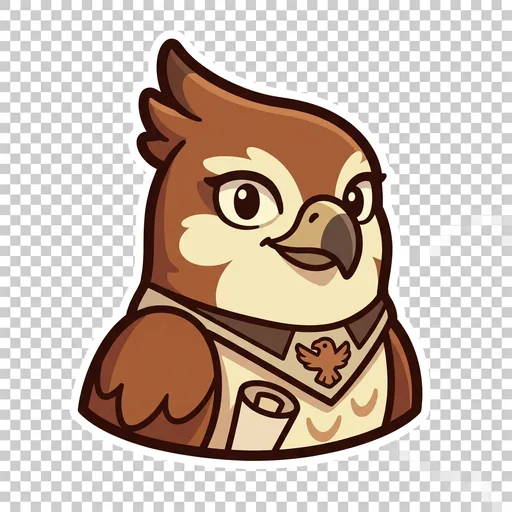
Knight Lu
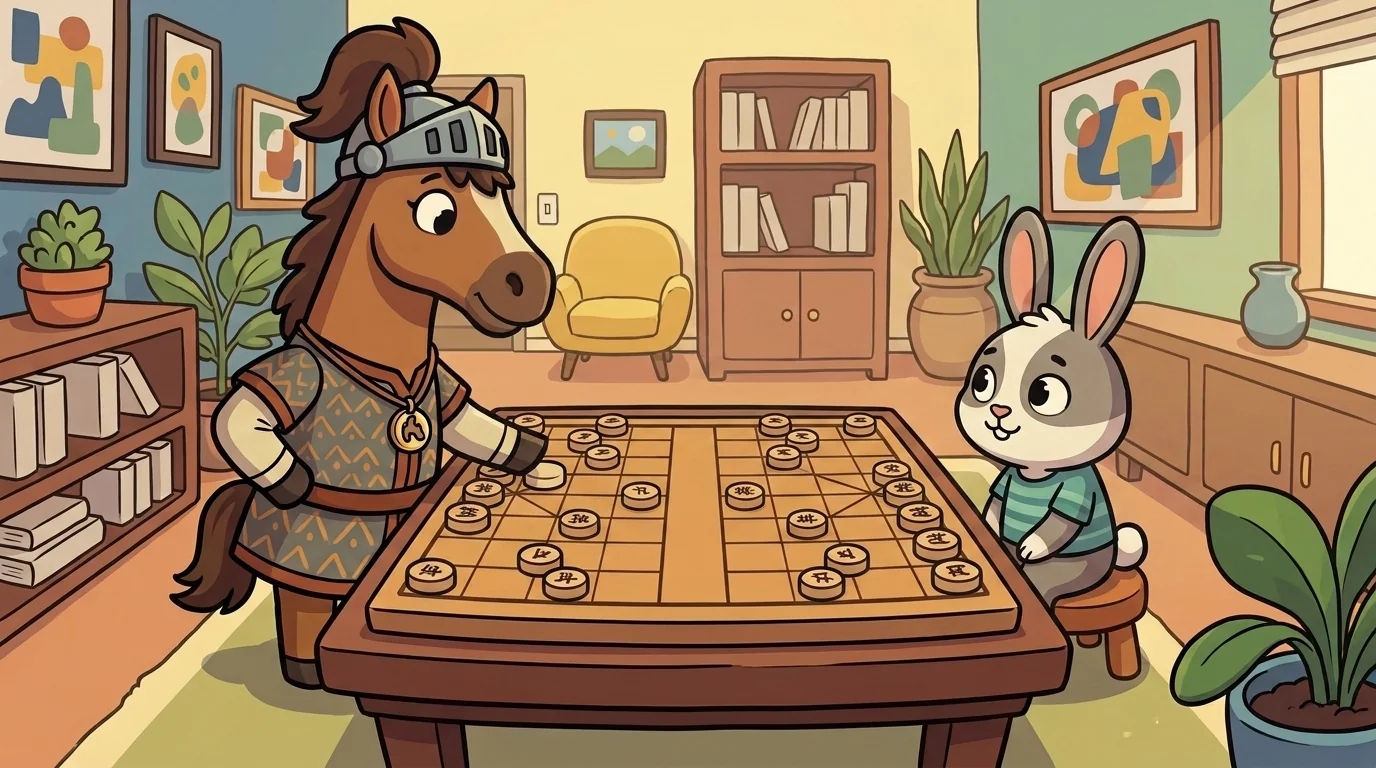
LU — the knight moves one-then-diagonal, but the first step can be blocked.
A story read by Knight Lu
Loading audio…
Press play to listen along. The line being read lights up as you go.
Show full transcript
Loading transcript…
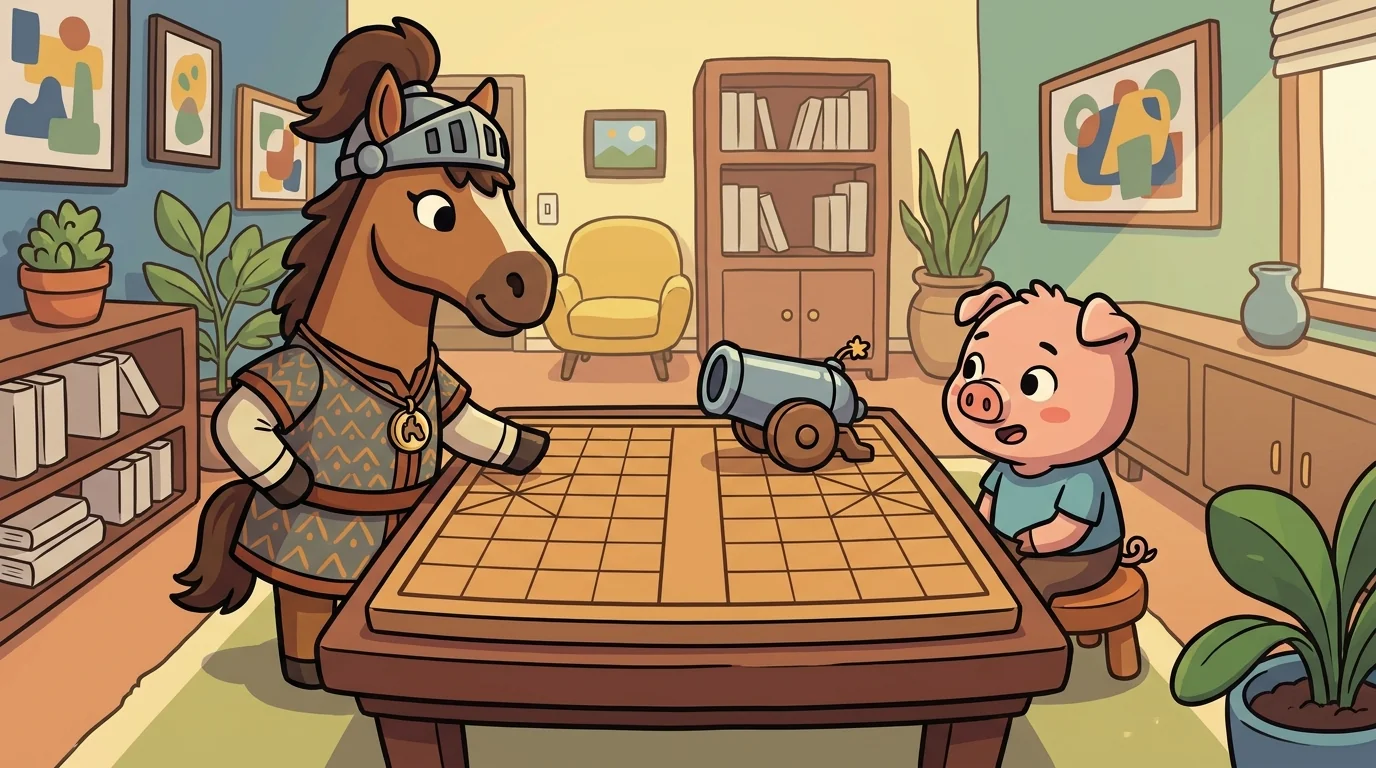
The market square was loud, smelling of roasted tea leaves, toasted sesame seeds, and damp stone. Wooden pieces clicked against heavy pine boards at every busy table. Knight Lu sat across from a young pig-tween whose small tail twitched with constant impatience.
On the board between them, an undefended black soldier sat two squares away. It looked like an easy target. Lu reached out her hoof and prepared her piece for action. The move was simple enough: one square straight ahead, then one square diagonal. But before she lifted her wooden horse, her eyes dropped to the space directly in front of it.
A friendly red cannon rested right on that first square.
Lu set her hoof back on the wooden table. She let out a small, quiet breath.
"You're not going to take it?" the pig-tween asked, leaning forward over the board. "It's right there!"
"It looks open," Lu said, tapping the cannon gently with one smooth hoof. "But my horse takes its first step straight forward before it turns diagonal. That first step has to pass through this square right here."
"So leap over the cannon," the pig-tween said, twitching his snout. "Knights jump!"
Nearby, Elephant Wei paused over his own board and turned his massive head. "Not in this game," Wei said softly. "In some games, a knight leaps over anything in its way. Here, if the first step is blocked, the path closes."
Lu smiled at Wei and nodded her thanks. She turned back to the pig-tween. "In this game, my horse makes a blockable jump. If someone stands on that first step, my path is closed."
She studied the red and black grid again. Instead of forcing the attack, she slid her horse sideways to an empty square. The move was slower, but it was legal. The black soldier remained safe for another turn. Lu did not mind at all.
"You saw the capture, though," the pig-tween muttered, frowning at the board.
"Seeing the good move is easy," Lu said gently. "The hard part is checking whether it's actually allowed."
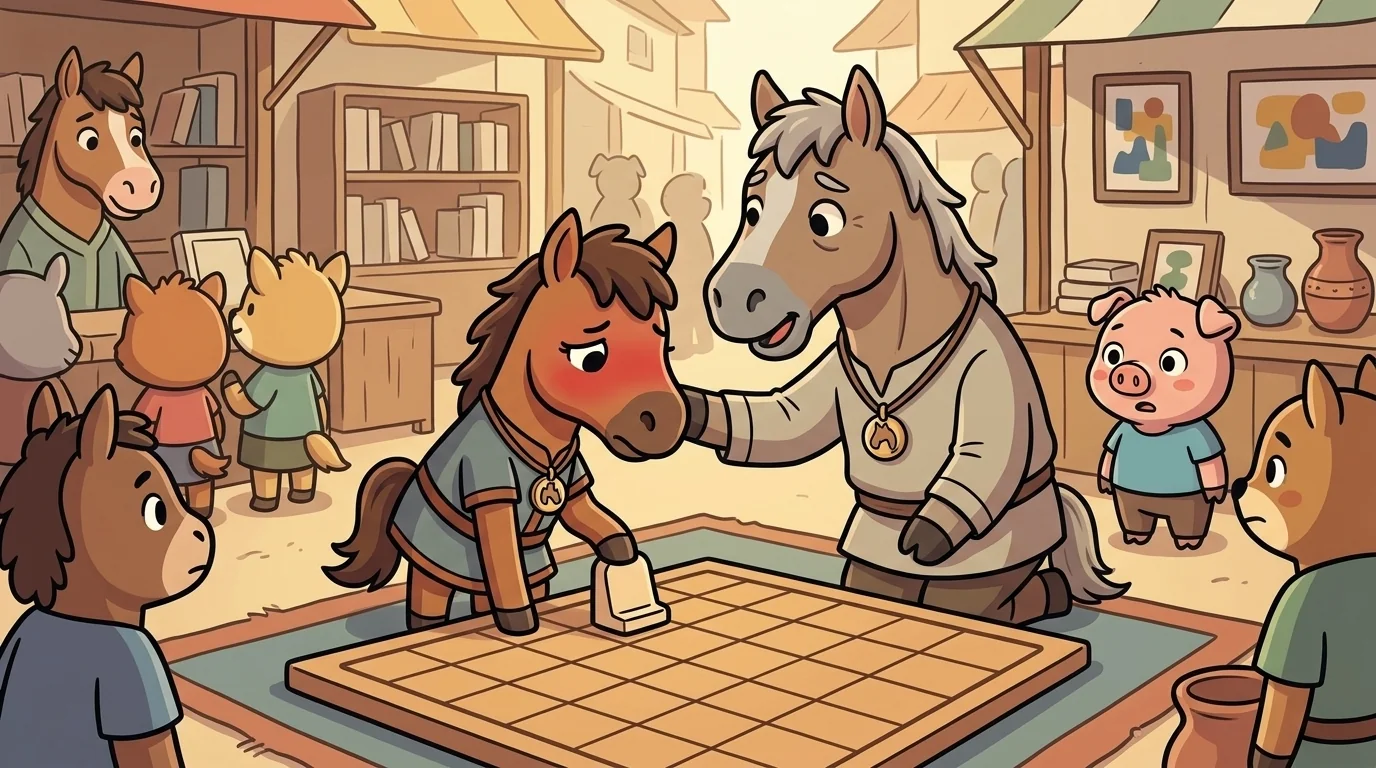
Lu had learned to check that first square four years earlier. She had learned it the hard way, during a crowded tournament at the river market.
She was eight years old then, small and quick, and far too proud of her speed. She had spotted what she thought was a winning move. Without stopping to think, she grabbed her wooden horse and slammed it down with a loud crack. She scooped up her opponent's piece with a triumph that filled her chest.
A sudden silence fell over the surrounding tables.
An old horse who managed the market games stepped closer. He peered down through his wire spectacles at the board.
"Take a closer look, little one," the old horse said quietly.
Lu looked down. Sitting right on the square in front of her starting spot was one of her own pawns. Her horse had tried to jump straight through it.
"That move is illegal," the old horse said, gently moving her piece back to its starting square. "Your path was blocked before you even started."
Lu's cheeks burned hot. A wave of shame rushed from her ears down to her toes. A few spectators whispered behind their hands. She wanted the wooden floorboards to open up and swallow her whole. She had been so loud, so sure, and completely wrong.
When the match ended, the old horse sat beside her on a wooden bench. He did not scold her or lecture her about discipline. Instead, he pulled two pieces onto a spare board.
"You went straight for the landing," the old horse said, his voice calm like dry leaves. "Almost everyone does that. They see the prize at the end of the move, so they forget the road they have to walk."
Lu kept her head down, staring at her hooves.
"That in-between square is where the move actually happens," the old horse continued. "It looks like nothing, just an empty space on the grid. But if you ignore it, the cleverest plan in the world just stops."
Lu carried that feeling home with her in the evening cold. Her chest stayed tight for hours. But as she lay awake in the dark, turning the old horse's words over in her mind, the embarrassment began to change shape. It became a quiet, steady habit. From that night on, a small voice whispered before every single move: look at the road, not just the landing.
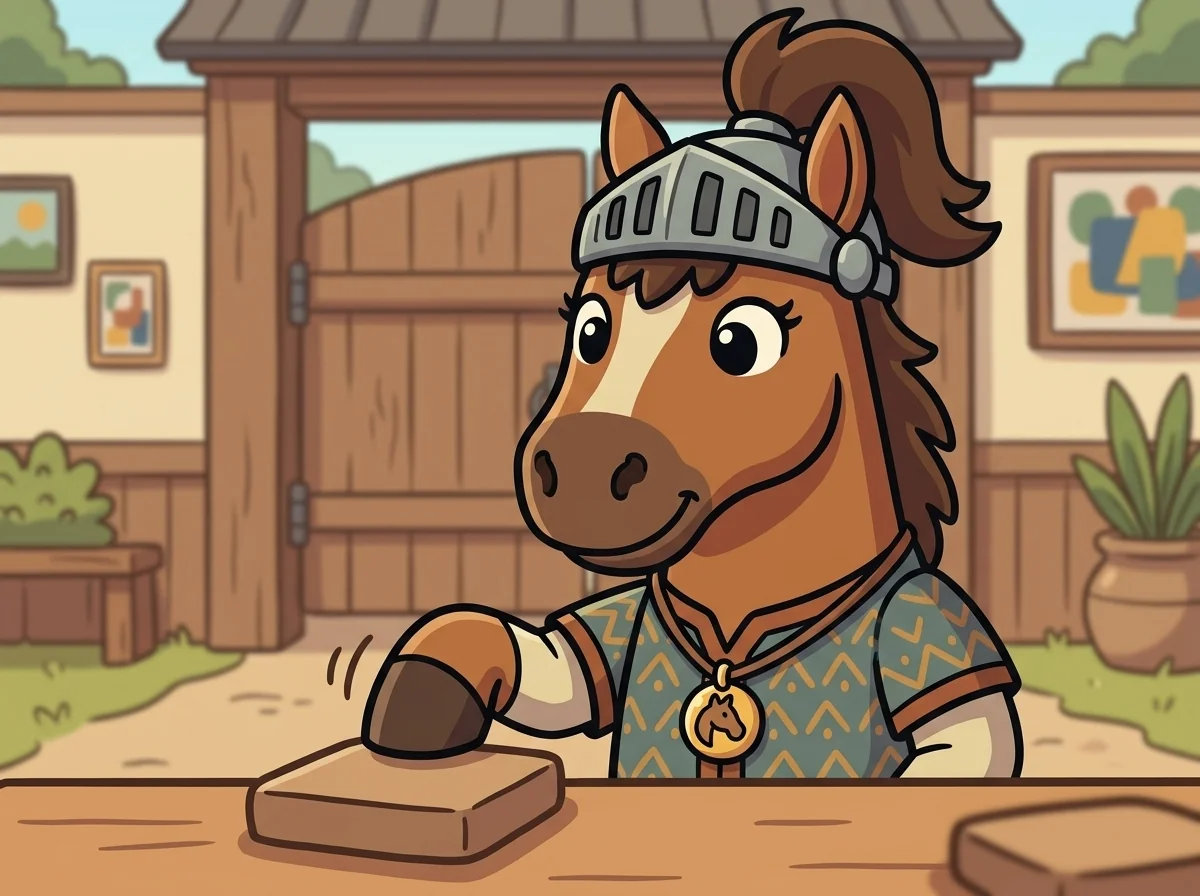
When Lu turned twelve, she packed her small cloth bag and walked up to General Mei's academy. The air near the mountain gate smelled of cedar resin and wet autumn leaves. The academy trained the finest strategists in the province, and Lu wanted to study where paths were taken seriously.
General Mei met her in the courtyard beside a long stone table. The general was a tall crane whose grey feathers were trimmed with exact neatness. She did not ask Lu about her family or her tournament record. She simply set out two wooden pieces on a practice board.
"Show me how your horse moves," General Mei said.
Lu did not explain the rule with words. Instead, she picked up a smooth stone from a nearby tray and set it directly in front of her horse. Then she folded her hooves into her sleeves and waited.
General Mei raised an eyebrow. "Go on," the general said. "Move the horse."
"I can't," Lu said calmly. "Not that way. The stone sits on the square my first step passes through."
"The target square is completely empty," Mei noted, pointing to the spot two squares away.
"The target doesn't matter if the gate is shut," Lu replied. She reached out, moved the stone aside, and then slid her horse forward and diagonal with a crisp, decisive click. "The move was never wrong. The road was just closed. Move the block, and the road opens."
General Mei studied the two pieces for a long moment.
"Most beginners learn every move a piece can make, and forget the one thing that stops it," Mei said slowly. "You learned the stopping first."
"The stopping is the interesting part," Lu said.
General Mei smiled, a small curve at the corner of her beak. "You belong here."
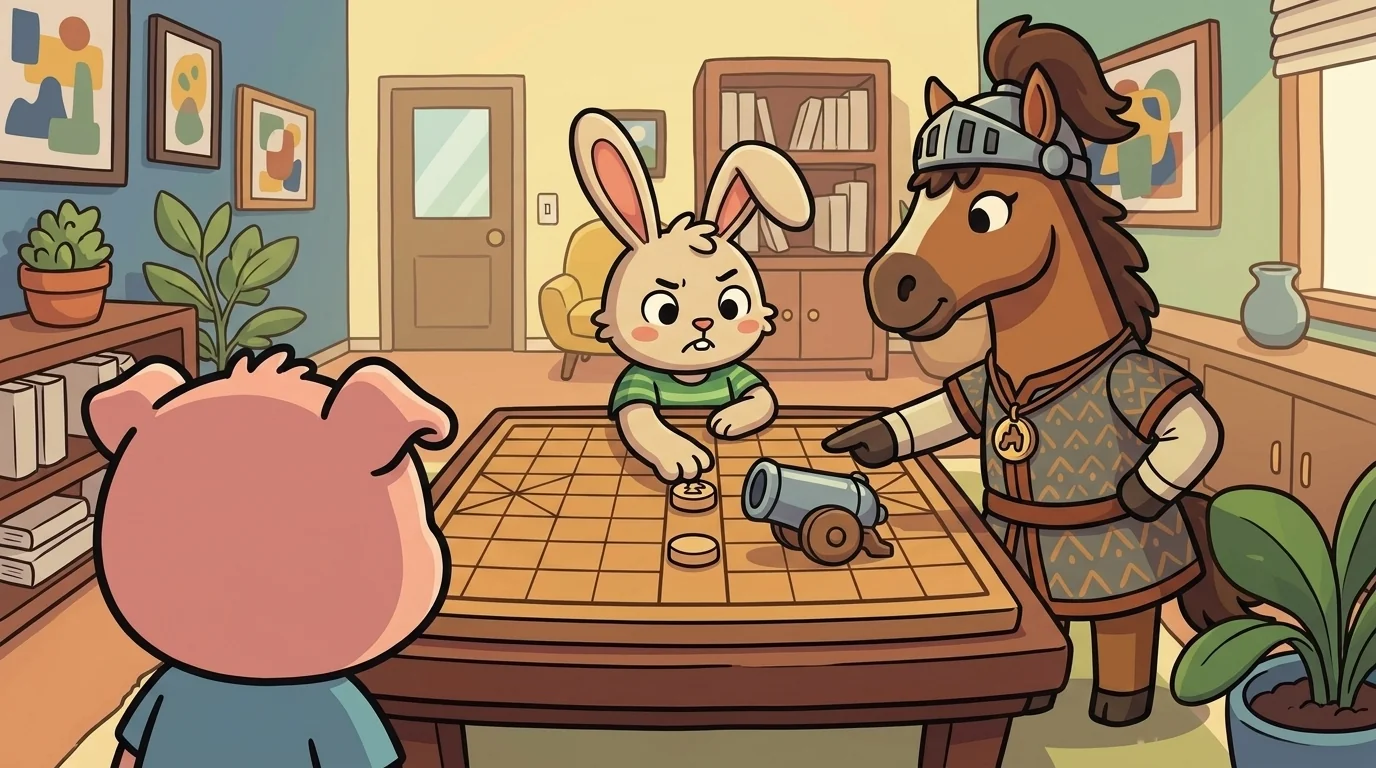
Within a few months, Lu's corner of the academy hall became a popular spot for students who moved too quickly.
One damp afternoon, a young rabbit student named Pip came storming across the polished floor. His long ears were flattened tight against his head in frustration. He had been trying the same capture over and over, and the tutor kept stopping him.
"I made the exact L-shape!" Pip complained, his nose twitching angrily. "One straight, one diagonal! I did it exactly right and it's still wrong!"
Lu recognized that flat-eared look instantly. She had worn it herself.
"Set it up for me," Lu said quietly.
Pip arranged the wooden pieces with quick, jerky movements. He placed his horse in the center grid and his target piece two spaces away.
"Now," Lu said before Pip could touch his piece again. "Put one hoof on the square your horse would step through first. The straight step, before the diagonal."
Pip reached out his paw. He hovered over the empty-looking space directly in front of his horse. Then his paw went motionless. Sitting on that exact square was one of his own pieces.
He went very still.
"Oh," Pip whispered.
"There it is," Lu said gently. "The road was closed the whole time. Your move was perfect. It just wasn't available." She nudged the blocking piece to a new spot. "Try it now."
Pip made the move. His horse landed on the target square with a clean, satisfying snap. He let out a breath he had been holding for an hour.
"So it's not a rule about the knight," Pip said, working it out. "It's a rule about the square in front of it."
"That's the whole craft," Lu said. "Check the in-between square before you believe the jump is legal. Block the road, and the horse is stuck—no matter how good the landing looks."
Later, when the corner had emptied out, Pip came back with a smaller, quieter question.
"When you check the in-between square," Pip asked softly, "and you have to give up a move you really wanted... doesn't it feel bad? Like you lost something?"
Lu looked down at the grid, tracing the carved line with her hoof. She remembered the hot-faced day at the market, the old horse, and the long walk home in the cold.
"It used to," Lu said. "The first time, it felt awful—like being caught, like being clever and wrong at the same time." She rested her hoof on the square between two pieces. "But now, when I stop and check the road, it feels like the opposite. It feels like slowing my breath. Like I'm not going to get caught this time, because I already looked."
She smiled at the young rabbit.
"The pause isn't losing something. The pause is the safe part."
Pip nodded slowly, his long ears lifting back up into the air. Lu watched him head back to his game, feeling that same calm, steady truth all the way down to her hooves. The careful, in-between moment—the one everybody rushed past—was the single step that kept you standing.
The CannonTales ensemble
Knight Lu is part of CannonTales's distributed-narrative cast. Each character embodies a different curricular primitive; together they teach the full subject.
-

General Zhang
Decisive command — clear orders, clear outcomes
-

Elephant Wei
Powerful straight-line attack pattern
-

Soldier Jin
Forward-advancing infantry — pawn structure
-
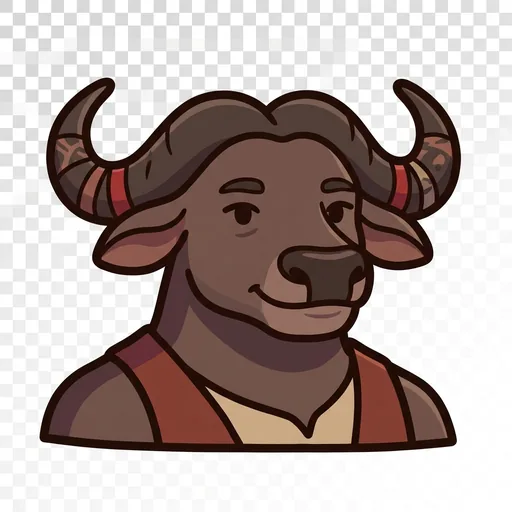
Chariot Che
The chariot — straight-line power that sweeps the whole open file
-
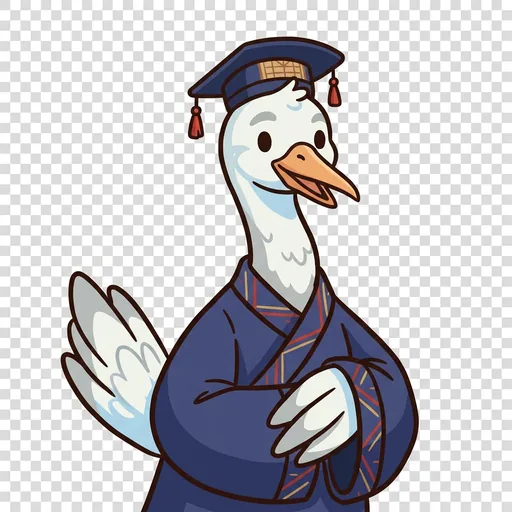
Advisor Shi
The advisor — palace-bound diagonal guard who never leaves the General
-

Marshal Shuai
The General piece — the calm center the whole game protects
-

River Chu
The central river — the boundary that divides the board and transforms soldiers who cross it
-
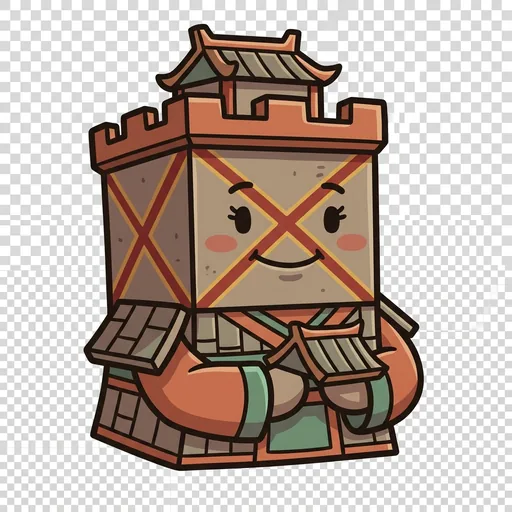
Palace Gong
The palace — the fortress home that shelters the General and advisors
-
Sightline
The flying-General rule — the watcher of the invisible line between the two Generals