
Ballast
STABILITY / CORNERS (Reversi/Othello) — in a game where pieces flip colour constantly, a *corner* can never be flipped — it has no two sides to be trapped between. A corner is *permanent.* From a stable corner, whole edges become stable too. The deepest Othello skill is valuing what *lasts* over what looks big right now, because a board full of your colour can flip in one move — but a corner is forever.
Loading audio…
Press play to listen along. The line being read lights up as you go.
Show full transcript
Loading transcript…
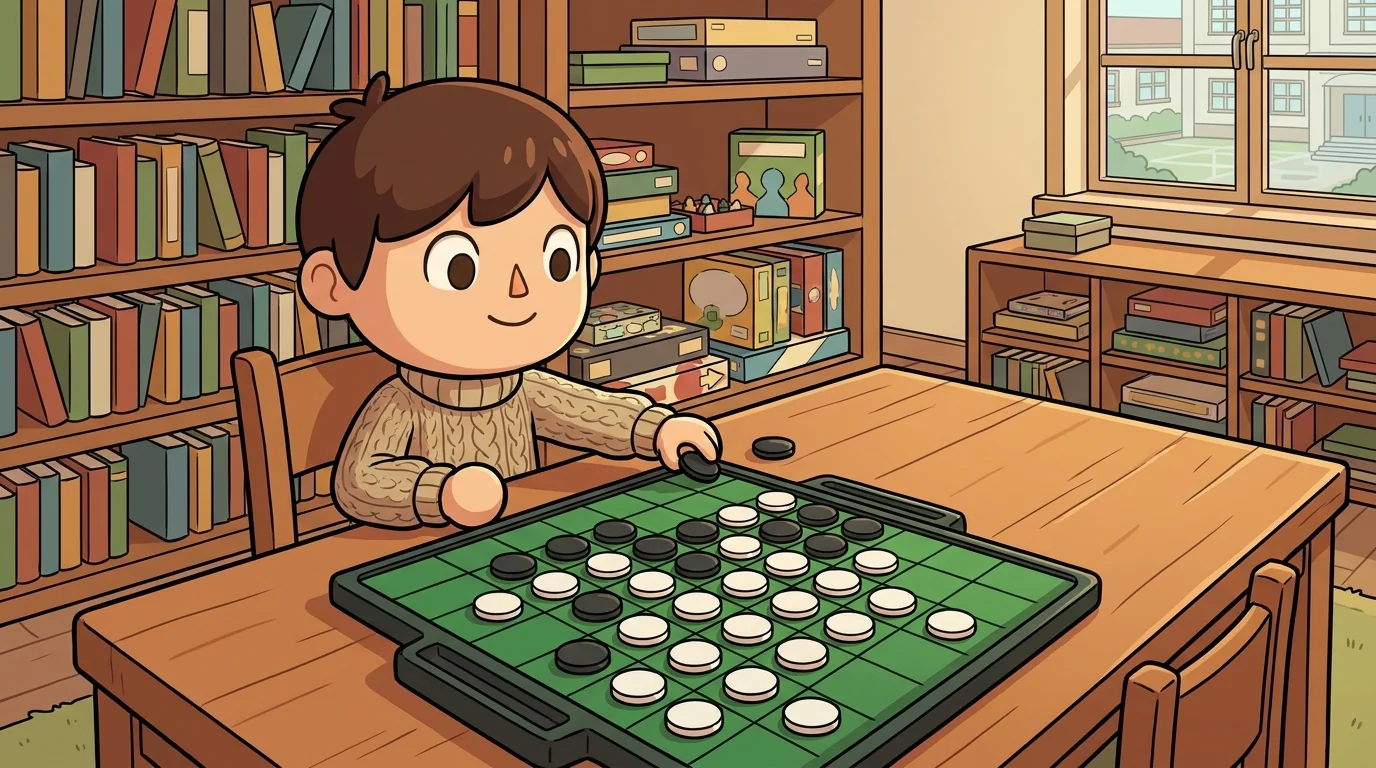
Ballast had watched more players lose while "winning" than anyone else at the GridForge academy. The experience had made him remarkably calm.
He sat at a low oak table in the center of the workshop, where an eight-by-eight green felt board rested between him and Maya. The game was Reversi, though most kids around the academy called it Othello. The rules were simple enough to learn in two minutes. Two players took turns placing double-sided discs that were black on one side and white on the other. When you trapped a row of opposing discs between two of your own, those discs flipped color.
Maya was twelve years old and full of restless energy. She slapped a black disc onto square E6, flipping eight white discs in a single diagonal line. The green board suddenly burst into a sea of dark plastic.
"Thirty-four to twelve!" Maya announced, leaning back with a triumphant grin. "I’m running the whole board, Ballast, and you’re almost wiped out."
Ballast did not look wiped out as he reached into his tray for a single white disc. His fingers were steady and unhurried, ignoring the giant clump of black pieces in the middle. Instead, his eyes stayed focused on the top-left corner at square A1.
"It feels good to flip eight pieces at once," Ballast said gently. "It feels like total control."
He placed his disc cleanly onto square A1, where it landed with a quiet, solid click.
"Now," Ballast said, leaning forward. "Try to flip that one back."
Maya blinked and leaned over the grid, hovering her black disc over the surrounding squares. She checked square A2, then square B1, and finally square B2. Her forehead wrinkled as she traced the grid lines with her finger.
"Wait," she said slowly. "I can't get behind it."
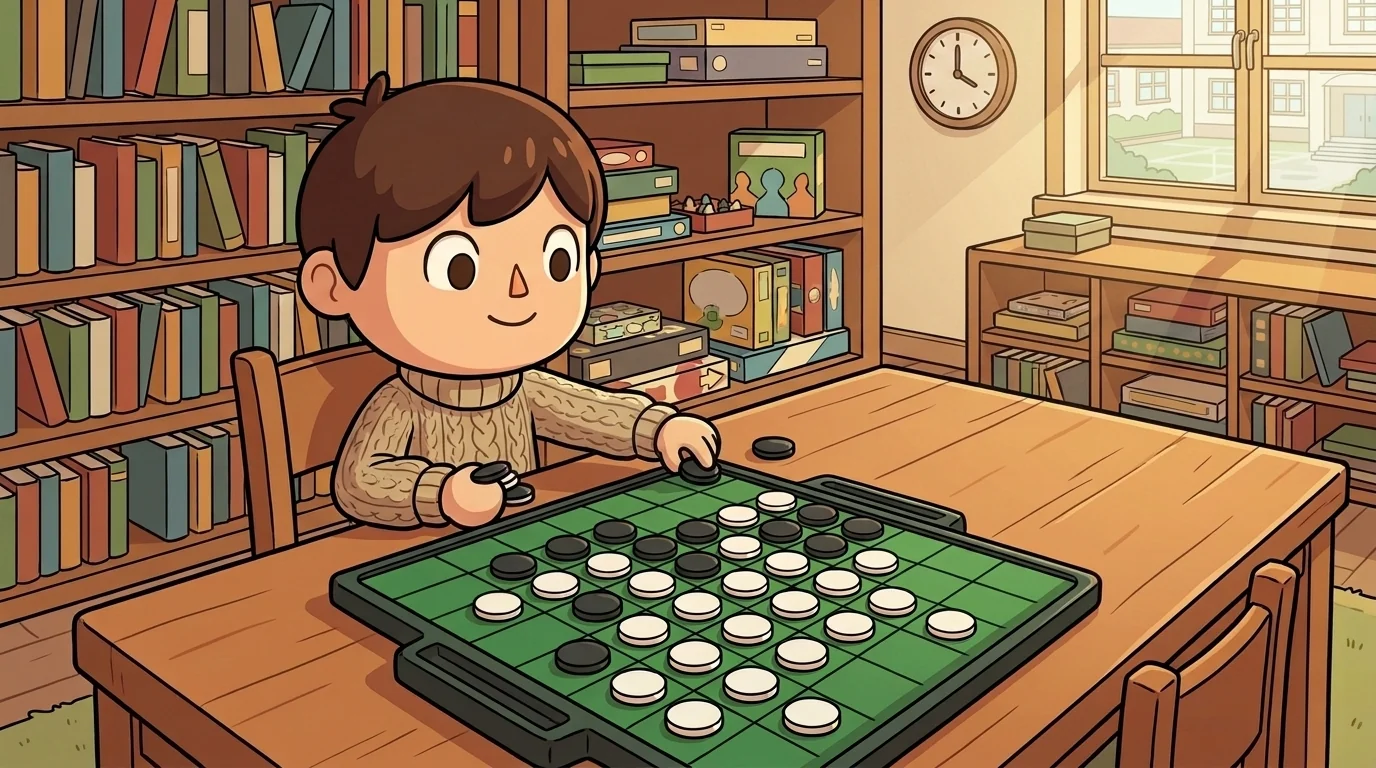
"You can never get behind it," Ballast told her with a nod. "A corner square has no opposite side, so it cannot be outflanked from anywhere."
He tapped the white disc on A1 with his index finger.
"This piece stays white until the game ends, because it has no two sides to be caught between."
Maya stared at the single white square surrounded by her vast dark army. "So that piece is just... yours?"
"That piece is owned," Ballast corrected softly. "Everything else on this board can change color a dozen times before we finish, but this corner is mine forever."
He gestured toward her sprawling collection of black pieces across the center grid.
"Those thirty-four pieces you just flipped feel like power, but you don't own them yet. You're just renting them."
Ballast had grown up watching people chase things that didn't last. He had seen the loudest friend groups dissolve long before the end of spring. He had watched kids fight over the trendiest toy, only to forget it a week later. Early on, he noticed a strange pattern in the world around him. The biggest, shiniest, most dramatic things were often the least stable. They were here today and flipped tomorrow. Meanwhile, the small, quiet, unglamorous things were the ones still standing when the dust cleared.
That realization had made him deep and patient. Flashy players at the academy often mistook his patience for laziness or a lack of drive. They thought he wasn't trying hard enough because he didn't launch huge, loud attacks. They were wrong, because Ballast was playing for the things that stayed.
On his very first day at GridForge, Gridley had set up a diagnostic board to test his thinking. Gridley was the head host, always searching for teachers who understood deep positional truth. The diagnostic board looked disastrous for Ballast at first glance. Ballast had only nine white discs visible, while the black discs numbered fifty-five.
"Explain to me why you aren't losing," Gridley had challenged, crossing his arms over his chest.
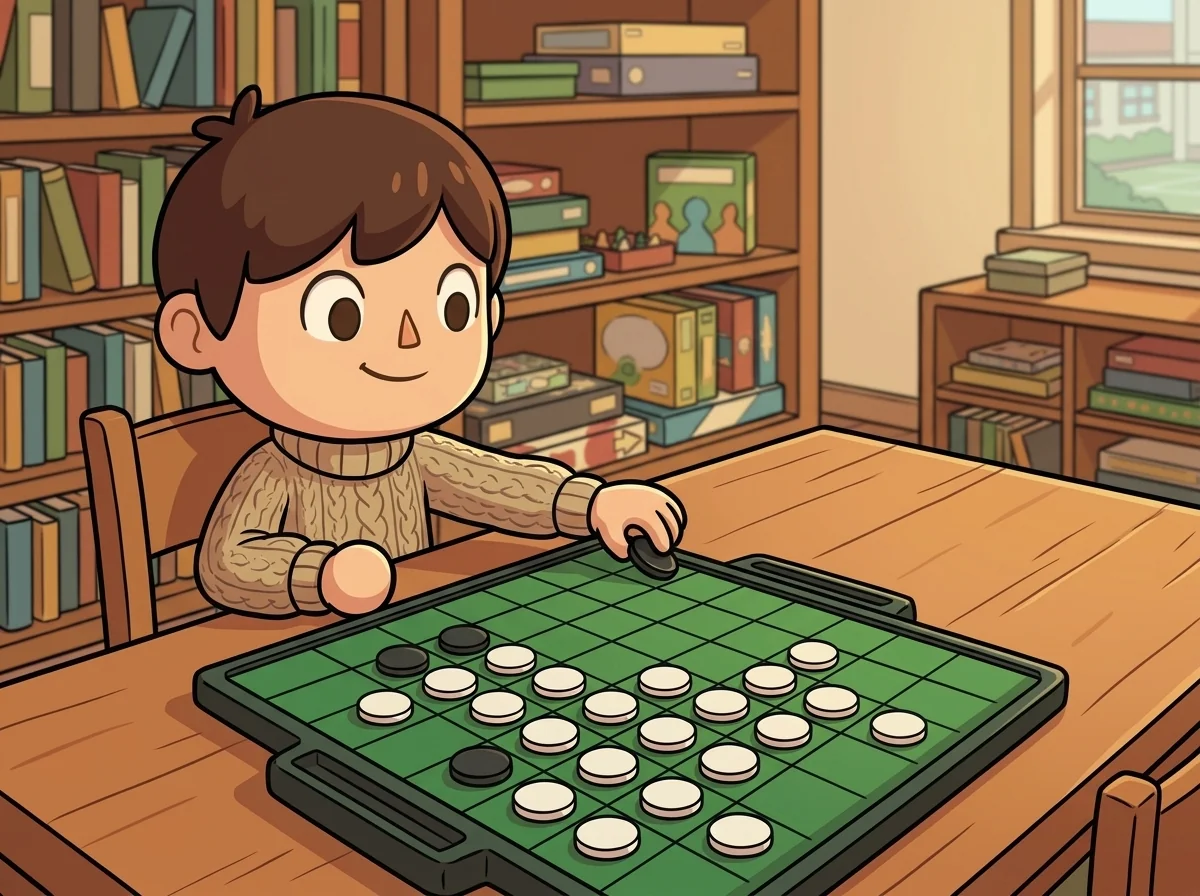
Ballast hadn't hesitated as he pointed at the board's four white corners. Then he traced the outer edges connecting those four safe points. A line of white discs stretched securely between top-left and top-right. Because the corners belonged to him, no opponent could ever trap that top row. Those edge pieces were fully anchored and completely safe.
"Count the total pieces right now, and I look ruined," Ballast told Gridley that day. "But count the pieces that can never be flipped back, and I hold four corners plus fourteen anchored edges."
He pointed at Gridley’s huge black cluster in the middle.
"Your pile is giant, but it has nowhere safe to hide, so your center will collapse on my next two turns."
Gridley had nodded slowly, a thin smile touching his lips.
"You didn't count the board," Gridley said quietly. "You counted what would survive it."
Back at the workshop table, Maya was learning that exact same truth the hard way. Three turns after Ballast took square A1, the flow of the game shifted sharply. Maya discovered a painful reality about holding a giant pile of pieces in the center. A large center cluster meant her discs were touching empty spaces all across the grid. Every empty space gave Ballast a new target to land on. Her huge footprint gave her opponent maximum opportunity while shrinking her own options.
"I don't have many good moves left," Maya muttered, staring at her dwindling tray. "Every square I pick lets you take another edge piece."
"That is the trap built into the game," Ballast explained smoothly. "When you flip half the board early, you feel like you are winning, but you are actually handing your opponent moves."
Flank walked past the workshop table carrying a heavy wooden crate of gear tiles. Flank was the academy's mechanics instructor, and he loved big, dramatic plays.
"Still playing like a turtle, Ballast?" Flank teased, stopping to look at the green board. "Maya's got black discs covering three-quarters of the board!"
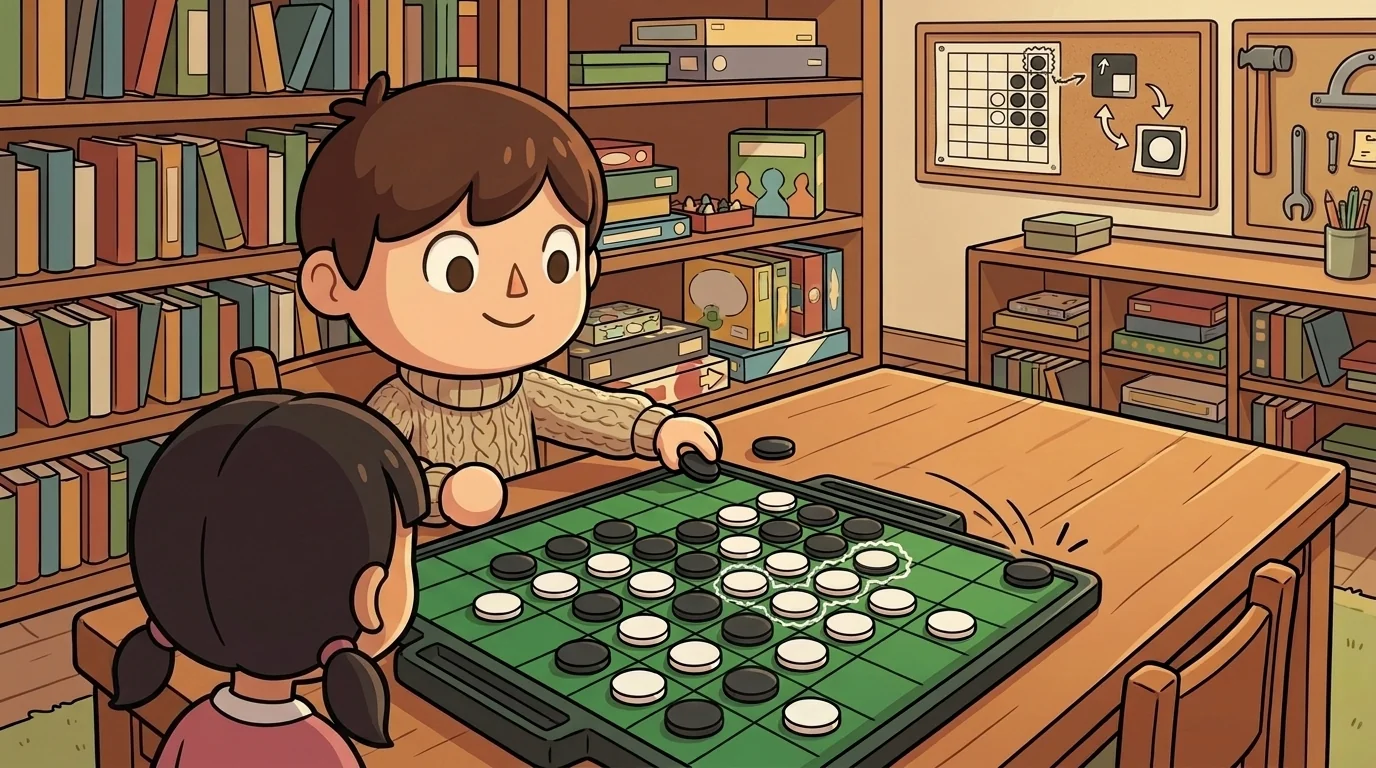
"Look closer at the edges, Flank," Ballast suggested mildly.
Flank leaned down, squinting at the grid until his expression changed. Ballast had secured two corners and built a solid wall of white between them. Maya had no interior moves left and was forced to play next to the bottom-right corner.
"Ah," Flank admitted, scratching his jaw. "You set a ladder trap."
"I didn't force her," Ballast said. "Her own giant pile ran out of room."
Mobi, the mobility instructor, stepped up beside Flank and smiled down at Maya.
"See what happened, Maya?" Mobi asked softly. "By keeping his own piece count small, Ballast kept his outer surface small, which preserved his freedom to move."
"He had ten legal moves while you only had two, and both of yours handed him corners."
"It feels unfair," Maya admitted, though she was fascinated by the board state. "I was crushing him three minutes ago!"
"You were winning by count, not by position," Ballast explained. "A piece count mid-game is just a distraction, because position is what pays out at the end."
Maya picked up her next disc, holding it carefully above square C7. "So should I only ever go for corners?" she asked. "Isn't that too slow? What if someone takes the middle and locks me out?"
"A corner isn't valuable just because it sits on the edge," Ballast replied. "It's valuable because it gives you stability, creating a square that can never be taken back."
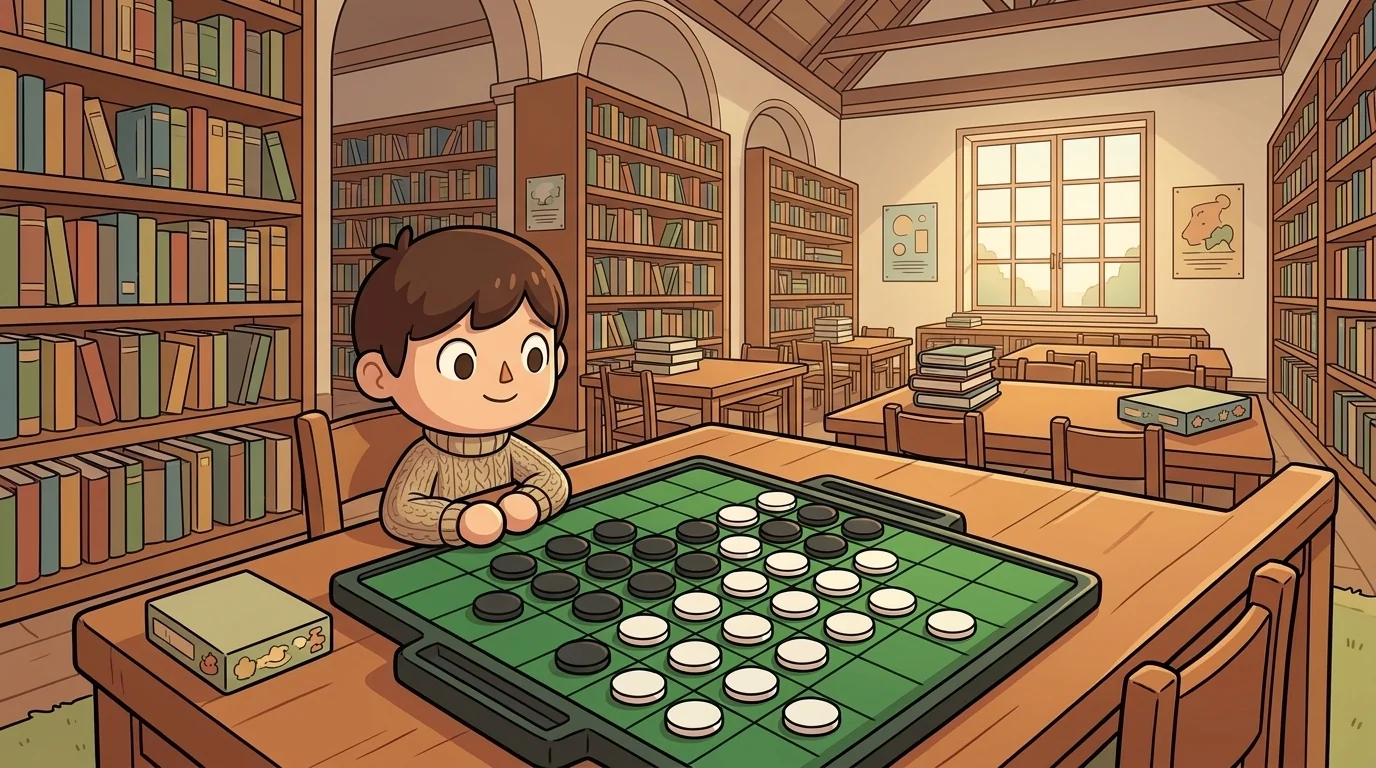
He leaned across the table so Maya could see his calm eyes.
"The real skill isn't grabbing corners mindlessly," he told her. "The real skill is asking yourself on every single move: how much of this is permanent, and how much is borrowed?"
He pointed to a space near the center grid.
"Sometimes a center move is brilliant because it sets up a trap or denies a corner to your opponent. And sometimes keeping your pile small is the strongest play on the board."
Maya looked down at the green felt and placed her disc on C7 with a quiet sigh. Ballast immediately placed his next white disc on the bottom-right corner at square H8.
From that single corner, a wave of white flipped clean across the bottom row. One locked row connected to the next like falling dominos. The stable edge swept upward, turning Maya’s borrowed black pieces back into white, one after another.
When the final space was filled, Ballast didn't boast, cheer, or celebrate. He simply counted the board out loud with Maya.
"Forty-two white," Ballast said gently. "Twenty-two black."
Maya stared at the board for a long moment. The dark army she had built early in the game was completely gone. Only four solid corners and the anchored edges remained, held firmly by white discs.
"I spent all my turns building a castle made of sand," she said quietly.
"Most players do," Ballast said, offering her a warm, encouraging smile. "Until they learn to want the quiet, permanent move more than the loud, temporary one."
That evening, as Maya walked home across the academy grounds, she thought about the game. She thought about the noisy chatter in the cafeteria and friends who vanished when trouble started. She thought about the flashiest gadgets that broke after a single week. For the first time, she started looking closely at her own life. She began separating what was borrowed from what was truly hers. And quietly, without making a big fuss, she started taking care of the corners.
The GridForge ensemble
Ballast is part of GridForge's distributed-narrative cast. Each character embodies a different curricular primitive; together they teach the full subject.
-
Arbor
The game tree: every position branches into the moves that follow
-

Causeway
The bridge: a virtual connection that cannot be cut in Hex
-
Domino
Forcing sequences: chaining threats to keep the initiative in Gomoku
-

Flank
Territory flip: capturing a line of pieces in Reversi
-

Mobi
Mobility: keeping more moves available than your opponent
-

Oddwin
Parity: who-moves-last, the key to Dots-and-Boxes
-

Rowan
Connection: extending a chain of your pieces toward a win
-

Twain
The fork: one move that makes two threats at once