
Mobi
MOBILITY (Reversi/Othello) — the counterintuitive Othello truth: having *more pieces* mid-game is often *bad,* because it gives your opponent more edges to attack and leaves you fewer safe moves. The deeper measure is *mobility* — how many good moves *you* have versus how many *they* have. Play to keep your own options open and shrink theirs, and eventually they're forced to hand you the squares you want.
Loading audio…
Press play to listen along. The line being read lights up as you go.
Show full transcript
Loading transcript…
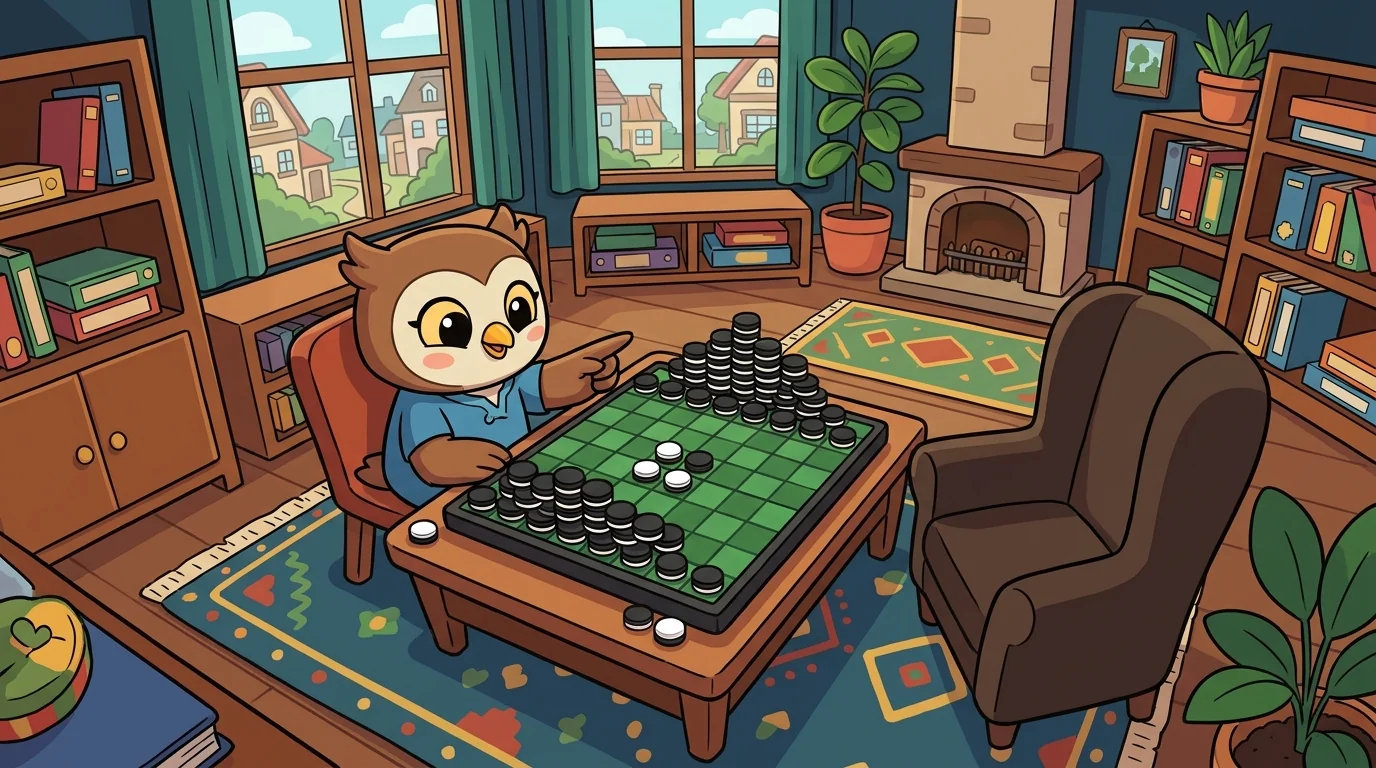
Mobi wins at Othello by wanting less. That single fact makes zero sense to anyone until they have lost to her three times in a row.
On a Tuesday afternoon in her GridForge workshop, the green felt table was covered in glossy plastic discs. Across the board sat Leo, a first-year student with dusty sleeves and a grin that was rapidly fading. Leo had spent twenty minutes gleefully flipping long rows of black pieces. His side of the box was empty. His pile on the board was huge, dark, and impressive.
Mobi sat quietly on her stool, her small pile of white pieces tucked tightly into the center four squares. She watched one single number that beginners never think to count. She counted how many moves each player had left.
"You have twenty-four pieces," Mobi agreed pleasantly, resting her chin on her hand. "I have seven. You look like you're winning by a mile."
Leo shifted in his chair and adjusted his spectacles. "I am winning by a mile."
"In about four moves," Mobi said, pointing at a blank corner, "you will have no good squares left. You will be forced to give me that corner." She offered him a tiny smile. "I don't want more pieces right now. Pieces flip back and forth. What I want is more choices."
Leo frowned at the board. He looked at his black wall, then at the empty edges. A sudden silence fell over the workshop table.
"When you run out of good moves," Mobi explained, "you have to make a bad one. A forced bad move is how this game is really lost."
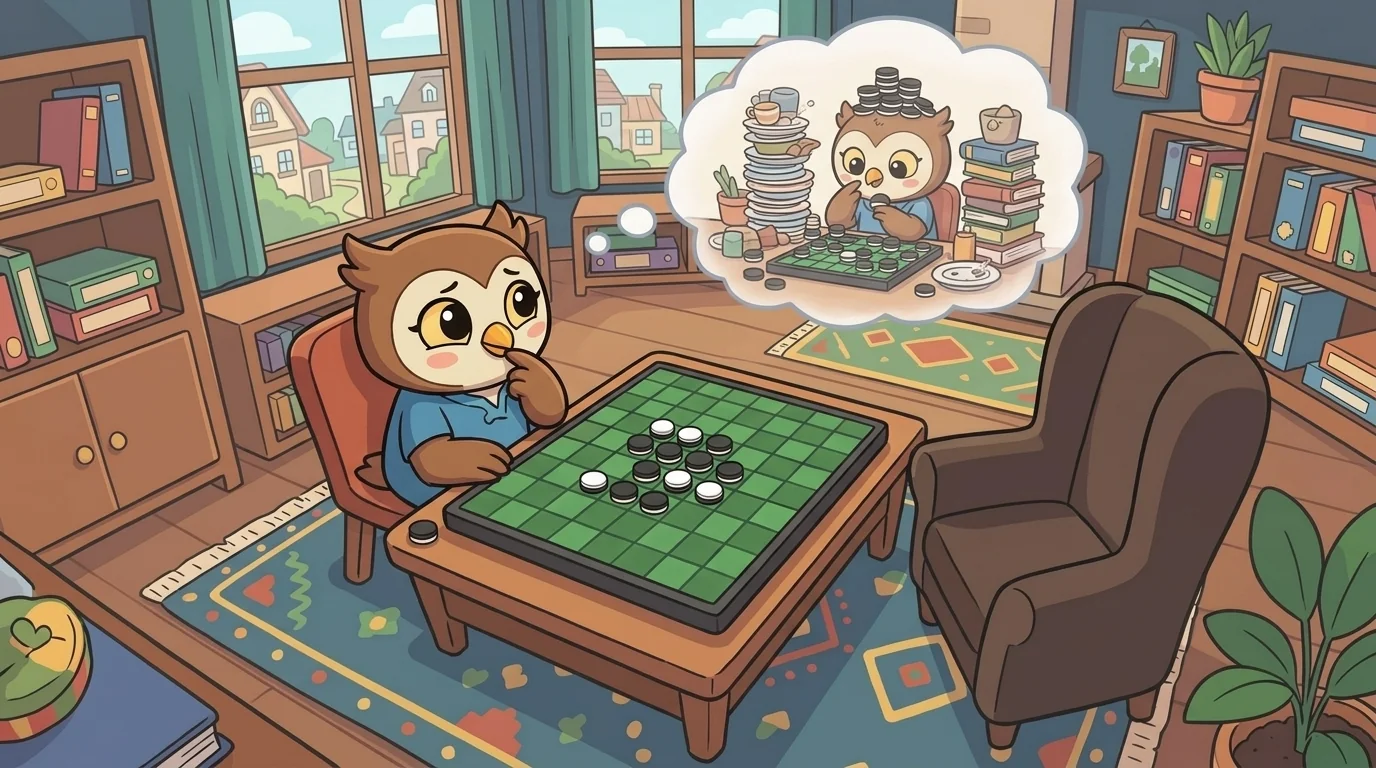
Mobi learned that lesson long before she ever touched a wooden game board. As a kid, she used to say yes to every single club, sport, and project that came her way. Her bedroom floor was a swamp of half-built telescopes, soccer cleats, and library books. Her schedule was jammed tight from six in the morning until ten at night.
On Sundays, her dinner plate looked the exact same way. She would stack mashed potatoes, pot roast, green beans, and dinner rolls into a towering mountain. Then the gravy would spill over the rim and turn her peach cobbler into soggy soup.
She had felt trapped by her own good fortune. She spent every evening rushing between appointments, constantly panicked, with zero room to breathe. She slowly realized that having a lot of stuff and having real freedom were often opposites. The more things she grabbed, the fewer real choices she had left.
The people who seemed most free wasn't the ones with the biggest piles. They were the ones who kept room to move.
When Gridley invited her to the GridForge Academy, he wanted that exact lesson taught to every new builder. Gridley was the head host, and he hated watching students mistake noise for progress. On her very first morning, Gridley set up a practice board. He handed Mobi six white pieces and took twenty black ones for himself.
"Tell me why you shouldn't surrender right now," Gridley had challenged, leaning over the oak table.
Mobi didn't count the plastic discs. She tapped the empty green squares instead.
"You have twenty pieces," she said, counting out loud. "You have four squares where you can safely land. I have six pieces and eleven open paths."
Gridley watched her closely as she tapped the border.

"In three turns, your four safe squares are gone," Mobi said. "Then the rules force you to play a terrible square. You'll hand me an edge or open a corner. You have nowhere to hide, but I have plenty of room."
Gridley smiled softly and sat back in his tall leather chair. "You didn't count what you have," he said quietly. "You counted what you can still do."
That core idea—the measure of mobility—became her entire teaching method.
Back at the workshop table, Leo stared at his trapped black pieces. Three turns later, just as Mobi had predicted, Leo ran out of interior squares. He stared at the four blank corners of the board in mounting horror.
"I have to play here," Leo whispered, pointing to a square next to the top-right corner. "If I play there, you take the corner on your next turn."
"That is correct," Mobi said softly. "The rules say you must move if you can. Because you filled up the middle too fast, your only legal move hands me the strongest square on the board."
Leo placed his disc with a quiet click. Mobi immediately dropped a white piece directly into the corner pocket. From that single corner, a white diagonal sliced across the board, flipping eleven of Leo's black pieces in one smooth sweep.
Leo threw his hands up in defeat. "I flipped almost the whole board five minutes ago! How did I end up boxed in?"
Mobi reset the green felt board, clicking the plastic pieces back into their starter grid.
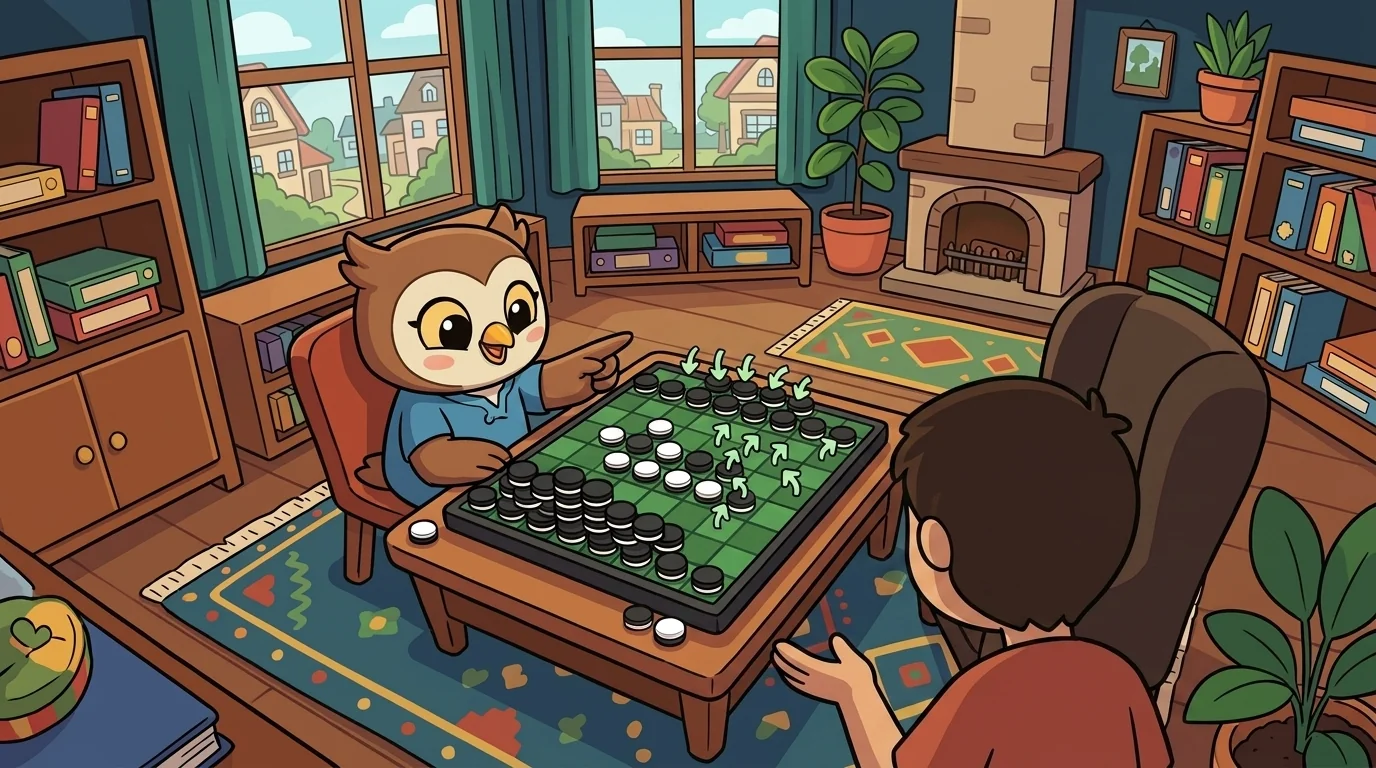
"You flipped the whole board," she said. "That means almost every square was full. Full squares are used-up choices. By the end, you had a huge pile of pieces and nowhere good to move."
She placed four starter pieces in the center.
"Keep your pile small," she said. "Play toward the center. Leave the edges alone as long as you can. Edges are heavy commitments. Watch your opponent's move count shrink while yours stays big."
Leo took a deep breath and tried it. For the first ten turns, playing for fewer pieces felt completely wrong. His gut screamed at him to flip every black disc he saw. But he gritted his teeth, kept his moves tucked into the middle, and watched Mobi's available moves dwindle.
On turn eighteen, Mobi looked down at the board and let out a dry laugh. She was trapped. She had to give up the bottom-left corner.
Leo's eyes widened as the strange logic clicked into place.
"The trap," Mobi told him, "is that the winning-feeling move and the actual winning move are opposites for most of the game. Your gut wants the big flip. Your gut is measuring the wrong thing. Count moves, not pieces."
Leo slid his winning piece into the corner pocket and flipped four white discs to black. He sat back, thoroughly fascinated, but a small wrinkle remained on his forehead.
"But it flips at the end, right?" Leo asked, leaning forward over the board. "At the very end of the game, whoever has more pieces wins. So when do I switch from wanting fewer to wanting more?"
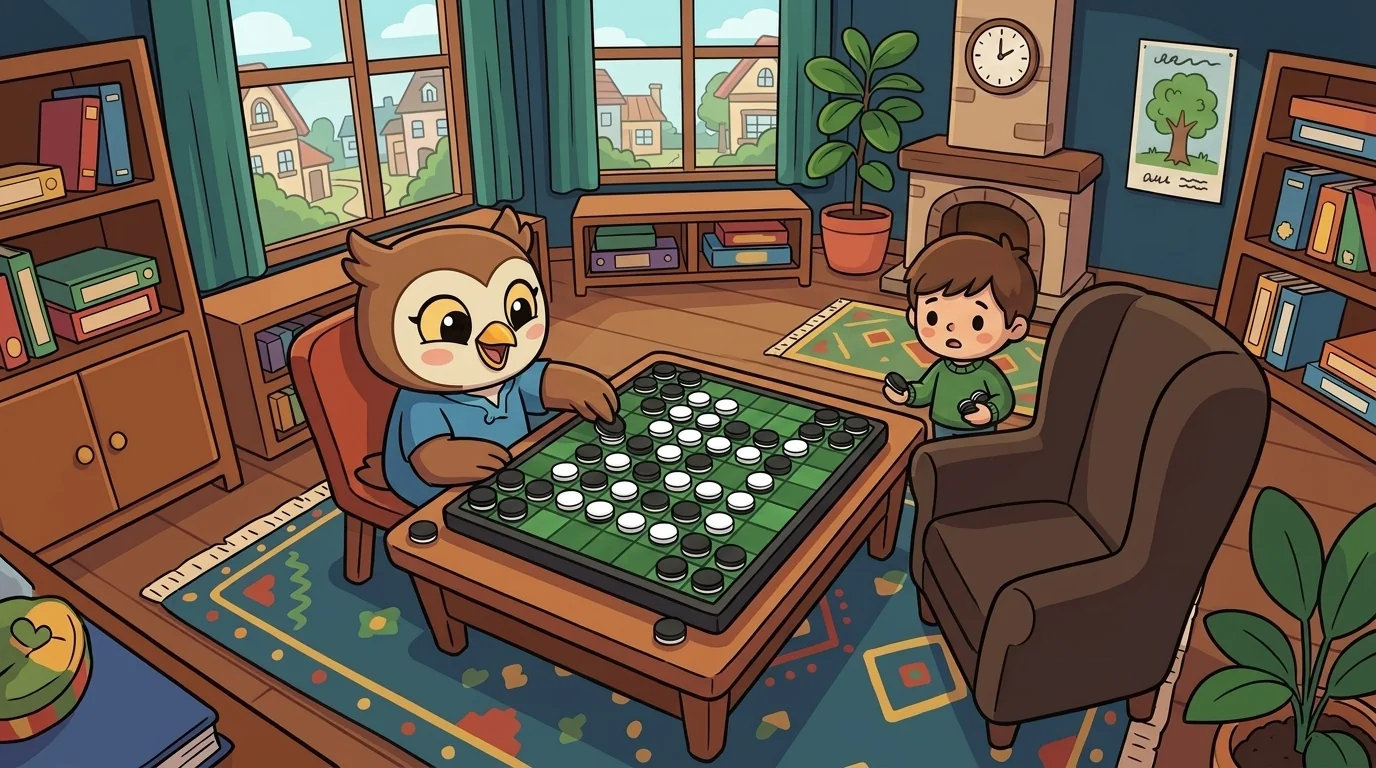
Mobi grinned. That was the exact right question.
"The endgame flips the rule on its head," she said, leaning in. "Knowing when to switch is the whole art. All through the middle of the game, mobility is everything. You keep your options open and starve theirs. But in the last handful of moves, when there are no more good choices to protect, it becomes a pure numbers game."
She tapped the edge of the board with her fingernail.
"In those final turns, you flip everything you can," Mobi explained. "The board is about to freeze, and whatever color a square is when the board fills up is final. So the skill is simple: play for choices in the middlegame, then switch to playing for count in the endgame."
"And the player who kept their choices longest?" Leo asked.
"Arrives at that switch holding the corners," Mobi said. "The corners make the final flip go your way. Patience buys you the position. The position buys you the pieces. But if you grab the pieces first, you never get the position. You lose while feeling like a winner."
Leo packed his game set into his canvas bag and walked out into the bright afternoon sun. He walked past the academy dining hall, where students were piling their trays high with fried food and pastries.
He walked back to his dormitory room, sat down at his desk, and looked at his bookshelf. He had eleven unread novels stacked on his nightstand and four different club sign-up sheets pinned to his corkboard.
Quietly, Leo took down three of the sign-up sheets and tossed them into the wastebasket. He sat back in his chair, stretched his legs out into the empty room, and enjoyed the sudden, wonderful feeling of having room to move.
The GridForge ensemble
Mobi is part of GridForge's distributed-narrative cast. Each character embodies a different curricular primitive; together they teach the full subject.
-
Arbor
The game tree: every position branches into the moves that follow
-

Ballast
Stability and corners: the unflippable pieces in Reversi
-

Causeway
The bridge: a virtual connection that cannot be cut in Hex
-
Domino
Forcing sequences: chaining threats to keep the initiative in Gomoku
-

Flank
Territory flip: capturing a line of pieces in Reversi
-

Oddwin
Parity: who-moves-last, the key to Dots-and-Boxes
-

Rowan
Connection: extending a chain of your pieces toward a win
-

Twain
The fork: one move that makes two threats at once