
The Solved Board (Gridley · Arbor · Rowan)
THINKING AHEAD → SOLVING — the game tree connects a human skill to a computer one. Rowan plays a move now. Arbor climbs the tree of futures a few branches deep to choose it well. And a game is "solved" when someone climbs the *whole* tree — Gridley's "how a game gets solved" story. Human thinking-ahead and machine game-solving are the *same act* at different depths: explore the tree, assume best play, back the value up.
A story read by The Solved Board (Gridley · Arbor · Rowan)
Loading audio…
Press play to listen along. The line being read lights up as you go.
Show full transcript
Loading transcript…
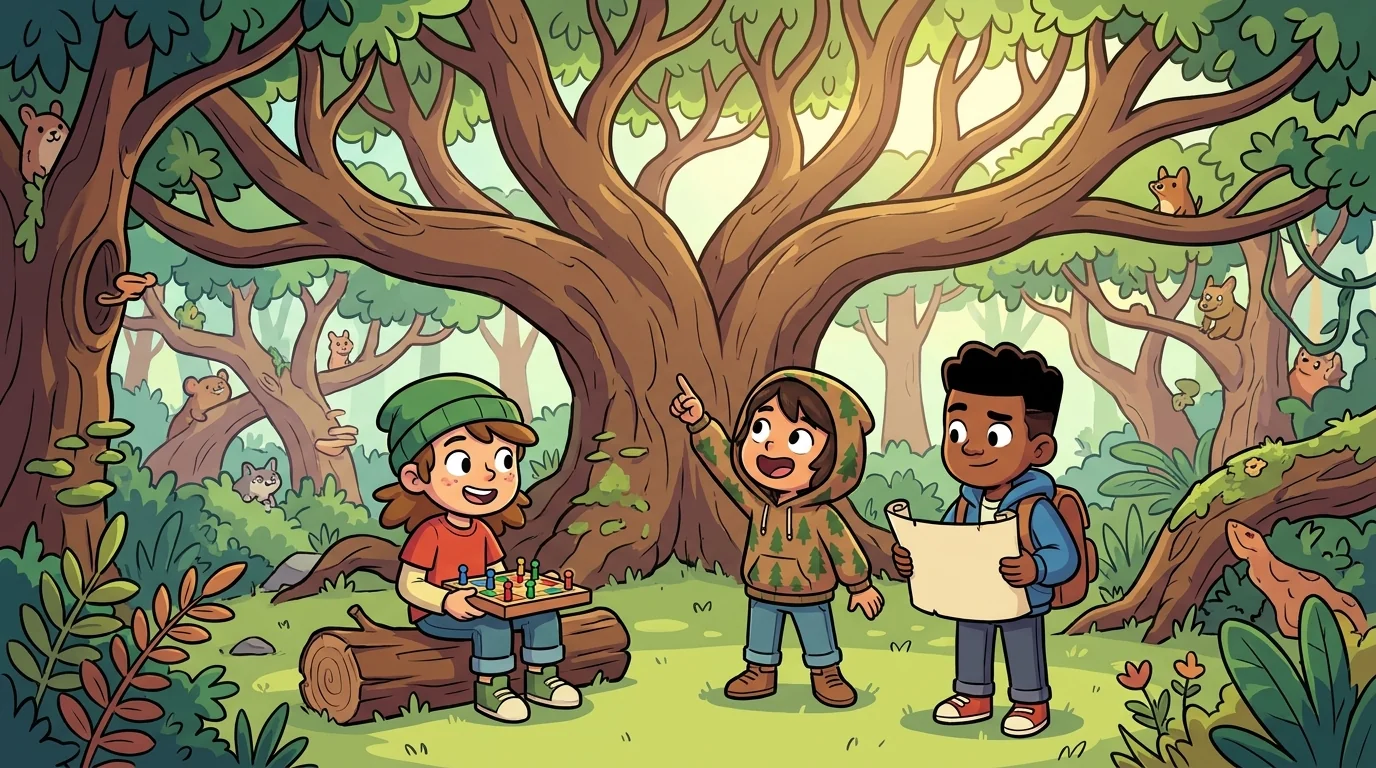
The wooden suggestion box by the workshop door was usually stuffed with jokes and complaints about lunch. Gridley pulled out a square index card written in smudged blue ink and smoothed it flat on the low game table.
"Listen to this," Gridley said, looking at Rowan and Arbor across the wooden grid. "A kid left a question on the board this morning, and it might be the best one all year."
He read the card out loud: "If computers already SOLVED some of these games, why should I bother playing?"
Rowan picked up a yellow plastic checker from the tray and dropped it from hand to hand. The plastic made a dry, hollow clack against his palm. Honestly, he had wondered the exact same thing himself last week. He had watched a video online about a computer beating a world chess champion, and it made playing feel a bit like running a race against a motorcycle. What was the point of trying if the answer was already finished?
Arbor leaned over her spiral notebook, her thumb already dark with graphite dust from her drawings. "Because winning isn't the only reason you play a game," she said without looking up.
"That sounds like something people say right after they lose," Rowan said.
Gridley smiled and set a blue plastic Connect-4 grid on the table between them. "It takes three of us to answer this properly," Gridley said. "The answer lives right in the space between how Rowan plays, how Arbor thinks, and how a machine works. Rowan, you make good moves. Arbor, you climb the tree. I will tell the part about what happens when the whole tree gets climbed."
He gestured at the empty blue frame. "Let's walk from a single move all the way to a solved game, and see if that question still holds up."
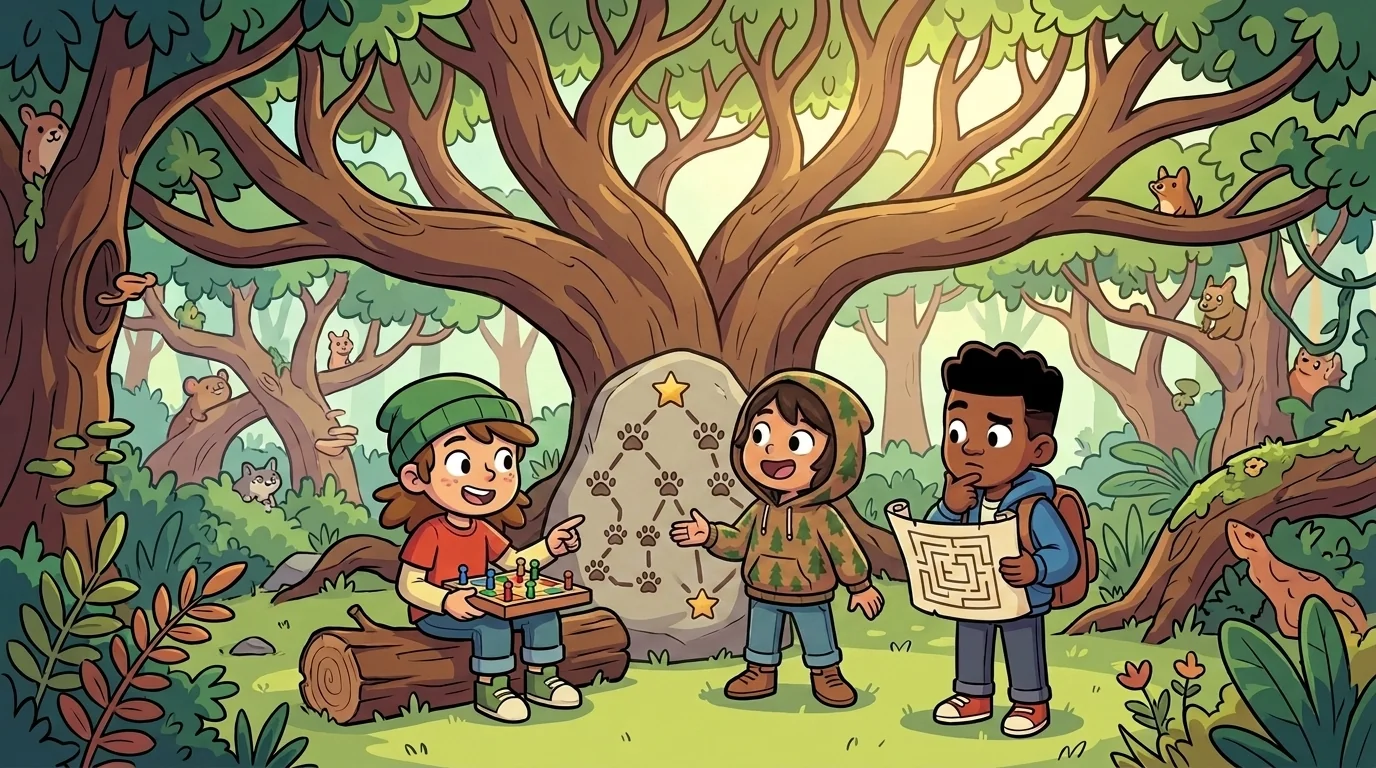
Gridley tapped the wooden tabletop. "Rowan, go first. Be completely honest about how you choose where to play."
Rowan dropped a yellow disc into the center slot of the vertical frame. The plastic checker slid down the track and landed with a sharp snap at the bottom.
"I don't do anything fancy," Rowan admitted, leaning his chin on his hand. "I look at the board right now, I see my checker, and I want to build a line of four. So I make the move that helps my line the most right in this moment."
He shrugged and looked up at Gridley. "I don't map out a dozen different futures in my head. I just play the single best move I can see."
Gridley nodded, entirely unbothered by the simple answer. "And you win plenty of games that way, because seeing the present clearly is a real skill. But tell me, Rowan. How far ahead do you usually look?"
"One move," Rowan said. "Maybe two if I slow down and really pay attention."
"Then watch what happens," Gridley said, turning toward Arbor, "when someone looks five moves into the future."
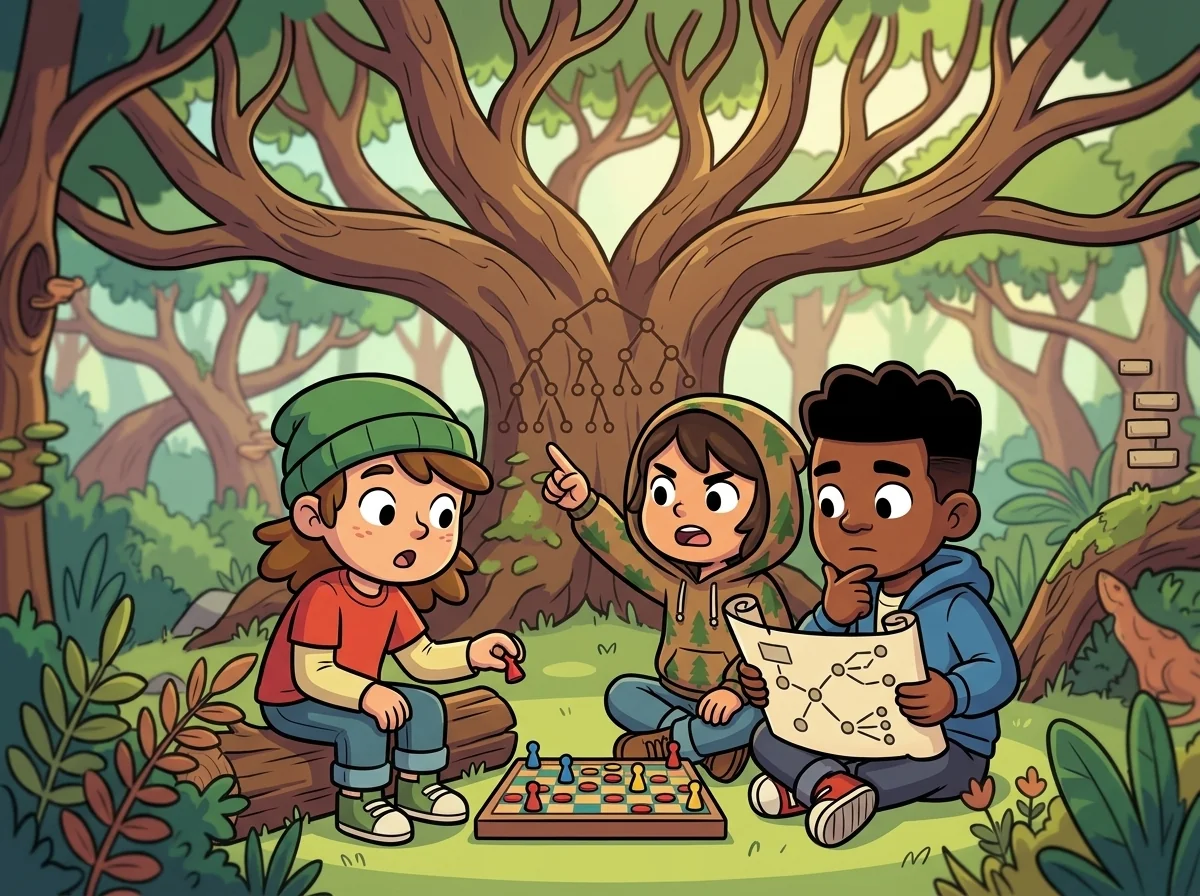
Arbor picked up her mechanical pencil instead of a plastic checker. She clicked the top twice and opened her notebook to a clean white page.
"Rowan stands on the move he is making right now," Arbor said. "I like to climb a little way up the tree of what comes next."
She drew a single dark circle at the top of the paper to represent Rowan's center move. Beneath it, she sketched three thin lines fanning downward like branches.
"If Rowan drops his yellow piece here," Arbor explained, pointing with her pencil tip, "my best reply is to drop a red piece in column four to block his line. That forces him to respond."
She drew two more levels of branches beneath her first response, sketching quick letters for each column.
"If he blocks me there," she continued, "then I can set up a threat on the left side of the board. Domino would love this pattern. It sets up two ways to win at the exact same time, which Twain calls a double threat."
Rowan leaned over her shoulder, watching the pencil lines spread across the page like roots in clear water.
"Did you compute every possible move on the board?" Rowan asked.
"No way," Arbor said. "The tree is far too big for anyone to draw by hand. I pruned the bad branches and ignored the silly moves that make no sense. I just assumed we both play our absolute best at every single turn."
She drew a tiny star at the bottom tip of the fifth branch.
"This path guarantees a win for red," Arbor said. "So I play toward it right now, on turn one."
Rowan stared at her sketch, then looked back at the plastic grid. "You picked the exact same move I would have made," he said slowly. "You dropped your red piece in column four."
"Same move," Arbor agreed with a small grin. "Deeper reason. You picked it because it looked good right now. I picked it by visiting five steps into the future and working my way backward."
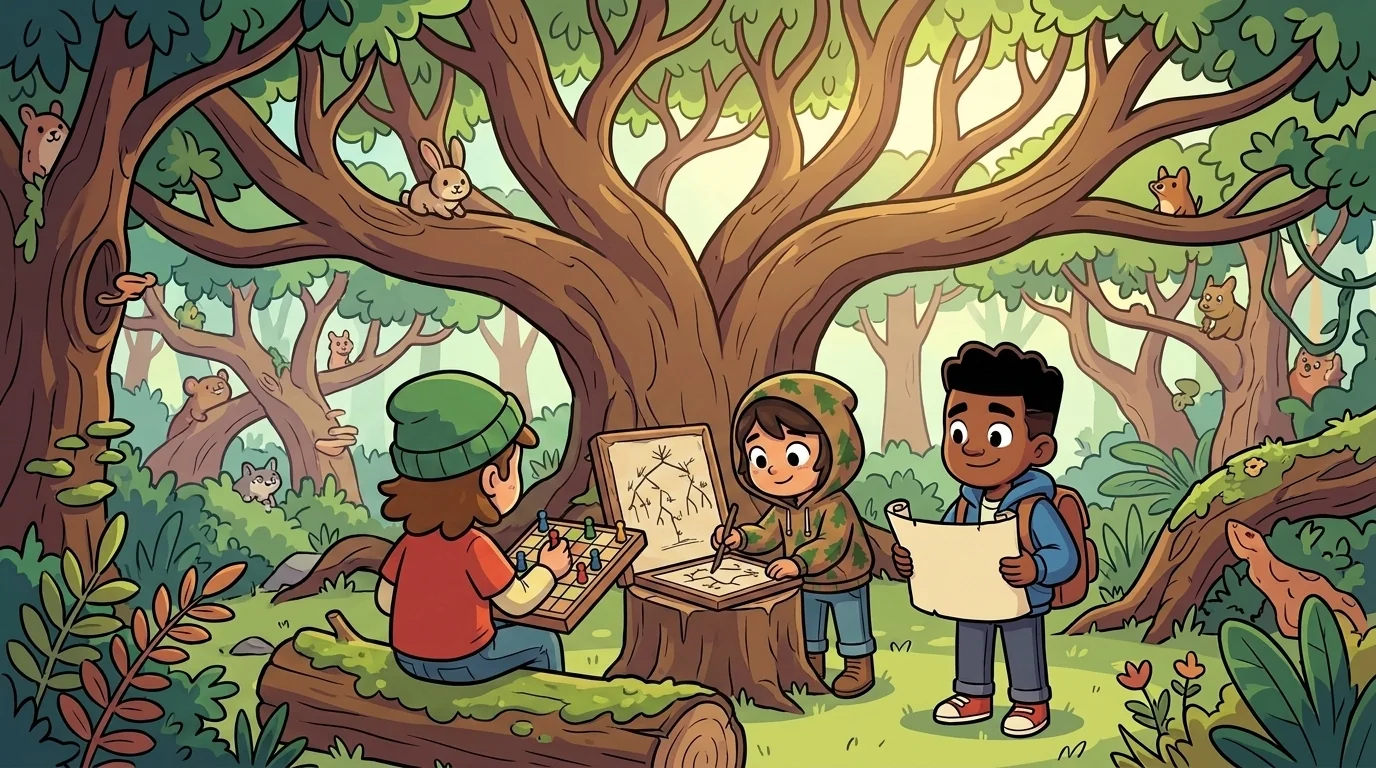
Gridley stood up and walked over to the green chalkboard hanging on the wall. He picked up a fresh stick of white chalk.
"Now imagine Arbor's tree," Gridley said, "except instead of looking five moves deep, imagine going all the way to the end. Every single branch, every reply, down to every finished game at the very tips."
He drew a small circle at the top of the board and fanned out chalk lines until the dark green slate was covered in white branches.
"That is what it means to solve a game," Gridley said. "A computer does not stop at five branches, and it does not have to guess which paths to ignore. It climbs every single branch to the absolute bottom."
He tapped his chalk against the lowest row of marks.
"In 1988, a computer climbed the entire Connect-4 tree," Gridley said. "It checked every path and proved that if the first player never makes a mistake, the first player always wins. Not usually. Always. The entire tree is completely known."
Arbor's eyes were shining as she stared at the board. "It is what I do," she whispered, "only complete."
"It is exactly what you do," Gridley said warmly. "Rowan sees one move by instinct. Arbor climbs five branches by choice. The machine checks every branch by calculation. All three of you are doing the exact same act at three different depths."
Rowan looked at the chalkboard, then down at his hands. The sticky note on the table suddenly felt much heavier.
"So if the computer already proved who wins," Rowan said, "then playing the game is just pretending we don't know the answer. The kid who wrote the note was right."
Gridley set the chalk in the wooden tray and wiped his hands, sending a soft white cloud into the air.
"Knowing a fact and growing a mind are two completely different things," Gridley said gently.
He walked back to the table and picked up the yellow plastic checker.
"The machine's prize was a fact," Gridley said. "It proved an answer about Connect-4. But that machine cannot hand you the ability to look ahead in your own life. You have to grow that strength yourself, one branch at a time."
He looked at Rowan and held out the yellow piece.
"Every game you play, you climb a little higher up the tree than you did before," Gridley said. "Your prize is becoming someone who sees further into the unknown."
Rowan took the smooth yellow disc. He thought about real decisions that had nothing to do with plastic grids—like deciding how to handle a disagreement with a friend or choosing what project to build next term. Nobody had solved those trees. No machine could calculate those outcomes for him.
"So the point isn't to be a computer," Rowan said slowly.
"Not at all," Gridley said.
"The point is to climb higher than I did yesterday," Rowan said.
"That," Gridley said with a broad smile, "is the whole point of this game, and of almost everything else worth getting good at."
Arbor was already turning to a fresh page in her notebook, sketching a new set of branches with happy focus. Rowan looked down at the blue plastic grid. He held his yellow piece over column three, paused, and tried for the first time to see three moves deep before letting go.
The GridForge ensemble
The Solved Board (Gridley · Arbor · Rowan) is part of GridForge's distributed-narrative cast. Each character embodies a different curricular primitive; together they teach the full subject.
-
Arbor
The game tree: every position branches into the moves that follow
-
Ballast
Stability and corners: the unflippable pieces in Reversi
-
Causeway
The bridge: a virtual connection that cannot be cut in Hex
-
Domino
Forcing sequences: chaining threats to keep the initiative in Gomoku
-
Flank
Territory flip: capturing a line of pieces in Reversi
-
Mobi
Mobility: keeping more moves available than your opponent
-
Oddwin
Parity: who-moves-last, the key to Dots-and-Boxes
-
Rowan
Connection: extending a chain of your pieces toward a win
-
Twain
The fork: one move that makes two threats at once