Fringe and Vanish
FRINGE & VANISH
Loading audio…
Press play to listen along. The line being read lights up as you go.
Show full transcript
Loading transcript…
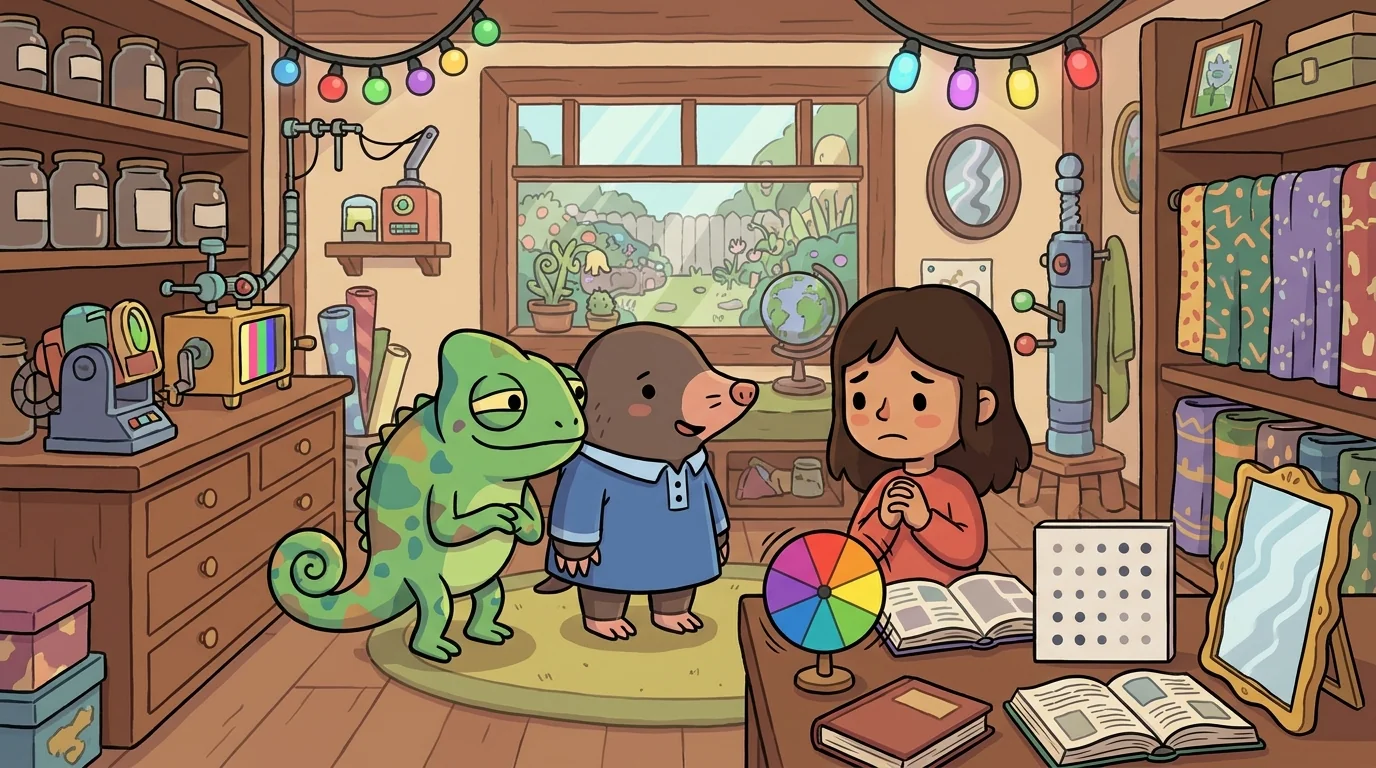
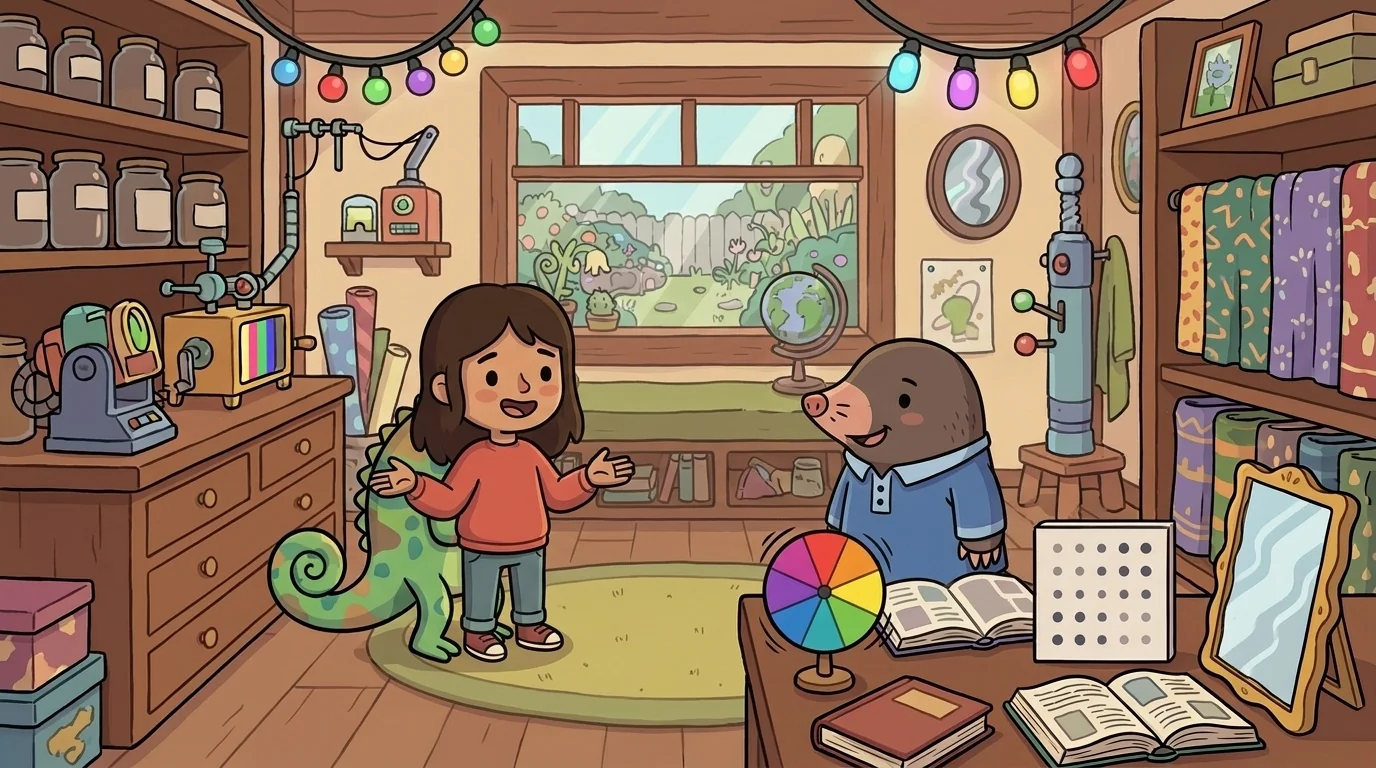
A girl came to IllusionForge upset in a way she couldn't quite explain. "I learned about the blind spot," she said, "and then about how colors change with their background, and now I feel — weird. Like I can't trust my own eyes anymore. Like the whole world I'm looking at might be fake. Is it? Is any of what I see actually real?"
Fringe the chameleon and Vanish the mole looked at each other — the one who shows color is invented, the one who shows the gaps are filled — and each knew half of what the girl needed, and knew the halves were really one big, gentle truth.
"It's not fake," said Fringe.
"But it's not a photograph either," said Vanish softly. "It's something in between, and better than both. Let us show you."
"Both of us," said Fringe. "Because neither half, alone, is the whole answer."
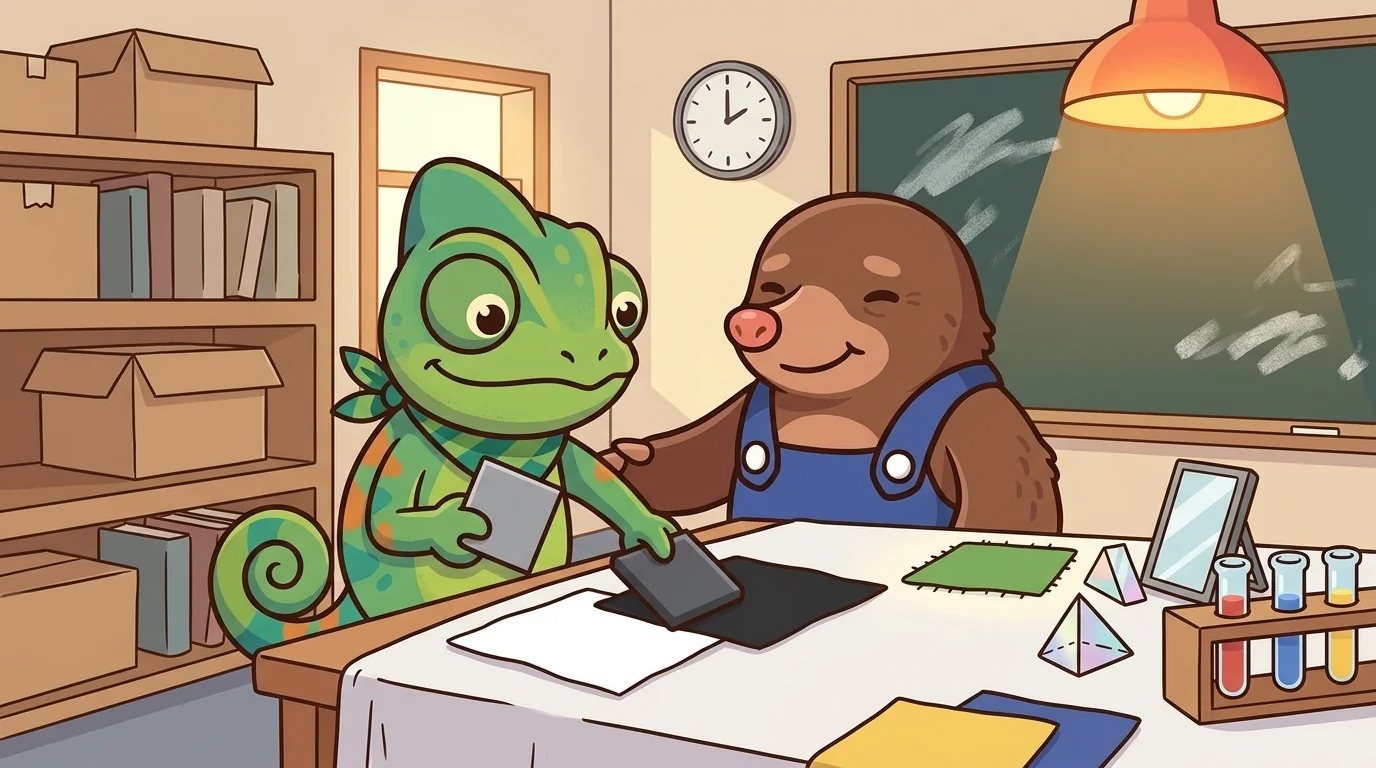
Fringe went first, because color is the easiest place to feel the building happen.
"You think your eye is a camera," Fringe said, laying a gray tile on a white cloth, then a black one. "A camera would give you the same gray both times — it just records the light. But your eye?" The tile went dark on white, pale on black, the same tile reading as two different grays. "Your brain doesn't record the color. It builds it — by comparing the tile to its neighbors and deciding what it must be." She swiveled an eye at the girl. "And here's why that's not a flaw: a camera would be fooled by a colored light — a white shirt under a sunset would look orange in a photo. But you still see it as white, because your brain figures out the light and corrects for it, building the 'real' color underneath. Your eye is smarter than a camera. It doesn't copy the light. It interprets it." She set the tile down. "So yes — the color you see is partly built by you. But it's built toward the truth, not away from it. It's construction in the service of seeing straight." She looked across at Vanish. "That's the inventing half. But your brain doesn't only build what's there — it builds over what isn't. And that's her half."
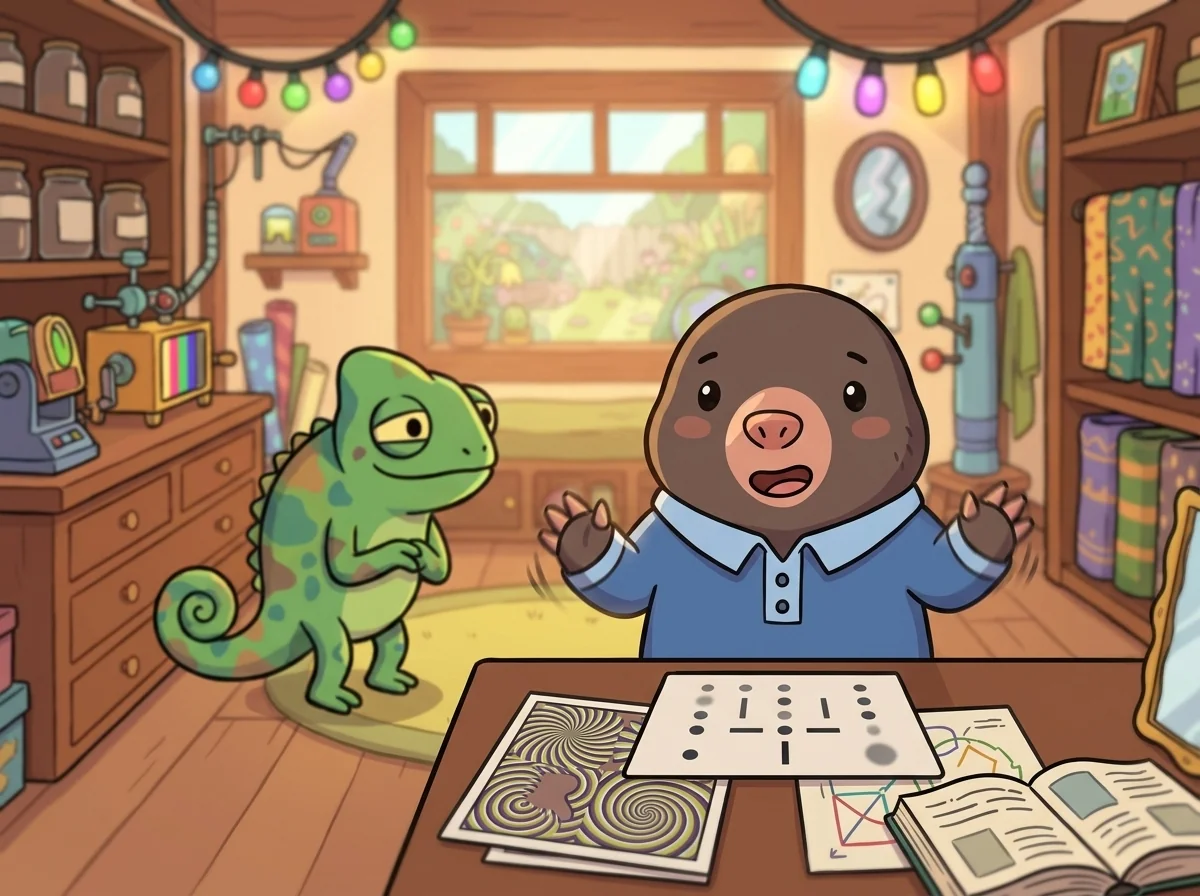
Vanish took over, gentle, because filling-in is where the building gets bold.
"Fringe showed you your brain interprets what it sees," Vanish said. "I'll show you it also invents where it sees nothing at all." She ran the girl through the cross-and-dot; the dot vanished into the blind spot; the brain painted smooth white over the hole. Then the broken line the brain quietly completed. "There's a hole in your sight, in each eye, that catches nothing. But you've never seen a black gap floating in your view, have you? Because your brain fills the hole in — with a confident guess of whatever's around it. Right now, as you look at me, there are two holes in your vision, patched so smoothly you'd swear your sight was seamless." She blinked her small soft eyes. "And it doesn't stop at the holes. Your sharp seeing is only in a tiny spot at the center; everything to the sides is blurry and dim — but it doesn't feel blurry, because your brain fills in a rich, detailed, whole-looking world out of a few sharp glances and a lot of clever guessing. You're not looking at a finished picture. You're looking at a painting your brain is making, right now, faster than you can catch it."
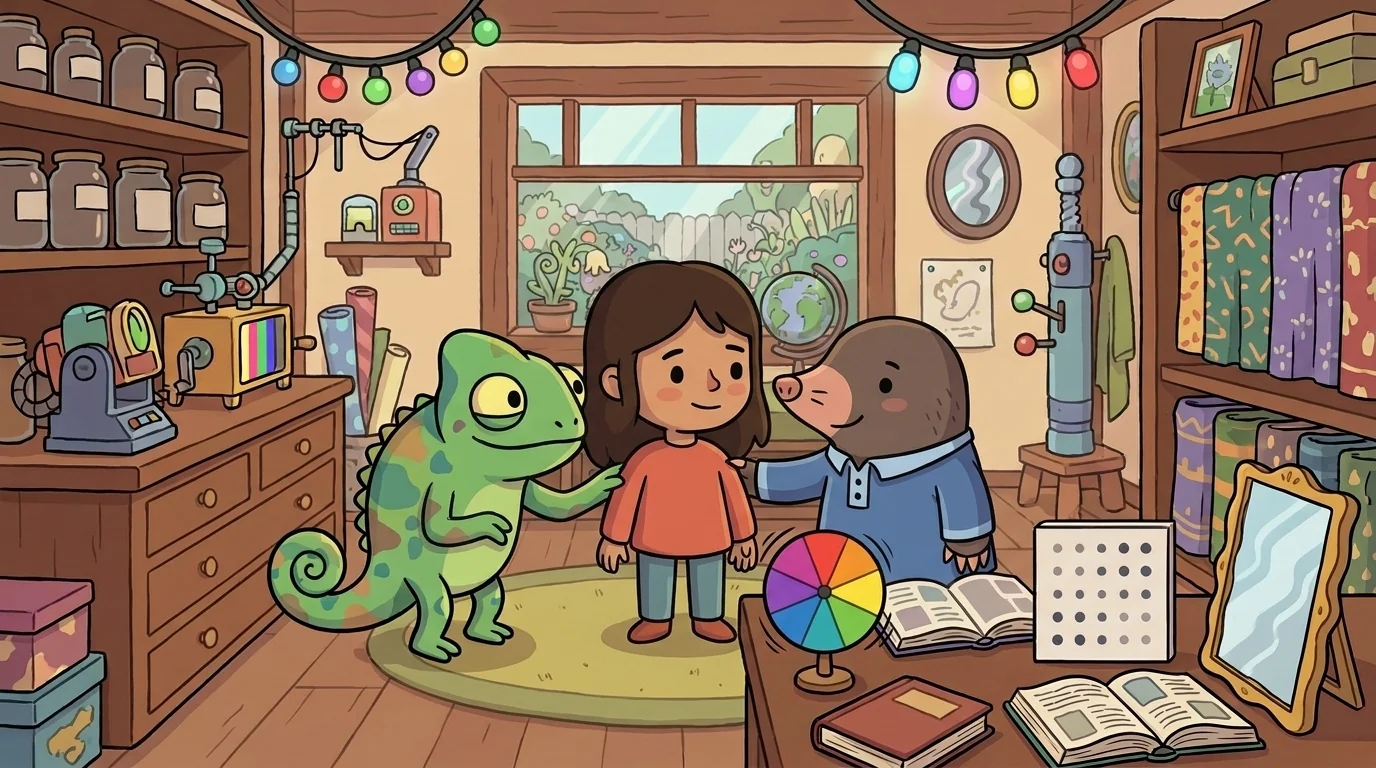
And then, together, they turned the girl's fear into something steadier.
"So here's the whole answer to 'is what I see real,'" said Fringe. "Seeing is not a photograph. It never was — not for you, not for anyone, not for any eye that ever existed. Your brain takes the little bit of light that gets in — patchy, gappy, colored by whatever light happens to be falling — and out of that, it builds a whole, smooth, colored world for you to live in." She and Vanish stood on either side of the girl. "I build the colors, interpreting them against their surroundings and the light. Vanish builds the completeness, filling the holes and the blur into a seamless whole. And separately —"
"— I'd tell you your world is invented, and you'd feel like it's fake," said Vanish.
"— and I'd tell you your colors are comparisons, and you'd feel like they're unreliable," said Fringe. "But together, the truth is kinder and stranger than either: your seeing is a construction — built, guessed, interpreted, filled-in — and it is also your best, truest, most useful grip on a real world that's really out there." She swiveled both eyes at the girl. "The tile is real. The light is real. The world is real. But the seeing of it is something your brain makes, every waking second, out of scraps — and mostly makes brilliantly. It's not a fake world. It's a built window onto a real one."
The girl was quiet, turning it over. "So it's not that my eyes lie to me," she said slowly. "It's that... seeing was never copying. It's building. And the building is how I get to see anything at all."
"That's it exactly," said Fringe and Vanish together.
"But then," the girl said, "two people looking at the same thing — they might each build it a little differently. And both be honest."
"Now you understand it completely," said Vanish, pleased. "Two brains, two constructions, both built in good faith from the same real light. That's why people can honestly see a color, or a scene, a bit differently — not because one is lying, but because each is building, and no two builders are identical."
"Which is why," said Fringe, "the wise thing isn't to trust your eyes blindly, or to panic that they're fake. It's to hold them honestly: I'm seeing a construction — a really good one, of a really real world — and so is everyone else, and none of us has the raw photograph, because there is no raw photograph." She smiled. "Knowing that doesn't make the world less real. It makes you a little wiser about the window you're looking through — and a lot kinder to the person beside you, who's looking through a window built just slightly differently than yours."
The girl looked around the studio — at the colors her brain was interpreting, the gaps it was filling, the whole seamless world it was quietly building for her, right now — and instead of feeling tricked, she felt something closer to awe.
And Fringe and Vanish felt it settle warm and shared between them — that clicked-together, your whole world is built and that's the wonder gladness that comes when a fear of being fooled turns into a deeper respect for the mind doing the seeing. Fringe loved the invented colors. Vanish loved the filled-in gaps. But what they loved most was this: taking a kid who thought her eyes had betrayed her and showing her, together, that seeing was never a lie or a photograph — it was a construction, a masterwork built fresh every second, her own private, honest, wondrous window onto a world that was really, truly there.
The IllusionForge ensemble
Fringe and Vanish is one of the friends in IllusionForge. Each friend shows you one idea by how they act; meet them all and you have the whole subject.
-

Skim
Attention; inattentional and change blindness
-

Vanish
The blind spot and perceptual filling-in
-

Fringe
Color constancy / simultaneous contrast; context changes what you see
-

Fade
The afterimage / persistence-of-vision — the visual trace left after a stimulus is removed (the foundation of animation, film, and many magic tricks)
-

Teeter
Ambiguous / bistable figures; figure-ground reversal
-

Notch
The impossible figure — the figure that locally reads as coherent but globally cannot exist (Penrose triangle, Escher staircase, blivet)
-

Stack
The perspective trap — the geometric arrangement that misleads size and depth judgments (Müller-Lyer, Ponzo, Ebbinghaus, vanishing-point depth cues)
-

Loop
The perceptual loop — the recursive / endless / barber-pole motion illusion (the mechanism that makes the brain see motion that can't end)
-

Notion
Pareidolia; the brain finds faces and patterns that aren't there
-

Cue
The auditory illusion — the sound-perception mechanism (Shepard tones, McGurk effect, phantom-melody, missing-fundamental)


