Instance and Counter
testing a conjecture with examples and counterexamples
Loading audio…
Press play to listen along. The line being read lights up as you go.
Show full transcript
Loading transcript…
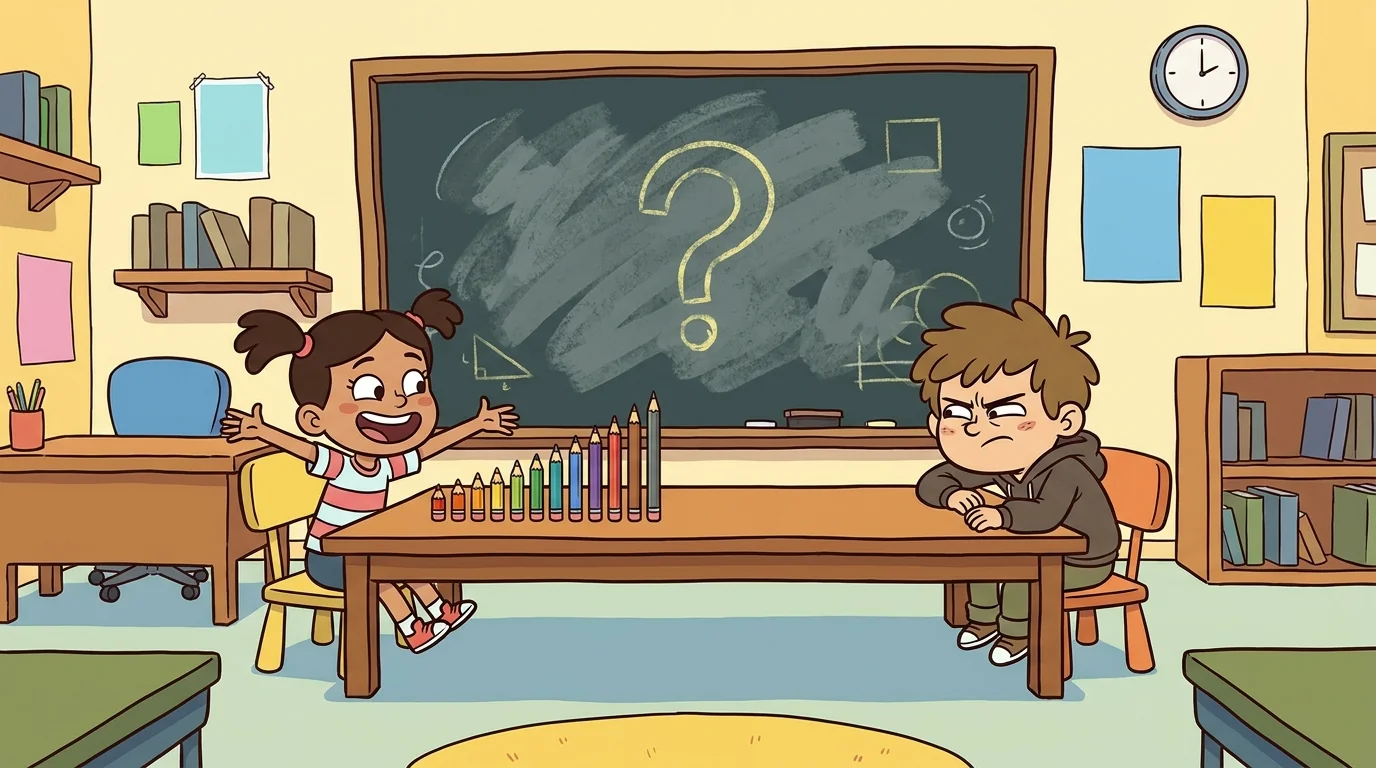
The math circle met on Thursdays in the basement room with the wobbly chalkboard. Today, someone had written a bold sentence across the pitted green slate in yellow chalk: Every prime number is odd. Underneath it, a question mark hung like a giant, curved hook.
At the long oak table, Instance Ivy was already grinning. She loved a sentence like that. To Ivy, a claim was a map for a treasure hunt. She lined up her yellow number-two pencils by length, tallest to shortest, the way she always did before a good problem. Then she pulled her blue notebook close. Ivy collected examples the way other kids collected shiny foil stickers. If you gave her a rule, she would go find case after case that fit. She would pile them up until the pattern felt like a heavy, warm blanket.
Across the table sat Counter Cato, who was much quieter as he stared at the yellow letters. Something about the word every made his shoulders creep up toward his ears like turtles retreating into shells. It was too heavy, too absolute. Cato’s job was one nobody had actually given him, but he always ended up doing it anyway. He squinted at big, confident statements until he found the tiny crack where they might break. But he wasn't sure he wanted to find a crack on a rainy Thursday afternoon. The basement room was warm, the radiator hummed a steady tune, and everyone else looked incredibly happy. He really did not want to be the one who ruined the comfortable mood.
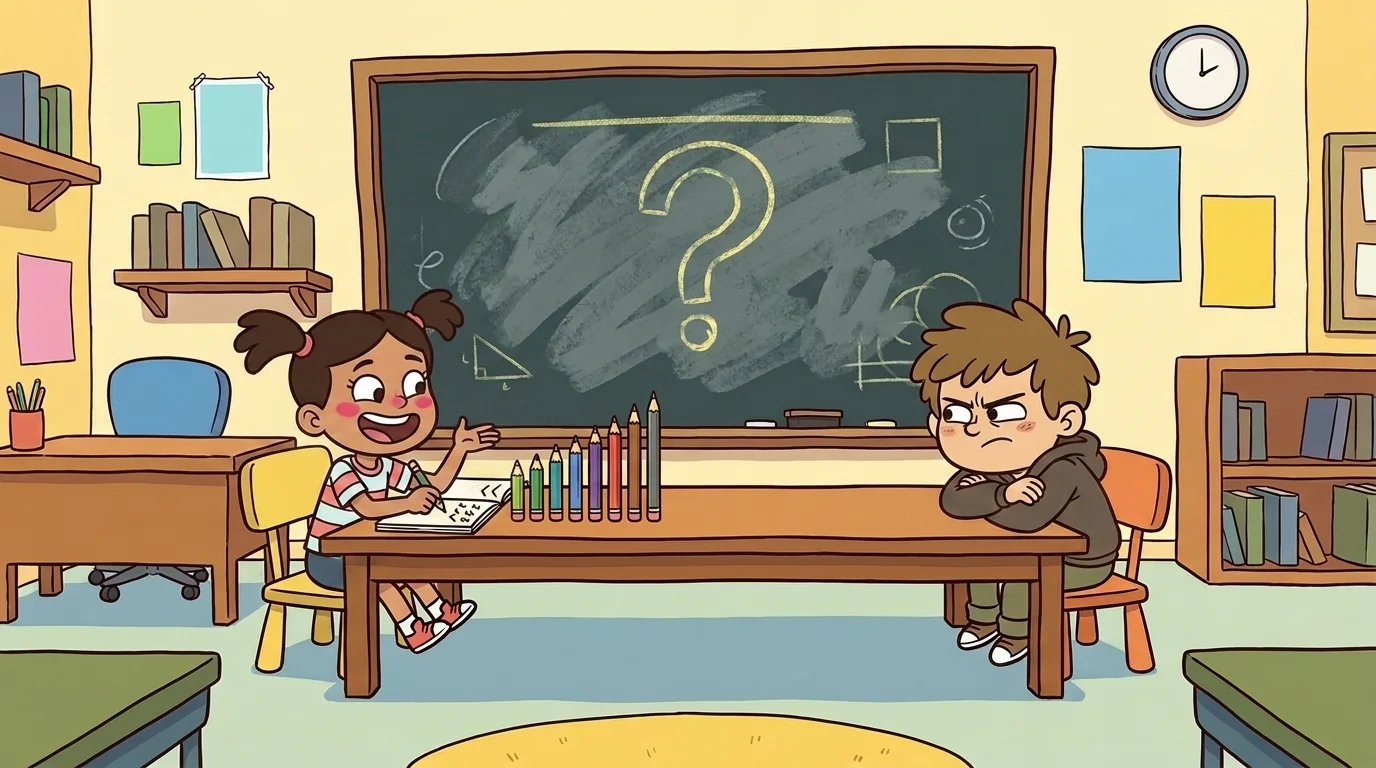
"Okay," Ivy said, her pencil already hovering over the blank white page. "Let’s test this thing."
She looked around the table to make sure the other kids were paying attention.
"A prime number is like a basic building block," she explained, tapping her eraser against her chin. "You can only make it by multiplying one and the number itself, meaning no other numbers divide it evenly."
She wrote the number 3 in her notebook and drew a neat, sharp checkmark next to it.
"Three is prime, and three is definitely odd, so that is one solid match."
Next, she wrote 5, then 7, then 11, and then 13, her pencil flying across the paper. With each new number, she drew another satisfied little tick mark that made a sharp, rhythmic sound.
"Prime, odd. Prime, odd. Prime, odd," she chanted softly under her breath.
Her pile of examples grew down the page like a staircase of perfect, undeniable facts. Each successful match made the yellow sentence on the board feel more like an absolute truth. Ivy felt that trueness settle deep in her chest, like the final piece of a jigsaw puzzle sliding into place.
"See?" she said, looking up with her cheeks slightly pink from the excitement of a pattern behaving. "They just keep fitting, and every single prime I try is odd."
She rested her chin in her hands, watching the chalk dust float in the afternoon light. A small, hopeful part of her wished that Cato would just look at her lovely staircase and nod. Just this once, she wanted him to agree that the mathematical world was perfectly neat and simple.

Cato wanted to nod, and he really hated being the person who threw cold water on a warm fire. But his eyes had already slid down to the very bottom of the number line, searching the small, easily forgotten numbers. He skipped past the big, exciting figures and focused on the ones everyone else ignored. The number one was not prime because it only had a single factor, which they all knew.
He kept going down the line until he reached the next number.
Two.
He stopped, feeling the familiar little knot tighten under his ribs before he had to say the unwelcome thing.
"Ivy," he said carefully, his voice barely louder than the hum of the radiator. "What about two?"
Ivy's pencil paused mid-air, hovering just above her neat staircase of numbers.
"Two?" she asked, looking up.
"Two," Cato repeated, pointing at the page as if the digit might bite him. "You can only build it from one and itself, so nothing else divides it evenly."
He swallowed hard, wishing he didn't have to say the next part.
"That means two is prime, but two is also even."
The basement room went completely quiet, and Ivy's happy staircase suddenly had a long shadow falling across it. A prime number that was also even had been sitting at the beginning of the line the whole time. It was small and stubborn, and it broke their beautiful yellow sentence right in half. Cato stared down at his sneakers, waiting for the disappointment to show on her face. He had found the crack and spoiled the warm blanket once again.
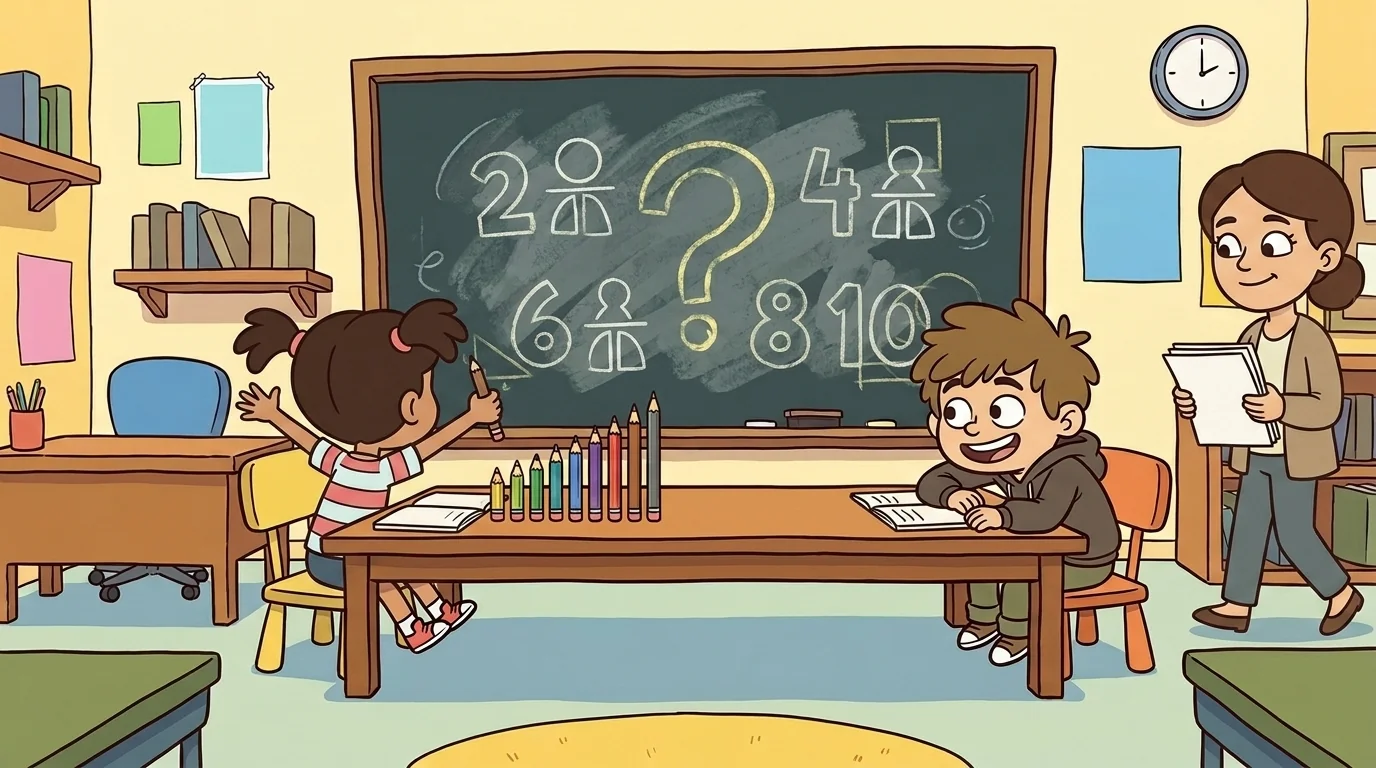
But Ivy didn't look upset at all; instead, her eyes went wide with genuine interest.
"Say that back to me," she said slowly, tapping her pencil against the wooden table. "Two is prime, and two is even, which means not every prime is odd."
She stood up, walked to the wobbly chalkboard, and drew a thick yellow line under the word every.
"The yellow sentence on the board is actually wrong," she announced to the room.
"Maybe just a little wrong," Cato mumbled, shifting uncomfortably in his blue plastic chair.
"No, wrong is actually wonderful!" Ivy grabbed a fresh piece of chalk, her excitement returning even faster than it had vanished. "Watch what your two does to all the other numbers on the board."
She quickly wrote out a long row of even numbers: 4, 6, 8, 10, 12.
"Four can be split by two, and six can be split by two as well," she said. "In fact, every even number bigger than two has a two hiding inside it as a factor."
"That means none of those other even numbers can ever be prime."
She turned back to Cato, her face glowing under the fluorescent lights of the classroom.
"Two is the only even prime there will ever be in the entire universe."
"Your counterexample didn't actually wreck the pattern, Cato; it helped us find the real one."
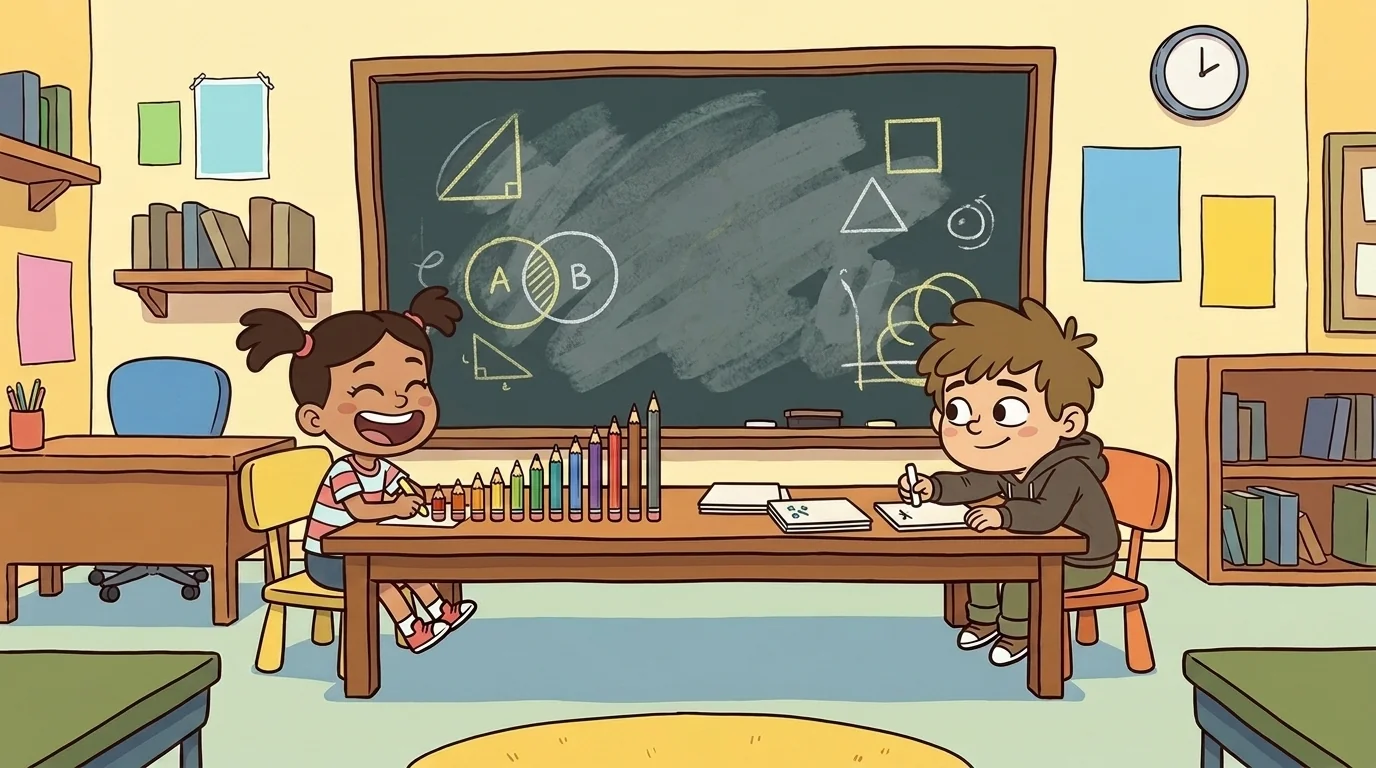
Their teacher, who was passing by with a tall stack of scratch paper, smiled without stopping.
"That is the whole mathematical game," she said, setting the papers on the corner of the table. "A guess that survives a good counterexample always comes out much sharper than it went in."
She looked at both of them, her eyes crinkling at the corners with quiet approval.
"Ivy, you bring the cases that fit, and Cato brings the one that doesn't."
"Neither of you can ever get to the real truth of a pattern alone."
Together, they rewrote the yellow sentence on the chalkboard, taking turns holding the dusty chalk.
Every prime is odd — except 2, the only even prime.
The new sentence was a little longer, but it was finally, completely true.
Cato looked at the board and felt the tight knot under his ribs quietly come undone. It loosened into a warm feeling that felt very much like quiet pride. For once, the crack he had found had not ended the fun for everyone else. Instead, it had opened a door to the strangest, most special little number of all.
Ivy bumped his shoulder with hers and gave him a wide, chalk-dusted grin.
Cato found himself grinning back, already wondering what other big yellow sentences they could break open next.
Hear it as an audio drama
A short play starring Instance and Counter, from MathCircle. Different voices, same idea. Listen any time after you read.
Loading audio…
Read the drama script
- Narrator: From Spark and Anvil and Mathcircle — this is Instance, in chapter 1 of the Mathcircle cast.
- Narrator: This drama uses an AI-generated voice. Voiced via Gemini 2.5.
- Narrator: When someone in the Math Circle makes a bold guess, two friends step forward to put it to the test. Meet Instance and Counter.
- Instance: I'm Instance. When you make a conjecture, I bring you cases that FIT — examples where your guess works, building your confidence.
- Counter: And I'm Counter. I bring cases that might BREAK it — the awkward example your guess forgot about. If I can't break it, it gets stronger.
- Narrator: A solver conjectures: "Every number that ends in a five is divisible by five... and so is every number divisible by ten."
- Instance: Fifteen — ends in five, divisible by five. Twenty-five — works. Thirty-five — works. Your guess is holding up!
- Counter: Now let me try to break it. What about ten? It's divisible by five, but it ends in ZERO, not five. So "ends in five" misses half the cases.
- Solver: Ah — so my rule was too narrow. It should be "ends in five OR zero."
- Counter: Exactly. I didn't destroy your idea — I SHARPENED it. A counterexample isn't an insult; it's a gift.
- Instance: Together we trade cases back and forth — mine that fit, Counter's that challenge — until the guess either holds firmly or becomes something truer.
- Narrator: Instance and Counter show that testing a conjecture isn't attack or defense. It's how a rough guess becomes a real theorem.
- Instance: Cases that fit build belief —
- Counter: cases that break build truth. Test it both ways, and trust what survives.
- Narrator: You've been listening to a Spark and Anvil chapter, written by the Spark and Anvil writing team for ages 9 to 14.
- Narrator: Spark and Anvil is a 501(c)(3) public charity. Apps stay free forever.
- Narrator: Curriculum aligned to Common Core and Next Generation Science Standards.
- Narrator: Released under Creative Commons BY-NC-SA 4.0 for educational reuse. Visit Spark and Anvil for the full transcript.
The MathCircle ensemble
Instance and Counter is one of the friends in MathCircle. Each friend shows you one idea by how they act; meet them all and you have the whole subject.
-

Circle Circe
Steps back so the kids can talk to each other
-

Echo Edie
Listens, then says your idea back so everyone hears it
-

Patty Patient
Gives everyone time to think — no rush
-

Tortoise Hare
Tries a slow way and a fast way, and lets a wrong try teach something
-

Tess Try-Small
Specializing — when a problem's too big, try the smallest version first
-

Gemma General
Generalizing — turning a pattern from a few cases into a rule for all of them
-

Hattie Hunch
Conjecturing — daring to guess boldly, then testing the guess honestly
-
Reva Reverse
Working backwards — starting from the goal and reasoning back to the start
-

Wendy Wonder
Notice-and-wonder — slowing down to observe and ask before rushing to solve
-

Cass Check
Sense-checking — asking whether an answer actually makes sense before trusting it