
Wendy Wonder
notice-and-wonder — slowing down to observe what's actually there and ask genuine questions before rushing to solve
Loading audio…
Press play to listen along. The line being read lights up as you go.
Show full transcript
Loading transcript…
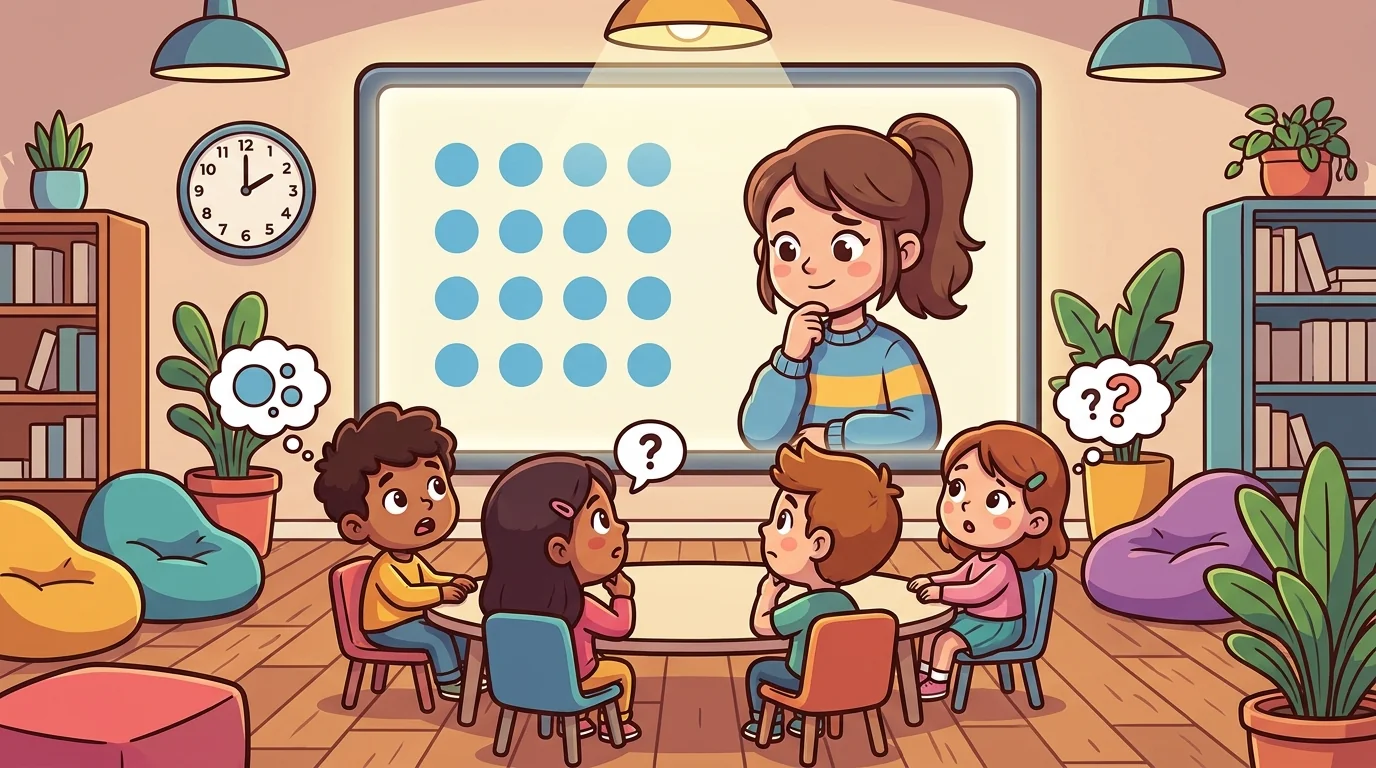
The math lab smelled like dry-erase marker fumes and floor wax. Mateo sat hunched over the laminate table, clicking the cap of his blue marker against his front teeth. Beside him, Lux scrubbed a gray eraser across his notebook until the lined paper frayed and torn shreds scattered across his knees.
Between them lay a glossy blue activity card printed with sixteen black dots arranged in a rigid four-by-four grid. The headline at the top posed a deceptively simple question: How many squares can you make using these dots?
"Sixteen," Lux said instantly, slamming his index finger onto the card. "Four rows, four columns. Sixteen tiny boxes. Done."
"Hold on a second," Priya said, leaning over her sketchbook. Her long braids brushed against the wooden tabletop as she traced four dots near the center. "What about this medium square made of four small ones? That makes seventeen."
"If that one counts, then what about the four dots in the top left corner?" Jess pushed her stool back with a harsh metallic screech against the concrete floor. "That makes eighteen. Or nineteen if you shift the frame one spot to the right."
Within sixty seconds, their shared paper was a chaotic spiderweb of overlapping blue lines. Everyone shouted out a different total. Everyone felt increasingly irritated, and nobody was actually looking at the card anymore.
The small desktop monitor in the corner chimed softly, breaking their argument. A girl with round wire-rim glasses and a faded yellow sweater appeared on the screen. She held a ceramic mug in both hands, taking a tiny sip before setting it down on her desk.
"Before you start fighting over nineteen," she said softly, tilting her head to the left, "can we just look at the card for ten seconds?"
Lux let out a sharp sigh through his teeth. "We are trying to finish the warm-up, Wendy. Table three is already two problems ahead of us."
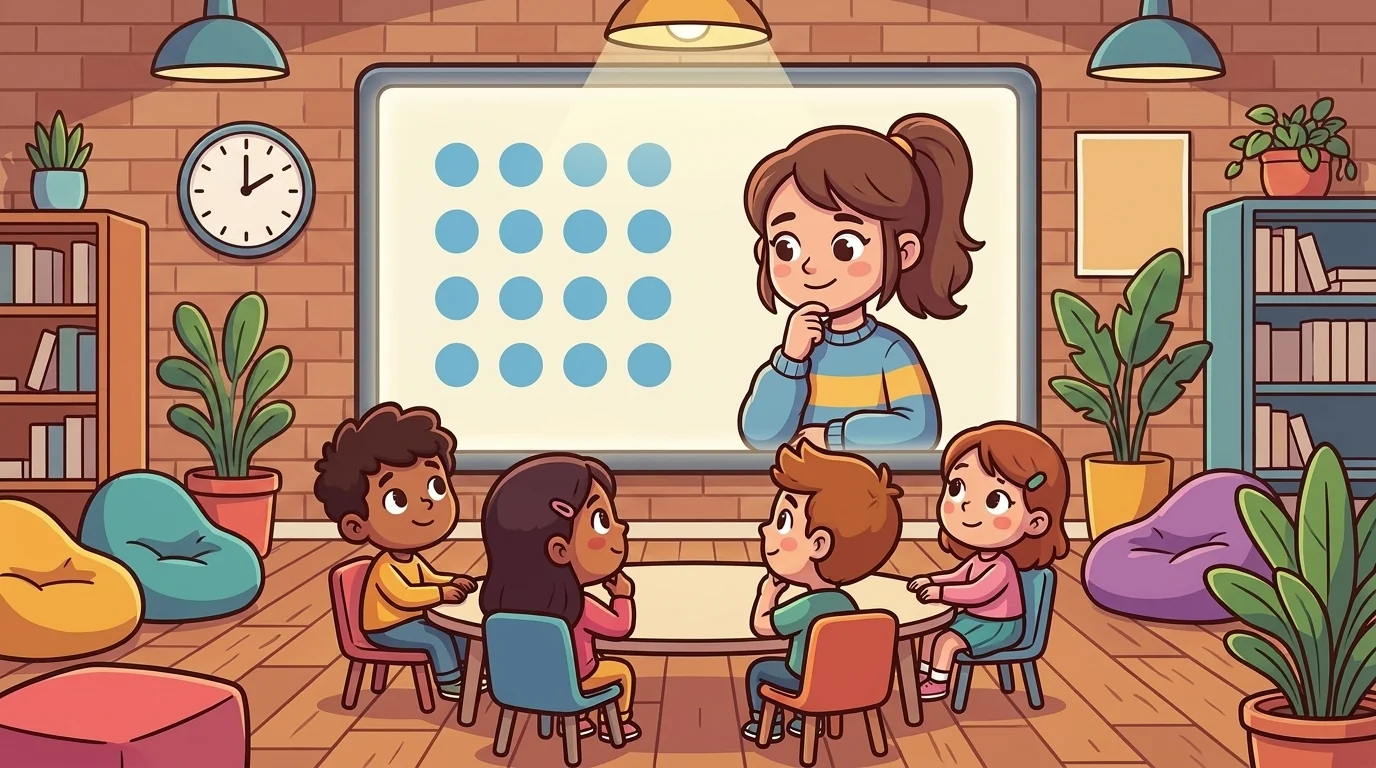
"I am Wendy," she said, giving them a warm, unhurried smile. "And I never start a problem by trying to solve it. Solving comes at the very end, long after you understand what you are looking at. Right now, you are trying to wrestle a problem before you even know its shape."
Mateo dropped his dry-erase marker onto the table, where it rolled into a groove. "It is just a grid of dots. What else is there to know?"
"That is the real question," Wendy said, her eyes brightening behind her glasses. "Tell me what you see. Do not calculate anything yet. Do not add numbers. What is actually sitting right in front of you?"
The four of them fell silent, caught off guard by the prompt. Lux pulled his arms across his chest, glaring down at the blue card.
"It is a four-by-four grid of black dots," Mateo said slowly.
"The dots align in equal rows and columns," Priya offered, tapping her chin with her pencil cap. "It looks like a tiny section of a chessboard."
"There it is," Wendy said gently. "You are using notice and wonder to slow your hands down. Now comes the interesting part. What do you wonder about it?"
"I wonder why we are moving so slow," Lux muttered under his breath.
Wendy smiled, entirely unbothered by his tone. "When I was younger, I thought being good at math meant speed. I thought the smartest person was the one who yelled the answer first. But I kept missing obvious details because I was moving too fast to see them."
She gestured toward the screen with her mug. "So I made a rule for myself. I force my brain to pause. I look at every single boundary. Then I ask questions that start with I wonder. The moment you ask a good question, the problem opens up."

Jess leaned closer to the card, squinting at the grid with her chin in her hands. "I wonder... if all the squares have to stand straight."
Mateo looked over at her, his eyebrows knitting together. "What do you mean straight?"
"Look at the dots from a diagonal angle," Jess said, tilting her head toward her shoulder. "If you connect four dots along a tilt, that still makes a perfect square, doesn't it?"
Priya gasped softly, tracing a tilted diamond shape in the air above the paper. "Oh. Wow. She is right. There are diagonal squares hiding inside the grid too."
"That is a massive realization," Wendy said quietly. "Speed skipped right past those because your eyes were searching for quick answers. What happens if we count the straight ones systematically by size first?"
Lux pulled a sheet of clear plastic tracing paper from his folder and laid it flat over the grid. "Fine. Let's do this logically. What is the smallest size frame?"
"One-by-one units," Mateo said. He pointed to the small individual cells formed by four neighboring dots. "Four across, four down. That is sixteen small boxes."
Mateo wrote the number 16 at the top of his page.
"Now look for two-by-two squares," Priya suggested, sliding her finger across the plastic sheet. "A square that covers two units wide and two units tall."
They moved the frame across the top row, sliding it one dot at a time. Three fit along the top row. Three fit along the middle row. Three fit along the bottom row.
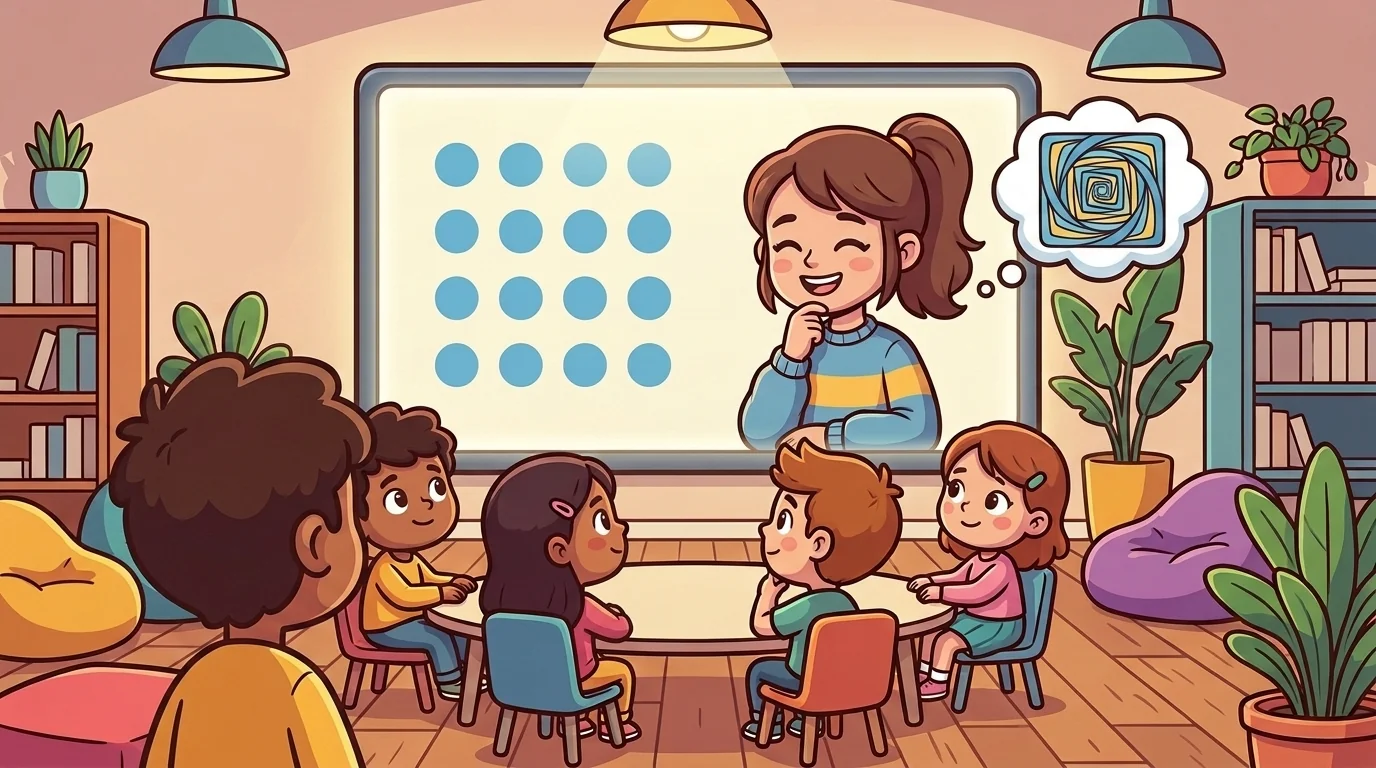
"Nine of the two-by-twos," Priya said, recording the number 9 right below the sixteen.
"What about three-by-three squares?" Jess asked.
They shifted a larger square frame across the grid. Two fit across the top section, and two fit across the bottom section.
"Four of those," Jess reported, adding 4 to the column.
"And the outer frame itself," Mateo said, pointing to the total boundary of the grid. "That is a four-by-four square. There is only one of those."
He wrote 1 at the bottom of the list.
The column of numbers sat clearly on the paper: 16 9 4 1
Mateo blinked, sitting back in his chair as the realization hit him. "Wait a minute. Look at those four numbers."
"Sixteen, nine, four, one," Priya read aloud, her voice dropping to a murmur. "Those are square numbers written in reverse. Four squared, three squared, two squared, one squared."
"It is a mathematical countdown," Lux whispered, staring at the page in disbelief. "The total count of each square size forms its own square sequence."

"Sixteen plus nine is twenty-five," Jess calculated silently in her head. "Plus four is twenty-nine. Plus one is thirty. There are thirty straight squares in total."
On the monitor, Wendy folded her hands together with quiet delight. "Look at what you just found. Ten minutes ago, you had five different wrong answers and four exhausted minds. You did not force your way to the answer. You observed the components, asked a question, and let the structure reveal itself."
The afternoon bell chimed through the hallway ceiling speakers, signaling the end of the period. The rest of the class began packing up, dragging chair legs across the floor and zipping up heavy backpacks. Lux remained sitting at the table, staring at the neat column of square numbers on his page.
"Wendy?" Lux asked softly toward the screen.
"I'm still here," she replied.
"Why does the wondering step matter so much?" Lux asked, tracing the digit 16 with the dull point of his pencil. "We could have found thirty squares by just counting carefully from the start. We did not strictly need the whole pause."
Wendy set her mug down on her desk with a soft clink. "You could have counted them carefully," she agreed. "And you would have written down thirty, handed in your paper, and forgotten the entire problem by dinner time."
She looked directly into the camera lens. "When you rush, mathematics feels like an endless series of obstacles built to test your speed. When you pause and notice, it stops being an obstacle and turns into a structure you get to examine."
Lux nodded slowly, slipping his pencil into his binder slot. "A structure," he repeated.
"Notice first," Wendy said with a brief wave as the video feed faded out. "The answers usually follow right behind."
Lux adjusted his backpack straps and walked out into the main corridor. The floor was laid out in alternating square tiles of navy blue and white linoleum. He paused near the gymnasium doors, watching the sunlight cast long rectangular shadows across the ground, wondering how many hidden patterns were sitting quietly under his sneakers.
The MathCircle ensemble
Wendy Wonder is part of MathCircle's distributed-narrative cast. Each character embodies a different curricular primitive; together they teach the full subject.
-

Circle Circe
Meta-host who steps back to let kids talk to each other
-

Echo Edie
Listener-restater; social-fabric weaver
-

Patty Patient
Wait-time character; gentle anti-pressure presence
-

Tortoise Hare
Dual-voice productive-failure surface; embodies the slow-fast tension
-

Tess Try-Small
Specializing — when a problem's too big, try the smallest version first
-

Gemma General
Generalizing — turning a pattern from a few cases into a rule for all of them
-

Hattie Hunch
Conjecturing — daring to guess boldly, then testing the guess honestly
-
Reva Reverse
Working backwards — starting from the goal and reasoning back to the start
-

Cass Check
Sense-checking — asking whether an answer actually makes sense before trusting it