
Bevel
ANGLE — how much a turn, not how long a line. An angle is ROTATION, measured in degrees as a fraction of a full 360° turn, read at the VERTEX; it is INVARIANT to arm-length (scaling the arms is a translation of the endpoints, not a change in the turn). Length is a one-dimensional distance; angle is a rotation between two rays sharing a vertex — a different quantity entirely.
Loading audio…
Press play to listen along. The line being read lights up as you go.
Show full transcript
Loading transcript…
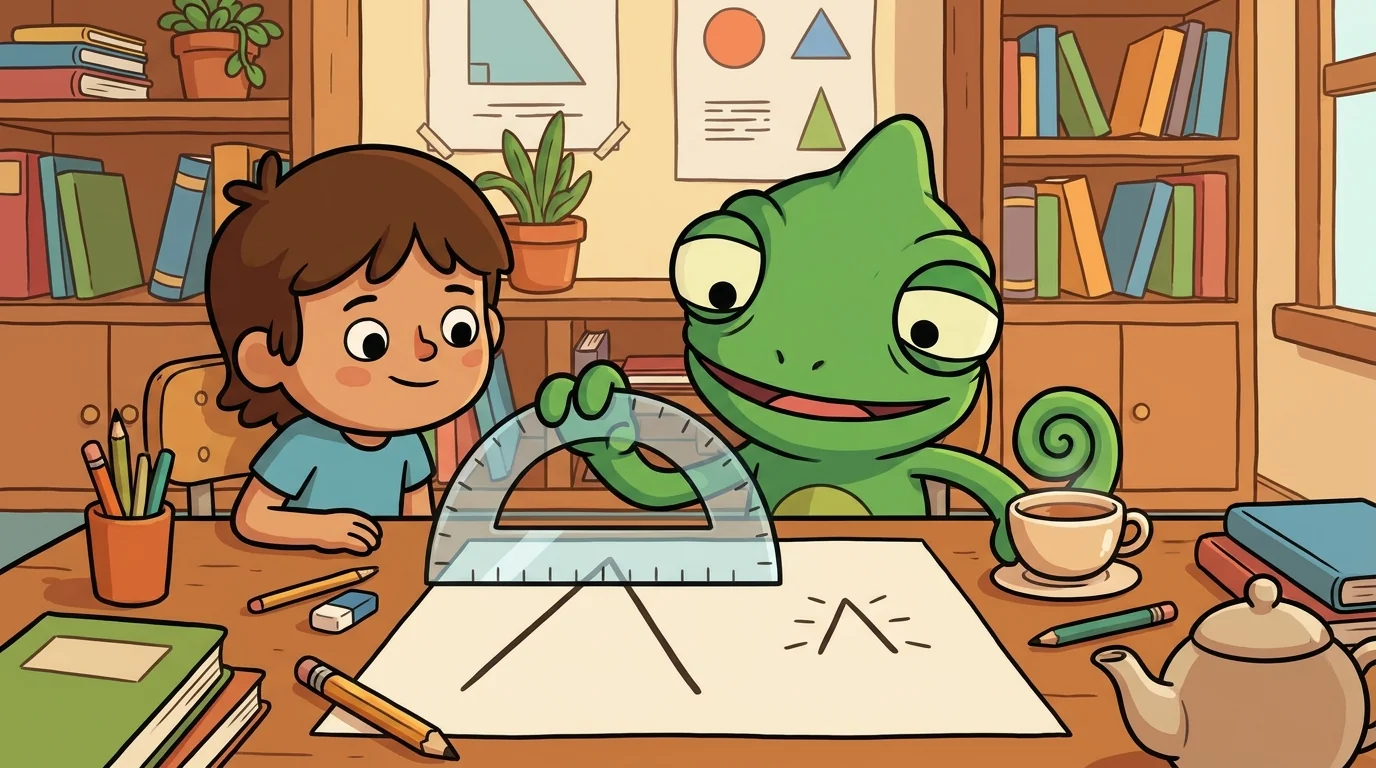
A student was measuring an angle wrong, and getting surer of the wrong answer with every long arm she drew.
She'd made a big open V with two long lines and a tiny open V beside it with two short lines. "This big one's a bigger angle. Obviously. The lines are way longer."
"Are they, though," said Bevel, swiveling one eye toward the paper while the other stayed on his tea. He was a chameleon, slow and deliberate, a protractor tucked behind one eye like a jeweler's loupe. "You're confusing two different quantities. Length is a distance along a line — one dimension, one number. An angle isn't a distance at all. It's a rotation — how far one arm has swung from the other, measured as a fraction of a full turn." He laid his protractor over both Vs. "Thirty degrees. Both. Same turn. You lengthened the arms — you moved the endpoints farther out — but moving a point along its own ray doesn't rotate anything. The turn between the rays is untouched."
The student stared. "But it looks bigger."
"It looks longer," Bevel said, "which your eye keeps mistranslating as wider. Here's the test: rotation is measured at the vertex, where the arms meet, and it depends only on the directions of the two rays — not on how far along them you travel. Stretch the arms to the moon; the directions never changed, so the angle never changed. Thirty degrees on a hair, thirty degrees on a rooftop."
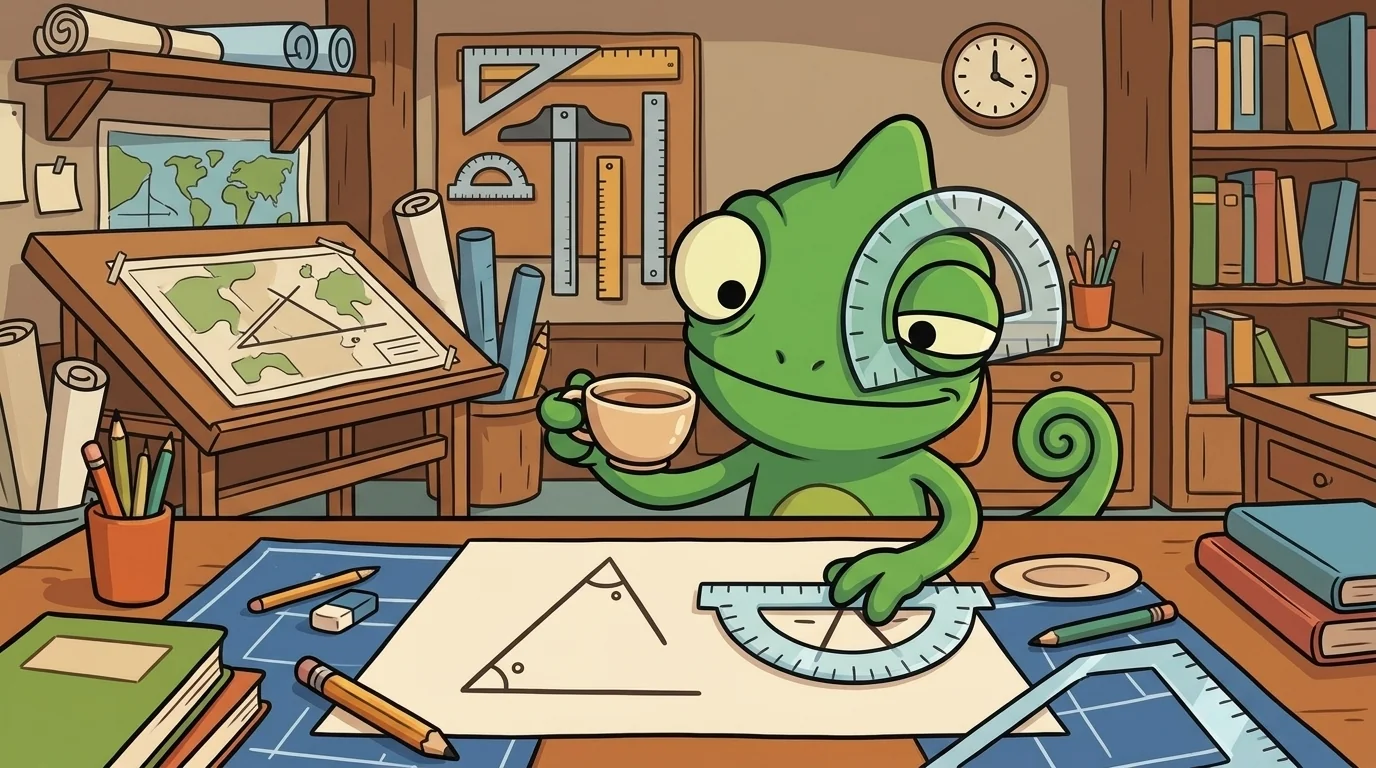
Bevel had learned to separate rotation from length young, in a way that once saved a rooftop.
His family were the angle-setters of MeasureQuest — chameleons, because a creature whose eyes swiveled independently was thought to understand turning from the inside. They set the pitch of roofs, the lean of ladders, the true square of doorframes; get the angle wrong and the whole thing slid.
When Bevel was small, two builders quarreled over a roof — one swore the rafters were "too big an angle" because they were long. His grandfather didn't argue about length. He set a protractor at the peak. "The rafter's length is the carpenter's business — that's a distance. The pitch is mine — that's a rotation, and it reads fifty-five degrees where it needs forty for the rain to run. Long handsome rafters at the wrong pitch are just a wrong turn on stilts." They shortened nothing; they re-set the turn, and the roof sat true. "A degree is a degree," his grandfather said. "It lives in the direction of the arms, never their length." Small Bevel held it: an angle is a rotation, read at the vertex, blind to how far the arms run.
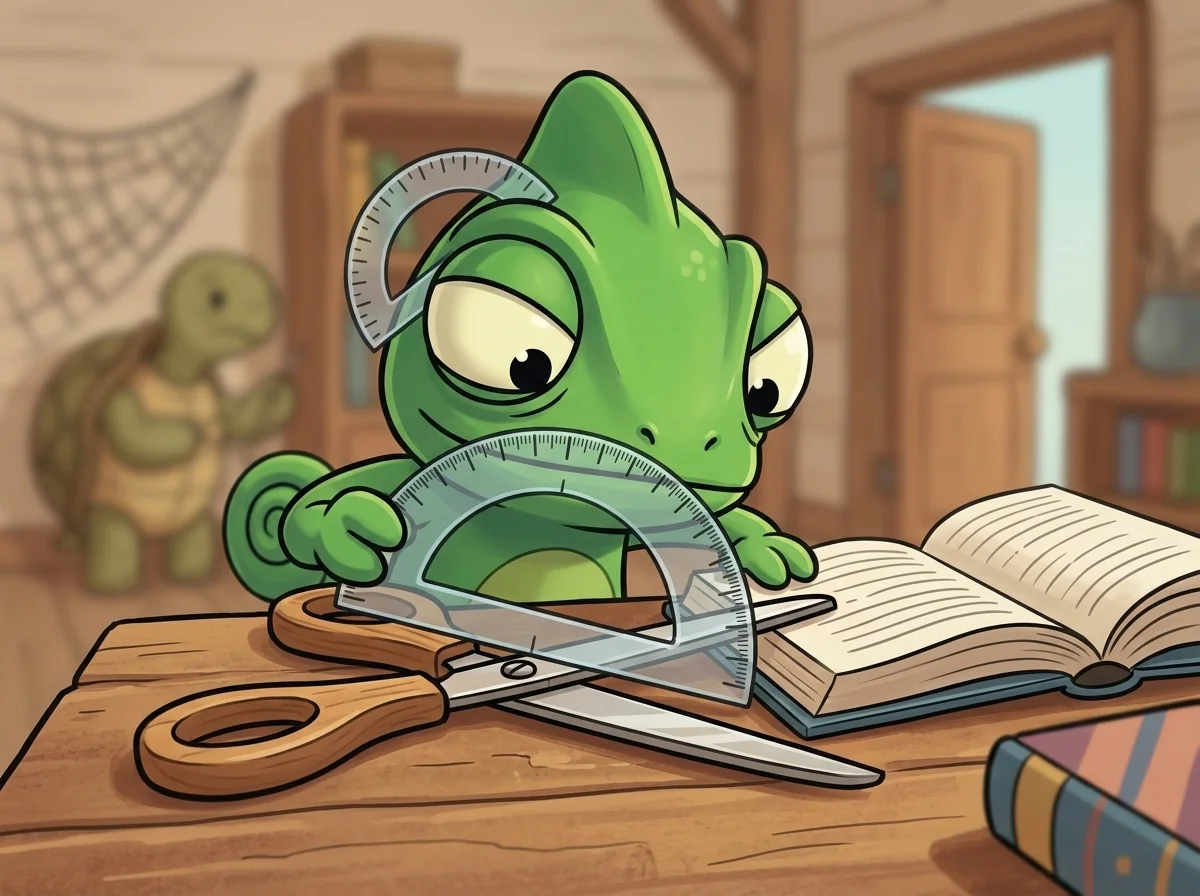
He crept into MeasureQuest at twelve, and Yard the old mentor was mending a net by the wall.
Instead of a quiz, Yard set out a slightly-open pair of scissors, a wide-open book, and a door ajar. "Tell me each angle — and tell me what you're not measuring."
Bevel didn't rush. He laid his protractor at the hinge of the scissors — "the vertex, the pivot, not the tips" — and read twenty degrees; then the book's spine, then the door's swing, each at its hinge. "I'm not measuring the blade length or the door's height," he added, unprompted. "Those are distances. I only want the rotation at the pivot. Measure out at the ends and the arm-length will masquerade as the angle."
Yard finally looked up. "Most kids read at the ends and let size fool them. You read the rotation at the vertex and ignored the arms. Sit down. You've got the craft."

Weeks later, Pip stood at the bench with two paper fans — one small, one enormous — both opened the same amount.
"Same rotation, wildly different arms," Bevel said, both eyes swiveling. "Watch where I put the protractor's center: right on the pivot, where the ribs all meet — not out at the floppy edge. The little fan: sixty degrees. The giant fan —" he shuffled the protractor to its pivot "— also sixty. Three times the ribs, identical turn."
Pip frowned. "It just seems like more."
"It's more fan — more paper, longer ribs, that's area and length, Tile's and Rod's departments. But the turn is one number, and it lives at the vertex. Read the wrong spot — out at the edge — and your number will be about the ribs, not the rotation." He caught her about to measure at a fan's edge. "The center of the protractor on the vertex, the baseline along one arm, read where the other arm crosses. That's the whole procedure. Everything else is the arms showing off."
Pip slid the protractor to the pivot and read sixty and sixty herself. "So the angle lives at the hinge, and the long arms are just... decoration."
"Now you've got it," Bevel said, one eye crinkling. "The turn is the truth. The arms can run as far as they like."
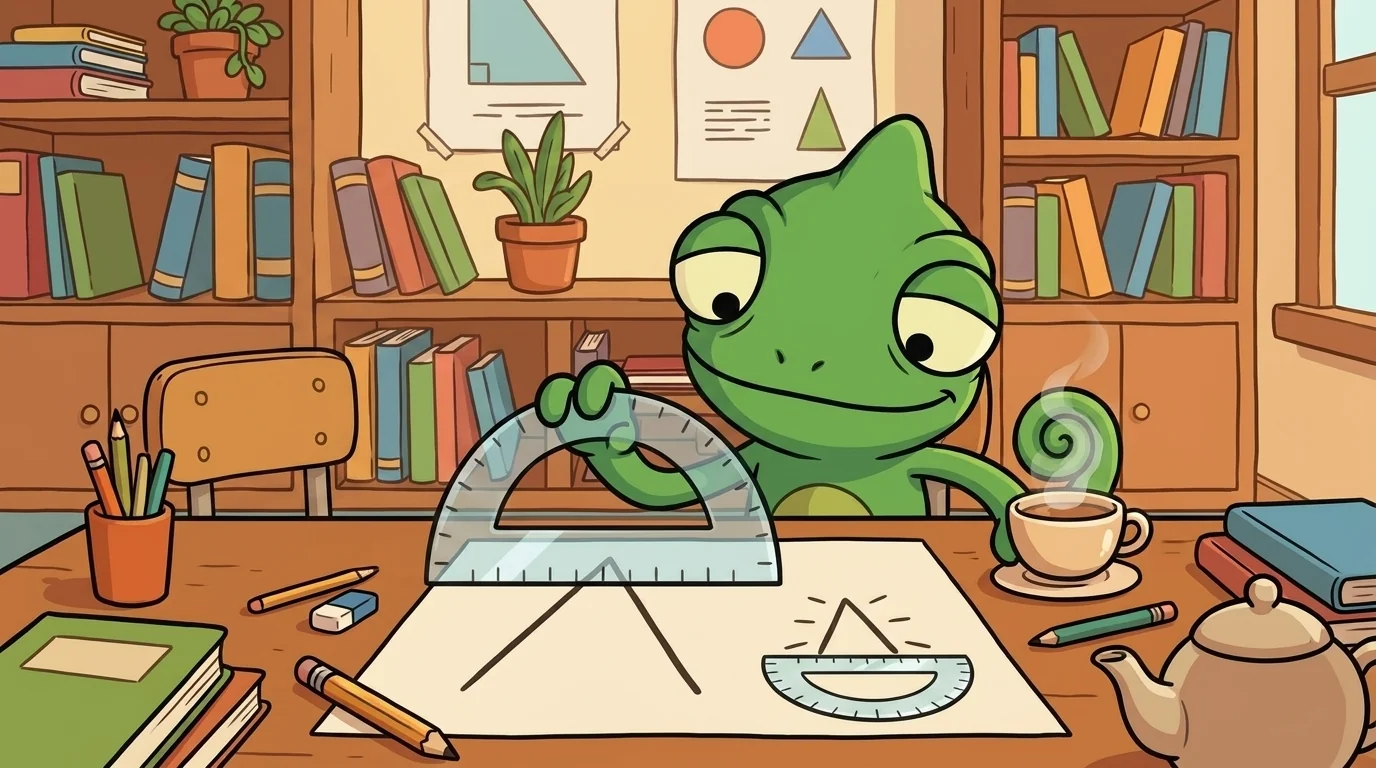
Pip measured both fans from the pivot again — sixty and sixty, the same true rotation, arms be hanged — and there was a small settled feeling in her chest, the click of a thing lined up right.
Bevel let both eyes drift back to his tea, and something in him settled — the quiet of a creature who'd spent his life reading rotations that long handsome arms kept trying to lie about. Somewhere in the memory of it, a leaning roof sat true and shed its rain.
"An angle is the turn, not the length of the arms," he said softly. "Center on the vertex, and don't let long legs fool you. That's the calm part. That's the part worth swiveling round to see."
The MeasureQuest ensemble
Bevel is part of MeasureQuest's distributed-narrative cast. Each character embodies a different curricular primitive; together they teach the full subject.
-

Rod
Linear measurement — length and perimeter (1D extent)
-

Tile
Area — 2D coverage (square units)
-

Cup
Volume and capacity — 3D space (cubic units, liquid measures)
-

Tick
Time — elapsed duration, intervals, and the special-case unit-system (60 / 60 / 24 / 7 / 12)
-

Pace
Unit conversion — translating between metric and customary systems
-

Degree
Temperature — how hot or cold, read off a thermometer; the scale (Celsius/Fahrenheit) you pick matters
-

Tare
Mass and weight — how much stuff there is; grams and kilograms read on a balance
-

Thumb
Estimation — measuring without a tool by comparing to references you carry
-
Whisker
Uncertainty — no measurement is exact; every real number carries a give-or-take (plus or minus)