Cup
VOLUME + CAPACITY
Loading audio…
Press play to listen along. The line being read lights up as you go.
Show full transcript
Loading transcript…
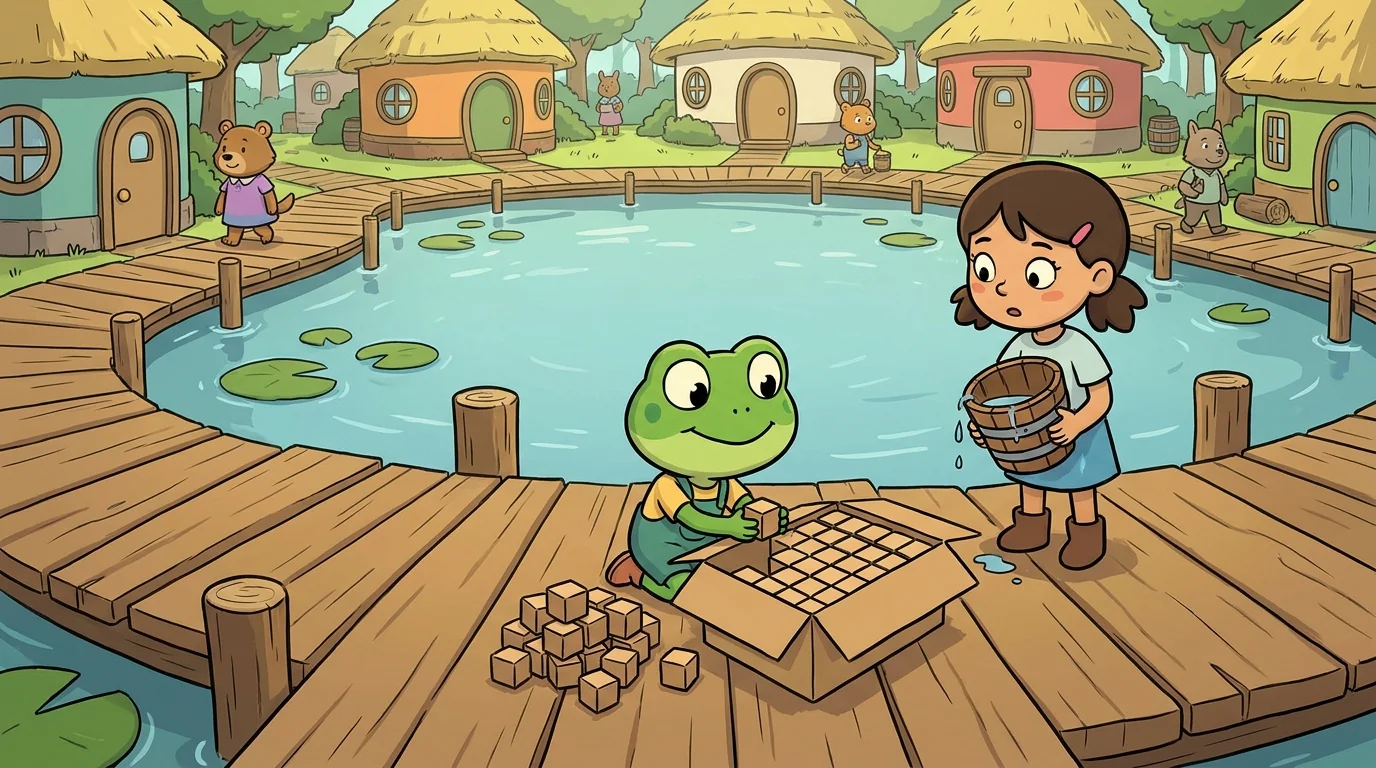
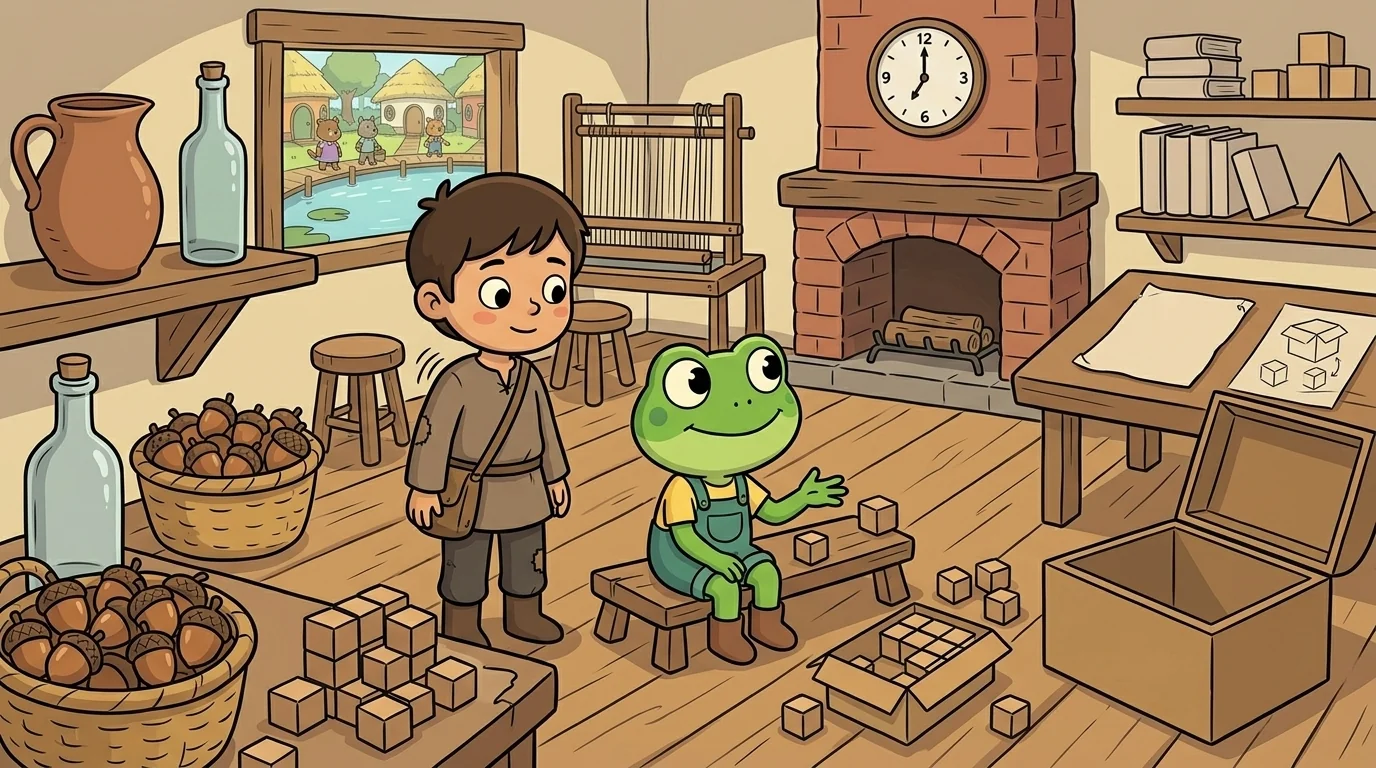
In the middle of the pond-village square, a small green frog-tween was stacking tiny wooden cubes into a shoebox, one careful layer at a time, and grinning like it was the best game in the world.
Cup laid down a row. Then another beside it, and another, until the bottom of the box was a neat little floor of cubes. She counted under her breath — five across, three deep — and pressed them flat with one webbed hand.
"That's one layer," she told the box, as if the box were listening. "Now we go up."
A girl carrying a leaky bucket had stopped to watch. "You're just... filling a box with blocks."
"I'm finding out how much room is inside it," Cup said, without looking up. She built a second layer on top of the first, then a third, then a fourth, humming the whole time. When she was done, the box was packed solid, corner to corner, lid to floor.
"Sixty," she announced, patting it. "Sixty cubes fit. That's how big the inside is." She tipped the box gently so the girl could see the neat grid of them. "Not how tall, not how wide — how much space. Every cube is a little cup of room, and I counted every one."
The girl set down her bucket and peered in. "Could you have just... measured it?"
Cup's whole face lit up. "Oh, I love that question," she said. "Come here. I'll show you the two-face trick."
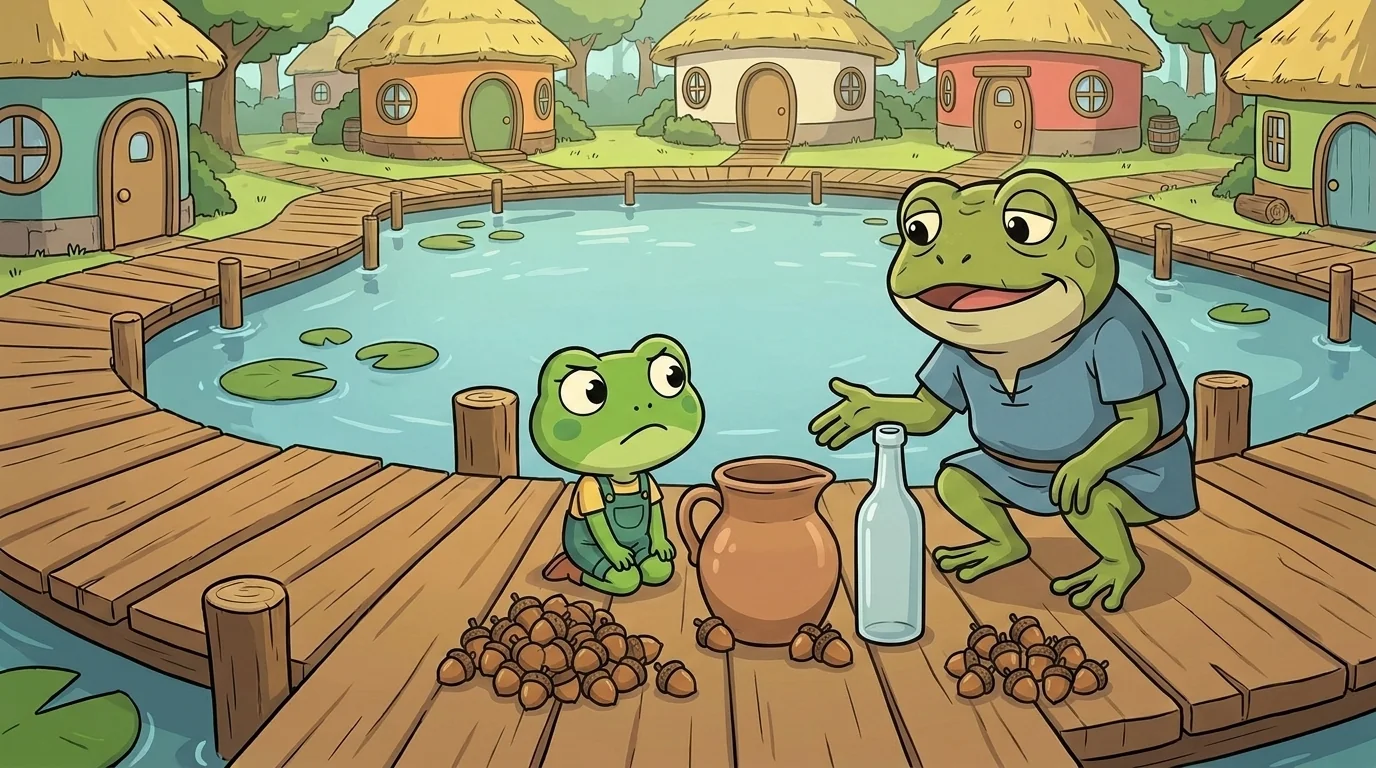
Cup hadn't always trusted the cubes. When she was small, the pond had felt like a bully.
Her family were water-pourers — the frogs who filled the village wells and measured out water for the fields. On her first real morning of work, her grandfather had handed her a fat clay jug and a slim tall bottle and asked her to say which one held more. Cup had stared. The bottle was taller. So she'd said the bottle, confident.
Her grandfather had poured the bottle into the jug. It filled it barely halfway.
Cup's ears had gone hot. She felt small and wrong, the way you do when your eyes lie to you in front of someone you want to impress. "But it looked bigger," she'd whispered.
"Tall isn't the same as roomy, little pour," her grandfather said. He wasn't cross. He crouched down beside her. "Your eyes measured one thing — how high it stood. But water doesn't care how tall. Water cares how much room. Wide room. Deep room. All of it, added up." He tapped the jug. "Fill it with something you can count, and it stops fooling you."
That afternoon Cup filled the jug with acorns, one by one, then the bottle, then counted both piles. The jug won by a landslide. And the hot, foolish feeling melted into something else entirely — a slow, steady certainty. The water hadn't tricked her. She just hadn't known how to ask it the right question yet. Now she did.
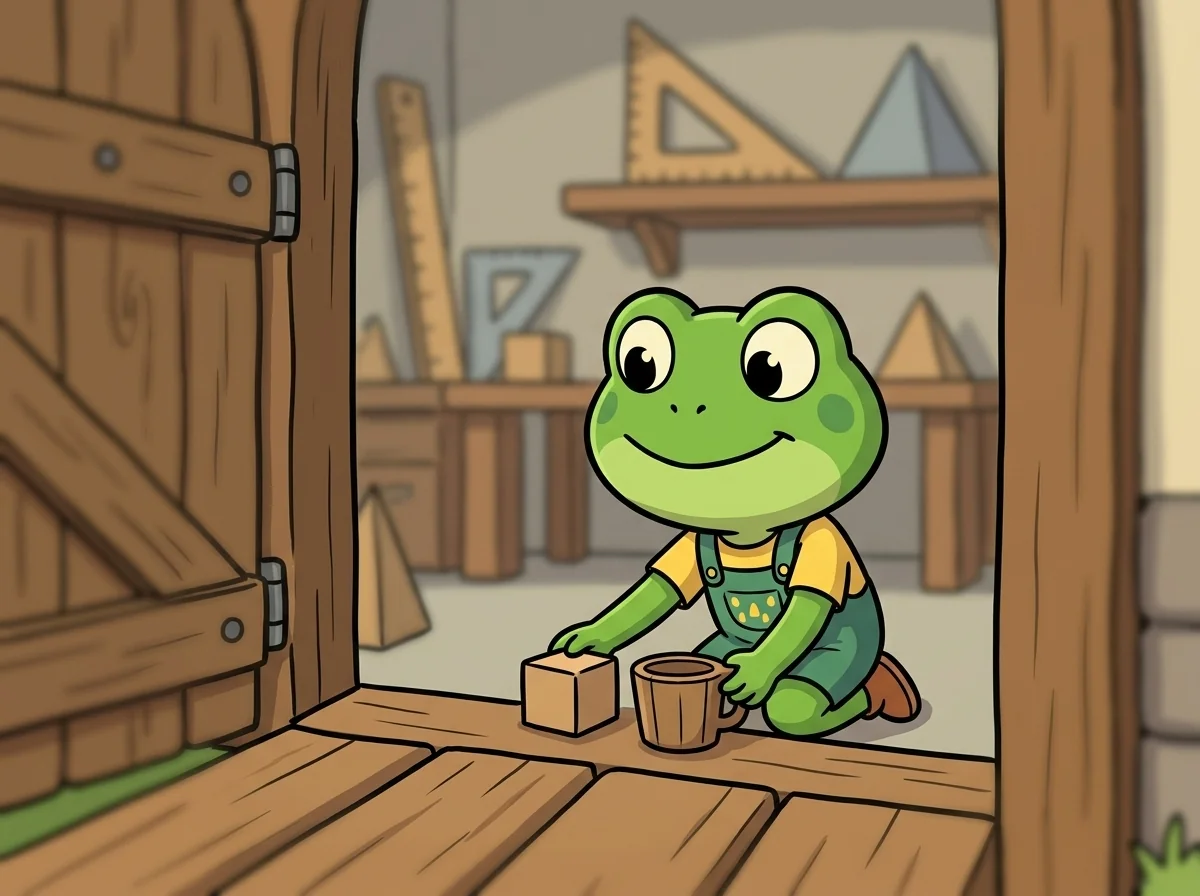
She walked to MeasureQuest at twelve, because a place that studied how big things were ought to care about the hardest kind of bigness — the kind that hides on the inside.
Yard, the old mentor who kept the workshops, met her at the gate. He didn't ask her to lift anything or prove she was clever. He asked one thing. "What is volume?"
Cup didn't answer straight away. She set down her satchel, took out a single small cube and a squat measuring-cup, and placed them side by side on the gatepost.
"This one," she said, touching the cube, "is how much room a solid thing takes up. You count the little cubes that fit inside it." Then she touched the cup. "This one is how much room a container can hold. Also little cubes — you just pour instead of stack." She looked up at him. "People give them two names. Volume. Capacity. But they're the same question wearing two coats. How much room is in there?"
Yard was quiet for a moment. Then he almost smiled. "You belong here," he said.
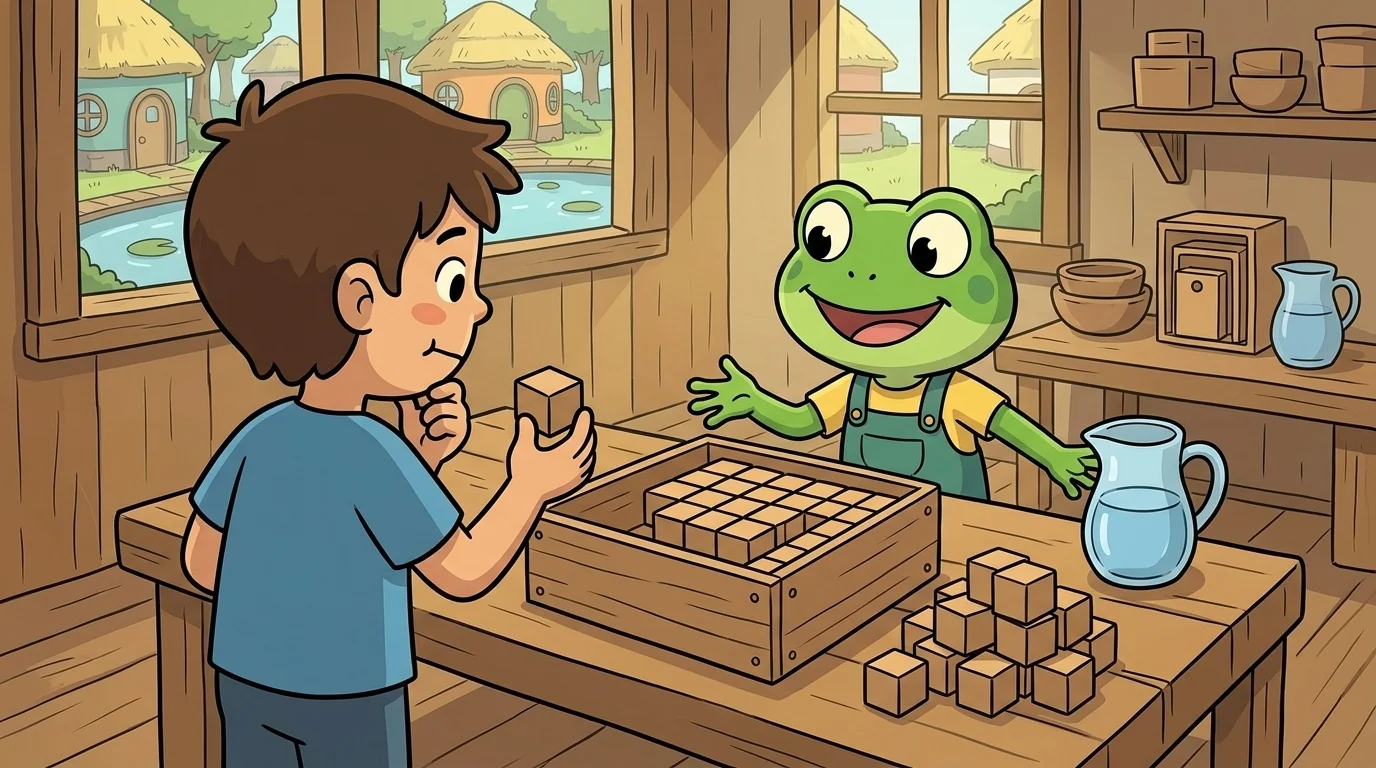
Cup's workshop was full of things that turned out to be roomier — or emptier — than they looked.
A boy came in one afternoon, chewing his lip over a homework page. "I have to find the volume of this box," he said, "and I keep getting the formula wrong. Length times width times... something. I don't even know what I'm doing."
Cup didn't reach for the formula. She reached for her box of cubes.
"Forget the formula for a second," she said. "How long is the bottom of your box?"
"Five."
"Lay me five cubes." He did. "How deep?"
"Three." He filled the row into a little floor — five across, three back. He counted without being asked. "Fifteen. That's one layer."
"Good. Now — how tall is the box?"
"Four."
"So how many layers?"
The boy stopped. She watched him get it — watched his hand hover over the fifteen cubes and then lift, once, twice, four times, stacking the idea in the air. "Four layers of fifteen," he said slowly. "That's... sixty."
"Sixty cubes. Sixty little rooms." Cup grinned. "And that's your formula. Five times three times four. It's not a magic spell. It's just counting the layers fast." She slid a pitcher of water across the bench. "Same with liquid. This holds a thousand of those cubes' worth of room — we call it a litre, but it's the same cubes, just poured. The number was never the point. The room was."
The boy looked at his page again, and this time he didn't chew his lip.
Later, when the workshop had emptied out, the boy stuck his head back in. Quieter now.
"When I get an answer," he said, "how do I know it's right? The formula gives me a number, but the number doesn't feel like anything."
Cup thought about the clay jug. About the tall bottle that lied, and the hot-eared feeling, and the acorns she'd counted until the truth stopped hiding.
"You build it back," she said gently. "In your head, or with real cubes if you can. If the number matches the room you can picture filling — layer on layer on layer — then it's honest. The formula's only a shortcut for counting. When you can still see the counting behind it, you're not lost anymore. You're just fast."
The boy nodded, and she watched something loosen in his shoulders — the same easing she'd felt at the edge of the pond, years ago, when the water finally stopped fooling her.
She didn't say the rest out loud, but she felt it, warm and round as a full jug: the most confusing things are usually just the ones you haven't filled up yet. Pour them full, one cube at a time, and the fear runs right out the bottom.
Hear it as an audio drama
A short play starring Cup, from MeasureQuest. Different voices, same idea. Listen any time after you read.
Loading audio…
Read the drama script
- Narrator: From Spark and Anvil and MeasureQuest — this is Cup, in chapter 1 of the MeasureQuest cast.
- Narrator: This drama uses an AI-generated voice. Voiced via Gemini 2.5.
- Narrator: Cup is a small frog tween. Round-bellied, in a chunky-cartoon way. She wears warm overalls. Tucked into her front pocket: a small set of nesting measuring cups, each one fitting inside the next. In her other paw: a small box of unit cubes — each cube exactly one centimeter wide, one centimeter long, one centimeter tall.
- Narrator: Cup is warm green and cream, with a cream belly. She is deeply patient about three-dimensional space. Her favorite saying is the essential principle of her measurement craft.
- Cup: Volume is how many cubes fit. Three-dimensional space. Cubic units. Capacity is the same idea — how many cubes a container can hold.
- Narrator: Cup is all about volume and capacity — three dimensional measurement, extending area into a third dimension. Most novices conflate volume — the three-dimensional extent of an object — and capacity — how much a container can hold. They are the same physical idea. Just measured for different purposes.
- Cup: I am Cup. What I teach is volume and capacity. The move is — count the cubes. The cubes are the units. The count is the measurement.
- Narrator: At the MeasureQuest workshop, a young measurer is at the work table. They have just finished a lesson with Tile, who taught them about area. They have learned how to count unit squares to measure two-dimensional space. Now they are wondering — how do you measure something that has thickness?
- Student: Tile taught me how to measure a rectangle. Count the squares. But what about a box? It has three sides.
- Cup: Then we add a third dimension. We do not count squares anymore. We count cubes. Each cube is one centimeter on each side. The cube is our unit. Watch.
- Narrator: Cup places a small box on the work table. It is a small open-topped box, roughly the size of a teacup. She picks up a unit cube. She drops it into the box. Clink.
- Cup: One cube. That is one cubic centimeter of space, occupied. Now I keep adding cubes.
- Narrator: She drops in more. Clink. Clink. Clink. The cubes pile up. They fill the bottom layer of the box first — a flat layer covering the floor.
- Cup: That is the first layer. Count the cubes in the first layer. Six cubes across. Four cubes deep. Twenty-four cubes in the first layer.
- Student: Twenty-four.
- Cup: Now I add a second layer. Then a third. Then a fourth. The box is four cubes tall.
- Narrator: She fills in the layers. Each layer is twenty-four cubes. The box ends up with four layers stacked. The student watches the layers fill.
- Student: Twenty-four cubes per layer, four layers tall, so — ninety-six cubes total.
- Cup: Yes. Ninety-six cubic centimeters. That is the volume of the box. Volume is how many cubes fit. Length times width times height equals the count of cubes. Six times four times four equals ninety-six.
- Student: And capacity?
- Cup: Capacity is the same thing, asked a different way. Volume asks — how much space does this object take up? Capacity asks — how much can this container hold? Same physical idea. Same number. The box has a volume of ninety-six cubic centimeters. The box has a capacity of ninety-six cubic centimeters. Same.
- Student: But what about liquid? Like in a measuring cup?
- Cup: Liquid measurement works the same way. A milliliter is the same as one cubic centimeter. One mL equals one cc. They are different names for the same volume. A bottle that holds one liter — one thousand milliliters — holds one thousand cubic centimeters. The same as a box that would fit one thousand unit cubes.
- Narrator: Cup picks up a small measuring cup from her pocket. She pours water into it. The water fills the cup. The water level reaches a line on the side that says — 100 mL.
- Cup: One hundred milliliters of water. Which is the same as one hundred cubic centimeters. Which would be the same as one hundred unit cubes — if cubes did not flow. Liquid flows, so it fills any shape. Cubes are stiff, so they only fit in cube-shaped or compatible spaces. But the volume — the amount of three-dimensional space — is the same.
- Student: So volume can be measured with cubes, or with liquid, or with any unit that takes up three dimensions.
- Cup: Yes. The cube is one good unit. Milliliters are another. Gallons. Liters. Cups. Quarts. Pints. Cubic inches. Cubic feet. Cubic meters. Each one is a way of asking — how much three-dimensional space? The unit changes. The question is the same.
- Student: Volume is how many cubes fit. Capacity is how many cubes a container can hold. Same idea.
- Cup: Same idea. The cube is the simple unit. Other units exist too. Some measure the same volume as a different number of cubes. But the underlying question is always — how much three-dimensional space? Count the cubes. The count is the measurement. The measurement is the answer.
- Narrator: Cup empties the box, one cube at a time. The student watches each cube come out. The volume was real. The count was the measurement. The three dimensions were the truth. The student picks up the small measuring cup. They look at the line for 100 mL. They imagine 100 unit cubes filling that space. The picture clicks. Three dimensions become countable. Volume becomes a number. The measurement is the answer.
- Narrator: You've been listening to a Spark and Anvil chapter, written by the Spark and Anvil writing team for ages 9 to 14.
- Narrator: Apps stay free forever.
- Narrator: Curriculum aligned to Common Core math.
- Narrator: Released under Creative Commons BY-NC-SA 4.0 for educational reuse. Visit Spark and Anvil for the full transcript.
More stories with Cup
Another short audio story about Cup. Open one when you are ready.
Volume capacity
Loading audio…
Read the script
- Narrator: From Spark and Anvil and MeasureQuest — this is Cup, in chapter 1 of the MeasureQuest cast.
- Narrator: This drama uses an AI-generated voice. Voiced via Gemini 2.5.
- Narrator: Cup is a small, round-bellied frog, green like moss. She carries nesting measuring cups and a box of unit cubes.
- Cup: The entire lesson is simple, and it is the whole truth. Volume is how many cubes fit.
- Narrator: For Cup, volume—the space an object fills—and capacity—how much a container holds—are the same physical idea.
- Cup: You must not get tangled in the different words. It is the same counting, the same craft, the same 3D space.
- Narrator: She grew up in a pond-village. Her family were the official water-pourers, who measured for the community wells.
- Cup: We learned that the water doesn't care what unit you use. The careful counting is what matters.
- Narrator: She walked to the MeasureQuest academy at twelve. Her mentor met her at the gate with one question.
- Cup: He asked, "What is volume?" I gave the answer I knew from my cubes and my family's water.
- Cup: I told him, "It's how many cubes fit. Capacity is the same idea, just for a container."
- Narrator: With that simple truth, she was appointed.
- Narrator: How many cubes fit. That is the whole lesson. That is the three-dimensional extension of the same craft.
- Narrator: You've been listening to a Spark and Anvil chapter, written by the Spark and Anvil writing team for ages 9 to 14.
- Narrator: Apps stay free forever.
- Narrator: Curriculum aligned to Common Core math.
- Narrator: Released under Creative Commons BY-NC-SA 4.0 for educational reuse. Visit Spark and Anvil for the full transcript.
The MeasureQuest ensemble
Cup is one of the friends in MeasureQuest. Each friend shows you one idea by how they act; meet them all and you have the whole subject.
-

Rod
Linear measurement — length and perimeter (1D extent)
-
Tile
Area — 2D coverage (square units)
-
Tick
Time — elapsed duration, intervals, and the special-case unit-system (60 / 60 / 24 / 7 / 12)
-
Pace
Unit conversion — translating between metric and customary systems
-
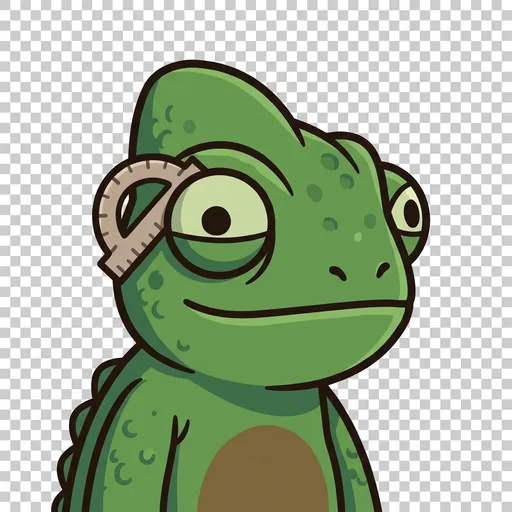
Bevel
Angle — how much a turn, not how long a line; measured in degrees on a protractor
-

Degree
Temperature — how hot or cold, read off a thermometer; the scale (Celsius/Fahrenheit) you pick matters
-
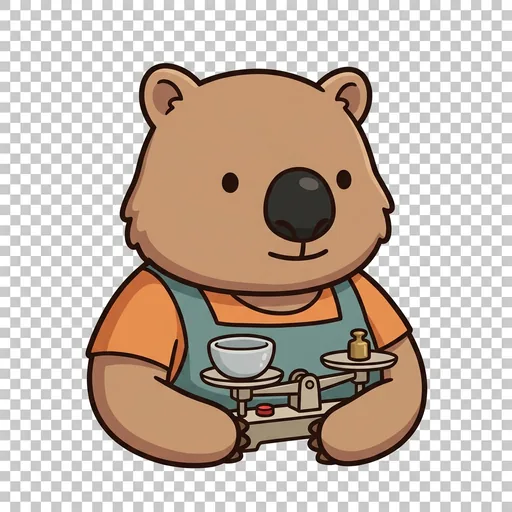
Tare
Mass and weight — how much stuff there is; grams and kilograms read on a balance
-

Thumb
Estimation — measuring without a tool by comparing to references you carry
-
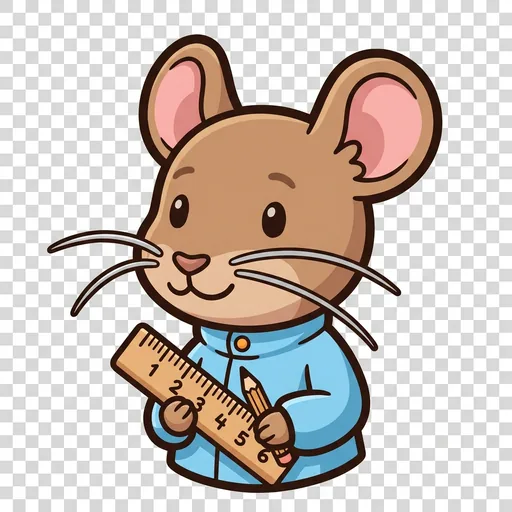
Whisker
Uncertainty — no measurement is exact; every real number carries a give-or-take (plus or minus)


