
Degree
TEMPERATURE — how hot or cold, read in degrees. A temperature SCALE is an AFFINE choice: you pick a zero and a step-size, so Celsius and Fahrenheit label the SAME physical warmth with different numbers (a linear conversion between them). And a reading only becomes true at THERMAL EQUILIBRIUM — you wait for the thermometer to stop climbing, because until then you're reading the instrument catching up, not the thing.
Loading audio…
Press play to listen along. The line being read lights up as you go.
Show full transcript
Loading transcript…

Two students were arguing about the weather, and neither was wrong, which was the problem.
"It's twenty out," said one. "Warm." "It's sixty-eight," said the other. "Also warm — but a totally different number."
"You're reading the same air," said Degree, sliding down from her sunny rock, a thermometer looped round her neck like a necklace. "Same warmth on your skin. You're each holding a ruler for hotness with different numbers painted on it. Here's the exact idea: a temperature scale is a choice of two things — where you put zero, and how big each step is. Celsius parks zero at water's freezing point and makes a hundred steps to boiling. Fahrenheit parks zero somewhere else and uses smaller steps. Twenty and sixty-eight are the same warmth wearing two labels, and there's a fixed conversion between them because both are just straight-line rescalings of the one real quantity."
The students blinked. "So which number is right?"
"Both. Neither. The warmth is right," Degree said, basking. "The air is exactly as warm as it is — that's the physical fact. The number depends on the zero and the step you brought. Change the scale, change the number; the afternoon doesn't get one degree warmer because you counted it differently. That's the difference between the thing and the label for the thing."

Degree had learned this young, in a way that once stopped a fight over a fever.
Her family were the temperature-readers of MeasureQuest — lizards, because a creature that basked all day was thought to understand heat from the inside. When Degree was small, two families quarreled over a feverish child: a northern thermometer read one scale, a coastal one another, the numbers didn't match, and each accused the other of a broken instrument while the child lay exactly as hot as she was.
Degree's grandmother set both under the child's tongue. "Thirty-nine here. A hundred and two there. Neither is broken." She unrolled a little chart. "Same heat, two languages — thirty-nine is a hundred and two, by a fixed rule. One fever, two labels." The quarrel dissolved. "A scale is a choice about how to count the heat," her grandmother said. "It never changes how hot the child truly is." Small Degree held it: the warmth is the real thing; the number is only the language, and the languages convert.
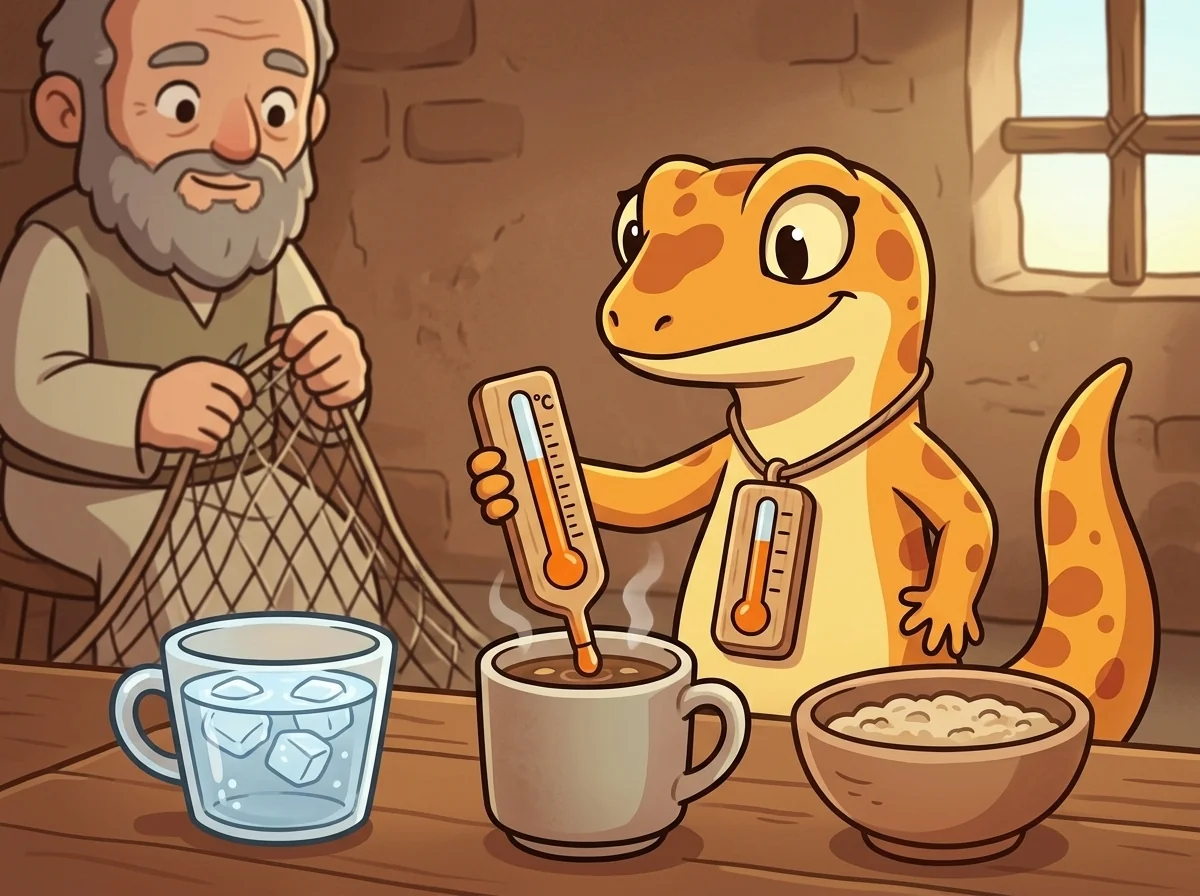
She slid into MeasureQuest at twelve, and Yard the old mentor was mending a net.
Instead of a quiz, Yard set out ice-water, a mug of soup, and room-warm porridge. "Tell me how hot each is — and tell me what your number even means."
Degree didn't rush. She dipped her thermometer and waited — "you wait, or you read the thermometer's own coldness, not the soup's" — then read each. "These are Celsius. The ice-water's near zero because that's where I chose my zero — water's freezing point. In Fahrenheit they'd wear bigger numbers, same cold and heat." Yard looked up. "Most kids read the number and stop. You told me what the number is — a chosen scale laid over a real warmth, only true once it settles. Sit down. You've got the craft."
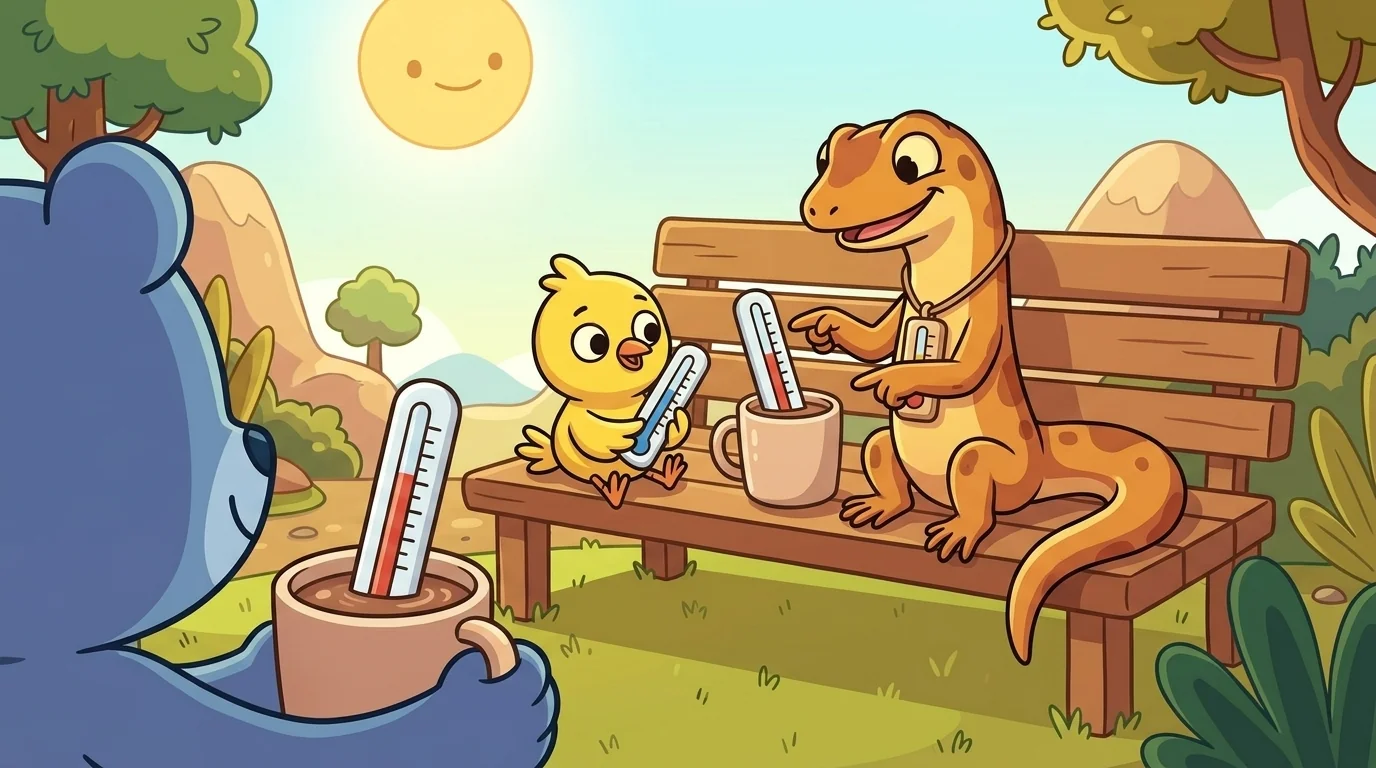
Weeks later, Pip frowned at a mug of cocoa, thermometer in hoof.
"Watch me read it," Degree said, coiling near. "Bulb in the cocoa, not against the mug — the mug's cooler than what's in it. And I wait: see the number climbing? It's not done. Right now the thermometer and the cocoa aren't at the same temperature yet — the reading is the instrument catching up. That settling is called reaching equilibrium." It steadied. "There. Fifty-two Celsius. Hot, not scalding."
Pip peered. "My gran's thermometer would say a hundred-twenty-something."
"And her cocoa and mine would be exactly as warm. Her scale paints bigger numbers — different zero, smaller steps — fifty-two and a-hundred-twenty-six are the same mug, one converts to the other." She caught Pip yanking the thermometer out early on a second mug. "Wait for equilibrium. A number read before the thermometer's caught up isn't the cocoa's temperature — it's a half-finished guess about the instrument."
Pip held still until the number stopped climbing. "So the temperature's real," she said slowly, "but the number I write depends on which scale I grabbed — and it's only true once it settles."
"Now you've got it," Degree said. "The heat is the truth. The scale is how you chose to count it. Wait for equilibrium, name your scale — same warm cocoa the whole time."

Pip read the cocoa again, waiting for it to settle, and got fifty-two — a real warmth she could hand to anyone with a Celsius thermometer — and there was a small settled feeling in her chest, a fuzzy "kind of warm" turned into an honest number.
Degree stretched back toward her rock and let out a slow, content breath, warm all through — the ease of a creature who'd spent her life turning "it's hot" into a number two strangers could agree on. Somewhere in the memory of it, two families stopped quarreling over one feverish child.
"The warmth is the truth; the number is the language," she said softly. "Wait for it to settle, and say which scale you're speaking. That's the calm part. That's the part worth basking on."
The MeasureQuest ensemble
Degree is part of MeasureQuest's distributed-narrative cast. Each character embodies a different curricular primitive; together they teach the full subject.
-

Rod
Linear measurement — length and perimeter (1D extent)
-

Tile
Area — 2D coverage (square units)
-

Cup
Volume and capacity — 3D space (cubic units, liquid measures)
-
Tick
Time — elapsed duration, intervals, and the special-case unit-system (60 / 60 / 24 / 7 / 12)
-

Pace
Unit conversion — translating between metric and customary systems
-
Bevel
Angle — how much a turn, not how long a line; measured in degrees on a protractor
-
Tare
Mass and weight — how much stuff there is; grams and kilograms read on a balance
-

Thumb
Estimation — measuring without a tool by comparing to references you carry
-
Whisker
Uncertainty — no measurement is exact; every real number carries a give-or-take (plus or minus)