
Whisker and Thumb
WHISKER & THUMB — a measurement is always a VALUE plus a CONFIDENCE. Thumb reports a rough 'about' from a calibrated body-ruler; Whisker reports a fine 'give or take' set by instrument resolution. Both are intervals, and two honest intervals can CROSS-CHECK each other — a quick estimate that overlaps a careful reading confirms both; a wild disagreement flags an error. Faking an exact number is the one dishonest move.
Loading audio…
Press play to listen along. The line being read lights up as you go.
Show full transcript
Loading transcript…
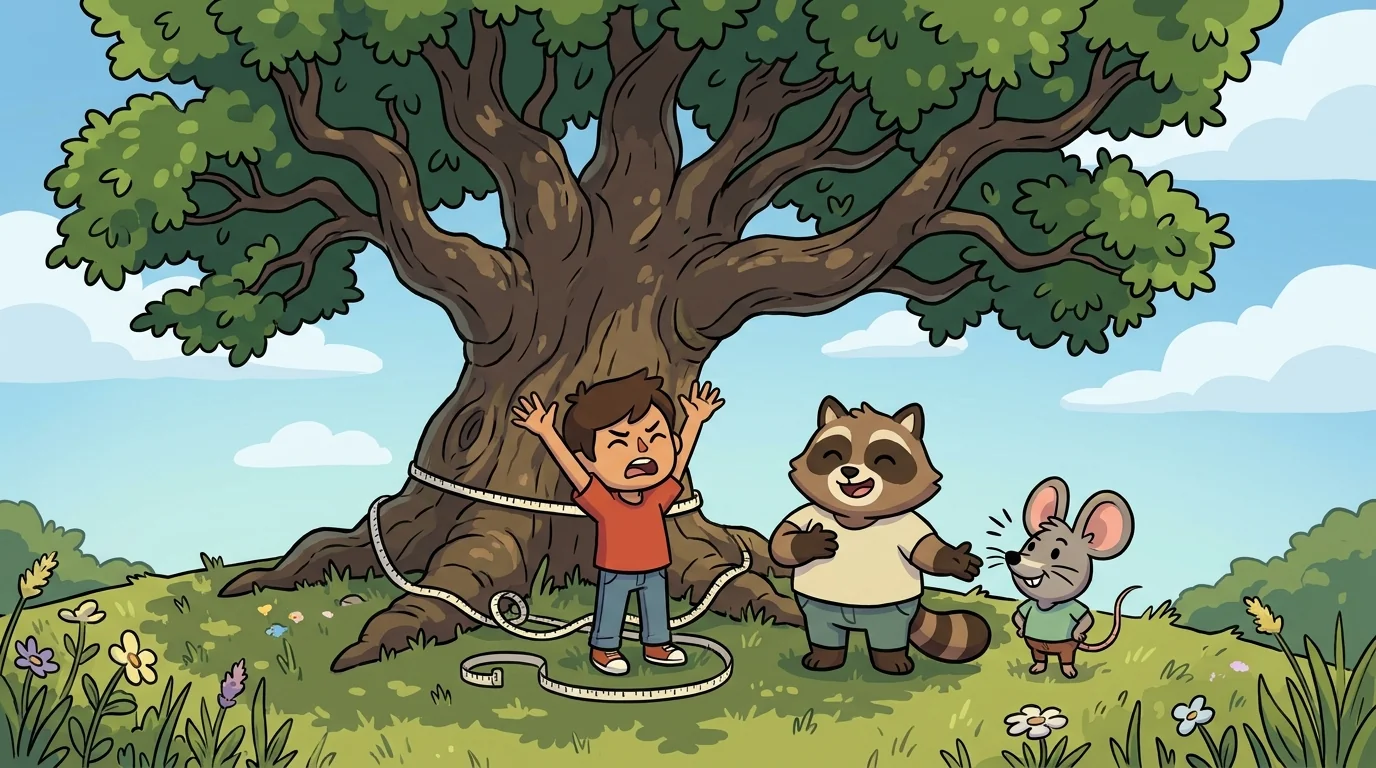
A student wanted to know exactly how tall the big oak was, and got more frustrated the more she tried.
"I need the exact height. To the millimeter. It's for the record."
"You'll be waiting a long time," said Thumb the raccoon, ambling up. "Nobody's laying a tape up a forty-foot oak — and even if they did—" "—it wouldn't be exact," said Whisker the mouse, whiskers twitching. "Nothing is. Not the tape, not the tree, not the wind moving the top. You're chasing a number that doesn't exist."
The student threw up her hands. "So it's hopeless?"
"Not hopeless — you just have to be honest about how well you can know it," Thumb said. "That's our whole department. Here's the idea both of us live by: a measurement isn't a bare number, it's a number and an interval of confidence — a value plus how far off it might be. Two of us, because there are two ends of that honesty. I work the rough end — a good 'about' with no tape at all. Whisker works the fine end — exactly how much doubt even a good tool leaves. Between us you get an honest height, just not a fake-exact one, because there's no such thing."
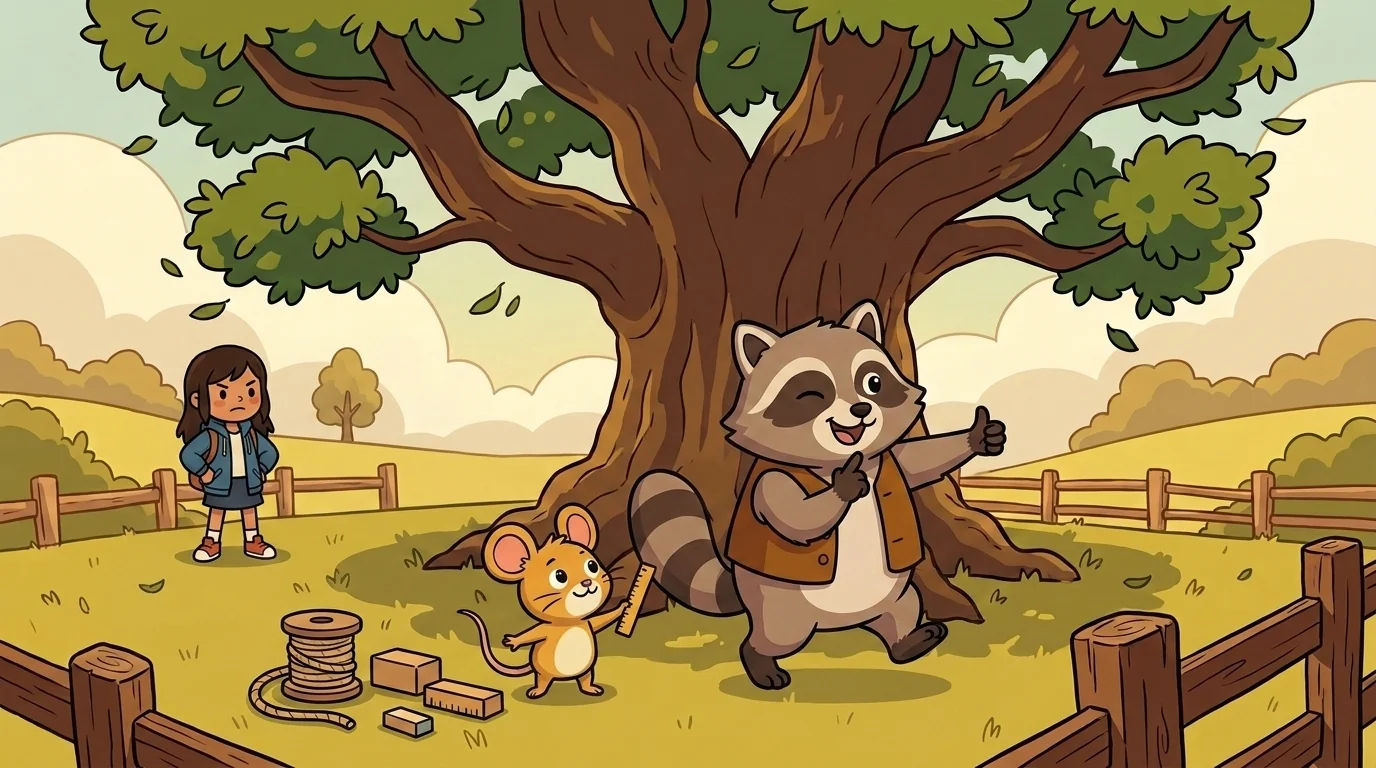
Thumb went first, because sometimes a good rough number is all you need.
"No tape up the tree? I'll use what I carry." He paced back, counting strides, held his thumb up at arm's length, and did a scout's sighting trick — comparing the tree to stacked copies of himself. "About six of me tall. I'm about a meter and a half. So — about nine meters. Give or take a meter, honestly; it's a rough method, so the interval's wide."
The student frowned. "But 'about nine' isn't the exact record I wanted."
"It's an honest nine — a value, nine, and an interval, give-or-take-a-meter, from a calibrated ruler I carry. That's not lazy; it's clear. Fast, free, and good enough to know it won't hit the power line." He nodded at Whisker. "But haul out the best tool in the guild, and even then it's not exact."
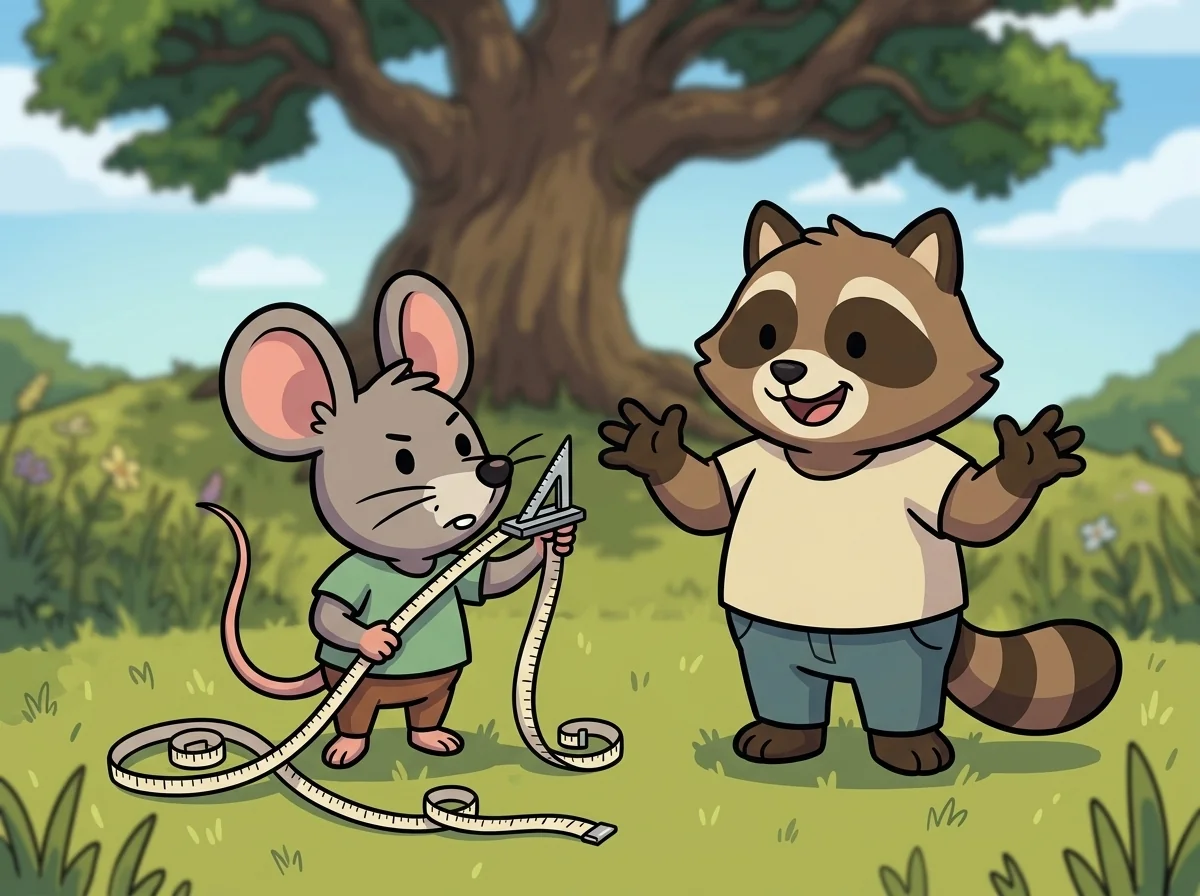
Whisker took over, unrolling a fine line and a clever angle-tool.
"Do it properly," she said. "Measure the distance to the tree with a good tape, the angle to its top with a fine tool, and compute the height." She did, whiskers over every reading. "Eight point seven meters. But — my tape resolves to the centimeter, my angle-tool has its own wobble, the treetop swayed a hair as I sighted. Add those doubts and the honest answer is eight point seven meters, give or take about twenty centimeters."
The student blinked. "So even the careful way isn't exact?"
"Nothing is. My careful interval — twenty centimeters — is far tighter than Thumb's rough meter, because my tool resolves finer. But neither of us can hand you a perfect number; perfect numbers aren't real. The tree is exactly as tall as it is; every measurement is a value and an interval." She looked at Thumb. "He says 'about,' I say 'give or take.' Same honesty, two resolutions."
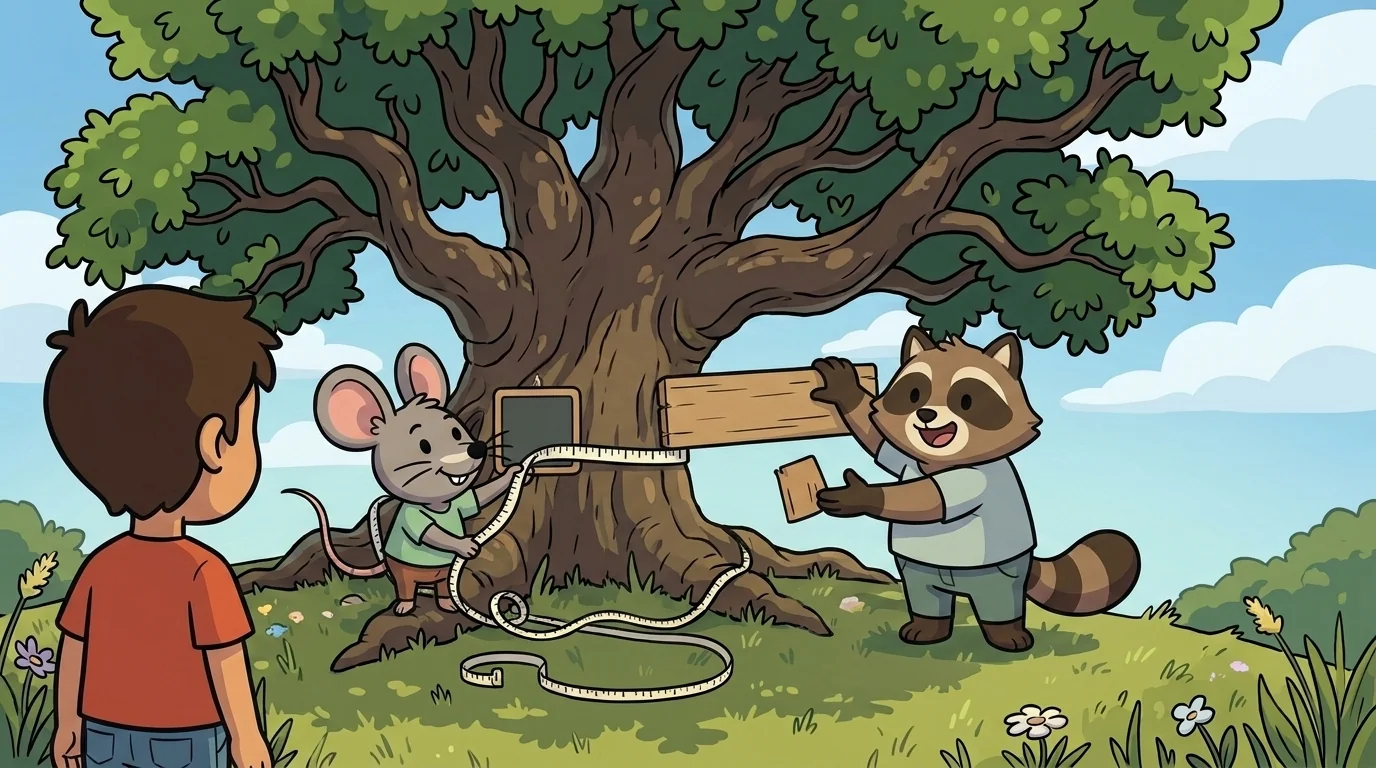
Then they measured together, both ways at once, and the student saw the one idea under both — and a bonus.
"Line them up," Thumb said. "My rough interval: about nine, give-or-take-a-meter — call it eight to ten. Her fine interval: eight point seven, give-or-take-twenty-centimeters — call it eight-point-five to eight-point-nine." He grinned. "They overlap. Her whole range sits inside mine. That's how you cross-check an estimate: if my quick 'about nine' had landed wildly outside her careful reading — say I'd got fifteen — one of us blundered, and we'd re-measure. They agreed, so both are trustworthy. Two honest intervals that overlap confirm each other; two that don't flag an error."
The student looked at the rough and the fine, each carrying its interval. "So neither of you gave me an exact number. But you both gave me an honest one — a value, and how much to trust it — and they check each other."
"That's the whole secret of measuring anything real," Whisker and Thumb said together. "It's never just a number. It's a value and a confidence. Thumb says 'about' when rough is enough. Whisker says 'give or take' when she's measured fine. But neither ever fakes an exact number — because faking exact is the one truly dishonest thing a measurer can do."
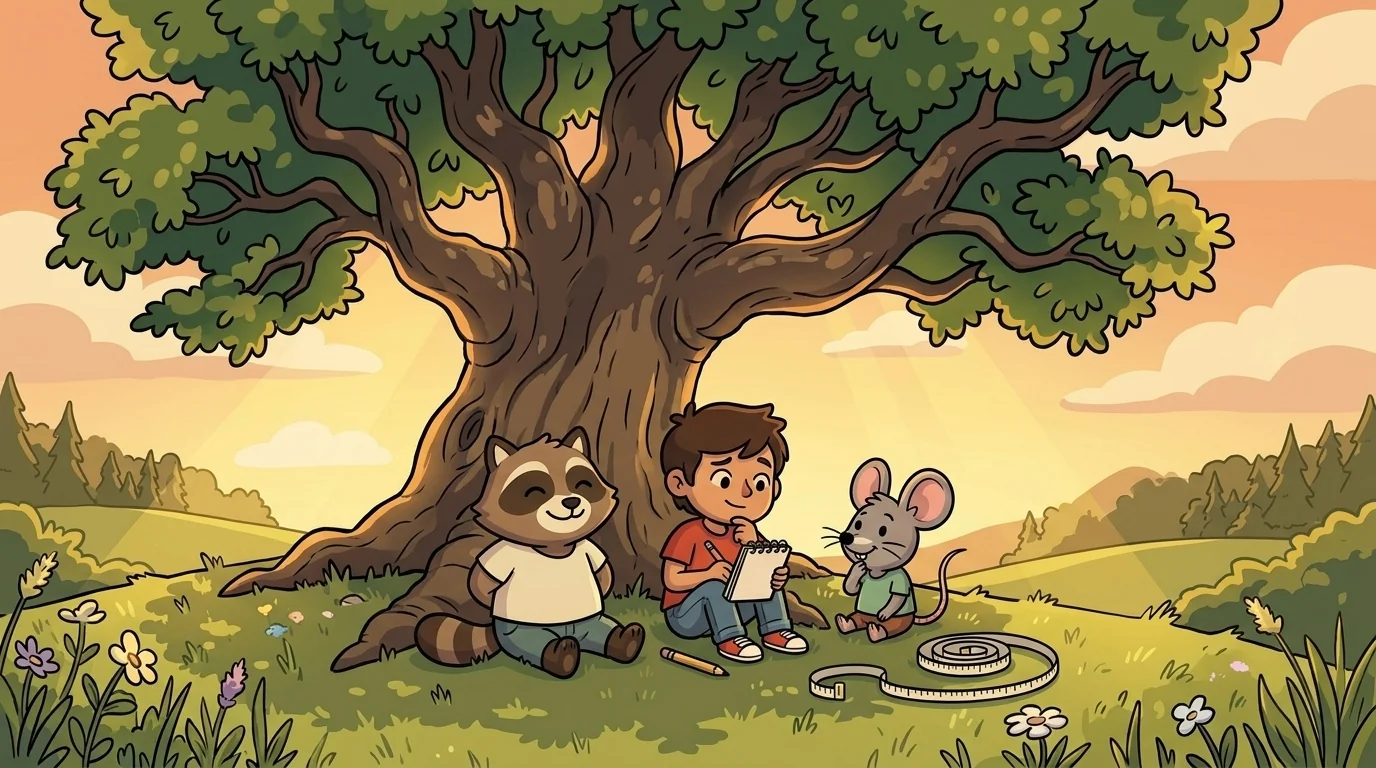
Later, light gone long and gold through the oak, the student sat between the mouse and the raccoon.
"I wanted one perfect number. It felt like the real answer had to be exact. You're telling me there isn't one — every measurement has a doubt baked in."
Whisker smoothed her whiskers. Thumb tucked his paws behind his back. "When I was small, faking exact felt safe," Whisker said. "A number with an interval sounded weak. It's the opposite — 'eight point seven, give or take twenty centimeters' means I know exactly how well I know. The fake-exact 'eight point seven three one' is the one that doesn't know what it's doing." "And a good 'about' isn't giving up," Thumb added. "'About nine' from a ruler I calibrated — real measurement, ten seconds, honest about its own width. The only bad guess is the one that pretends it isn't a guess." "Alone," Whisker went on, "I might've had you think honesty means always measuring fine; Thumb, always rough. Together: honesty isn't how fine you measure — it's always saying how sure you are, and letting a rough and a fine reading check each other."
The student looked at her two honest intervals, the rough and the fine, overlapping. "So there was never an exact answer to chase. There was a choice — how sure do I need to be — and then an honest interval to match, that another interval could confirm."
"Every real measurement anyone ever made," said Whisker and Thumb together, softly — and the three sat under the oak that was, honestly, about nine meters give or take, and something in the student went quiet and settled and glad.
The MeasureQuest ensemble
Whisker and Thumb is part of MeasureQuest's distributed-narrative cast. Each character embodies a different curricular primitive; together they teach the full subject.
-

Rod
Linear measurement — length and perimeter (1D extent)
-

Tile
Area — 2D coverage (square units)
-

Cup
Volume and capacity — 3D space (cubic units, liquid measures)
-

Tick
Time — elapsed duration, intervals, and the special-case unit-system (60 / 60 / 24 / 7 / 12)
-

Pace
Unit conversion — translating between metric and customary systems
-
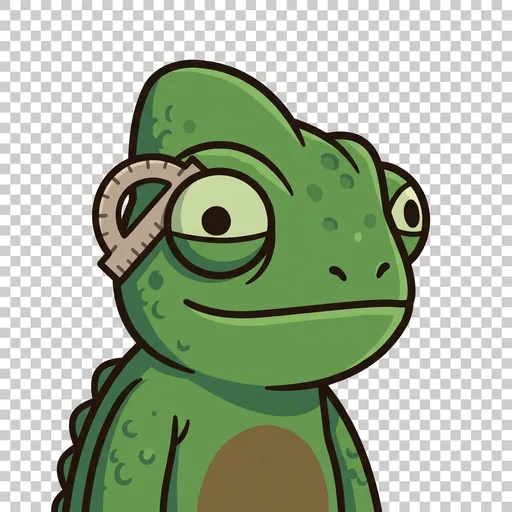
Bevel
Angle — how much a turn, not how long a line; measured in degrees on a protractor
-
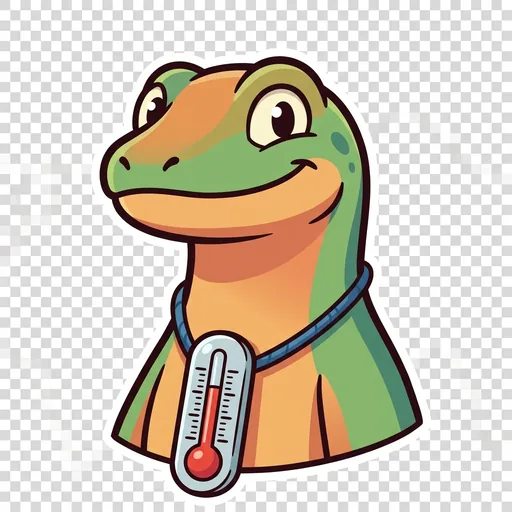
Degree
Temperature — how hot or cold, read off a thermometer; the scale (Celsius/Fahrenheit) you pick matters
-
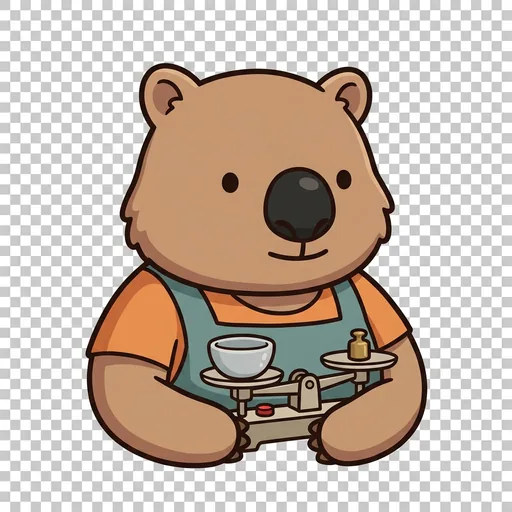
Tare
Mass and weight — how much stuff there is; grams and kilograms read on a balance
-

Thumb
Estimation — measuring without a tool by comparing to references you carry
-
Whisker
Uncertainty — no measurement is exact; every real number carries a give-or-take (plus or minus)