
Whisker
UNCERTAINTY — no measurement is exact. Every real number carries a give-or-take set by the tool's RESOLUTION (the size of its smallest division). The honest measurer records only the digits the tool can resolve PLUS one estimated guess-digit between the marks, then the ± tolerance. Reporting more digits than the instrument can resolve is false precision — a guess dressed as certainty.
Loading audio…
Press play to listen along. The line being read lights up as you go.
Show full transcript
Loading transcript…
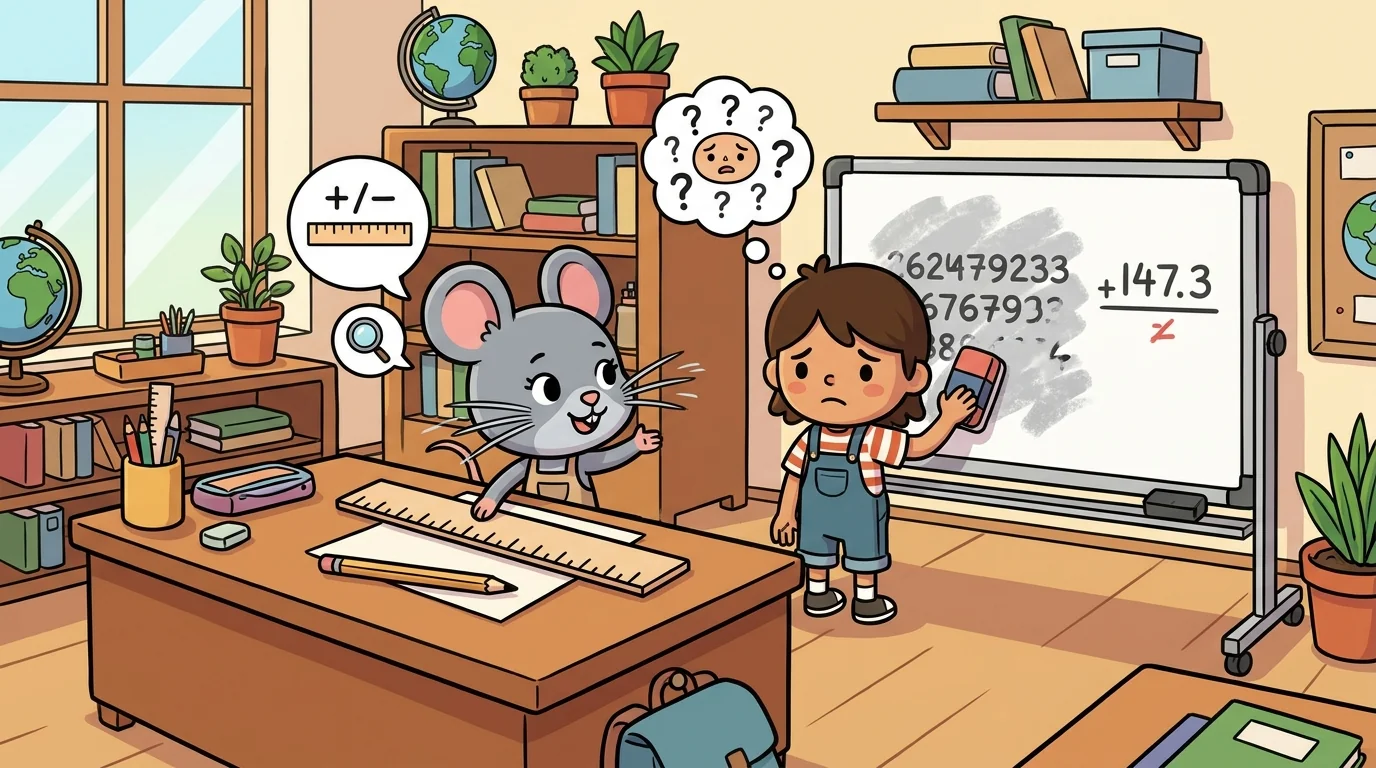
A student was writing a measurement with far too many digits after the dot, and feeling far too proud.
"The pencil is a hundred forty-seven point three-eight-two-nine millimeters," she announced, reading off a ruler marked every millimeter.
"Your ruler can't resolve the eight-two-nine," said Whisker, twitching the silver whiskers that gave her her name — a mouse, small, quick, endlessly careful. "Resolution is the size of a tool's smallest division. Yours has marks every millimeter and nothing between. So you can honestly report a hundred forty-seven millimeters, and estimate one guess-digit — the point-three — for where it falls between two marks. But the two-nine after that? Your ruler is blind below a millimeter. You invented those digits. You dressed a guess in a lab coat and called it precise."
The student deflated. "So what's the real number?"
"A hundred forty-seven point three millimeters — give or take about half a millimeter," Whisker said. "That's the honest one — not because it's fuzzy, but because it tells the truth about itself. A real measurement is a value and a doubt, together, and the doubt is set by the resolution. It isn't weakness. It's you being exact about how sharp your tool can see."
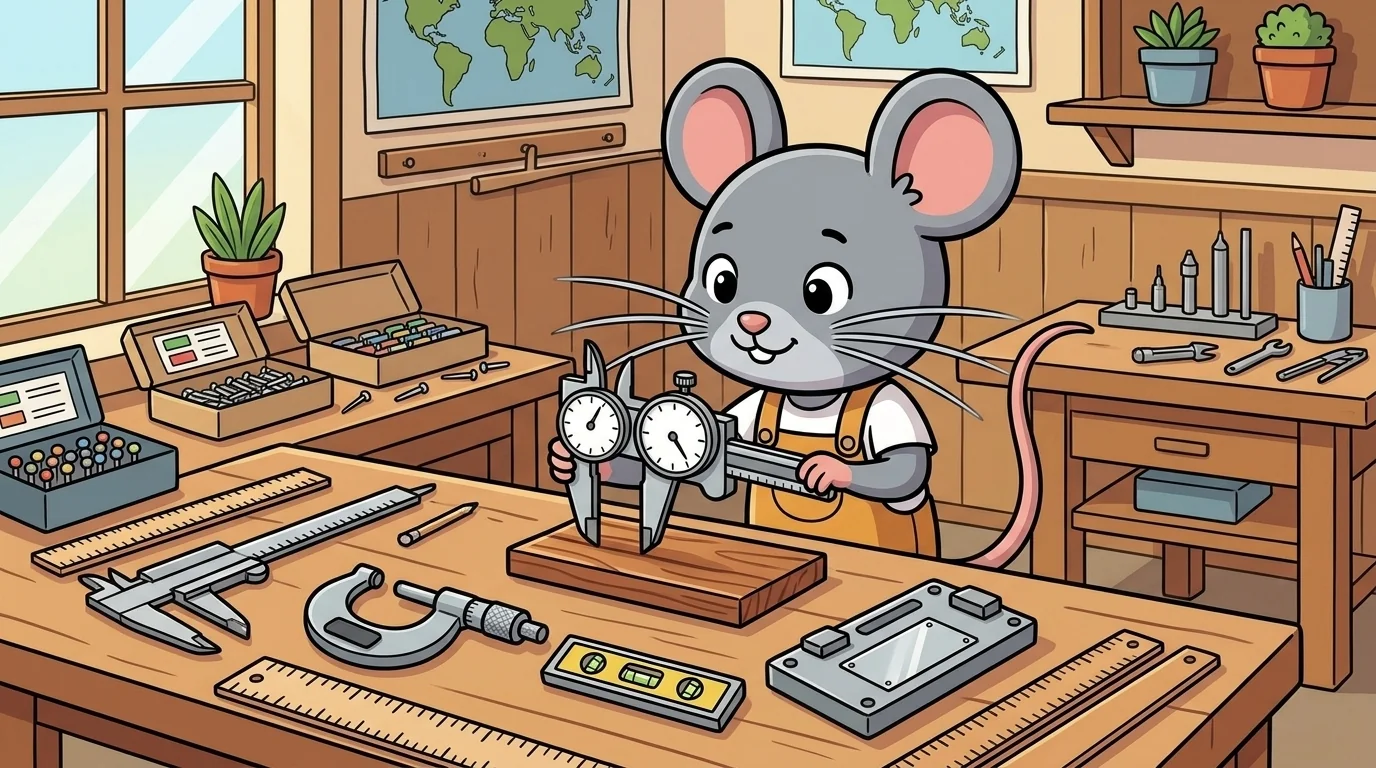
Whisker had learned to carry her doubt honestly young, in a way that once saved a bridge.
Her family were the fine-measurers of MeasureQuest — mice, whose whiskers felt gaps too small for any eye. When Whisker was small, a builder measured a beam "exactly two meters" and cut a slot "exactly two meters" and swore they'd fit. Her grandmother measured both fine and shook her head. "Your beam is two meters give or take three millimeters; so is your slot. The beam might run three big, the slot three small — six millimeters of trouble you called 'exact.'" They cut the slot a hair loose on purpose, to swallow the doubt, and the bridge held.
"'Exactly' is the most dangerous word a measurer can say," her grandmother told her. "Nothing is exactly. Everything is about, and the honest builder plans for the about." Small Whisker held it: a number without its doubt is half a measurement, and the missing half is where things break.
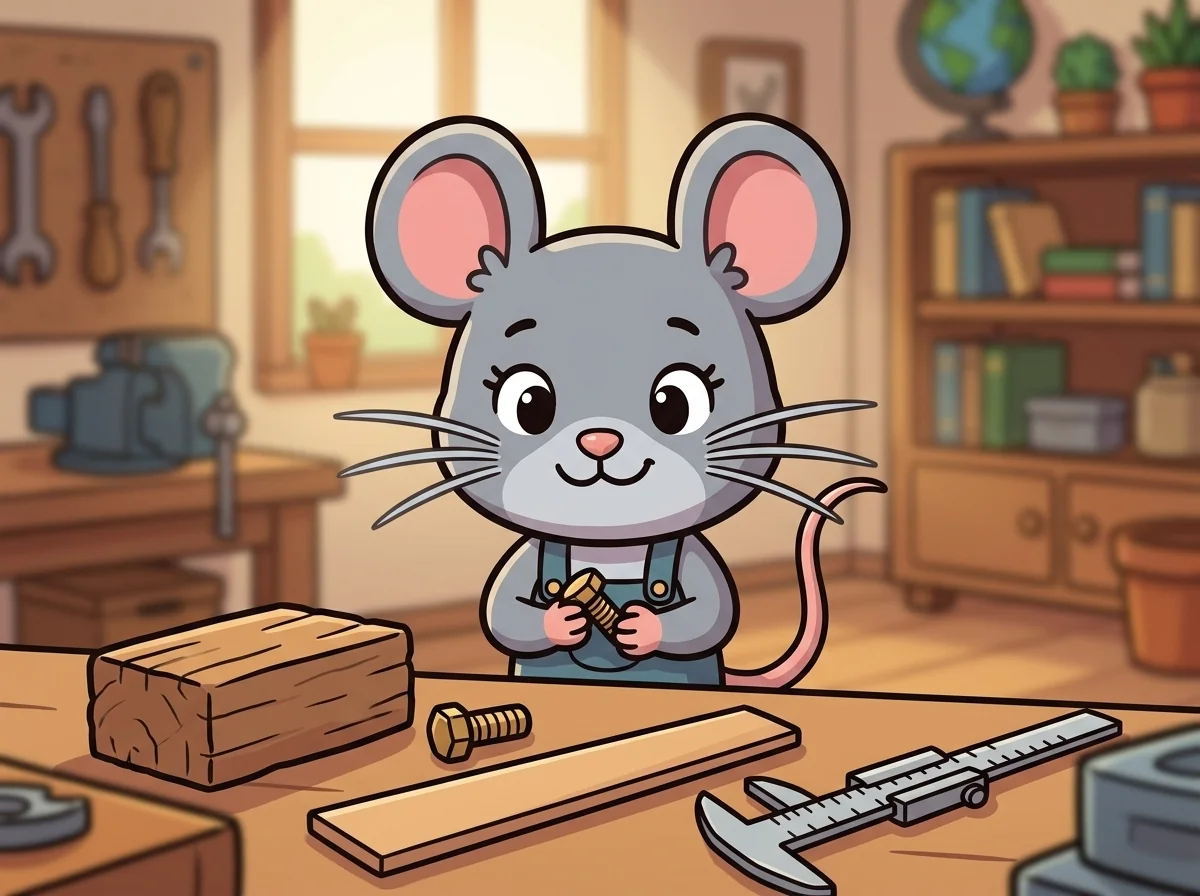
She skittered into MeasureQuest at twelve, and Yard handed her a rough hand-span, a plain ruler, and a fine caliper, plus one small bolt. "Measure it three times — and tell me how sure you are each time."
Whisker didn't rush. Hand-span: "about two centimeters, give or take half a centimeter — rough tool, coarse resolution." Ruler: "one point nine centimeters, give or take a millimeter." Caliper: "one point eight-eight, give or take a hundredth." Same bolt, three values, three doubts — each matched to the tool's resolution.
Yard looked up. "Most kids read the finest number and call it truth. You gave me the value and how much to trust it. Sit down. You've got the craft."
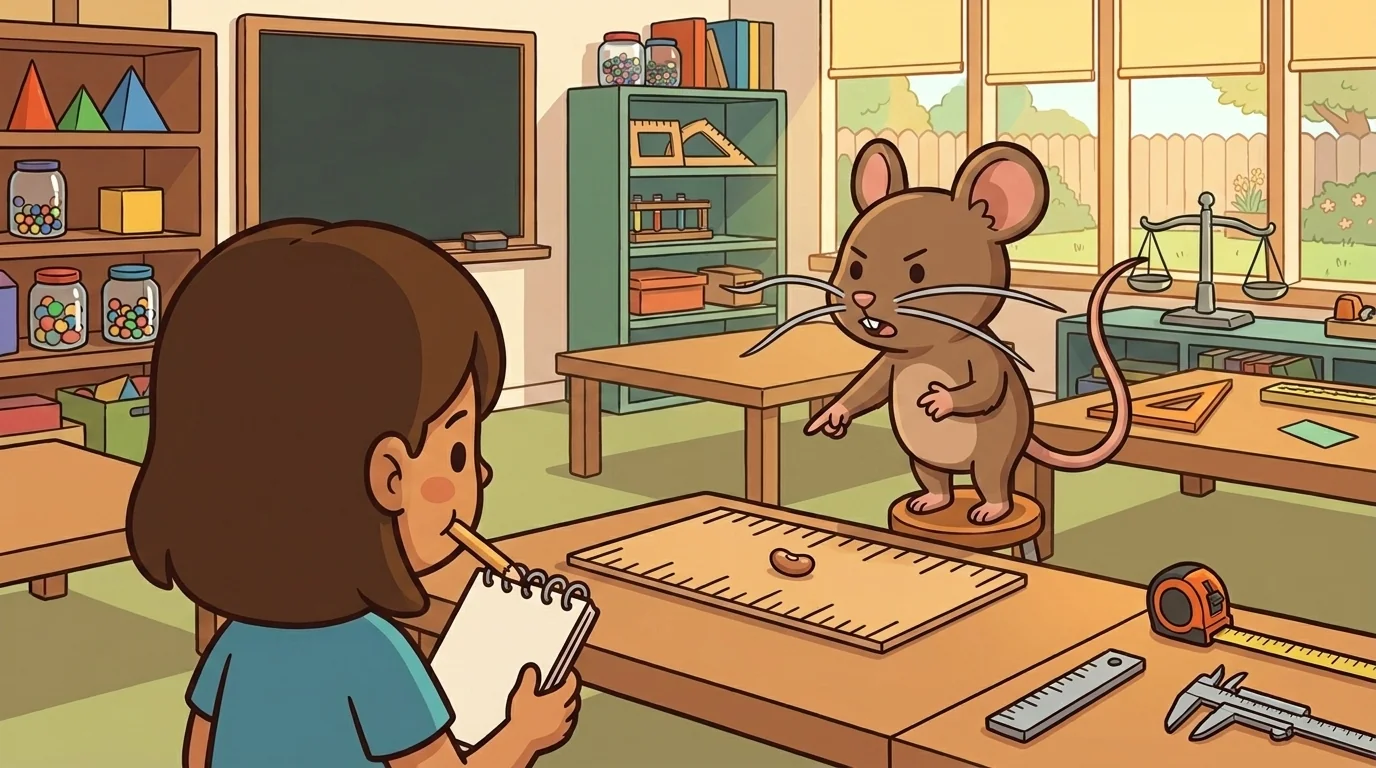
Weeks later, Pip measured a bean with a plain ruler, chewing her pencil.
"Marks every millimeter," Whisker said, whiskers brushing the bean. "The edge sits between twelve and thirteen, closer to twelve — so I read twelve, and estimate one guess-digit: point three. That's the last honest digit, because my ruler can't resolve finer. Whole truth: twelve point three, give or take half a millimeter. Someone else might get twelve point two or point four — we'd all be right, within the doubt."
Pip frowned. "But I want to be exact. Give-or-take sounds like I don't know."
"Give-or-take means you know exactly how well you know — stronger than fake-exact, not weaker. If I wrote twelve point three-seven-one, I'd be lying: my ruler can't resolve that. The rule of significant figures is just this — keep the digits the tool resolves, plus one estimated digit, and stop." She caught Pip writing six digits off a plain ruler. "Only the digits your tool can resolve, plus one honest guess-digit, then the give-or-take. More than that is decoration, not measurement."
Pip crossed off the extras. "So the doubt isn't me being unsure," she said slowly. "It's me being exactly sure of how unsure I am — set by what my tool can resolve."
"Now you've got it," Whisker said, whiskers quivering. "A value and its doubt. That's an honest measurement. Everything else is a guess in a costume."
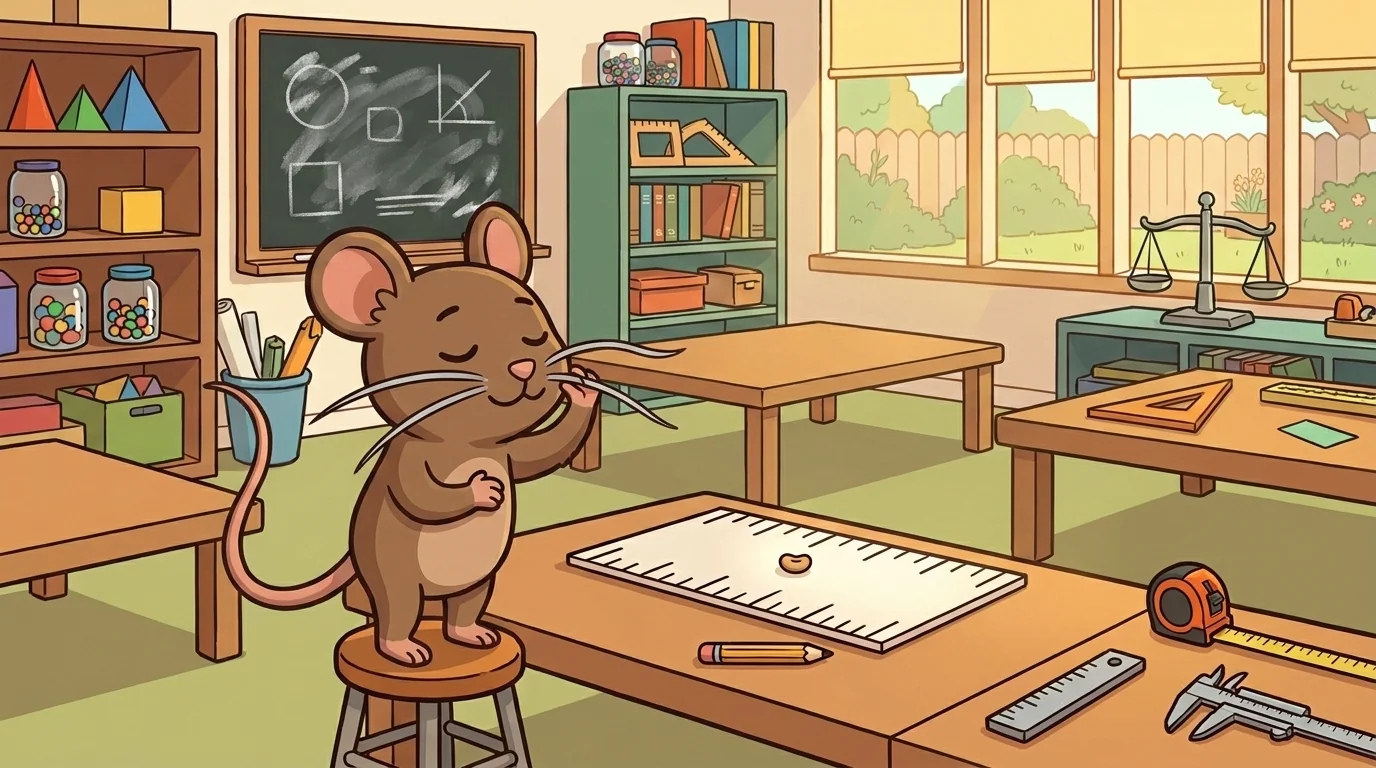
Pip measured again and wrote "12.3 mm, give or take 0.5" — a number that told the truth about itself, that anyone could check and get near — and a small settled feeling in her chest, the calm of not pretending she knew more than she did.
Whisker smoothed her whiskers, slow and pleased, and something in her went quiet — the ease of a creature who'd spent her life refusing to fake a digit she couldn't see. Somewhere in the memory of it, a bridge held because someone planned for the about.
"A value and its doubt, always together," she said softly. "Say how sure you are, and no surer. That's the calm part. That's the part worth being honest for."
The MeasureQuest ensemble
Whisker is part of MeasureQuest's distributed-narrative cast. Each character embodies a different curricular primitive; together they teach the full subject.
-

Rod
Linear measurement — length and perimeter (1D extent)
-

Tile
Area — 2D coverage (square units)
-

Cup
Volume and capacity — 3D space (cubic units, liquid measures)
-

Tick
Time — elapsed duration, intervals, and the special-case unit-system (60 / 60 / 24 / 7 / 12)
-

Pace
Unit conversion — translating between metric and customary systems
-
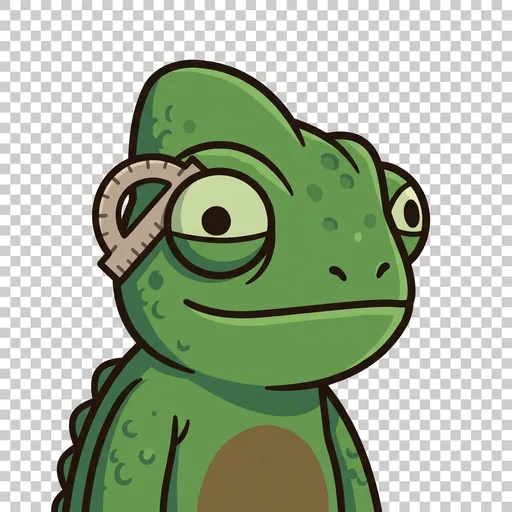
Bevel
Angle — how much a turn, not how long a line; measured in degrees on a protractor
-

Degree
Temperature — how hot or cold, read off a thermometer; the scale (Celsius/Fahrenheit) you pick matters
-
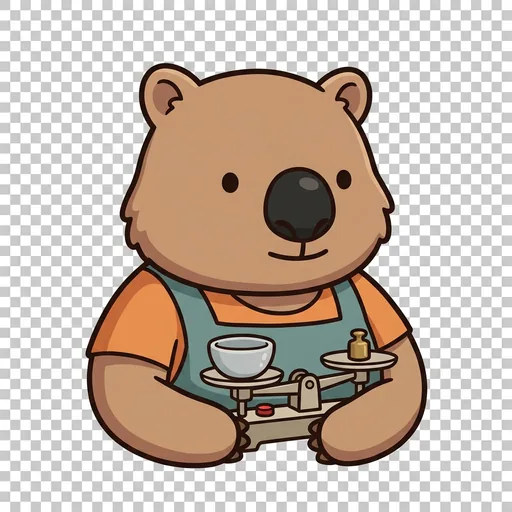
Tare
Mass and weight — how much stuff there is; grams and kilograms read on a balance
-

Thumb
Estimation — measuring without a tool by comparing to references you carry