
Trill
MOTIF AS PROTAGONIST — a small musical idea that *is* the story's main character, undergoing six stages: introduction → motif statement → development → contrast → recapitulation → resolution.
Loading audio…
Press play to listen along. The line being read lights up as you go.
Show full transcript
Loading transcript…

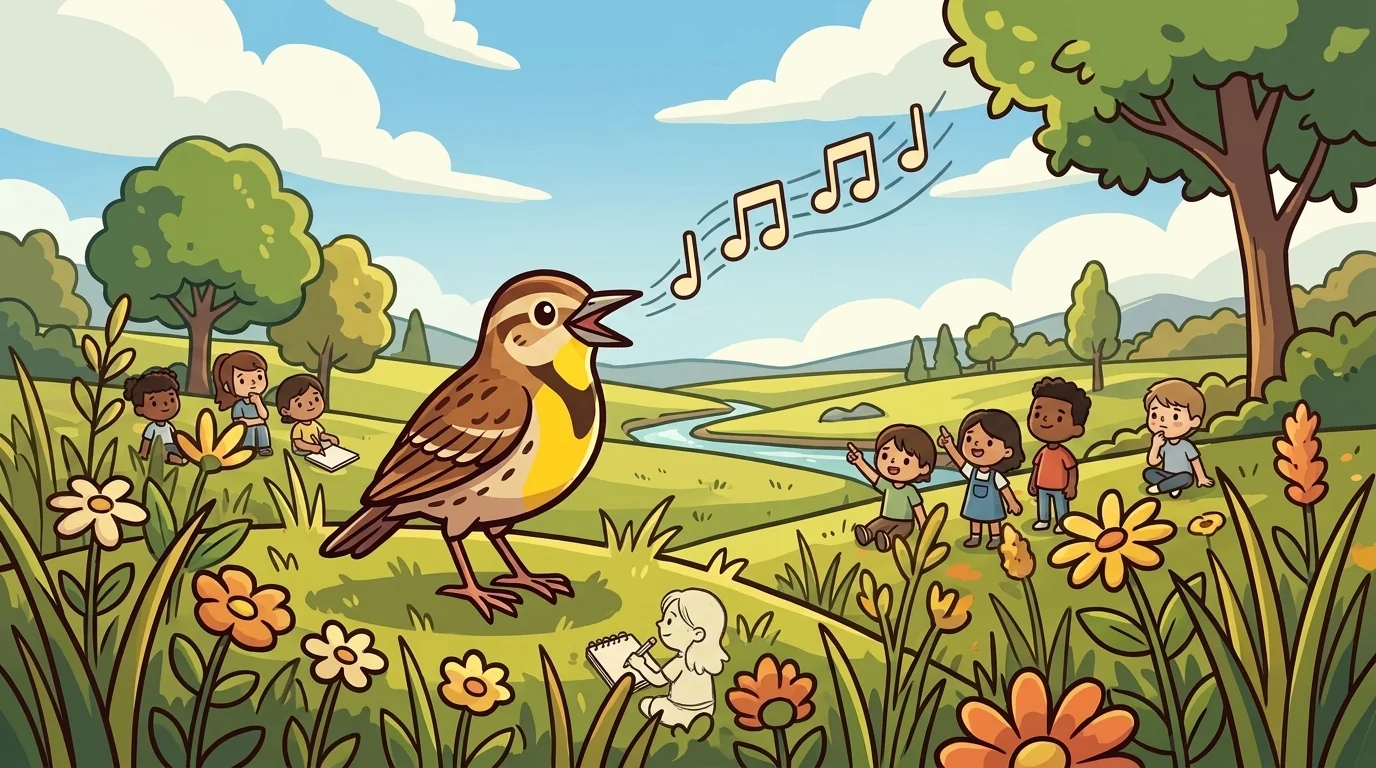
On the highest perch in the practice hall, a meadowlark no bigger than a plum tipped back his head and sang four notes. Up, up, down, hold. That was the whole song — four notes, the same four he had sung since he could sing at all. He was Trill, and the little tune was so much a part of him that the students who watched him could not say where the bird ended and the melody began. When he sang, his bright yellow chest lifted; when the four notes settled, so did he. Sing, settle. Sing, settle. He never got bored of it, and neither, strangely, did anyone listening.
A girl at the front bench leaned toward her friend. "It's just four notes," she whispered. "Why can't I stop humming it?"
Trill heard her — meadowlarks always hear — and turned his head a quarter-turn, considering. Then he did something small and enormous. He sang the four notes again, but the third one lower, dragged out, almost sad. The same tune. Not the same tune. The girl's mouth fell open. She had recognized it and been surprised by it in the same half-second, and that collision was the whole lesson, standing right there in the room in feathers.
He sang it once more, upright and bright, exactly as before, and folded a wing over his chest as if to say: there, you have it now. The bird had not explained anything. He had only sung a small idea, then bent it, then sung it plain again — and the students already felt, in their chests, how far a four-note thought could travel and still find its way home.

Trill had learned that a long time ago, on a fence rail behind the barn where he hatched.
He was young then, still working out which notes belonged to him. He would sing a phrase, lose it, sing something else, lose that too. Nothing stuck. His songs scattered like seed on wind. An old thrush who nested in the elm listened to this for three straight mornings and finally hopped down to the rail beside him.
"You keep starting new songs," the thrush said. "Try keeping one."
"But it gets boring," Trill said. "The same four notes."
The thrush laughed, a low burr of a sound. "Watch." And she took Trill's own four notes — up, up, down, hold — and sang them back to him. Then she sang them faster, so they tumbled. Then slower, so they ached. Then she sang three of them and stopped, and the missing fourth hung in the air so loudly that Trill sang it himself just to end the itch.
"It was the same song the whole time," she said. "You didn't get bored. You got curious." She ruffled and settled. "A small idea isn't a cage. It's a thread. You pull it through everything, and everything holds together because of it."
Trill spent the rest of that summer pulling one thread through the whole meadow. He never scattered a song again. And when he grew, and MotifLab's founder came walking the hedgerows listening for exactly this — a bird who was his own melody — Trill was ready. He sang his four notes. Then he bent them. Then he brought them home.

The founder of MotifLab was a tired composer who had heard a thousand jingles and forgotten every one. She did not want a mascot who lectured. She wanted proof that a tiny musical idea could carry a whole story, the way a single character carries a whole book.
So when she found the meadowlark on the hedgerow, she did not offer him a job. She sat down in the wet grass and said, "Show me."
Trill sang his four notes, plain. The founder waited, unmoved — she had heard four notes before. Then Trill lowered the third and stretched it thin, and her shoulders dropped a little. He sped the phrase into a scurry, and she almost smiled. He fell silent — a long, deliberate silence where the song should have been — and she leaned forward without meaning to, waiting, missing it. When the four notes finally came back, changed by the journey and yet unmistakably his, she found her eyes were wet.
"That," she said quietly, "is the whole curriculum. One small idea, given a life." She did not have to ask him to stay. He was already the thing she had been trying to build.

Now the students came to Trill's workshop to learn how a melody grows up, and Trill taught the only way he knew: by living it in front of them.
"Watch him," the instructor said. "He'll show you when it's working."
Trill sat quiet on his perch, song unsung, while a boy named Devi began his piece with a slow wash of chords. "He hasn't sung yet," Devi worried. "Did I break him?" But the instructor shook her head — the opening was setting a scene, and Trill was simply waiting for his entrance, the way a hero waits in the wings.
Devi added his melody. Trill straightened, threw back his head, and sang the four notes clear and strong — the idea, stated at last, ringing through the hall. Devi grinned.
Then the instructor said, "Now change him. Don't replace him — change him." Devi shifted the notes up a step, quickened them. On the screen Trill lifted a wing, tilted, his song the same shape at a new height. "Still Trill," Devi breathed. "But different." Exactly, the instructor said. That was the idea growing.
Devi got greedy and let a whole new tune take over. Trill hopped to the edge of the frame and turned his back — stepping aside, letting the stranger-music hold the floor. The class groaned; they missed him. "Good," said the instructor. "You feel the absence. That's contrast doing its work."
And when Devi finally brought the four notes back, Trill returned to center — feathers a touch ruffled from travel, posture surer, a faint echo of the stranger-tune caught in his song. He sang it one last time, plain and true, and settled. Devi's piece was over. Trill had come home.
Devi stared at the screen for a moment. "So it was the same little song the whole time," he said. "It just... went somewhere and came back."
"That's most songs worth remembering," the instructor said. "And most of us, too."
Trill preened one wing, unbothered by the philosophy, and sang his four notes into the settling quiet of the hall — up, up, down, hold. The students had heard it at the start of the lesson and thought it slight, a scrap of a thing. Now, after watching it stretch and vanish and return, the same four notes landed differently in the room, heavier and warmer, the way a friend's voice sounds after they've been away. Something glad and aching settled in the students' chests all at once, the private happiness of watching a small, brave idea travel a long way and make it all the way home.
The MotifLab ensemble
Trill is part of MotifLab's distributed-narrative cast. Each character embodies a different curricular primitive; together they teach the full subject.
-

Meld
Harmony — notes that bloom underneath to support the melody
-

Thrum
Bass — the deep low foundation the whole song stands on
-

Clap
Rhythm — the steady beat pattern the song walks on
-

Twine
Counter-melody — a second tune that weaves against the main one
-

Surge
Dynamics — how loud and soft; how a song breathes
-

Ply
Texture — how many layers sound at once; thick or thin
-

Tint
Timbre — the color or flavor of a sound
-

Nest
Key — the home note the song keeps returning to
-

Wend
Cadence — how a phrase comes to rest; the song's punctuation