
Rive
FACTORS AND PRIMES — a factor divides a number into equal whole groups with nothing left over; a prime rives into no equal rows but one-times-itself. Every number is either prime or a unique product of primes — the primes are the building blocks all other numbers are made from.
Loading audio…
Press play to listen along. The line being read lights up as you go.
Show full transcript
Loading transcript…
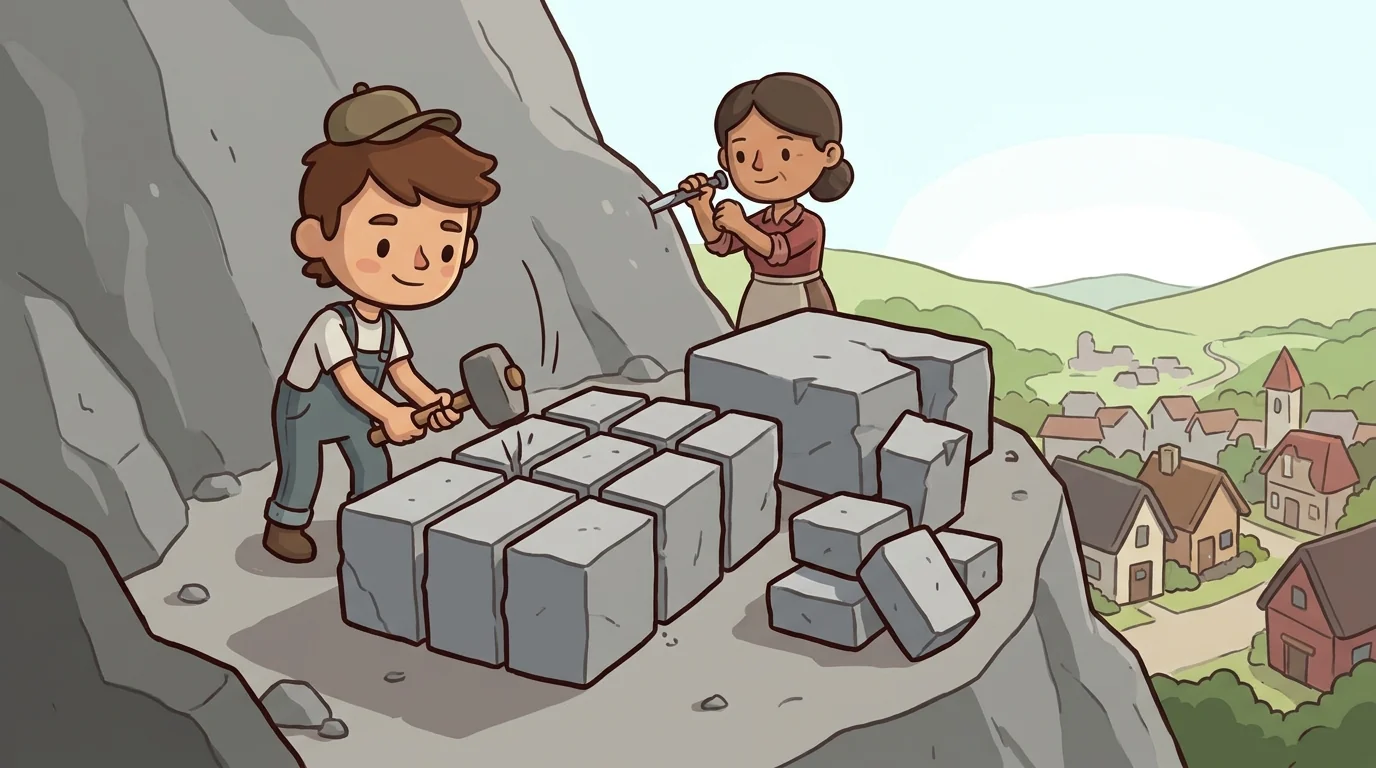
Rive grew up in a quarry, splitting stone, and learned about numbers from the way stone chose to break. His family cut paving-blocks from the grey hillside above Scarp, and Rive's job — from the time he could swing a small maul — was to rive a rough block into equal smaller stones a mason could lay in tidy rows. A block that made twelve stones could be riven into two rows of six, three of four, four of three, six of two — every split even, no scrap, every stone the same. But a block that made seven refused: two rows left one over, three rows left one over. You could only lay it as one row of seven. The stone simply would not divide.
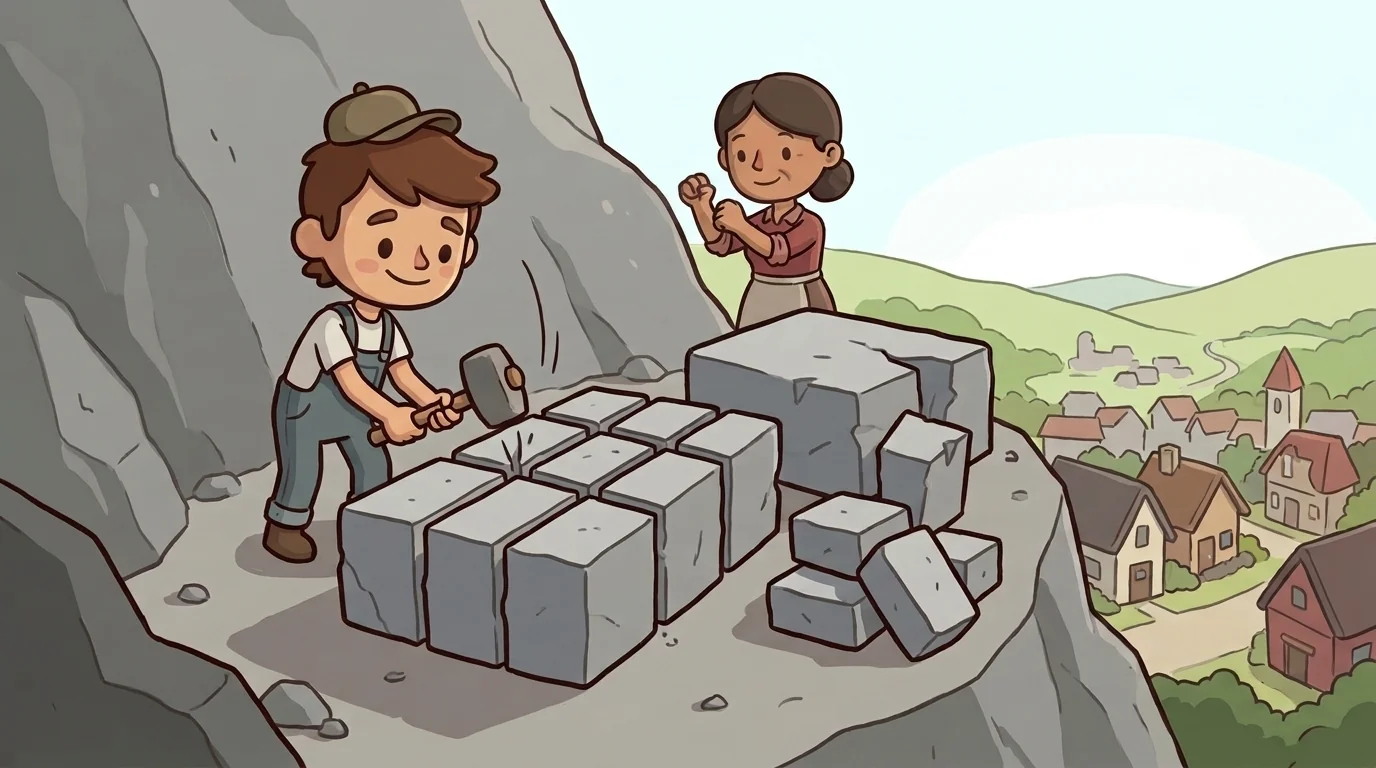
"Some numbers split. Some don't," his aunt said, sighting a chisel. "The ones that won't — they're the stubborn ones. They're also the ones everything else is built from, though it took me years to see it."
That sorting — splits cleanly versus won't split — is exactly what the academy calls finding factors and identifying primes. A factor is any number that rives another into equal whole rows with nothing left; a prime is a number greater than one whose only factors are one and itself.

Rive's given name was Bram, but he was called Rive from the day a mason asked for a block that would tile a courtyard exactly and he walked the whole quarry tapping stone until he found one that rived into the mason's precise number of rows with nothing wasted. He came to treat every number as a block waiting to be tested: does it break into rows of two? three? four? Each clean split names a pair of factors — twelve breaks at two (giving 2 and 6), at three (giving 3 and 4). And here Rive teaches the shortcut the quarry taught him: you never have to test past a number's square root. "Once I reach the row-size whose square passes the block," he tells students, "every new split I'd find is just a pair I already found, flipped. Four-times-three is three-times-four wearing the other coat. So I stop at the square root and I have them all." It halves the labour and misses nothing — a symmetry, not a guess.
The stubborn blocks — two, three, five, seven, eleven, thirteen — he learned to call primes. "Not broken," he insists. "Whole. Un-riveable." And then the deep claim, the one the academy calls the fundamental fact of arithmetic: every number is either a prime or is built, in exactly one way, from a product of primes. Rive shows it by riving thirty into 2×15, then riving the 15 into 3×5, and holding up the bottom row — 2, 3, 5 — the primes from which thirty is made. "Keep riving any number," he says, "and it comes down to a handful of primes, always the same handful, in only one way. The primes are the blocks. Every other number is a wall built from them."
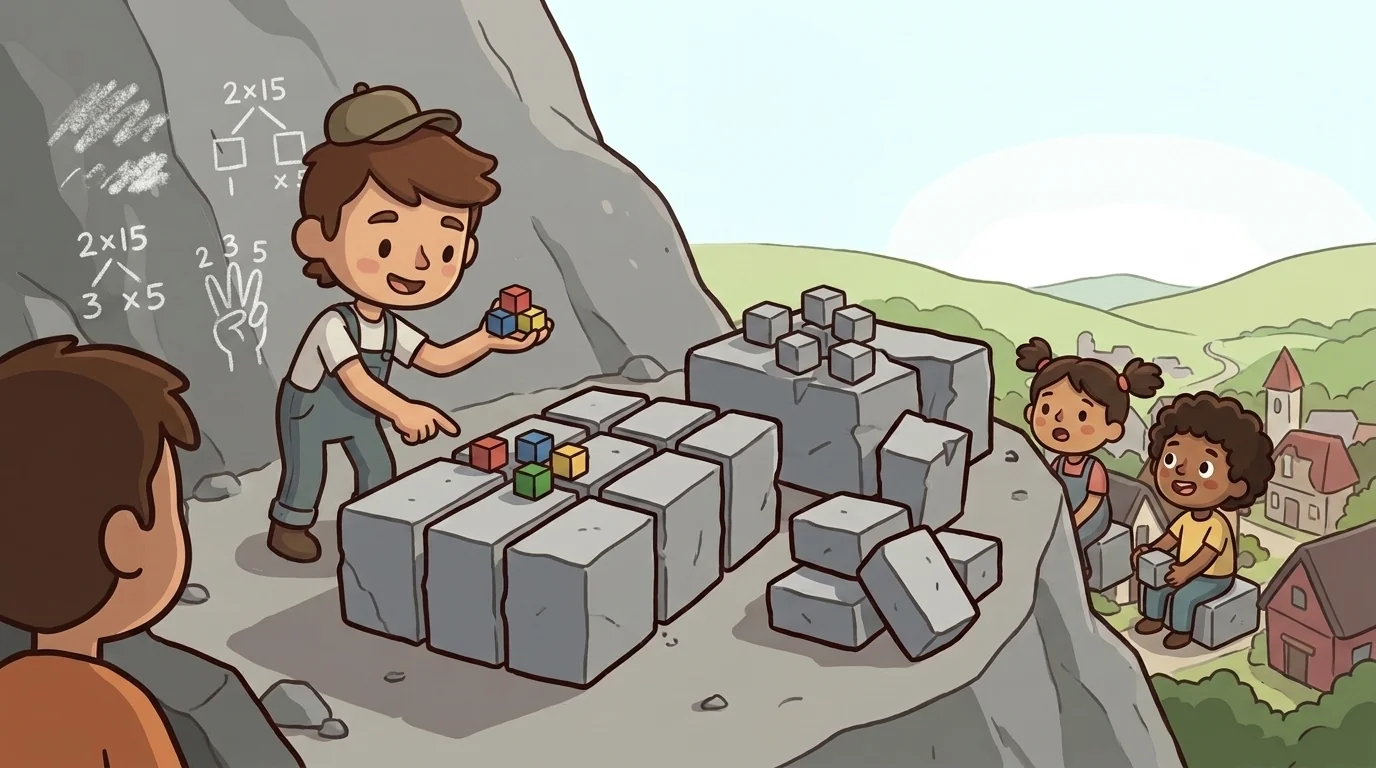
An academy quarrier came for building-stone and found Rive sorting a season's blocks into "splits cleanly" and "won't split." "You are factoring," he said, "and your stubborn stones are the primes. We teach that every number is built from primes, and children think it a rule from nowhere. You have it in your hands." Rive left the quarry the next spring and has taught factors and primes for eight years, keeping a set of small wooden cubes on his classroom floor for riving.
He begins each year with twelve cubes. "Rive them into equal rows." The children find twelve generous — two sixes, three fours, four threes, six twos — and Rive writes the factor list: 1, 2, 3, 4, 6, 12. Then he hands them seven cubes: "Now rive these." They try; two rows leave one over, three rows leave one over; they cannot. "You're not failing," Rive smiles. "Seven is a prime. Its only factors are one and itself — a building number, not a broken one." Then he rives thirty down to 2, 3, 5 and lets them see the blocks at the bottom.
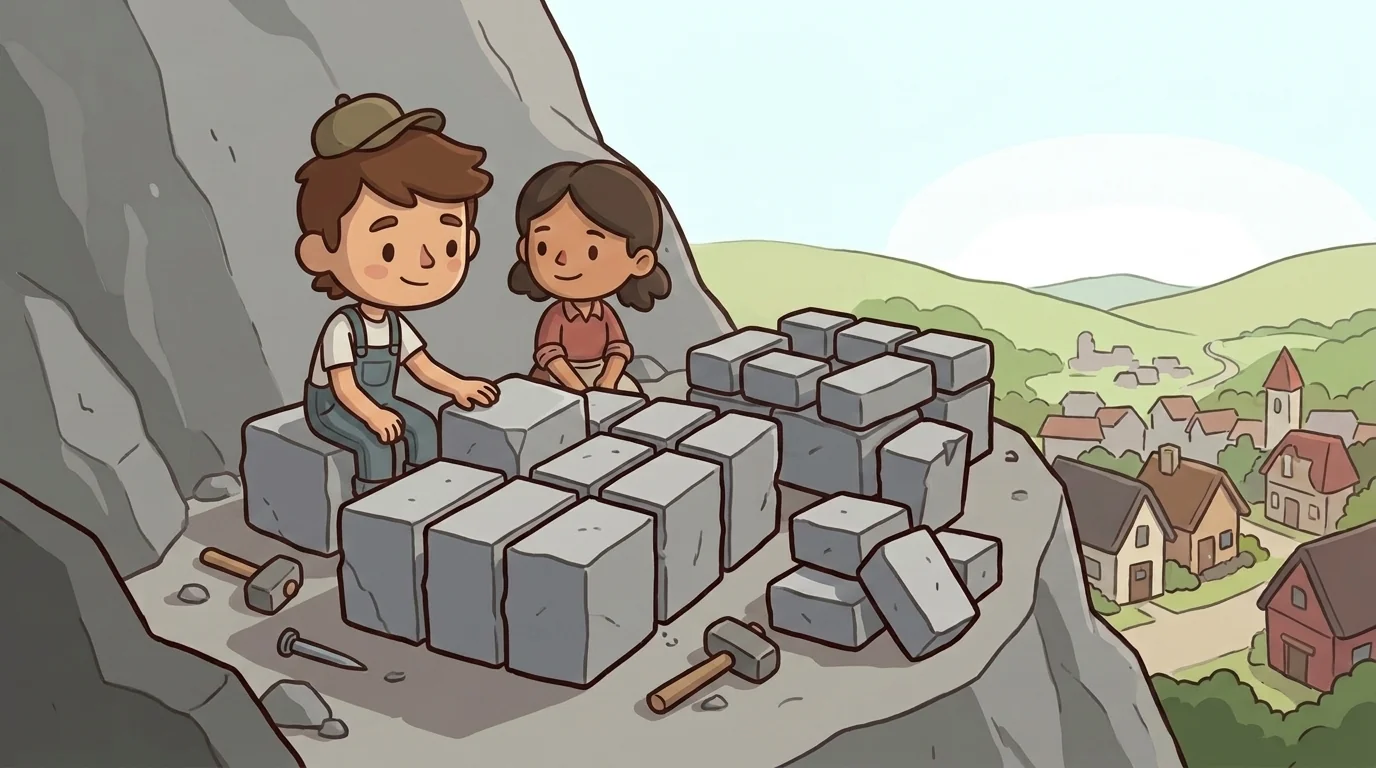
A girl named Odile stayed behind. She had always thought the numbers that wouldn't split were the worst ones — the failures — and it turned the world over to hear the stubborn primes were the most important numbers of all. Rive sat on an upturned cube. "For years I thought a block that wouldn't rive was a bad block. Then my aunt showed me those were the true stones — the ones every wall is finally made of. The number that resists being broken is the number everything else is built from." Odile turned an un-riveable seven over in her hands and felt something rearrange quietly: a thing she'd filed under problem had been the point the whole time.
Rive is patient, tactile, and cannot look at a number without silently testing whether it splits. He still goes up to Scarp at the year's turning to help with the cutting, and he still feels a quiet tenderness toward the stubborn ones — because he remembers being a boy who thought the unbreakable blocks were failures, and he loves that they turned out to be the very stones the world is built on.
The MathVerse ensemble
Rive is part of MathVerse's distributed-narrative cast. Each character embodies a different curricular primitive; together they teach the full subject.
-

Tenfold
Place value — powers of 10, positional notation
-

Zeph
The zero placeholder — its load-bearing role in positional notation
-

Mirror
Negative numbers — reflection across zero on the number line
-

Skip
Skip-counting and multiples — repeated addition as forward stepping
-

Tug
Inverse operations — addition ↔ subtraction (and the same idea for × ↔ ÷) as opposite pulls on the same line
-

Nigh
Rounding and estimation (judging a number by the nearest landmark)
-

Vie
Comparing and ordering (magnitude — greater-than and less-than)
-

Weld
Number bonds (part-part-whole decomposition; making ten)
-

Yoke
Parity (even and odd numbers)