Vie
COMPARING AND ORDERING — deciding which of two numbers is greater and arranging a set from least to greatest. On the number line the number further to the right is the larger; the greater-than sign opens its wide mouth toward the bigger number and its point toward the smaller.
Loading audio…
Press play to listen along. The line being read lights up as you go.
Show full transcript
Loading transcript…
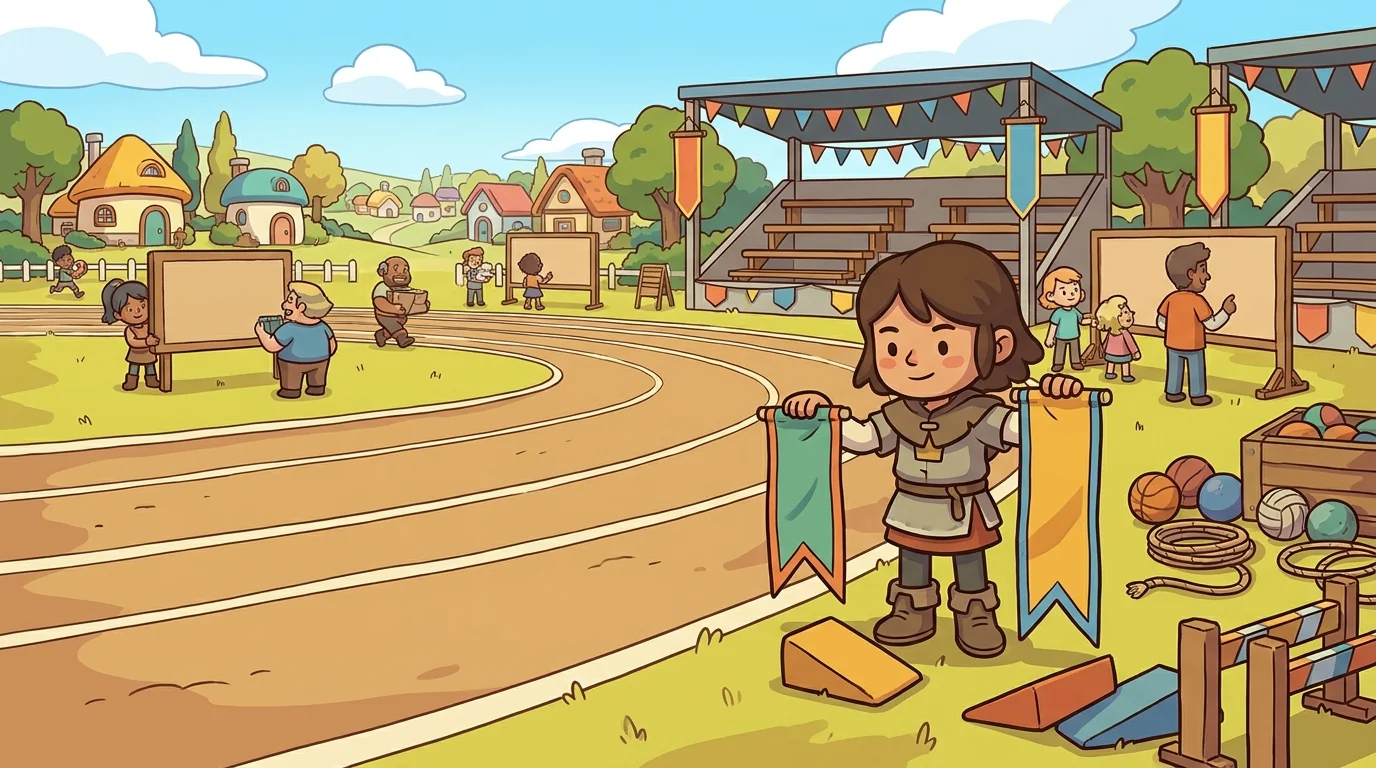
Vie grew up beside a tournament field, where every summer the whole province came to run, wrestle, throw, and argue about who had won.
Her family were the stewards of the field — the people who, before every contest, arranged the entrants in order. Not the winners; that was the contest's job. The starting order. Who ran in the first heat, who in the last; who was seeded first, who tenth. And to arrange a field of runners in order you had to do one thing, over and over, honestly: take two of them and decide which was faster, which was stronger, which — by the previous year's marks — was greater.
"You never order the whole field at once," her grandfather told her, chalk in hand. "You can't. The mind won't hold thirty runners at once. You order them two at a time. This one or that one — which is greater? Set the greater ahead. Then the next two. The whole field falls into order out of nothing but little comparisons, each one small enough for a fair mind to make."
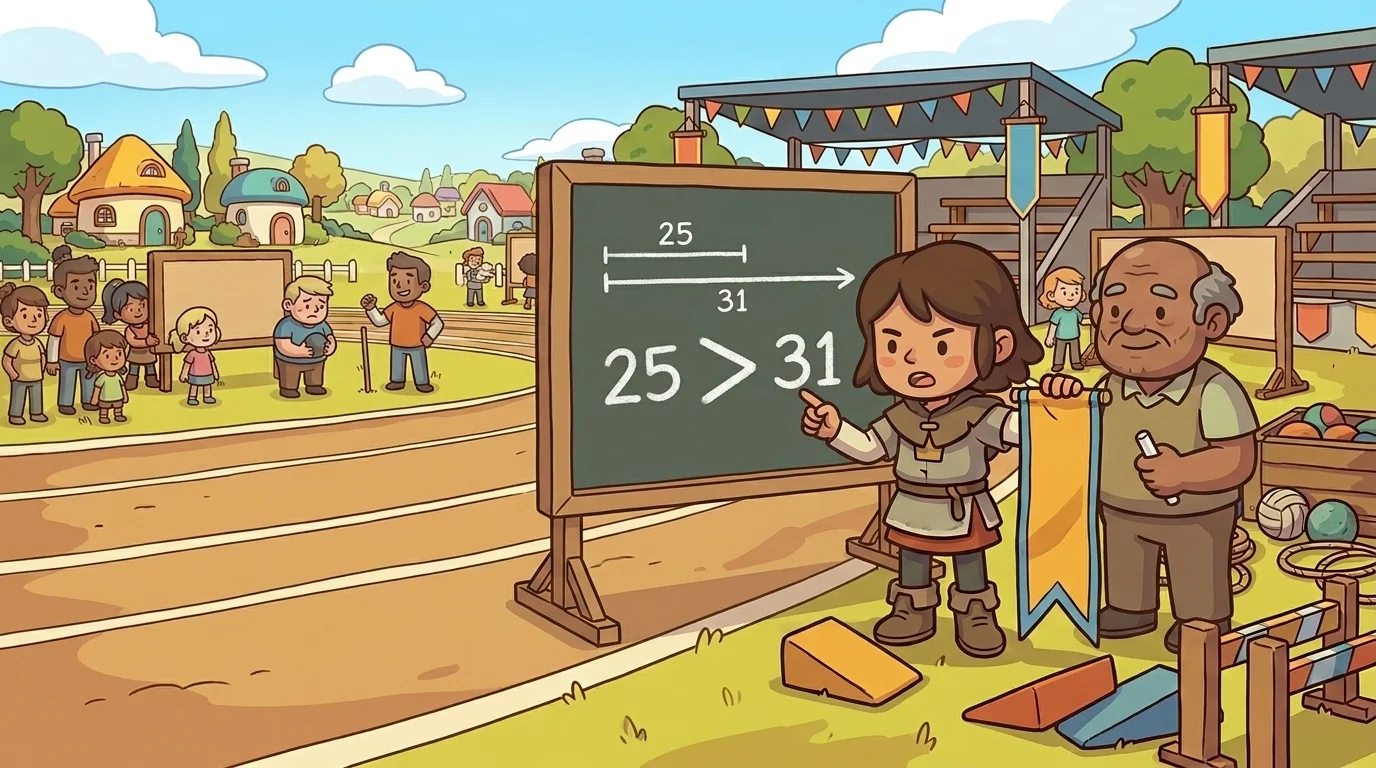
Vie's given name was Ada, but she had been called Vie since she was eleven, when she settled a shouting-match between two throwers by chalking their two marks side by side, drawing a single line to show which reached further, and saying, plainly, "This one is greater. There is nothing to argue." The crowd went quiet. Ada had vied them — set them against each other and named the winner — and the name stuck.
She understood magnitude before she had a word for it. A number, to Vie, was a reach. The runner who reached the further mark was greater; the number that sat further along the line was greater. To compare two numbers you did not need to subtract them or fret over them. You only had to see which one reached further down the line.
She learned to read the two of them from the front. Compare the biggest positions first: a number with more digits reaches further than one with fewer, the way a longer stride covers more ground. If they have the same number of digits, compare the leading digit, then the next, and the first place where they differ decides it — the one with the larger digit there is greater, and nothing behind it can change the verdict.
An academy examiner passed through the tournament one year to judge the scholars' foot-race and watched Vie seed a field of forty in the time it took him to lace his boots.
"You are ordering," he said. "By repeated comparison. We teach exactly that — least to greatest — and most children find it slippery."
"It is not slippery," said Vie. "It is only this one or that one, done until you run out of pairs."
The examiner offered her a place. Vie, who had never wanted anything but the field, surprised herself by wanting the academy too. She has taught comparing and ordering for seven years.
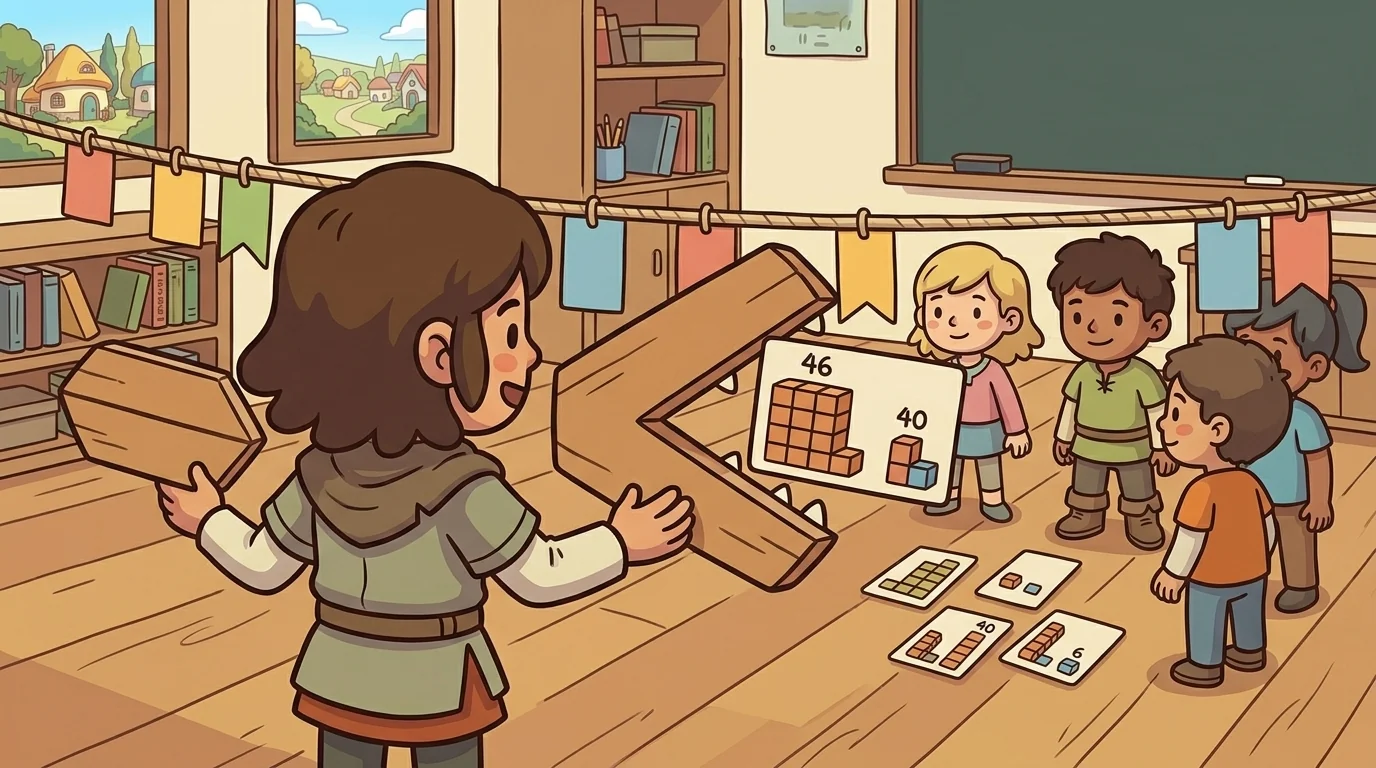
In her classroom Vie keeps a long rope stretched across the room, pinned with numbers, and she keeps two great wooden signs — one shaped like a mouth open wide, one shaped like a mouth closed to a point. She begins the same way each year. She holds up four hundred and six and four hundred and sixty and asks, "Which is greater?"
The children hunt through the digits. Vie stops them. "From the front," she says. "Both start with four hundred. Same. Then this one has no tens and that one has six tens. Six tens beats no tens. So four hundred and sixty is greater — decided at the tens, and nothing after it matters." Then she brings out the mouth. "The greater-than sign is hungry. Its wide mouth always opens toward the bigger number, its little point toward the smaller. Four hundred sixty is greater than four hundred six." She sets the open mouth facing the larger. The children see that the sign is not a rule to memorize but a picture of an appetite — it eats the bigger meal.
Then she gives them the whole field. She scatters ten numbers on the floor and asks the class to lay them along the rope from least to greatest. The children panic at ten-at-once — until a boy named Fen picks up two, decides which is greater, and sets them down in order. Then two more. Then two more. The rope fills. The panic drains out of the room. They have ordered ten numbers and never once held more than two in their heads.
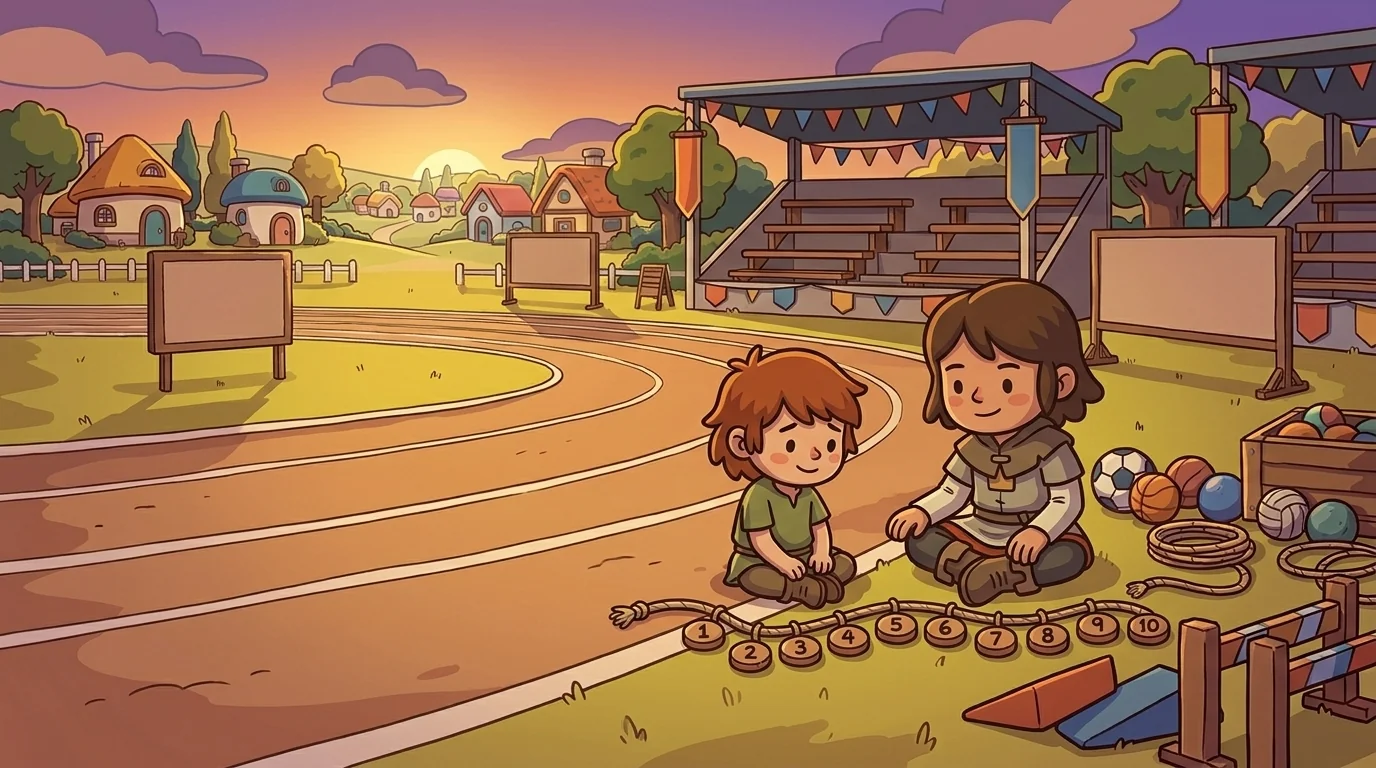
Fen stayed after and said he had thought ordering ten numbers would be ten times as hard as comparing two, and it had turned out to be the same easy thing, just repeated, and he did not understand why it had frightened him.
Vie sat with him on the floor by the rope. She said big tasks often look like one enormous cliff when they are really a stairway of small, fair steps. "Thirty runners frightened me too, once," she said. "Then my grandfather showed me it was never thirty at all. It was always just this one or that one. You can always do this one or that one." Fen looked at the ordered rope — the whole tangled crowd of numbers now lying quiet and in line — and felt the particular relief of a thing that had looked impossible turning out to be small, and possible, and already done.
Vie is direct, a little competitive, and cannot pass two of anything without silently deciding which is greater. She still stewards the tournament each summer, and she still seeds the field two at a time. And there is a quiet gladness in her now, watching a crowd that once shouted itself hoarse stand calm and in order along the rope — the same relief she felt as a girl the first time a shouting-match went silent under a single fair line, the feeling of fairness landing softly where noise used to be.
The MathVerse ensemble
Vie is part of MathVerse's distributed-narrative cast. Each character embodies a different curricular primitive; together they teach the full subject.
-

Tenfold
Place value — powers of 10, positional notation
-

Zeph
The zero placeholder — its load-bearing role in positional notation
-

Mirror
Negative numbers — reflection across zero on the number line
-

Skip
Skip-counting and multiples — repeated addition as forward stepping
-

Tug
Inverse operations — addition ↔ subtraction (and the same idea for × ↔ ÷) as opposite pulls on the same line
-

Nigh
Rounding and estimation (judging a number by the nearest landmark)
-

Rive
Factors, divisors, and prime numbers (splitting a number into what divides it)
-

Weld
Number bonds (part-part-whole decomposition; making ten)
-

Yoke
Parity (even and odd numbers)