
Yoke
PARITY (EVEN AND ODD) — a number is even if every unit pairs off with none left over, odd if pairing always leaves one standing. Evenness is exactly divisibility by two, and it is decided by the last digit alone — because every power of ten above the ones place is itself even.
Loading audio…
Press play to listen along. The line being read lights up as you go.
Show full transcript
Loading transcript…
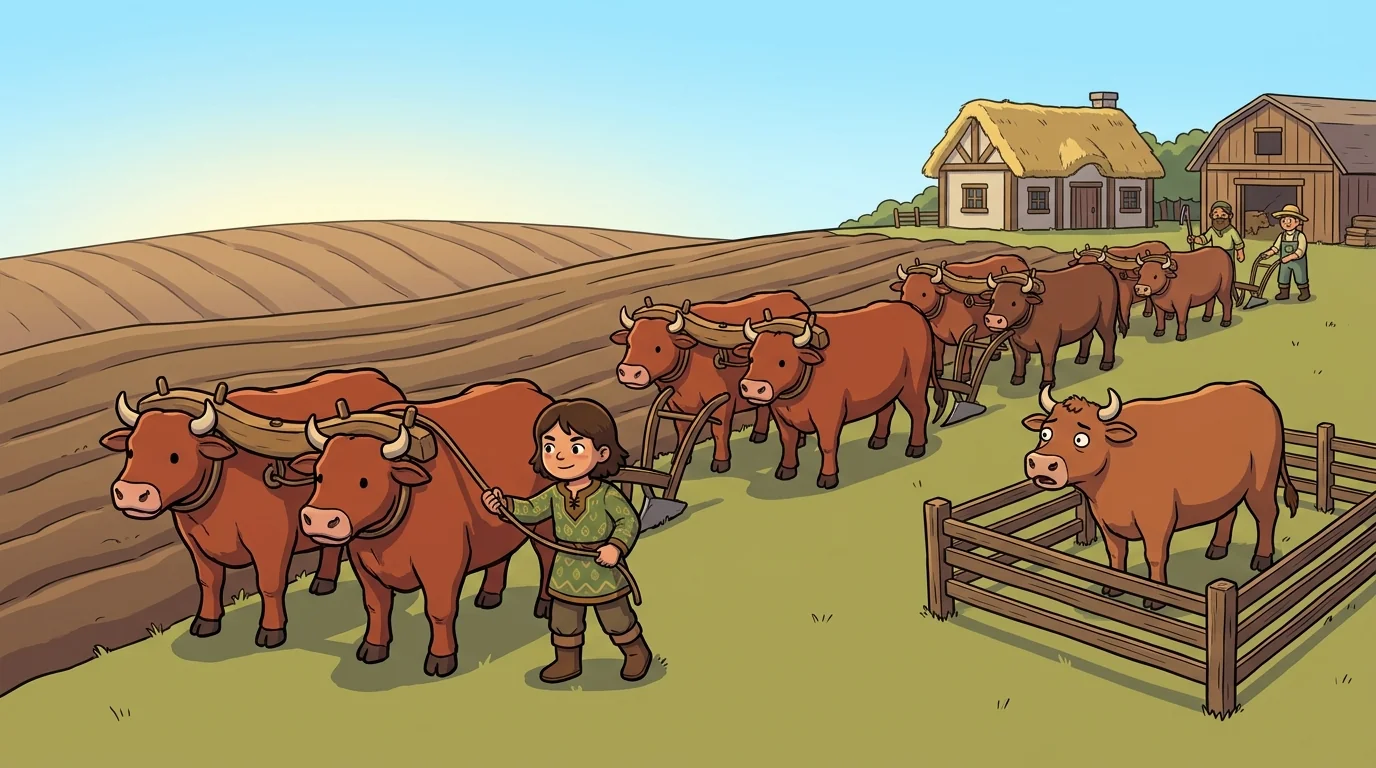
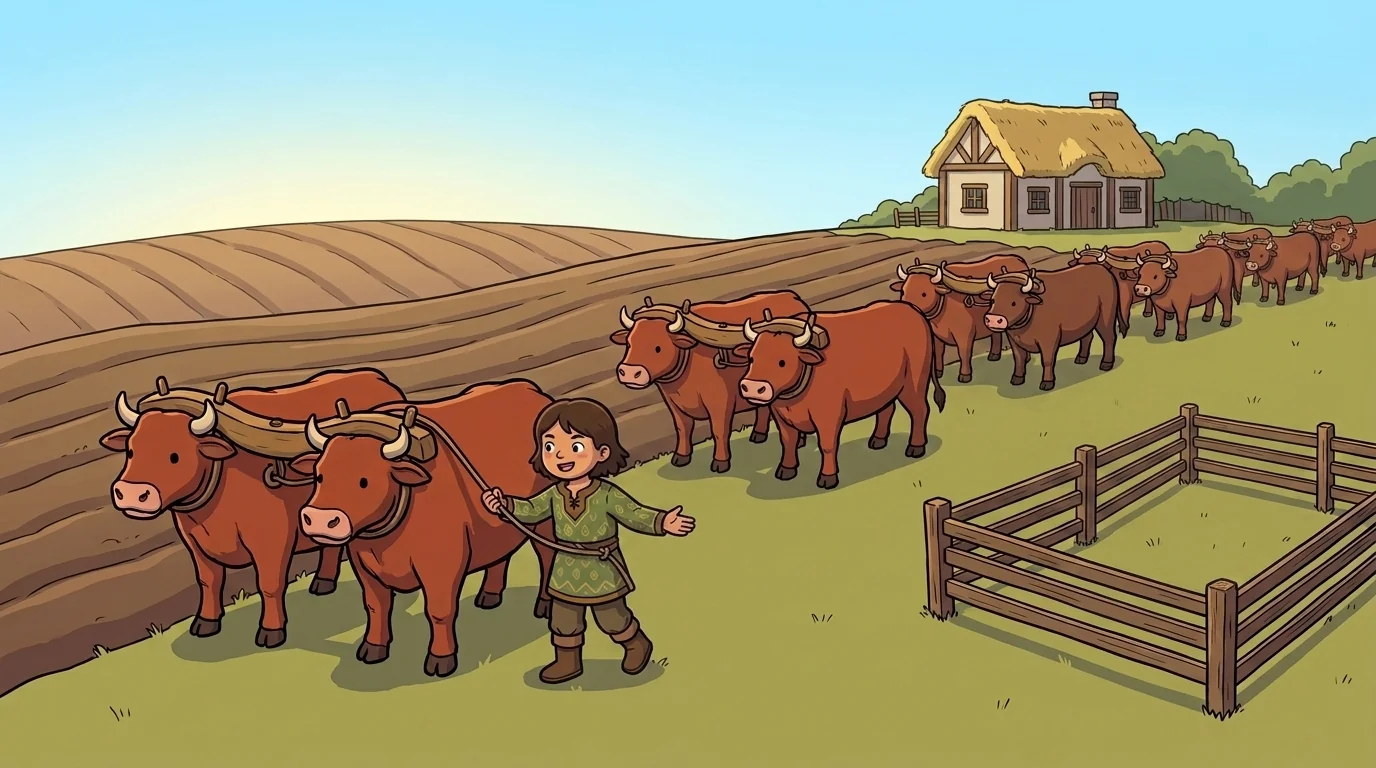
Yoke grew up behind a plough, and learned even and odd from the oxen, who could only work in pairs. Her family farmed the long fields below the ridge above Furrow, and the plough was drawn by oxen yoked side by side so their strength matched and the furrow ran straight. Yoke's job from a young age was to pair the team at dawn: this ox with that, down the line, until every ox stood yoked. Some mornings six oxen made three clean pairs — even mornings. Other mornings seven oxen left one standing alone no matter how she arranged them — odd mornings, and the lone ox waited in the pen.
"Count them into pairs," her mother said. "If they all find a partner, the number's even. If one's left standing, it's odd. There's no third way. Every number is one or the other, decided the moment you try to pair them." That is parity exactly as the academy defines it: even means every unit pairs off, which is the same as being divisible by two; odd means pairing always leaves a remainder of one.
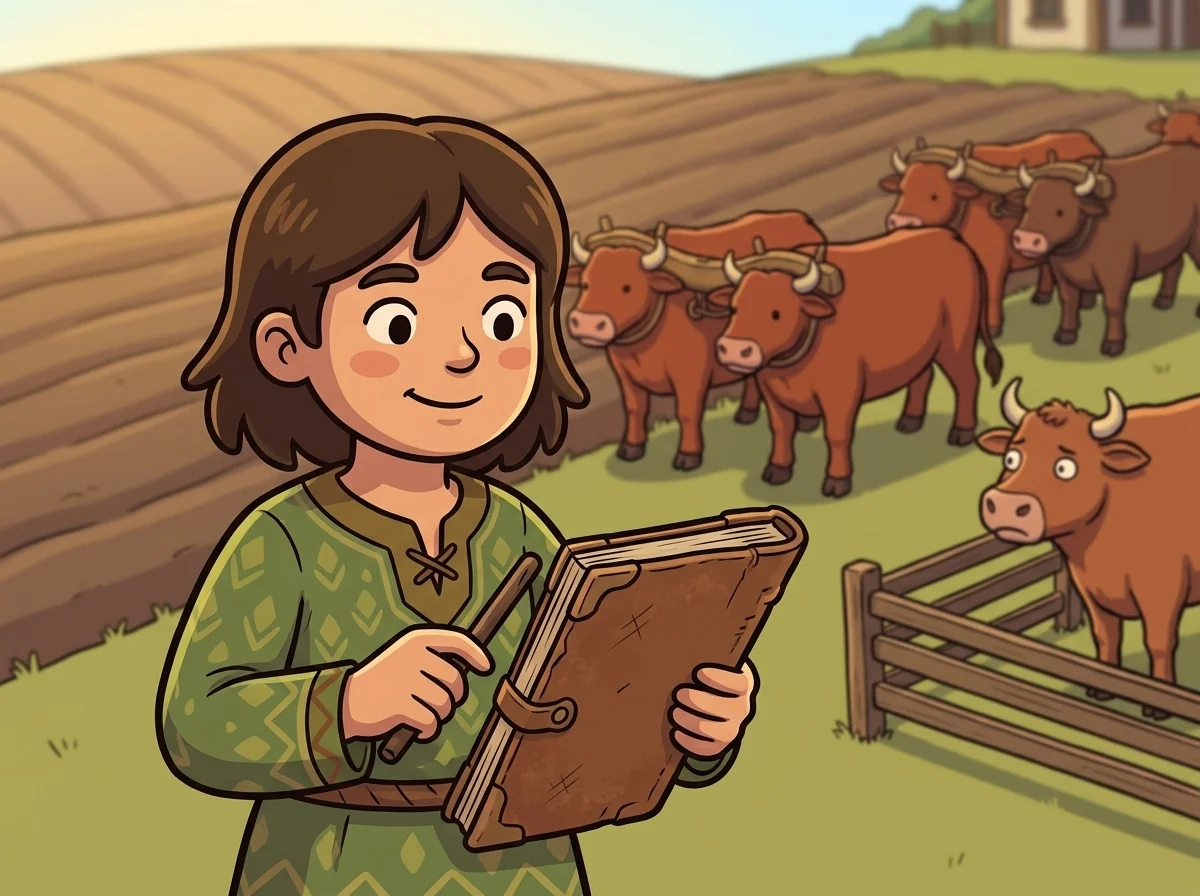
Yoke's given name was Mabel, but she was called Yoke from the day a neighbour with a mixed herd couldn't tell whether he had enough beasts for two ploughs, and she walked the field pairing them by eye and said, "Even. Ten. Five pairs. Two ploughs, no ox idle," faster than he could count. She came to read every quantity as a question of partners — and standing in the pen morning after morning, she found the shortcut her mother never named: you do not have to pair the whole herd. You only look at the ones. A number ending in 0, 2, 4, 6, or 8 pairs off cleanly; one ending in 1, 3, 5, 7, or 9 always leaves one standing. The last digit alone tells the whole story, however long the number.
And she saw why — the deeper thing that took her longer. "Every place above the ones is a ten, or a hundred, or a thousand," she tells students, "and every one of those is already even — ten is five pairs, a hundred is fifty. So all the higher places pair off no matter what. The only place that can leave a straggler is the ones. That's why the last digit decides parity: everything above it is guaranteed even already." She also saw that even is exactly halvable: if everyone has a partner, send the left-hand oxen one way and the right-hand oxen the other, and the two groups match. Even is divisible by two — which is why parity is the first, cheapest test of whether two will rive a number cleanly.
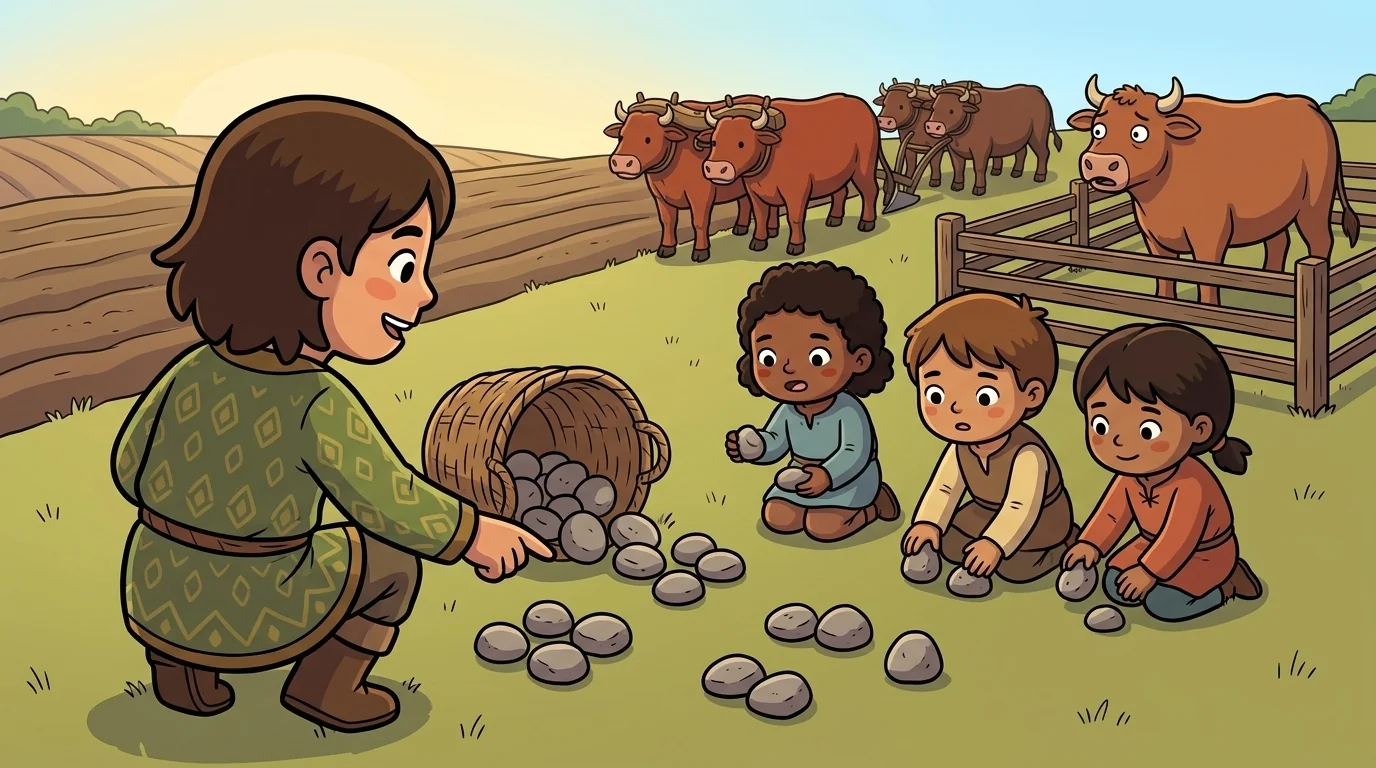
An academy stockman found Yoke sorting a herd into "pairs cleanly" and "one left over." "You are testing parity — even and odd — and you've found the last-digit rule on your own," he said. Yoke liked a place where the pairing mattered as an idea, not only a chore, and has taught even and odd for six years.
She begins each year with a basket of round stones. "Pair them off," she says, tipping out eight. The children lay four pairs, none left over: "Even. Everyone partnered." Then nine — they pair and pair and are left holding one lonely stone: "Odd. One left standing. No arranging makes it go away." Then the shortcut: "You don't have to pair the whole basket. Look at the last digit — 0, 2, 4, 6, 8 is even; 1, 3, 5, 7, 9 is odd. A number a mile long is decided by the one digit at its tail, because everything above the ones is already even." Finally the reason it matters: "Even means you can share it fairly between two — split it clean in half. Odd means you can't, not without cutting one in two. That's why even and fair feel like the same word."
A boy named Tam stayed after, holding the lonely ninth stone, and said he felt sorry for it — the odd one, always left out. Yoke sat beside him. She used to feel the same about the lone ox in the pen — until one winter the team fell ill and only the odd, un-yoked ox was healthy enough to fetch the doctor, alone and fast, and it had never once needed a partner to matter. "Odd isn't left out. Odd is just one who stands on its own. Half the numbers in the world are odd. They get along fine." Tam looked at the single stone — no longer the reject at the end of the row but a whole thing that stood by itself — and the small ache he'd felt on its behalf eased into something steadier.
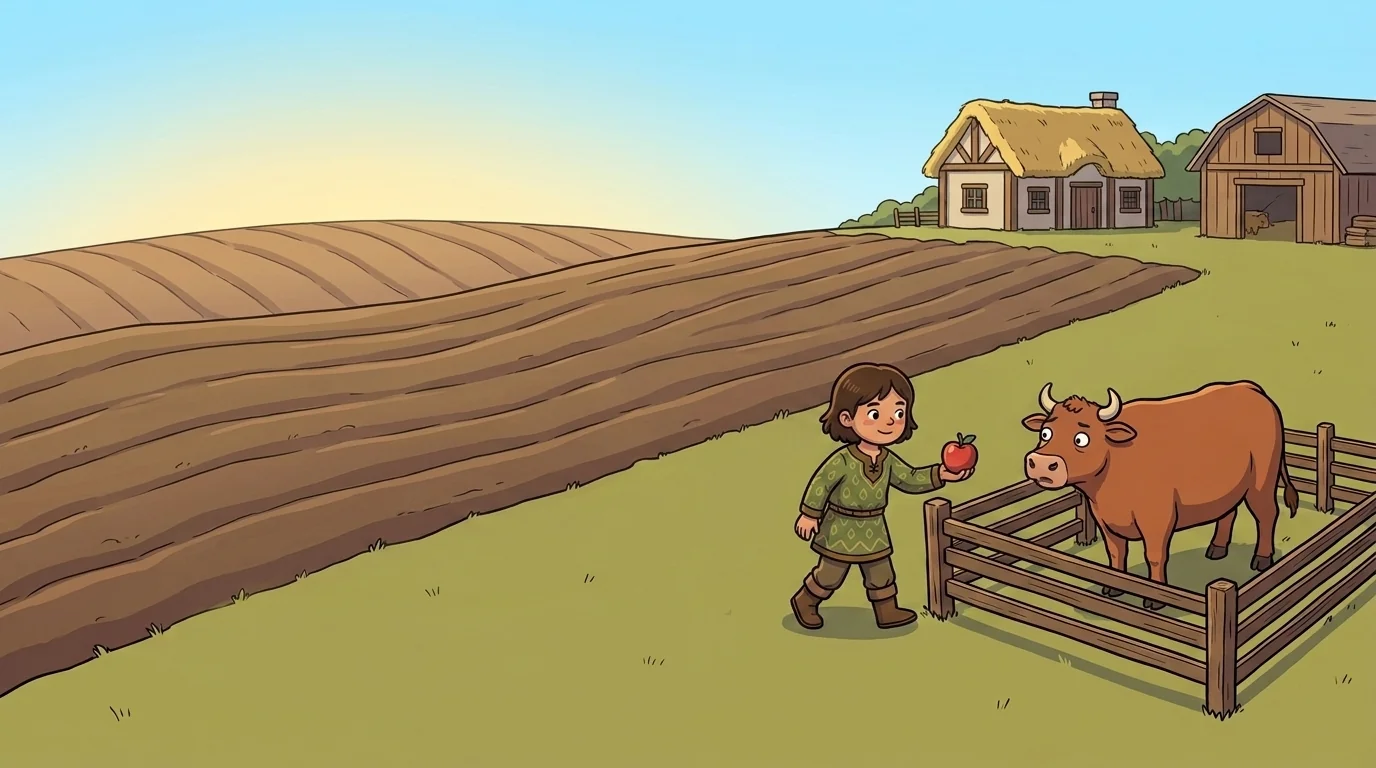
Yoke is calm, even-tempered, and counts anything in pairs before she counts it any other way. She still goes back to Furrow at ploughing-time, still yokes the team at dawn, and on odd mornings she gives the lone ox an apple and tells it, quietly, that it is doing fine.
The MathVerse ensemble
Yoke is part of MathVerse's distributed-narrative cast. Each character embodies a different curricular primitive; together they teach the full subject.
-

Tenfold
Place value — powers of 10, positional notation
-

Zeph
The zero placeholder — its load-bearing role in positional notation
-

Mirror
Negative numbers — reflection across zero on the number line
-

Skip
Skip-counting and multiples — repeated addition as forward stepping
-

Tug
Inverse operations — addition ↔ subtraction (and the same idea for × ↔ ÷) as opposite pulls on the same line
-

Nigh
Rounding and estimation (judging a number by the nearest landmark)
-

Rive
Factors, divisors, and prime numbers (splitting a number into what divides it)
-

Vie
Comparing and ordering (magnitude — greater-than and less-than)
-

Weld
Number bonds (part-part-whole decomposition; making ten)