
Dolly and Snip
MOVE OR CUT — two ways to carry an audience from one thing to another: move the camera to it (Dolly's glide, which connects and keeps time flowing) or cut to it (Snip's edit, which jumps and compresses time). A glide binds two things together; a cut sets them apart. Choosing which a reveal wants is choosing how the moment feels.
Loading audio…
Press play to listen along. The line being read lights up as you go.
Show full transcript
Loading transcript…
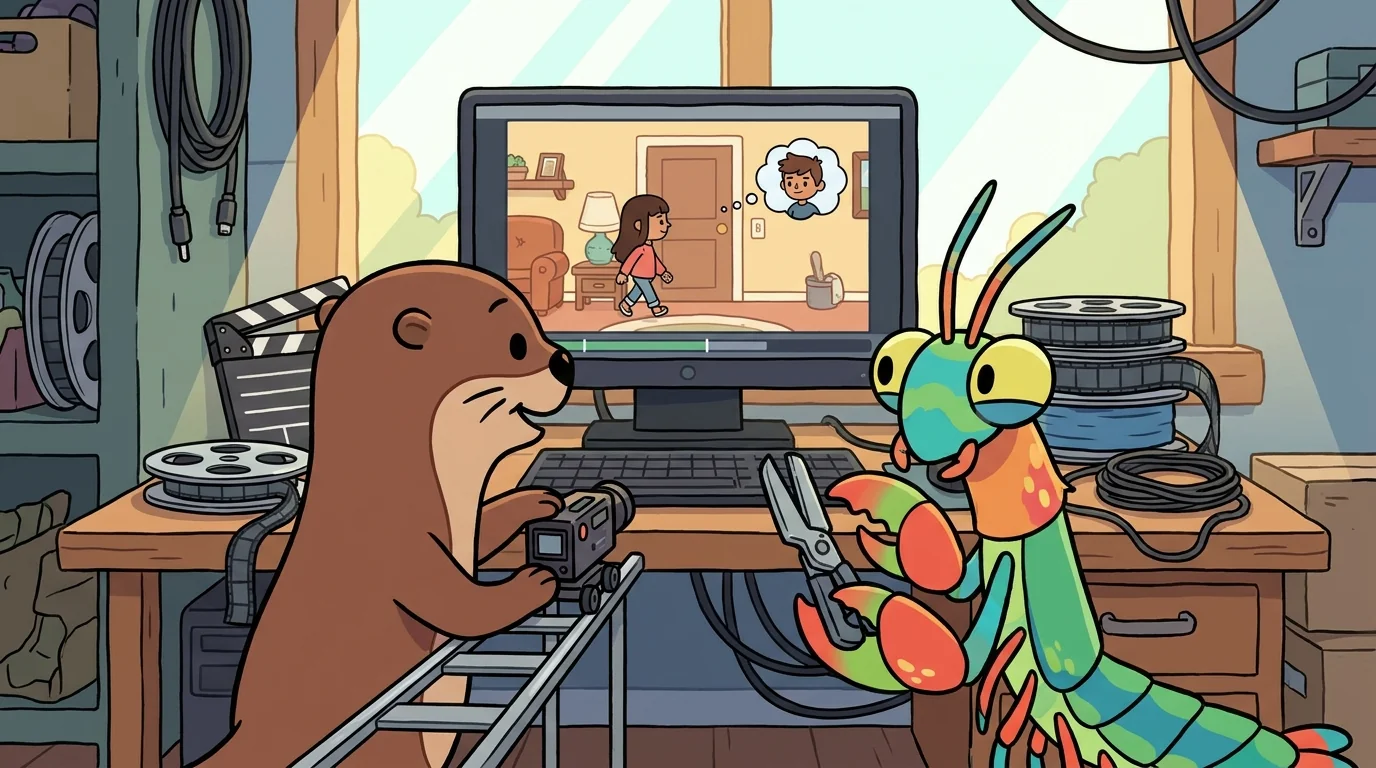
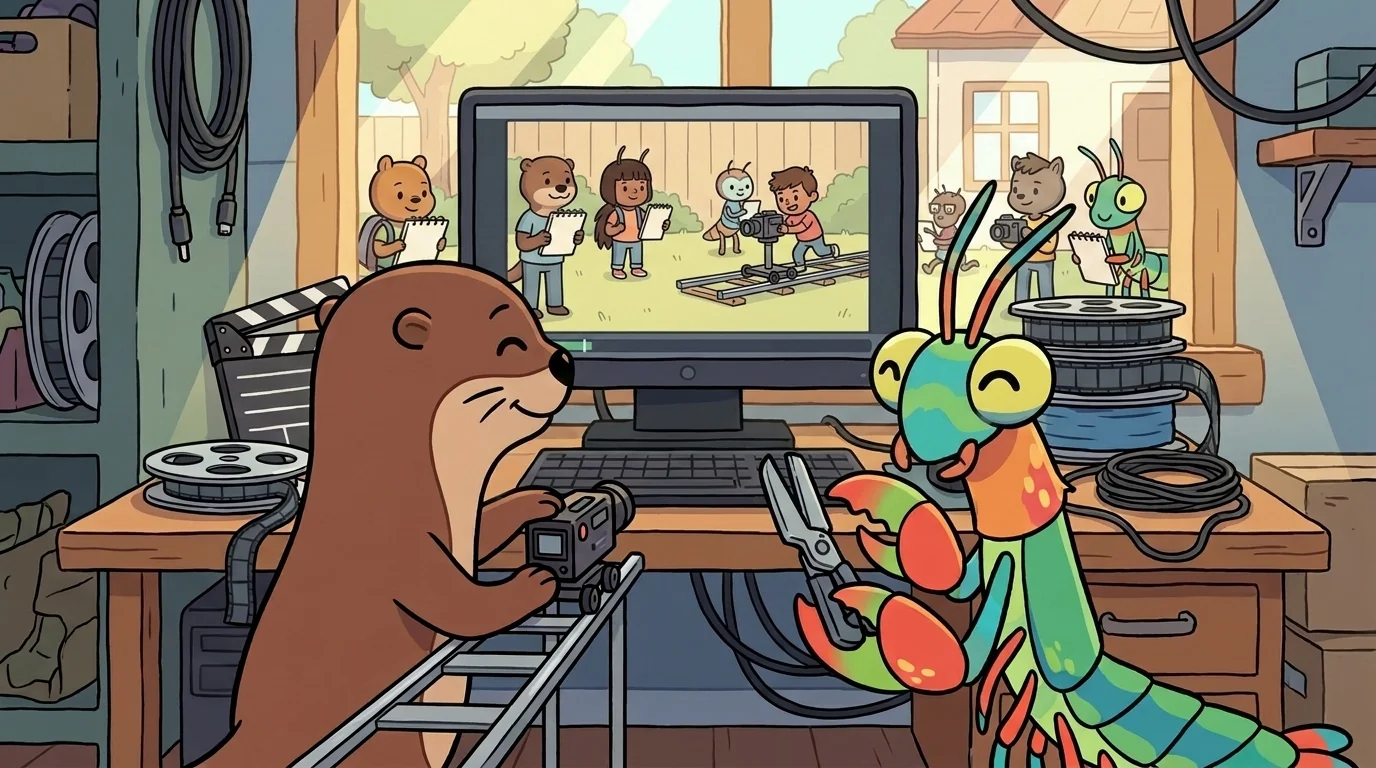
A kid came to Reelforge with a moment that wouldn't land, and it sent two very different teachers to the same editing-bench. The scene was simple: a girl hears a knock, crosses a room, and opens a door to find her long-lost brother. The reveal — the brother's face — had to hit. But the footage felt wrong, and the kid couldn't say why, so they went to Dolly, the otter-tween who moved cameras, and then to Snip, the mantis-shrimp-tween who cut them, and the two, who usually worked at opposite ends of the craft, leaned over the same footage together. And each, at first, was certain their own way was the way to reach that face.
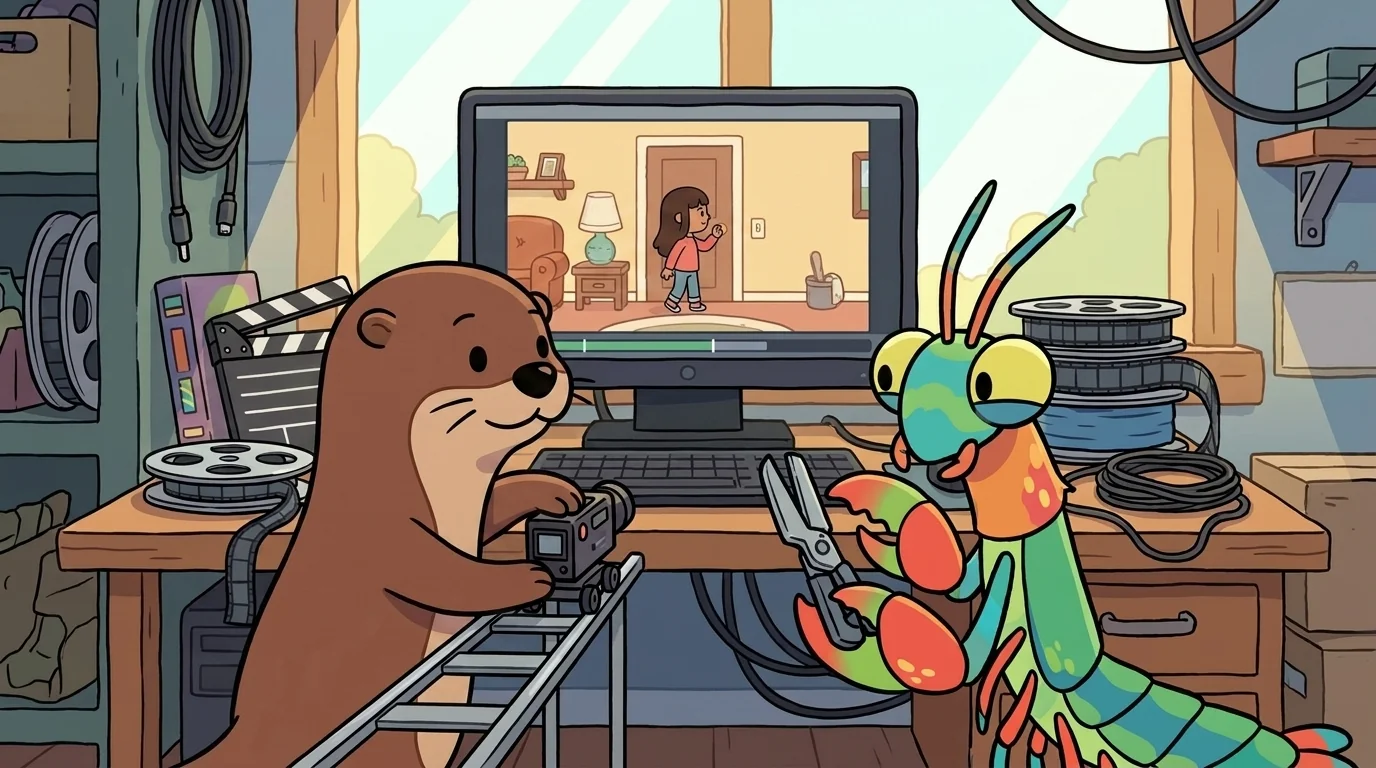
Dolly did her half — the glide. "You reach the brother by cutting to him, all at once, and it feels jarring," she said. "Let me travel there instead." She took the shot of the girl crossing the room and let the camera move with her — one unbroken glide following her to the door, sweeping past it as it opened, arriving on the brother's face in the same continuous breath. "See what the move did?" Dolly said. "No cut. Time never broke. The camera carried the audience across the room and bound the girl and her brother into one connected space — we crossed the distance with her, so the arrival feels earned, like a held breath finally let out." She sat back, pleased. "There. One smooth move. That's how you reach a face." But the kid tilted their head — beautiful, yes, but the surprise of the reveal had somehow softened, dissolved into the smoothness.
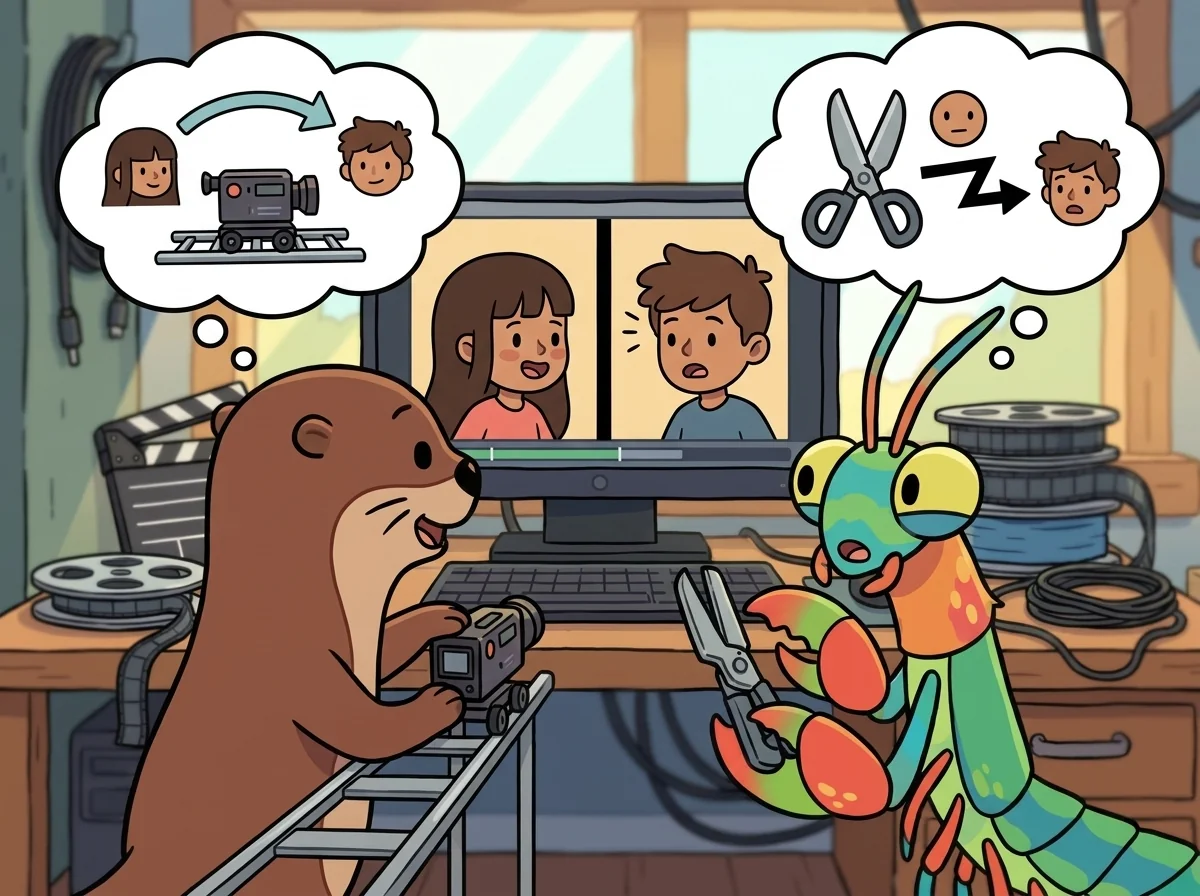
Then Snip did his half — the cut. "Your glide is gorgeous," he said, "but a reveal is a shock, and shocks want a cut." He chopped the footage: the girl's hand on the knob — cut — the brother's face, bang, all at once, no travel, no warning. The kid actually jumped. "That's a reveal," Snip said. "A cut doesn't carry you — it jumps you. It breaks time and slams two images together, and the collision is the feeling. It also compresses — I can cut from the knock straight to the open door and throw away the boring walk entirely." He sat back too, satisfied. But now the kid frowned: the shock landed hard — but the tender connection Dolly's glide had built, the sense of crossing the distance with the girl, was gone. It was surprising, but a little cold.
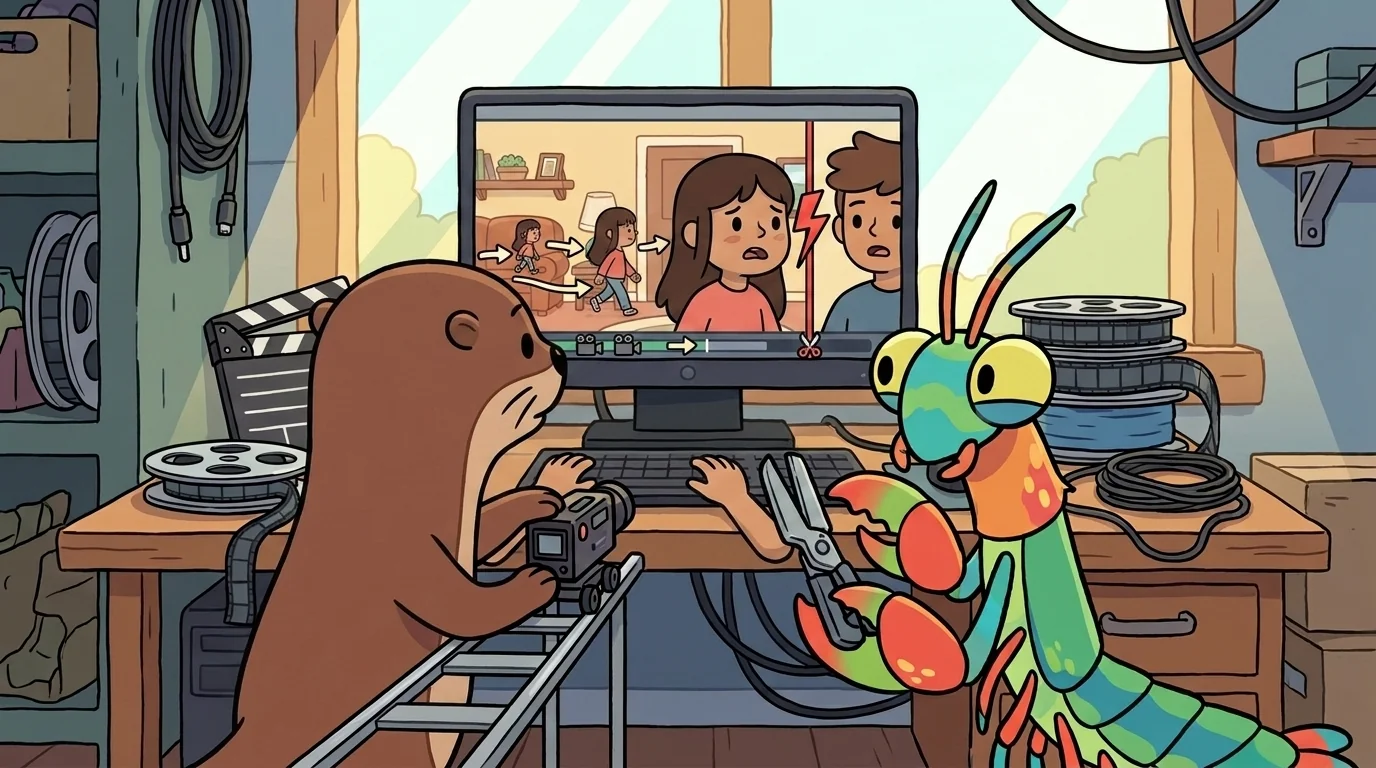
And there the two of them saw it — that move and cut weren't rivals but two different tools for two different feelings. "Oh," said Dolly. "My glide connects — it keeps time flowing and binds two things into one space. That's for tenderness, for together." "And my cut separates," said Snip. "It breaks time, juxtaposes, shocks, and compresses. That's for surprise, for impact, for skipping the dull parts." They looked at the footage and built it together, each tool where it belonged: Dolly's smooth glide to carry the girl across the room (the tender crossing, time unbroken) — and then, at the exact instant the door swung wide, Snip's hard cut to the brother's face (the shock, the collision). Connection then impact. "You cut on the action," Snip added, "right as the door opens — the movement hides the join, so the cut feels invisible and inevitable instead of jarring." The reveal finally hit — earned by the glide, detonated by the cut. "One of us alone made it either smooth-but-flat or sharp-but-cold," Dolly said. "It took both — move to connect, cut to strike."
"So there are two ways to get anywhere in a scene," the kid said, working it out, "move to it or cut to it — and they feel opposite? One binds, one breaks — and I choose which the moment wants?"
"That's the secret of it," Dolly said, and Snip nodded fast beside her. They laid down the finished sequence — her glide across the room, his cut-on-action to the face — and the long-lost brother's reveal landed exactly as tender and as shocking as the story had always wanted. Under the quiet, the two of them felt the same paired gladness: not the lovely flatness of an all-glide reveal with no shock, not the cold jolt of an all-cut scene with no connection, but a built, both-tools-in-their-place rightness — the ease of an otter who knew how to carry an audience and a mantis-shrimp who knew how to strike one, discovering that a scene needs both the binding move and the breaking cut. That move-then-cut, connect-then-strike feeling, steadier than either tool used alone for everything, was to Dolly and Snip exactly why they'd ended up at the same bench — and stayed.
The ReelForge ensemble
Dolly and Snip is part of ReelForge's distributed-narrative cast. Each character embodies a different curricular primitive; together they teach the full subject.
-
Draft
Storyboarding — pre-visualization; 'Draw it first. Then film it.'
-
Aim
Camera angles + framing — 'Where the camera stands changes the story.'
-

Bright
Lighting design — 'Three lights. Different feelings.'
-
Buzz
Sound design — foley + ambient + dialogue — 'Sound is the other half.'
-
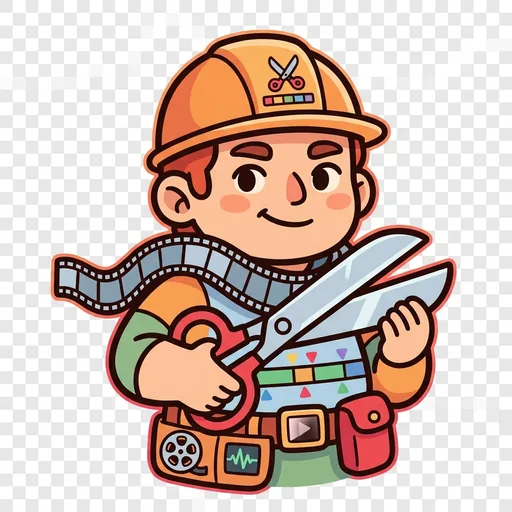
Snip
Editing — timeline + transitions + pacing — 'Cut here. Not there.'
-

Whole
Multi-scene narrative — 'Beginning. Middle. End.'
-
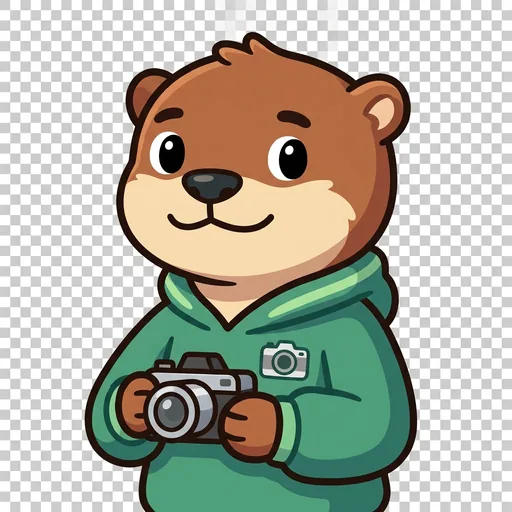
Dolly
Camera movement — the push-in, the follow, the reveal — 'Move the camera to move the eye.'
-
Sharp
Focus + depth of field — 'Where the eye lands.'
-
Stir
Blocking + performance — 'The body carries the scene.'
-
Vast
Shot size — wide, medium, close — 'How much you see changes how you feel.'