
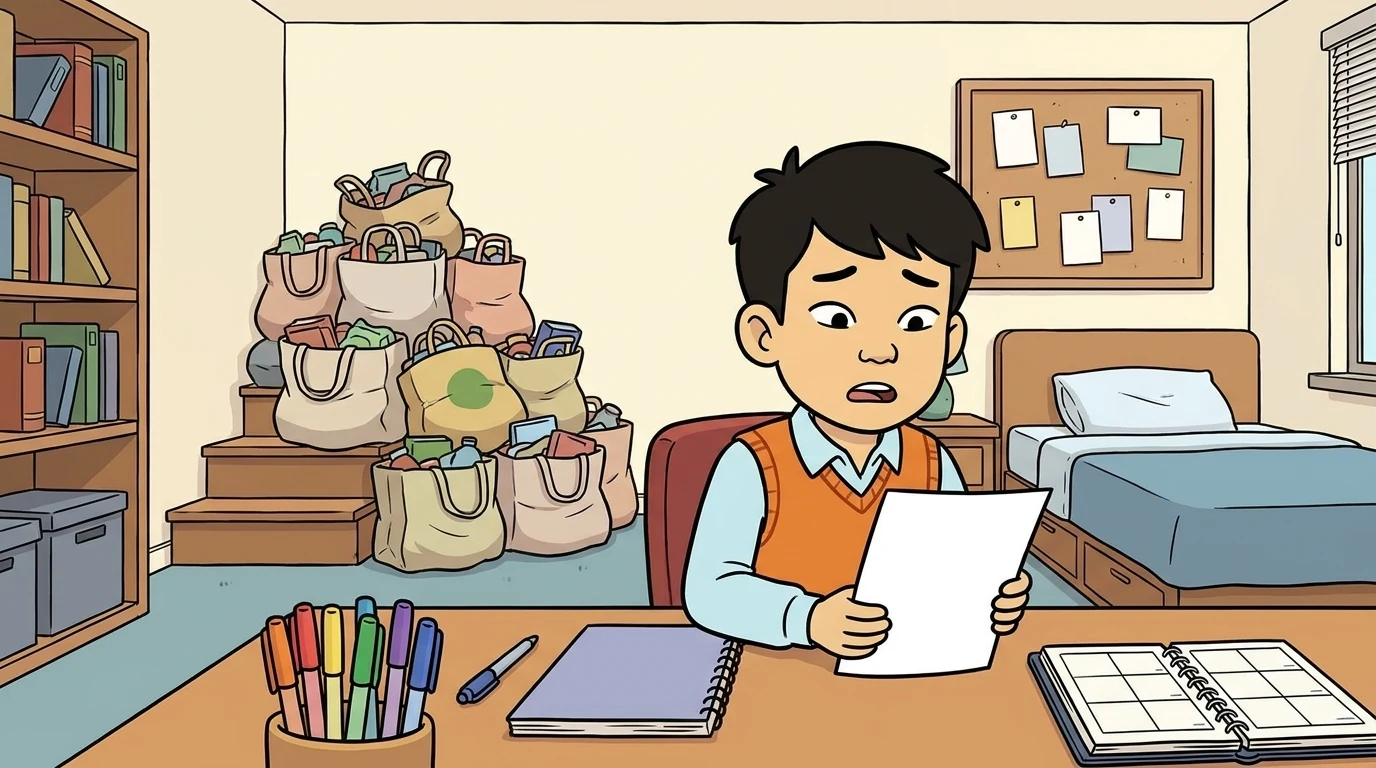
Orrin
TANGLED THINKING - when a task has too many steps to hold at once, or a person believes it must be perfect or it is a disaster, they can freeze or avoid it, so you check the thinking load before you call it laziness.
Listen along — Orrin
Loading audio…
Press play to listen along. The line being read lights up as you go.
Show full transcript
Loading transcript…
Orrin and the Six Boxes
Orrin likes things in order. His socks are in pairs. His pens are in colour order. His homework planner is a small work of art.
So you might think he’d have no patience with people who don’t get things done. Actually, it’s the opposite. Orrin knows exactly how it feels to freeze.
Last year, his teacher set a history project on the Romans. It was due in four weeks. It needed a poster, a model, a written report and a talk to the class. Orrin looked at the sheet and something in his head went completely blank. It was all too much at once, like trying to carry eight bags of shopping up the stairs in one go.
He didn’t start for two weeks. He tidied his desk instead. Twice.
That’s what Orrin looks for in the Clue Club. The thinking load.
His best case was a boy called Dev.
Dev had a reputation. “He never does anything,” people said. “He just sits there.” In group projects, the others ended up doing his share and moaning about it. Even the teacher sighed when she saw his empty pages.
Orrin was put in Dev’s group for a science project on bridges. On the first day, Dev looked at the instruction sheet for a long time. Then he pushed it away and stared out of the window.
Orrin had seen that look before. In the mirror, the week of the Romans.
“It’s a lot, isn’t it?” he said quietly.
Dev glanced at him. “There’s like fifty things,” he muttered. “I don’t even know which one’s first.”
So Orrin did what had finally helped him with the Romans. He took a blank sheet and drew six boxes. In the first box he wrote just one thing: Look at three pictures of bridges. In the second: Pick one kind. And so on, one small step per box.
“We only have to do box one today,” he said.
Dev did box one. Then, because it was easy, he did box two.
There was a second tangle too, and it took Orrin longer to spot it. Every time Dev started drawing his bridge, he’d rub it out. Then again. Then he’d give up. Orrin finally asked why.
“It has to be good,” Dev said. “If it’s rubbish, everyone will see I’m rubbish.”
That’s what Orrin calls all-or-nothing thinking. It has to be perfect, or it’s a disaster. There’s nothing in between. And if those are the only two choices, then not starting at all can feel safer.
“What if it just has to be a first try?” Orrin said. “First tries are allowed to be wobbly. That’s what second tries are for.”
Their bridge held four tins of beans before it collapsed. It was the second best in the class. Dev made the whole of the middle bit.
Here’s what Orrin tells the Clue Club.
When someone freezes, sits there, or keeps putting something off, check the thinking. Are there too many steps to hold in your head at once? Is it unclear where to begin? Are the instructions long and twisty? Do they believe it must be perfect or it’s a disaster?
None of those things is laziness. They are a traffic jam in the brain. And traffic jams can be cleared, one car at a time.
If they freeze, check the thinking: too many steps at once, or all-or-nothing.
The ReframeQuest ensemble
Orrin is part of ReframeQuest's distributed-narrative cast. Each character embodies a different curricular primitive; together they teach the full subject.
-

Inez
(Mentor) - a behavior is a clue, not a verdict
-

Bramley
The Body detective - checks sleep, food and noise first
-

Thea
The Feelings detective - finds the worry under the behavior
-

Pella
The Friends detective - checks who is in, who is out, and the group chat
-

Ashby
The Doing-what's-right detective - notices guilt, secrets and promises
-
Ressa
The Reframe move - swaps a judgment word for a load word
-

Lessing
The Reduce move - finds one stress that can really get smaller
-

Imogen
The Restore move - knows what refills the tank
-

Sefton
A case of my own - turns the clue-finding on himself, privately and kindly
-

Hamish
Too heavy to carry alone - knows when a load needs a grown-up